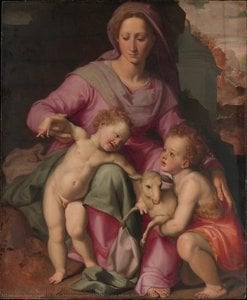
1of 71
El Greco 1541–1614
Born in Heraklion Wikipedia in 31/32 languages

Notable works include: The Burial of the Count of Orgaz (1586-1588).

Mannerist painters, ranked
The most famous Mannerist painter is El Greco (1541–1614), known for The Burial of the Count of Orgaz and View of Toledo. Next come Jacopo Tintoretto, Giuseppe Arcimboldo, Bronzino and Sofonisba Anguissola. This ranking of the 71 most famous Mannerist painters runs from Amico Aspertini (born 1475) to Cristofano Allori (born 1577), across 9 countries.
How this list is ranked. Artists whose works our catalogue files under Mannerist, in the order of our fame ranking of artists. Artists without a Wikidata identifier born after 1955 are left out until verified. The Wikipedia figure next to each name is the number of our 32 languages in which Wikipedia has an article on the artist.
The essentials
Ranked, with their masterpieces
1of 71
Born in Heraklion Wikipedia in 31/32 languages
Notable works include: The Burial of the Count of Orgaz (1586-1588).
2of 71
Italian Born in Venice Mannerist, Venetian school Wikipedia in 31/32 languages

In his large-scale religious works, such as the Crucifixion at the Scuola Grande di San Rocco, the light does not merely fall upon the subjects but seems to collide with them, emphasizing the spiritual and physical weight of the moment. The Origin of the Milky Way (Scuola Grande di San Rocco, Venice). His approach to composition and psychological intensity left a mark on several major figures of later movements, including El Greco, Caravaggio, Rembrandt, and Delacroix.
Where to see The Scuola Grande di San Rocco remains the most concentrated repository of his output, housing over sixty canvases that transform the building's halls into a cinematic experience of biblical narratives.
3of 71
Born in Milan Wikipedia in 30/32 languages

These works were often viewed as curiosities, yet they required a sophisticated understanding of how to merge the organic with the artificial to create a recognizable human form. His technical precision allowed him to transform the mundane into the anatomical. Painters such as Salvador Dalí and Pablo Picasso found a kindred spirit in his ability to manipulate perception, drawing from his habit of assembling disparate objects into a singular, recognizable identity.
Where to see The physical remnants of Arcimboldo’s imagination are scattered across Europe, preserved within the halls of institutions that once served the very courts he once entertained.
4of 71
Italian Born in Florence Mannerism Wikipedia in 29/32 languages

He was a founding member of the Accademia delle Arti del Disegno in 1563, an institution dedicated to promoting the study of art and fostering artistic excellence.
Pupil of Pontormo #6 · Teacher of Alessandro Allori #20
5of 71
Italian Born in Cremona Renaissance, Mannerism Wikipedia in 29/32 languages

These weren't merely exercises in likeness; they were insightful explorations of personality and familial relationships. Her style initially drew from Lombard Mannerism, but evolved during her time in Spain into a more refined approach suited to the demands of court portraiture. Key influences on Anguissola included the Lombard school of painting, particularly the work of Bernardino Campi and Bernardino Gatti, but she ultimately forged her own unique style characterized by realism, intimacy, and psychological insight.
6of 71
Italian Born in Empoli Florentine Mannerism Wikipedia in 28/32 languages

As a young apprentice in Florence, he moved through a world of shifting artistic paradigms, eventually emerging as a central figure of the Florentine Mannerist movement. Unlike the masters of the High Renaissance who sought perfection through balance and mathematical harmony, Pontormo looked inward, seeking to express the turbulent, often unsettling complexities of the human soul.
Teacher of Bronzino #4
7of 71
Italian Born in Parma Mannerism Wikipedia in 28/32 languages

He presented Pope Clement VII with three paintings, including a striking self-portrait in a convex mirror – a testament to his technical skill and burgeoning self-awareness. Forced to flee, Parmigianino sought refuge in Bologna, where he painted one of his most celebrated works, the Holy Family. Tragically, Parmigianino's promising career was cut short by his untimely death in Casalmaggiore in 1540 at the age of thirty-seven.
8of 71
Italian Born in Arezzo Mannerism Wikipedia in 31/32 languages

This groundbreaking text wasn’t merely a collection of biographies; it established a narrative framework for the development of Italian Renaissance art, tracing its evolution from the early masters like Cimabue and Giotto to his contemporaries Michelangelo and Raphael.
Teacher of Jacopo Zucchi #54, Federico Zuccari #41
9of 71
Italian Born in Rome Mannerism Wikipedia in 28/32 languages

In 1524, Giulio accepted the invitation of Federico Gonzaga, Duke of Mantua, to become court painter and architect. Beyond Palazzo Te, Giulio also undertook significant renovations to Mantua’s ducal palace and cathedral, leaving an indelible mark on the city's urban landscape. Giulio Romano died in Mantua in 1546, leaving behind a legacy that extended far beyond Italy’s borders.
10of 71
Italian Born in Florence Mannerism Wikipedia in 27/32 languages

Rosso's journey eventually led him to France in 1530, where he entered the service of King Francis I.
11of 71
Italian Born in Venice High Renaissance, Mannerism Wikipedia in 23/32 languages

This move placed him directly into the orbit of Raphael, whose workshop was at its zenith, and soon after, into the complex world surrounding Michelangelo. The two masters recognized a kindred spirit in each other’s pursuit of grandeur and anatomical precision; Michelangelo actively championed Sebastiano's work, urging him to compete with Raphael for prestigious commissions. The latter part of Sebastiano's life took an unexpected turn in 1531 when he was appointed piombatore, Keeper of the Seals for the Papacy.
12of 71
Dutch Born in Bracht Northern Mannerism & Baroque engraving Wikipedia in 19/32 languages

13of 71
Italian Born in Castelnuovo Berardenga Mannerism, Renaissance Wikipedia in 21/32 languages

Born around 1486 in the small Tuscan town of Montaperto, near Siena, Beccafumi’s artistic journey was one of remarkable development, culminating in a style that bridged the High Renaissance and the burgeoning complexities of Mannerism. Sienese Tradition with Mannerist Influences: He skillfully blended the decorative elements and emotional intensity of the Sienese school with the emerging stylistic features of Mannerism.
14of 71
Dutch Born in Amsterdam Northern Mannerism Wikipedia in 28/32 languages

The Renaissance humanist Hadrianus Junius (Adriaen de Jonghe) compared Aertsen to Peiraikos, an ancient Greek painter celebrated for his ability to depict ordinary subjects with extraordinary realism and symbolic depth.
15of 71
Flemish Born in Antwerp Northern Mannerism Wikipedia in 18/32 languages

His paintings are distinguished by their smooth modeling, meticulous detail, and a subtle use of color. He skillfully blended Netherlandish realism with Italian mannerist influences, particularly the Roman tradition of depicting classical mythology. Crucially, his travels extended into Italy, where he spent eight months in Milan and three months in Parma, assisting Bernardino Gatti on the ambitious fresco project for the dome of Santa Maria della Steccata.
16of 71
Italian Born in Bologna Mannerism, Baroque Wikipedia in 26/32 languages

Fontana’s artistic style initially mirrored that of her father, steeped in the traditions of the School of Bologna. Other significant pieces include “ Venus and Cupid ” (1592), a Baroque portrait brimming with symbolic beauty, and “ Newborn Baby in a Crib ” (1583), a poignant depiction of maternal tenderness and domestic life. Lavinia Fontana’s impact extends beyond her paintings; she remains an icon of female empowerment in the art world.
17of 71
Italian Born in Urbino Renaissance, Baroque Wikipedia in 24/32 languages

Barocci's work was highly esteemed and influential, foreshadowing the Baroque style of Peter Paul Rubens. He worked in the pre-eminent studio of Taddeo and Federico Zuccari in Rome, where he was exposed to various artistic influences. He was invited by Pope Pius IV to assist in the decoration of the Vatican Belvedere Palace at Rome, where he painted the Virgin Mary and infant, with several saints and a ceiling in fresco, representing the Annunciation.
Key works · The 100 most famous works
18of 71
German Born in Cologne Mannerist Painting Wikipedia in 26/32 languages

19of 71
Italian Born in Florence Mannerism Wikipedia in 23/32 languages

In the twilight of the Renaissance, as the balanced harmonies of the previous century gave way to the restless energy of Mannerism, Cristofano Allori emerged as a vital voice in the Florentine school. Born in 1577 into a city steeped in artistic prestige, Allori was destined for the brush.
Pupil of Alessandro Allori #20
20of 71
Italian Born in Florence Mannerism Wikipedia in 24/32 languages

Allori’s work is deeply rooted in the Mannerist tradition, an artistic movement characterized by its artificiality, elegance, and emphasis on stylistic sophistication over naturalistic representation. Critics often noted his tendency to draw heavily from pre-existing art, refining and reinterpreting the works of masters like Michelangelo and Raphael through the lens of Bronzino’s aesthetic. Alessandro Allori, born in Florence on May 31st, 1535, stands as a compelling figure within the late Mannerist school.
Pupil of Bronzino #4 · Teacher of Cristofano Allori #19
21of 71
Italian Born in Modena Mannerism Wikipedia in 25/32 languages

His landscapes are not simply scenic backgrounds; they are meticulously crafted environments imbued with a sense of depth, atmosphere, and psychological resonance. These landscapes frequently served as the setting for dramatic scenes featuring figures from classical mythology – tales of Orpheus and Eurydice, Proserpine’s abduction, and the Judgment of Paris. Dell’Abbate’s work at Fontainebleau also contributed significantly to the development of French Mannerism, introducing Italian Renaissance principles to the French court and shaping the artistic tastes of a nation.
22of 71
Born in Albino Wikipedia in 16/32 languages

Moroni’s artistic journey took him through various Italian cities, including Trento and Bergamo. While initially influenced by earlier Renaissance styles, Moroni gradually developed a distinctive Mannerist approach characterized by elegance and realism.
23of 71
Italian Born in Florence Mannerism

Born into a family with musical inclinations – his father was a musician and instrument maker – Cellini initially showed promise in music. This marked the beginning of his formal artistic training. He represents the quintessential Renaissance ideal – a polymath skilled in multiple disciplines, driven by ambition, and unafraid to express his individuality.
24of 71
Italian Born in Florence Mannerism” Wikipedia in 17/32 languages

His figures are often elongated and contorted, their poses imbued with an almost theatrical intensity. Portraiture: While primarily known for his frescoes and decorative works, Salviati also excelled as a portrait painter. Francesco Salviati’s impact on the development of Italian Mannerism is undeniable.
25of 71
Flemish Born in Douai Mannerist Sculpture

He skillfully employed contrapposto, a pose where the torso tilts slightly away from the viewer, creating an illusion of movement and balance—a technique perfected by Michelangelo and subsequently adopted by Giambologna himself. Giambologna’s influence extended far beyond his lifetime, shaping the artistic sensibilities of subsequent generations and establishing him as a pivotal figure in the transition from Renaissance to Baroque art.
26of 71
Flemish Born in Meulebeke Northern Mannerism Wikipedia in 20/32 languages

The biographical sketch mentions him as the "discoverer of caves," possibly referring to the catacombs. This experience exposed him further to Mannerist influences. Influence on Dutch Art: He significantly influenced artists in Haarlem and beyond, shaping the artistic landscape of the Dutch Republic.
27of 71
Italian Born in Volterra Mannerism Wikipedia in 17/32 languages

He was a product of his time – an artist operating within the constraints of religious dogma while simultaneously striving to assert his own creative vision. Sybil (c. 1540–1545); Hermitage Museum, Saint petersburgdescent from the cross (c. 1545), before its 2004 restoration; trinità dei monti, romedescent from the cross (detail, before restoration)descent from the cross (detail, after restoration)
28of 71
French Born in Normandy Mannerism

His work on the Façade of the Cour Carrée (wing Lescot) remains an iconic achievement, showcasing classical elegance through intricate carvings that reflect French artistic brilliance. These ten masterful figures represent the pinnacle of 16th-century French Renaissance sculpture, bringing a sense of classical grandeur and sophisticated elegance to the viewer.
29of 71
Italian Born in Bologna Late Renaissance & Mannerism Wikipedia in 18/32 languages

Beyond the Adoration, Fontana's contributions are visible in the frescoes at the Palazzo Vecchio in Florence (1563-65), where he skillfully integrated architectural elements into his paintings. Fontana’s legacy endures through his surviving works, which are housed in prestigious collections such as the Pinacoteca di Vicenza and the La collezione Bonello (Malta).
30of 71
Dutch Born in Utrecht Mannerism Wikipedia in 14/32 languages

A pivotal period arrived when he embarked on travels through Italy and France starting in 1586. Yet, despite these influences, Wtewael possessed a unique internal compass.
31of 71
Italian Born in Bologna Mannerism Wikipedia in 22/32 languages

Whether through the delicate line work of a chalk drawing like Ceres or the monumental scale of fresco fragments such as Ulysses Winning the Archery Contest in the Presence of Penelope, Primaticcio’s oeuvre remains a testament to an artist who could navigate the complexities of myth, majesty, and the human psyche with unparalleled grace.
Pupil of Giulio Romano #9
32of 71
Flemish Born in Leiden Mannerism Wikipedia in 15/32 languages

Arnold Houbraken, the renowned Dutch art historian, recognized him as the most impressive artist and scholar of his time, even featuring his portrait on the title page of his influential De Groote Schouburgh der Nederlantsche Konstschilders en Schildersessen.
Pupil of Federico Zuccari #41
33of 71
Italian Born in Moneglia Genoese School, Mannerism Wikipedia in 15/32 languages

Cambiaso’s style is often described as Mannerist, yet it transcends simple categorization. He was influenced by Correggio and Raphael, absorbing their dynamism and compositional brilliance while developing his own unique voice. His journey to Spain in 1583, invited by Philip II to complete frescoes at the Escorial, highlights both his international recognition and his personal ambitions.
34of 71
Italian Born in Arpino Mannerist Wikipedia in 14/32 languages

Cesari's artistic style is often described as Mannerist, characterized by its elegance, refinement, and intricate detail. His style is often described as polished and somewhat mannered, lacking the raw emotional intensity of later Baroque artists like Caravaggio. He absorbed influences from the High Renaissance masters – Raphael and Michelangelo – while also engaging with the more eccentric tendencies of Mannerism.
35of 71
Italian Born in Bassano del Grappa Venetian Renaissance Wikipedia in 12/32 languages

Within the bustling, cosmopolitan atmosphere of the Venetian Republic, he ascended rapidly through the ranks of the city's elite artistic circles. He was not merely a painter but a vital administrator of the family’s legacy, taking on significant responsibilities for the Bassano branch in Venice. This collaborative environment, guided by the meticulous instruction of his father, Jacopo Bassano, allowed him to absorb the nuances of Venetian Mannerism and the burgeoning influences of the Baroque style.
36of 71
Flemish Late Mannerism

Brussels Court Painter: In 1594, De Clerck ascended to the prestigious role of court painter to Archduke Ernest I of Habsburg Austria, securing patronage that afforded him considerable freedom and resources. The Iconoclastic Crisis & Altarpiece Commissions: The Protestant iconoclasm of 1566 profoundly impacted the religious landscape of Flanders, prompting a dramatic shift towards more restrained artistic expression. Collaborations with Jan Brueghel the Elder on landscapes such as “ Paradise ” further cemented De Clerck’s reputation as a visionary artist who skillfully blended tradition and innovation.
37of 71
Italian Born in Bassano del Grappa Mannerism Wikipedia in 13/32 languages

He withdrew from the vibrant Florentine art scene, becoming increasingly reclusive and troubled.
38of 71
Italian Born in Florence Mannerist Painting Wikipedia in 15/32 languages

Beyond the walls of Rome, Perino’s influence stretched into the maritime strength of Genoa and the historic centers of Pistoia.
39of 71
Flemish Born in Bruges Renaissance, 16th Century Painting Wikipedia in 15/32 languages

His arrival coincided with a period of immense artistic patronage and experimentation within the court, orchestrated by Grand Duke Cosimo I de’ Medici and his advisor, Giorgio Vasari. The Metropolitan Museum of Art’s collection features a significant drawing by Stradanus – “ Allegory of America” – offering valuable insight into his artistic vision and providing a tangible connection to this remarkable Florentine master.
Teacher of Antonio Tempesta #56
40of 71
Italian Born in Pordenone Renaissance Painting Wikipedia in 16/32 languages

Here, Pordenone became a prominent figure in the vibrant Venetian art scene, collaborating with younger artists like Tintoretto at the Scuola Grande della Carità. Despite these tensions, Pordenone continued to produce a remarkable body of work during his Venetian years, refining his signature style and cementing his reputation as one of Italy's leading Mannerist painters. This period saw the development of large-scale fresco cycles, notably at Cremona Cathedral, where his Passion scenes shocked viewers with their visceral realism and powerful depiction of human suffering – a foreshadowing of the expressive force that would later define artists like Goya.
41of 71
Italian Born in Sant'Angelo in Vado Mannerism Wikipedia in 18/32 languages

One cannot discuss the brilliance of Federico Zuccaro without acknowledging the profound influence of his brother, Taddeo Zuccaro. While Taddeo’s mastery of sculpture provided a structural strength to their shared visions, Federico’s painting prowess brought them to life with ethereal light and movement. Their collaborative spirit yielded masterpieces such as “The Holy Family ” in Palazzo Vecchio, a work that serves as a testament to their unified artistic language.
Pupil of Giorgio Vasari #8
42of 71
Italian Born in Florence Mannerist Painting

In the vibrant, shifting landscape of the sixteenth century, few artists captured the restless energy of the Mannerist movement as profoundly as Francesco Salviati, known to history by his evocative moniker, Cecchino del Salviti. Born in Florence around 1510 into a lineage of creative talent—his father being the painter Francesco Rossi—Cecchino was destined for a life steeped in the aesthetic complexities of the Italian Renaissance.
43of 71
Dutch Born in Gouda Mannerism Wikipedia in 13/32 languages

He spent time in Paris with Jean de la Hame, a glass-painter serving King Charles IX, before securing a position at Fontainebleau during the twilight years of the School of Fontainebleau.
44of 71
Flemish Born in Hulst Mannerism, Renaissance Wikipedia in 8/32 languages

His artistic style was deeply rooted in the Mannerist aesthetic, characterized by a naturalistic portrayal of nature alongside carefully constructed compositions. The influence of Hieronymus Bosch is also readily apparent in Mostaert’s oeuvre, particularly in compositions derived from tapestries based on Bosch's fantastical creations. Gillis Mostaert died in Antwerp in 1598, reportedly burdened by debt, which led to the dispersal of his workshop’s contents among creditors following his death.
45of 71
Italian Born in Florence Florentine Mannerism Wikipedia in 11/32 languages

Unlike the balanced compositions favored by his contemporaries, Bacchiacca often employed asymmetrical arrangements, creating a feeling of instability and tension. He was particularly adept at portraying women, imbuing them with a captivating blend of vulnerability and strength. John the Baptist,” now housed in Berlin, and “Ghismonda with Heart of Guiscardo,” a dramatic portrayal of a tragic love story displayed at the Lowe Art Museum in Miami.
46of 71
Born in Gaeta Wikipedia in 11/32 languages

He developed a refined and detailed approach, characterized by precise rendering and a focus on naturalism. He skillfully balanced Renaissance ideals with emerging Baroque sensibilities.
47of 71
Italian Born in Florence Proto-Baroque & Counter-Maniera Wikipedia in 14/32 languages

His prolific output, including monumental altarpieces such as The Resurrection for Santa Croce, demonstrated that art could be both profoundly beautiful and deeply communicative.
48of 71
Italian Born in Caravaggio Mannerism Wikipedia in 10/32 languages

Partnering with Maturino, he pioneered a technique known as sgraffito, where layers of contrasting plaster were scratched away to reveal underlying designs—a method that allowed for large-scale narrative scenes and architectural motifs directly onto building exteriors. These weren’t merely decorative embellishments; they were public displays of art, accessible to all who traversed the streets of Rome. Though many of his Roman frescoes are lost to time, Polidoro da Caravaggio remains an important and compelling figure in Italian Renaissance history—a testament to the power of artistic innovation and the enduring impact of personal experience on creative expression.
49of 71
Italian Born in Cremona Flemish Style / Lombard Naturalism Wikipedia in 13/32 languages

His works often feature: Market Scenes: Lively, bustling compositions filled with fishmongers, butchers, and peasants, where every scale on a fish or fold in a linen apron is rendered with startling precision. Born around 1536 into a family where the brush was a primary language, Campi was shaped by the rich creative atmosphere of his lineage.
50of 71
Italian Born in Zadar Baroque Sculpture; Mannerism Wikipedia in 14/32 languages

The career of Andrea Schiavone was one of prolific achievement, leaving behind a body of work that includes everything from intimate etchings to monumental religious narratives.
51of 71
Italian Born in Verona Late Renaissance & Mannerism Wikipedia in 11/32 languages

Ligozzi’s artistic journey was significantly shaped by his time in Florence, where he studied under the legendary sculptor Giovanni Battista Buonarroti. This period of intense training within the Florentine Mannerist tradition instilled in him a mastery of form, light, and dramatic composition. The historical significance of Jacopo Ligozzi lies in his refusal to see art and science as separate disciplines.
52of 71
Italian Born in Bologna Mannerism Wikipedia in 10/32 languages

His later works, influenced by Tuscan models such as Giorgio Vasari and Prospero Fontana, demonstrate a continuous evolution and an enduring curiosity about the changing tides of aesthetic taste.
53of 71
Italian Born in Vicenza Late Renaissance/Mannerist Wikipedia in 5/32 languages

Through his work, the halls of the palace—including the Sala del Senato and Sala dello Scrutinio—were transformed into theatrical stages where history and myth converged.
54of 71
Italian Born in Florence Mannerist Painting Wikipedia in 11/32 languages

His works often serve as windows into the complex allegories of the 16th century: Religious Devotion: In pieces such as Allegory of the Creation, Zucchi captures profound moments of divine connection, utilizing dramatic lighting and celestial figures to evoke a sense of awe and religious fervor.
Pupil of Giorgio Vasari #8
55of 71
Italian Born in Venice Mannerism Wikipedia in 9/32 languages

The historical significance of Domenico Robusti lies in his role as a bridge between the high drama of the late Renaissance and the more refined, poised sensibilities of the following era. His work remains a vital testament to the enduring legacy of the Robusti name and the intricate layers of influence that shaped the artistic identity of Venice. In the golden, sun-drenched era of the Venetian Renaissance, names often echoed through the marble halls of history with a thunderous intensity.
56of 71
Italian Born in Florence Mannerism Wikipedia in 11/32 languages

As a fresco painter, he contributed significantly to some of the most celebrated decorative programs of the age, including works for Villa Lante and Palazzo Farnese. Narrative Allegories: Utilizing complex symbolism to communicate religious and political themes, such as in his evocative work The Expulsion of Heliodorus from the Temple. While his roots remained firmly planted in the disciplined Mannerism of Florence, his work anticipated the emotional intensity and theatricality of the Baroque.
Pupil of Stradanus #39
57of 71
Italian Born in Bologna Mannerism Wikipedia in 11/32 languages

His formative years were spent in Bologna, where he honed his skills under the tutelage of established masters like Francia and Costa. Crucially, Aspertini’s travels with his father to Rome in 1496 provided an opportunity to witness firsthand the burgeoning artistic scene of the papal court, further broadening his stylistic horizons. His work anticipated many of the stylistic innovations that would define Mannerism, paving the way for artists like El Greco.
58of 71
German Born in Vienna Northern Mannerism

This rigorous training instilled in him a profound understanding of goldsmithing techniques—a craft that demanded precision, artistry, and meticulous attention to detail. Notably, he studied alongside Euclid's Elements and Plato’s Timaeus, texts considered foundational for geometric reasoning and philosophical contemplation – influences that would profoundly shape his later artistic pursuits. Born in Vienna, Italy, Wenzel was the son of Hans Jamnitzer the Elder, a goldsmith who established a tradition of excellence that would continue through subsequent generations.
59of 71
Italian Born in Vicenza

His monumental two-volume treatise, L'idea dell'architettura universale, published in Venice in 1615, stands as one of the final great works of the Renaissance.
60of 71
Italian Born in Melide Late Renaissance

He honed his skills in Rome before the death of Michelangelo, immersing himself in the architectural principles of the past while simultaneously embracing new approaches. His initial commissions were modest – designing villas for wealthy patrons like Cardinal Montalto – but these early projects laid the groundwork for a career defined by ambition and technical mastery. The Fontana dell'Acqua Felice (Fountain of Moses), built for Pope Sixtus V, stands as a prime example.
61of 71
Born in Antwerp Antwerp Mannerism Wikipedia in 9/32 languages

He was a contemporary of other great figures like Quentin Matsys and may have even collaborated with landscape innovators such as Joachim Patinir.
62of 71
Italian Born in Mazzo di Valtellina Mannerist Wikipedia in 10/32 languages

His most celebrated achievement remains the scaled oil copy of the Last Judgment, commissioned by Cardinal Alessandro Farnese.
63of 71
French Born in Paris Second School Fontainebleau; Mannerism; Italian Art Influence Wikipedia in 8/32 languages

He found endless inspiration in the epic tales of Homer, the poetic explorations of Pierre de Rationale, and the dramatic narratives of Torquato Tasso. Born in Paris around 1561, Dubreuil emerged during a transformative era when the French court sought to mirror the sophisticated aesthetics of the Italian masters.
64of 71
Swiss Born in Schaffhausen Mannerism Wikipedia in 7/32 languages

However, Stimmer didn’t simply imitate his predecessor; he absorbed these lessons and forged his own distinctive path within the evolving aesthetic of Mannerism.
65of 71
Italian Born in Florence Mannerist Wikipedia in 10/32 languages

Beyond his fresco cycles, Conte also produced a series of individual portraits, most notably his portrait of Michelangelo (c. 1540). The portrait is characterized by its dramatic lighting, intense gaze, and subtle gestures—elements that reflect Conte's growing mastery of chiaroscuro and his increasing interest in psychological realism. Conte's career took a significant turn in 1547-48 when he joined forces with Siciolante da Sermoneta on the ambitious fresco decoration of the chapel of San Remigio in San Luigi dei Francesi.
66of 71
Flemish Born in Antwerp Landscape with mythological and allegorical Wikipedia in 8/32 languages

In 1580, Fiammingo was tasked with creating extensive series of paintings to adorn Castle Kirchheim in Württemberg.
67of 71
French Born in Bassigny Northern Mannerism Wikipedia in 9/32 languages

Though his life was cut short in 1616, Bellange’s influence endured far beyond the borders of Lorraine.
68of 71
Italian Born in Parma Mannerist Painting Wikipedia in 8/32 languages

His contributions to the decoration of landmarks like the Santa Maria della Steccata underscore his role as a cornerstone of Parma’s artistic golden age.
69of 71
Italian Born in Novellara Mannerist Wikipedia in 7/32 languages

Born in the small town of Novellara around 1508 or 1511, Orsi navigated an era defined by shifting theological certainties and the complex intellectual currents of humanism.
70of 71
Italian Born in Florence Renaissance and Mannerism Wikipedia in 5/32 languages

The historical significance of Michele Tosini lies in his role as a bridge between eras. Whether depicting the tender intimacy of a Holy Family or the rustic devotion found in an Adoration of the Shepherds, Tosini possessed the rare ability to capture the profound intersection of the divine and the human. His early training under Lorenzo di Credi and Antonio del Ceraiolo anchored him in the refined traditions of the High Renaissance.
71of 71
Spanish Born in Mascaraque Renaissance, Mannerism Wikipedia in 6/32 languages

Correa's early commissions, such as the altarpiece for the monastery of Santa María de Guadalupe in Mascaraque (circa 1532-1534), demonstrate a clear adherence to Raphael’s principles – elegant figures, balanced compositions, and harmonious color palettes.
The paintings behind the names
Through time
In figures
| Italy | 49 |
|---|---|
| Netherlands | 5 |
| Belgium | 5 |
| France | 4 |
| Germany | 2 |
| Switzerland | 2 |
| Greece | 1 |
| Croatia | 1 |
| 1470s | 2 |
|---|---|
| 1480s | 3 |
| 1490s | 5 |
| 1500s | 11 |
| 1510s | 10 |
| 1520s | 8 |
| 1530s | 7 |
| 1540s | 11 |
| 1550s | 7 |
| 1560s | 4 |
| 1570s | 3 |
| Kunsthistorisches Museum | 17 |
|---|---|
| National Gallery | 8 |
| Hermitage Museum | 8 |
| Galleria degli Uffizi | 7 |
| Bavarian State Painting Collections | 6 |
| The Louvre | 6 |
| Rijksmuseum | 5 |
| Museo del Prado | 5 |
All of them, in order
El Greco1541–1614Jacopo TintorettoItalian · 1519–1594Giuseppe Arcimboldo1527–1593BronzinoItalian · 1503–1572Sofonisba AnguissolaItalian · 1532–1625PontormoItalian · 1494–1556ParmigianinoItalian · 1503–1540Giorgio VasariItalian · 1511–1574Giulio RomanoItalian · 1499–1546Rosso FiorentinoItalian · 1494–1540Sebastiano del PiomboItalian · 1485–1547Hendrik GoltziusDutch · 1558–1617Domenico BeccafumiItalian · 1484–1551Pieter AertsenDutch · 1508–1575Bartholomeus SprangerFlemish · 1546–1611Lavinia FontanaItalian · 1552–1614Federico BarocciItalian · 1535–1612Hans von AachenGerman · 1552–1615Cristofano AlloriItalian · 1577–1621Alessandro AlloriItalian · 1535–1607Niccolò Dell' AbbateItalian · 1512–1571Giovanni Battista Moroni1525–1578Benvenuto CelliniItalian · 1500–1571Francesco SalviatiItalian · 1510–1563GiambolognaFlemish · 1529–1608Karel van Mander the ElderFlemish · 1548–1606Daniele da VolterraItalian · 1509–1566Jean GoujonFrench · 1510–1567Prospero FontanaItalian · 1512–1597Joachim WtewaelDutch · 1566–1638Francesco PrimaticcioItalian · 1504–1570Otto van VeenFlemish · 1556–1629Luca CambiasoItalian · 1527–1585Giuseppe CesariItalian · 1568–1640Francesco Bassano the YoungerItalian · 1549–1592Hendrick De ClerckFlemish · 1570–1630Leandro BassanoItalian · 1557–1622Perino del VagaItalian · 1501–1547StradanusFlemish · 1523–1605Il PordenoneItalian · 1484–1539Federico ZuccariItalian · 1539–1609Cecchino Del SalviatiItalian · 1510–1563Cornelis KetelDutch · 1548–1616Gillis MostaertFlemish · 1528–1598Francesco BacchiaccaItalian · 1494–1557Scipione Pulzone1550–1598Santi di TitoItalian · 1536–1603Polidoro Da CaravaggioItalian · 1499–1543Vincenzo CampiItalian · 1536–1591Andrea SchiavoneItalian · 1522–1563Jacopo LigozziItalian · 1547–1627Bartolomeo PassarottiItalian · 1529–1592Andrea VicentinoItalian · 1542–1617Jacopo ZucchiItalian · 1542–1596Domenico TintorettoItalian · 1560–1635Antonio TempestaItalian · 1555–1630Amico AspertiniItalian · 1475–1552Wenzel JamnitzerGerman · 1507–1585Vincenzo ScamozziItalian · 1548–1616Domenico FontanaItalian · 1543–1607Jan De Beer1475–1528Marcello VenustiItalian · 1510–1579Toussaint DubreuilFrench · 1561–1602Tobias StimmerSwiss · 1539–1584Jacopino del ConteItalian · 1510–1598Paolo FiammingoFlemish · 1540–1596Jacques BellangeFrench · 1575–1616Girolamo Mazzola BedoliItalian · 1500–1569Lelio OrsiItalian · 1508–1587Michele TosiniItalian · 1503–1577Juan Correa De VivarSpanish · 1510–1566Your questions, answered
First place goes to El Greco (#1); Jacopo Tintoretto (#2) and Giuseppe Arcimboldo (#3) complete the podium.
El Greco (#1), Jacopo Tintoretto (#2), Giuseppe Arcimboldo (#3), Bronzino (#4) and Sofonisba Anguissola (#5).
Most painters in this list were born in the 1540s (11 of 71), between 1475 and 1577 overall.
The highest-ranked painters born in the Netherlands are Pieter Aertsen (#14), Joachim Wtewael (#30), Otto van Veen (#32), Cornelis Ketel (#43) and Gillis Mostaert (#44).
The museums holding the most key works of this list are Kunsthistorisches Museum (17), National Gallery (8) and Hermitage Museum (8).
Giorgio Vasari (#8) taught Jacopo Zucchi (#54) and Federico Zuccari (#41); Bronzino (#4) taught Alessandro Allori (#20); Pontormo (#6) taught Bronzino (#4).
The highest-ranked painters born in Italy are Jacopo Tintoretto (#2), Giuseppe Arcimboldo (#3), Bronzino (#4), Sofonisba Anguissola (#5) and Pontormo (#6).
Florence: 14 of the painters in this list were born there.
The earliest-born painter in this list is Amico Aspertini (#57), born in 1475.
Italy: 49 of the 71 painters in this list were born there, then Netherlands (5) and Belgium (5).
The women of this list (2): Sofonisba Anguissola (#5) and Lavinia Fontana (#16).
Our catalogue holds 5,179 works by these painters. Each one can be ordered as a hand-painted oil reproduction or a print.
Keep reading
Other movements
 Famous Baroque artistsNight Watch · Rembrandt
 Famous Contemporary Realist artistsThe Gleaners · Jean-François Millet
 Famous Impressionist artistsStarry Night (New York, MoMA) · Vincent van Gogh
 Famous Romanticist artistsSaturn Devouring His Son · Francisco Goya
 Famous Neoclassicist artistsThe Death of Marat · Jacques-Louis David
 Famous Realist artistsThe origin of the world · Gustave Courbet
 Famous Renaissance artistsMona Lisa (La Gioconda) · Leonardo da Vinci
 Famous Dutch Golden Age artistsThe Girl with a Pearl Earring · Johannes Vermeer
 Famous Expressionist artistsComposition VII · Wassily Kandinsky
 Famous Rococo artistsThe Embarkation for Cythera · Jean-Antoine Watteau
Other periods
 Famous Early Medieval artistsSnowy River · Wang Wei
 Famous High Medieval artistsMadonna in Maest (Ognissanti Madonna) · Giotto
 Famous Late Medieval artistsThe Annunciation and Two Saints · Simone Martini
 Famous Renaissance artistsThe Creation of Adam · Michelangelo
 Famous Early Modern artistsThe Calling of Saint Matthew · Caravaggio
 Famous 19th Century artistsWater Lilies (or Nympheas) · Claude Monet
 Famous Modern artistsGuernica · Pablo Picasso
 Famous Contemporary artistsWind Sculpture III (one in a series of nine) · Yinka Shonibare
Famous paintings
Famous Impressionism paintingsWater Lilies · Claude Monet Famous Baroque paintingsLas Meninas · Diego Velázquez
 Famous Romanticism paintingsLiberty Leading the People · Eugène Delacroix
 Famous Realism paintingsNighthawks · Edward HopperFamous Post-Impressionism paintingsStarry Night · Vincent van Gogh
 Famous Expressionism paintingsThe Scream · Edvard Munch
 Famous Surrealism paintingsThe Persistence of Memory · Salvador Dalí
 Famous Neoclassicism paintingsNapoleon at the St. Bernard Pass · Jacques-Louis DavidFamous Renaissance paintingsMona Lisa · Leonardo da Vinci
 Famous Symbolism paintingsThe Birth of Venus · William-Adolphe Bouguereau
 Famous Rococo paintingsThe Swing · Jean-Honoré Fragonard
 Famous Art Nouveau paintingsThe kiss · Gustav Klimt
More rankings