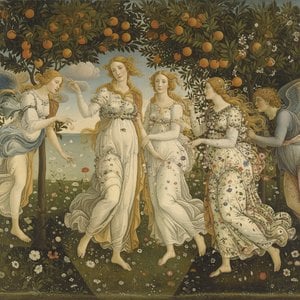
A Florentine Legacy: The Life and Art of Alessandro Allori
Alessandro Allori, born in Florence on May 31st, 1535, stands as a compelling figure within the late Mannerist school. His artistic journey was profoundly shaped by circumstance; orphaned at a young age, he found an unlikely father figure and mentor in Agnolo Bronzino, one of Florence’s most celebrated painters. This adoption wasn't merely familial—it was an immersion into a world of refined technique, intellectual rigor, and the distinctive aesthetic principles that would come to define Allori’s own style. Bronzino instilled within him not only technical mastery but also a particular sensibility: a preference for polished surfaces, elongated forms, and a cool, almost sculptural quality in his figures. This influence became the cornerstone of Allori's artistic identity, though it often drew criticism for its perceived derivativeness throughout his career. He supplemented this foundational training with anatomical studies – even undertaking dissections at the Hospital of Santa Maria Nuova – demonstrating a commitment to understanding the human form that underpinned his stylized representations.The Echoes of Mannerism and Artistic Development
Allori’s work is deeply rooted in the Mannerist tradition, an artistic movement characterized by its artificiality, elegance, and emphasis on stylistic sophistication over naturalistic representation. However, he wasn't a revolutionary; rather, he was a skilled interpreter and developer of existing forms. Critics often noted his tendency to draw heavily from pre-existing art, refining and reinterpreting the works of masters like Michelangelo and Raphael through the lens of Bronzino’s aesthetic. This isn’t necessarily a detraction—it speaks to Allori's role as a crucial link in the transmission of artistic knowledge within Florentine circles. His paintings are marked by an almost unsettling smoothness, figures possessing a marble-like quality that lends them a two-dimensional, statue-esque appearance. This effect wasn’t simply a matter of technique; it was a deliberate aesthetic choice, reflecting the Mannerist desire to elevate art above nature, to create images of idealized beauty and intellectual complexity. He headed one of Florence's most important workshops alongside Santi di Tito, and his pupils included notable artists like Cristoforo del Altissimo, Cesare Dandini, Aurelio Lomi, and his own son, Cristofano Allori, ensuring the continuation of this artistic lineage.Major Works and Patronage
Allori’s career flourished under the patronage of prominent Florentine families, most notably the Medici. He contributed significantly to several important decorative projects for them, including his work on the Studiolo of Francesco I in the Palazzo Vecchio. His *Pearl Fishers*, part of this elaborate chamber, exemplifies his ability to create complex allegorical scenes filled with graceful figures and intricate detail. He also expanded upon frescoes begun by earlier masters like Andrea del Sarto and Franciabigio within the Villa di Poggio a Caiano, demonstrating both his technical skill and his willingness to engage with the artistic legacy of Florence. Beyond these grand commissions, Allori produced numerous portraits, religious paintings, and altarpieces that showcase his mastery of composition, color, and form. A notable example is “Allegory of Human Life,” housed in the Uffizi Gallery, which encapsulates the Renaissance humanist ideals prevalent during his time. His "Stories of St. Jerome" fresco further demonstrates his skill in narrative painting and illusionistic space.Legacy and Historical Significance
Alessandro Allori died in Florence on September 22nd, 1607, leaving behind a body of work that continues to fascinate and challenge art historians. While often overshadowed by the more innovative artists of his time, his significance lies in his role as a key figure in the late Mannerist movement and as a transmitter of artistic tradition. He wasn’t an innovator in the same vein as Michelangelo or Leonardo da Vinci, but he was a supremely skilled craftsman who refined and developed existing styles, ensuring their survival for future generations. The story of a painting – possibly a portrait of Eleonora di Toledo de' Medici – returned to the Gemäldegalerie in Berlin after decades lost adds an intriguing layer to his legacy. His influence extended through his numerous pupils, most notably his son Cristofano Allori, who continued the family’s artistic tradition. Allori’s paintings remain valuable testaments to the elegance and intellectual complexity of Florentine Mannerism, offering a glimpse into a world where art was not merely about representation but about the pursuit of idealized beauty and refined expression. He remains an important figure for understanding the transition from Renaissance artistry towards the Baroque period.Exploring Allori’s World Today
- Museum Collections: Discover Alessandro Allori's masterpieces in institutions like the Uffizi Gallery, the Gemäldegalerie in Berlin, and various other museums worldwide.
- Notable Works: Explore iconic paintings such as “Allegory of Human Life,” “Stories of St. Jerome,” and his contributions to the Studiolo of Francesco I.
- Further Research: Delve deeper into Allori’s life and art through resources like Wikipedia, Getty Museum archives, and scholarly articles on Florentine Mannerism.
Questions & Answers
How can I follow Alessandro Allori's work year by year?
The artist's Artwork Timeline page presents Alessandro Allori's works ordered by date, year by year.
Can I explore Alessandro Allori's works by color spectrum?
Alessandro Allori's works can be explored by color on the artist's Spectral Index page.
Where are Alessandro Allori's artworks grouped by keywords?
To find works by Alessandro Allori on a specific theme, use the artist's By Keywords page, which groups the artworks by keyword.