Ask for the most famous Renaissance paintings and you will hear of Leonardo da Vinci's Mona Lisa (La Gioconda) (1503–1519, The Louvre), Hieronymus Bosch's The Garden of Earthly Delights (1504, Museo del Prado), Leonardo da Vinci's The Last Supper (1497, Church Santa Maria delle Grazie), Sandro Botticelli's The Birth of Venus (1485, Galleria degli Uffizi) and Michelangelo's The Creation of Adam (1508–1512, Sistine Chapel). The list runs to 100 paintings by 31 artists, from 1425 to 1595, each with the collection that holds it today.
No. 1 · Leonardo da VinciMona Lisa (La Gioconda)1503–1519 · The Louvre, Paris
100paintings, ranked by fame
31painters · Masaccio – Pieter Brueghel the Younger
42museums in 23 cities
13at the Galleria degli Uffizi alone
The ranking
The 100 most famous paintings of the Renaissance
Ranked by how widely each painting is known. The artist, the date, the size of the original, the museum that holds it today — and one detail to look for.
1503–1519Oil on poplar panel77 × 53 cmThe Louvre, Paris
The gaze of the woman in Mona Lisa (La Gioconda) meets the viewer with a quiet, unsettling presence. This half-length portrait, rendered by Leonardo da Vinci, captures a moment of stillness that feels alive. Most scholars believe the sitter is Lisa Gherardini, a woman whose life was tied to the bustling commerce of Florence. King Francis I acquires the work after 1519, ensuring its place within the French royal collections. Following attacks in 1956, bulletproof glass was implemented to ensure the sitter remains safe from physical harm.
The triptych unfolds in three distinct movements across oak panels. A strange fountain rises from the earth, its pink waters reflecting a quiet, primordial light.
Commissioned by Ludovico Sforza, Duke of Milan, the painting adorns the refectory wall of the Convent of Santa Maria delle Grazie in Milan. "The Last Supper" exemplifies the High Renaissance style, characterized by its balance, harmony, and idealized beauty. "The Last Supper" is deeply symbolic, depicting the moment when Jesus announces his betrayal.
Look foremotional range captured in apostles' expressionsuse of perspective and lighting to focus on Jesusdynamic composition with Jesus at the center
At the center of this movement, Venus stands upon the pearl-like surface of her vessel, her form defined by soft, flowing lines that seem to ripple like the water itself.
Executed between 1508 and 1512 on the ceiling of the Sistine Chapel in Vatican City, this fresco captures a singular moment of transition. The composition centers on the near-contact of two hands: one belonging to a reclining, muscular Adam and the other to an elderly, powerful God.
The " Lady with an Ermine " exemplifies the High Renaissance style, characterized by its meticulous detail, realistic portrayal, and harmonious composition. The presence of the lion cub at Cecilia’s feet further reinforces her connection to the Duke, symbolizing his power and lineage.
It depicts a gathering of the greatest Greek philosophers and scientists – Plato, Aristotle, Socrates, Pythagoras – engaged in animated discussion, their figures rendered with an unprecedented level of realism and intellectual depth. It served as an inspiration for countless artists who followed, including Leonardo da Vinci and Michelangelo, solidifying Raphael's position as a leading figure of the era.
However, after extensive restoration, it was rediscovered and included in a major Leonardo exhibition at the National Gallery, London, in 2011–12. The Salvator Mundi is one of fewer than 20 known works by Leonardo da Vinci, making it a significant addition to his oeuvre. National Gallery, London: A museum that hosted a major Leonardo exhibition in 2011–12.
Attributed to Giorgione and/or Titian, the painting emerged around 1510. The provenance of the work traces back to 1695, when it was acquired from a French dealer for Augustus the Strong of Saxony. While traditionally attributed to Giorgione, it is widely believed that Titian completed the work following the artist's death in 1510.
Commissioned for the church of San Pietro in Montorio in Rome, “The Transfiguration” was intended as an altarpiece. The work demonstrates Raphael's ability to synthesize influences from Leonardo da Vinci (in the atmospheric perspective) and Michelangelo (in the energetic figure groupings).
Look forcomplex compositiondivision between heavenlyearthly realmsdramatic lighting
This oil on panel painting offers a rare glimpse into an intimate moment – the twelve-year-old Jesus engaging in scholarly debate with learned men in the Temple of Jerusalem, as recounted in the Gospel of Luke. Executed with meticulous detail characteristic of the Northern Renaissance, Dürer’s work showcases his exceptional skill in oil painting. Unlike the High Renaissance emphasis on idealized beauty, this piece prioritizes a raw, almost palpable realism, reflecting the artistic sensibilities prevalent in Northern Europe. Created during Dürer’s first visit to Italy, this painting reveals the influence of Italian masters like Leonardo da Vinci while retaining his distinctly German style.
Look fordetailed figuresintense focus on faceshandsbooks
Hieronymus Bosch, born around 1450 in's-Hertogenbosch, Netherlands, was a prominent Dutch painter known for his surreal and imaginative depictions of religious themes. It was part of a group of six paintings acquired by King Philip II of Spain in 1570 and later recomposed in the Museo del Prado, Madrid, where it remains today.
Look forChrist in the sky observing the sceneinfernal beings pulling the wagon towards Hell
Primavera unfolds as a lavish scene drawn from classical mythology. The flowing lines, elongated figures, and refined details are hallmarks of Early Renaissance Florentine painting. It’s believed that Botticelli collaborated with the poet Poliziano to devise the complex iconography, drawing inspiration from ancient texts like Ovid's Metamorphoses and Lucretius’ De Rerum Natura.
Look formercurycupidorange groveabundance of flowers
Commissioned by Pope Clement VII and completed during a period of religious upheaval following the Sack of Rome, this work reflects both the anxieties of its time and Michelangelo's evolving artistic style. The fresco depicts the Second Coming of Christ and the final judgment by God.
Look forhundreds of nude figuresChrist as Judgeinstruments of the Passionrising of the dead
Created in 1511, this monumental work captures a moment of celestial convergence. The origins of this work are tied to the civic and spiritual life of Nuremberg, Germany. In 1508, Matthias Landauer, a successful smelter with a deep sense of social responsibility, commissioned the altarpiece. In 1585, Emperor Rudolf II acquires the painting, bringing it into his imperial sphere.
The painting presents Jean de Dinteville, French ambassador to England, and Georges de Selve, Bishop of Lavaur, positioned as imposing figures against a rich green backdrop. The inclusion of objects referencing both Catholic and Protestant beliefs suggests a nuanced commentary on the religious divisions of the time.
Look forcelestial sphereanamorphic skulllute with broken stringterrestrial globe
Raphael, also known as Raffaello Sanzio da Urbino, was a renowned Italian painter and architect of the High Renaissance. Raphael's works are admired for their clarity of form, ease of composition, and visual achievement of the Neoplatonic ideal of human grandeur. It is believed that Raphael completed the work shortly before his death in 1520.
The scene unfolds with a bustling energy, depicting the Virgin Mary tenderly holding the Christ Child while the Magi – representing the known world – kneel before them offering gold, frankincense, and myrrh. These gifts aren’t merely symbolic; they foreshadow Jesus's role as King, God, and ultimately, his human mortality.
Giorgione’s enigmatic painting transports viewers to a world steeped in atmosphere and veiled symbolism. The painting features two figures set against a dramatic landscape. This artwork exemplifies the distinctive qualities of the Venetian School of painting. Unlike Florentine artists who prioritized line and form, Giorgione – alongside Titian – championed color and atmosphere.
Look forclassical ruinsatmospheric perspectivedramatic sky with lightninggrieving woman
Unlike the rigid anatomical precision favored by some of his contemporaries, Titian prioritized a sensual beauty and refined elegance that relied heavily on his peerless ability to manipulate light and color.
Fra Angelico's use of color is both vibrant and restrained, with earthy tones of greens, browns, and blues accented by rich reds and golds. The painting's history, including its looting during World War II and subsequent return to Italy, adds a layer of intrigue and cultural significance.
Look forpredella with scenes from the life of Maryarchitectural framework with arches and columnsintricate detailing of architectural elements and figuresenclosed garden symbolizing Mary's virginity
At the very heart of this swirling composition sits Jesus Christ, depicted not as a triumphant conqueror, but as a solemn judge. As a cornerstone of the Northern Renaissance, this central panel exemplifies the incredible technical skill of Bosch.
God, perceiving this hubris, confounded their language, halting construction and scattering humankind across the earth. This was a period of religious upheaval in the Netherlands, with growing Protestant dissent against the Catholic Church; some scholars suggest the painting subtly reflects these tensions, contrasting a unified (though ultimately flawed) human effort with the fractured landscape of religious belief.
Look forbiblical story of Babeldetailed architecturebustling construction site
Created during a period of religious upheaval, “The Mocking of Christ” reflects the anxieties and spiritual fervor of the early 16th century. The scene draws directly from the biblical accounts of the Passion of Christ, specifically the events leading up to his crucifixion where he was subjected to ridicule and torment by Roman soldiers.
Look fordramatic compositionintense emotiondetailed figurescrowded scene
This oil panel painting depicts a desolate landscape overrun by an army of skeletons, wreaking havoc on the living. "The Triumph of Death" is rich in symbolism, reflecting the societal fears and anxieties of the mid-16th century.
Look forfour Horsemen of the Apocalypsescenes of everyday life and execution methodssymbolism of mortality and fragilityarmy of skeletons wreaking havoc
Measuring an impressive 360 x 690 cm, this monumental canvas immediately commands attention with its rich palette and meticulously rendered figures. The lighting, particularly focused on Mary and the ascending angels, is dramatic and theatrical, reminiscent of Baroque painting but filtered through a distinctly American sensibility.
Commissioned during Leonardo's apprenticeship with Verrocchio, this painting reflects the artistic influences of 15th-century Florence. The marble table in front of Mary is believed to be derived from the tomb of Piero and Giovanni de' Medici in the Basilica of San Lorenzo, which Verrocchio had sculpted during the same period.
Look forangel Gabriel announcing to Marymadonna lily symbolizing puritymarble table derived from Medici tombsemi-transparent veil under the Holy Scriptures
Central to the composition is Saint Anthony himself, depicted in a moment of intense prayer and contemplation, confronting the temptations and vices that threaten his spiritual purity. Produced during the height of the Northern Renaissance, this work reflects Bosch’s fascination with religious themes and moral allegory.
Look forsurreal creaturessymbolic scenes of temptationmoral allegory
The painting’s composition is strikingly balanced, mirroring the humanist ideals prevalent in Renaissance Europe. Created during a period of religious upheaval, The Ambassadors reflects the tensions between humanist ideals and Catholic dogma. For more information on Hans Holbein the Younger and his remarkable oeuvre, visit https://AllPaintingsStore.com. Handmade oil painting reproductions of The Ambassadors are available at https://AllPaintingsStore.com.
The composition is meticulously organized, with figures arranged to guide the viewer’s eye through a complex story of truth, slander, envy, and repentance. Central to the scene is the figure of Slander, dragging an innocent victim, surrounded by symbolic characters such as Ignorance, Suspicion, and Envy, all set within an architectural framework reminiscent of a grand classical temple. Painted around 1495, this work is a rare secular piece by Botticelli that draws inspiration from classical literature and ancient Greek painting. The donkey ears of King Midas, for example, symbolize foolishness and ignorance, while the torch held by Slander signifies destructive passion.
Look forclassical influencedetailed architectural frameworkallegory of slandervirtue
The piece depicts St. John the Baptist in isolation, dressed in simple pelts, with long curly hair, and an enigmatic smile reminiscent of Da Vinci’s famous Mona Lisa. This careful consideration of composition and tonal harmony exemplifies Da Vinci’s meticulous attention to detail and his unwavering commitment to achieving artistic perfection.
Joseph leans protectively over Mary, while the young John the Baptist gazes towards Jesus, anticipating his future role. The ignudi are often interpreted as representing pagan humanity, separated from the divine grace of the Holy Family by a low wall – symbolizing original sin.
Look forvibrant colorsspiral compositionnude figures in background
Crafted by the renowned Venetian master Jacopo Tintoretto in 1557, this work captures a moment of vulnerability, moral tension, and divine justice. Painted during the Venetian Renaissance, this work reflects Tintoretto’s innovative approach to storytelling and his fascination with human emotion.
Look forrealistic human anatomydramatic realismemotional intensityvibrant color
Altdorfer, a pioneer of landscape art and a key figure in the Danube School, employs a rich and earthy color palette dominated by deep reds, browns, and blues. As one of the most famous examples of the "world landscape" genre, The Battle of Alexander at Issus reaches an unprecedented grandeur.
Look fordramatic battle scenechaotic compositionrich color palettedetailed figures and horses
At first glance, the painting appears strikingly serene. Federico da Montefeltro was a pivotal figure in the Italian Renaissance, not just for his military leadership but also for his patronage of the arts and sciences. Additionally, the Galleria degli Uffizi is featured in The Uffizi Gallery, Florence Italy, providing insights into the museum's rich history and collection.
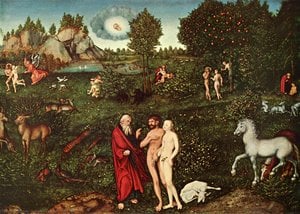
Executed with meticulous craftsmanship, this piece exemplifies Cranach’s mastery of early Renaissance realism combined with detailed iconography. Cranach, a court painter to the Electors of Saxony, was deeply engaged with the spiritual and intellectual currents of his time.
Look forsymbolic depiction of the serpentapplelush landscapehuman
This event, central to Christian theology, symbolizes purification, repentance, and the beginning of Christ’s public ministry. The composition is rich with symbolic meaning: the dove descending from above represents the Holy Spirit, while the delicate cross subtly foreshadows Christ's eventual sacrifice. Painted during the height of the Florentine Renaissance, this artwork reflects the intellectual and artistic ferment of the era.
Look fordepiction of the Holy Spirit as a doveangel painted by Leonardo da Vinci
The central figure, adorned in luxurious attire, exudes an air of regal bearing that suggests wealth and status. Created in 1580, "Lucretia" is a product of the Late Renaissance, a period marked by artistic innovation and cultural flourishing. Paolo Veronese, alongside Titian and Tintoretto, was part of the "great trio" that dominated Venetian painting during this era.
Look fordramatic use of light and shadow (chiaroscuro)opulent detailing in attire and jewelryelaborate patterns in the background
Eschewing the harsh, dramatic shadows often found in German portraiture of the era, he instead employs a gentle, diffused illumination that caresses the subject's pale skin and highlights the reddish-blonde waves of her hair.
The artwork's central focus is a large, meticulously rendered circular wheel set against a dramatically dark background. Within each segment of the wheel, miniature scenes unfold, depicting humanity’s fluctuating fortunes – moments of prosperity and success juxtaposed with episodes of hardship and downfall. Hieronymus Bosch was a unique voice in 15th-century art, renowned for his imaginative and often unsettling imagery. “The Wheel of Fortune” motif itself was deeply ingrained in medieval thought, representing both the arbitrary nature of fate and the potential for spiritual redemption.
Look fordetailed figuresinscriptionsdepiction of fatemorality
The positioning of Mary Magdalene and Saint John —leaning over Christ's body—represents compassion and sorrow, mirroring the universal human response to loss. This technique, perfected in monumental frescoes like “The Camera degli Sposi,” revolutionized artistic practice and established Mantegna as a pioneer of Renaissance innovation.
The painting depicts a serene and deeply human scene: Mary tenderly embracing the Christ Child while seated in a chair. Madonna della Seggiola is a prime example of High Renaissance artistry. Its history includes a brief sojourn to Paris with Napoleon’s troops in 1799 before being returned to Florence in 1815.
Look fortondo formnaturalistic representation of the Madonna
1595Oil on canvas123 × 164 cmRockox House, Antwerp
The scene unfolds like a bustling village square during a time of crisis or upheaval. The original title, "The Blue Cloak" or "The Folly of the World," indicates Bruegel's intent to catalogue human folly.
Look forbanging one's head against a brick wallarmed to the teethliteral illustrations of Dutch-language proverbs and idiomsthe Blue Cloak
Flanking Him are mourners, saints, and symbolic figures that deepen the narrative, including Mary, John the Evangelist, and Mary Magdalene, each expressing grief and reverence. This work reflects the spiritual and medical concerns of early 16th-century Europe, blending religious devotion with compassionate understanding. The surrounding figures, including Mary and John, express grief and reverence, drawing viewers into an emotional dialogue.
Look forvivid colorsintricate gildingsymbolic figurescrucifixion scene
The composition is densely populated with figures engaged in various activities, creating a sense of chaos and vibrancy that brings 16th-century peasant life to vivid reality. Bruegel's use of lines guides the viewer's eye through the scene, with horizontal tables and benches providing structure, while vertical wooden beams add balance.
Look fordrinkvariety of activitiesinteractions among figurescentral figure in white apron
The painting Venus and the Three Graces Presenting Gifts to a Young Woman is a renowned work by the Italian Renaissance master Sandro Botticelli. Created in circa 1483-1486, this fresco originally decorated the walls of Villa Lemmi, a country villa near Florence owned by Giovanni Tornabuoni. It is now housed in the Musée du Louvre in Paris.
The painting portrays Jean de Dinteville, French ambassador to England, on the left, and Georges de Selve, Bishop of Lavaur, on the right. Painted during a period of immense political and religious upheaval – Henry VIII’s break with the Catholic Church – The Ambassadors reflects the anxieties and uncertainties of the time.
The artwork exudes a sense of tranquility and classical elegance, reminiscent of Renaissance and Mannerist traditions. The style is characteristic of Renaissance or Mannerist art, with meticulous attention to detail, naturalistic forms, and a harmonious balance. This artwork likely dates back to the Renaissance period, a time of great artistic innovation and cultural flourishing in Europe.
Look fornude figures and clothed individualsserene landscape with trees and distant buildingsfour figures in a lush landscape
Uccello's distinctive style is evident in this artwork, characterized by its intricate details, bold lines, and innovative use of perspective. Painted in oil on wood, " The Battle of San Romano - The Counter-Attack by Mich" showcases Uccello's mastery of technique. " The Battle of San Romano - The Counter-Attack by Mich" conveys a sense of drama, intensity, and conflict.
Look forbold, diagonal lines emphasizing movementdynamic and chaotic battle scenedetailed armor and horse coverings
Produced during the Italian Renaissance, this work reflects the period’s fascination with classical mythology, humanism, and artistic innovation. This piece not only exemplifies the artistic mastery of its time but also captures the Renaissance’s spirit of discovery and celebration of human beauty.
Within this shallow, compressed space, the limp, pale body of Christ begins its slow descent from the cross. Created in 1449, this work emerges from the traditions of Early Netherlandish painting, where hyper-realistic detail meets intense emotional expression.
The Trinity by Masaccio is a fresco painting that marked the beginning of the Renaissance in Italy. Created in 1425, it is considered one of the most important works of the early Renaissance period. The painting is housed in the Santa Maria Novella church in Florence, Italy.
1483Oil and tempera on poplar panel69 × 173 cmNational Gallery, London
The artwork is rich in symbolism, with Venus and Mars representing the eternal struggle between love and war. "Venus and Mars" conveys a sense of tranquility and sensuality, with the relaxed poses of the figures suggesting a moment of leisure or contemplation. Created during the High Renaissance, this painting reflects the cultural and artistic ideals of the period.
Look forluxurious fabrics and intricate patternsrich textures and vibrant colorsmythological narrative
The figures are arranged in a harmonious pyramidal structure, emphasizing stability and spiritual unity. Created during the High Renaissance, this work exemplifies Leonardo da Vinci’s mastery of realism and atmospheric depth. Painted in the late 15th century, this work reflects Leonardo’s innovative approach to religious art, blending spiritual symbolism with naturalistic detail.
Look foruse of chiaroscurosfumato techniquedetailed natural landscapeharmonious composition
Rendered in profile, the painting emphasizes her regal bearing, intricate attire, and poised expression. Commissioned during the height of the Italian Renaissance, this portrait reflects the era’s emphasis on individualism, humanism, and the celebration of noble virtues.
Look forstark profile viewdetailed landscape backgroundrealistic texturessubtle narrative themes of power
The painting depicts a serene gathering on Mount Parnassus, revered as the birthplace of poetry and music in antiquity. The fresco features several prominent figures from Greek mythology —Mars, god of war, juxtaposed with Venus—representing the delicate balance between conflict and harmony. Andrea Mantegna on AllPaintingsStore Musée du Louvre Experience the beauty of Renaissance art with hand-made oil painting reproductions from AllPaintingsStore.
Raphael presents him in profile, exuding an air of quiet contemplation and intellectual depth. Raphael, alongside Leonardo da Vinci and Michelangelo, was a key figure in this movement, known for his ability to blend technical skill with emotional resonance.
Look forcontrast between light and dark backgrounddelicate precision in rendering skin and hairsubdued elegance with rich color paletteuse of chiaroscuro for dramatic effect
Emerging from Florence at the dawn of the fifteenth century, this era witnessed a fervent revival of classical learning alongside burgeoning humanism. Fra Angelico’s work exemplifies these principles—a harmonious blend of observation and contemplation that distinguishes it from earlier Gothic styles. The depiction of Christ enthroned symbolizes his divine sovereignty and triumph over death—a central theme within Christian iconography.
The scene is filled with dynamic movement and dramatic tension, showcasing Uccello's fascination with perspective and his ability to convey the chaos and brutality of war. Uccello's style is characterized by its detailed depiction of figures, use of bold colors, and emphasis on narrative content. "The Battle of San Romano" conveys themes of war, violence, and the brutality of conflict.
Look forcentral figure on a white horsedynamic battle compositionvivid colors and bold linesintricate details in armor and clothing
The Pietà depicts the Virgin Mary cradling the lifeless body of Jesus Christ after his crucifixion. Commissioned by French Cardinal Jean de Billheres for his funeral chapel in Old St. Peter's Basilica, the Pietà quickly gained renown. The sculpture’s creation coincided with a period of artistic flourishing in Rome and marked Michelangelo as a leading figure of the High Renaissance – an era defined by intellectual curiosity, humanism, and artistic innovation. Though tragically vandalized in 1972 (and now protected by bulletproof glass), its beauty remains undiminished.
There is a starkness to the anatomy; ribs and tendons are rendered with a precision that refuses to look away from the physical reality of death. The painting avoids the spiritual light often found in sacred art, choosing instead to focus on the grim, biological truth of the deceased Son of God.
Leonardo da Vinci's style in this artwork is characteristic of the High Renaissance, with its emphasis on harmony, proportion, and the depiction of human emotion. The painting was commissioned as the high altarpiece for the Church of Santissima Annunziata in Florence. The lamb held by the Christ Child symbolizes His future sacrifice and the redemption of humanity.
Look formary sitting on Saint Anne's laptriangular composition of three figuressacrificial lamb held by the infant Jesus
When one gazes upon Judith, one does not simply see a heroine from scripture, but a symbol of righteous strength standing against overwhelming oppression. The painting breathes with the spirit of its time, reflecting the socio-political anxieties and the burgeoning humanist ideals that defined the Saxon court under Frederick III.
1490Tempera on poplar panel62 × 46 cmThe Louvre, Paris
The painting presents us with an elderly man, his face etched with the wisdom of years, tenderly cradling a young child. Clad in rich, crimson robes that catch the light, both figures are locked in a silent, soulful exchange.
This arrangement creates a sense of stability and focus on the sacred figures. Created during the height of the Florentine Renaissance, this painting reflects the artistic innovations and spiritual fervor of the period. Sandro Botticelli, a pivotal figure in Italian Renaissance painting, was known for his elegant linearity and ability to blend late Gothic influences with early Renaissance ideals.
Look forintricate details in drapery and figuressoft, diffused lightingbackground landscape providing depthpyramidal composition
“The Nativity” is rich in symbolic detail, each element carefully chosen to convey a specific meaning. Piero della Francesca’s “The Nativity” exemplifies the artistic innovations of the Early Renaissance.
While Michelangelo would later become synonymous with the monumental strength of marble sculpture, this early foray into painting reveals a sensitive observer capable of translating visceral terror onto a miniature canvas. The technical execution of this work reflects the rigorous training Michelangelo received under the Florentine master Domenico Ghirlandaio.
The maiden’s calm expression contrasts with the skeletal figure’s gentle support, symbolizing the complex relationship between life, death, and the hope for spiritual awakening. Created with meticulous attention to detail, this piece exemplifies classical realism rooted in Renaissance and Baroque artistic traditions. The skeletal figure, often personified as Death, gently supports the maiden, suggesting a tender acceptance rather than fear.
Look fordramatic chiaroscuro lightingrealistic texturessymbolic themes of mortalitytranscendence
At the heart of the composition, the Virgin Mary sits with a grace that anchors the entire scene. Beside her, the Christ Child and a young Saint John the Baptist interact with a gentle, unhurried energy. The young Saint John the Baptist holds a goldfinch in his hands, a tiny creature that brings a flicker of movement to the stillness.
Employing oil on panel, he utilized a technique that allowed for layering colors and textures with remarkable precision. Unlike many portraits of his time which relied heavily on idealized beauty, Holbein prioritized conveying Henry VIII’s character and authority through realistic depiction. Created during Henry VIII's tumultuous reign, marked by the break from Rome and the establishment of the Church of England, “Portrait of Henry VIII” served as a deliberate statement of power.
This layering of pigment allows the light to penetrate the surface, catching the subtle textures of drapery and the soft contours of human flesh with unparalleled realism.
1500Oil on canvas109 × 75 cmNational Gallery, London
The composition is divided into two main sections: the upper portion featuring celestial beings and the lower portion illustrating the birth of Jesus. The lower section focuses on the Virgin Mary kneeling before the Christ Child, with various figures gathered around the manger. The painting reflects these anxieties and hopes for Christ's millennium as stated in the Book of Revelation.
Look fordevils fleeing to the underworldcelestial beings in the upper sectionnativity scene with Virgin Mary and infant Jesusangels dancing with olive branches
This deliberate alteration speaks volumes about the artist’s intent and the evolving tastes of his patrons. The most common theories suggest they represent the Three Kings, astronomers, or even representatives of three distinct religions.
In 1746, the upper levels of the work face a transformation as the artist Vincenzo Meucci paints over them, obscuring the original vision. The struggle for survival continues when a fire ravages the church in 1771, leaving the chapel in ruins and threatening the very existence of the painted scenes.
Measuring 59 x 82 cm, this oil on panel resides within the Galleria Nazionale delle Marche in Urbino, Italy, beckoning viewers to unravel its complexities. The painting portrays a pivotal moment from the Passion of Christ – His flagellation by Roman soldiers. However, Piero doesn’t present a chaotic scene of brutality.
Look forperspectivedepiction of flagellation scenegeometric forms
At first glance, the viewer is met with a somber procession of six men traversing a rugged Brabant terrain. The emotional weight of the painting is amplified by Brue el’s sophisticated use of light and shadow.
Bosch’s meticulous attention to detail is immediately apparent. At the center sits a man draped in a hat, perched atop a barrel—a deliberate staging of his predicament.
The painting depicts the biblical scene of the Magi’s arrival to worship the infant Jesus. The composition centers around the Virgin Mary, tenderly presenting her child, forming a stable triangular core. Another tree, belonging to the carob family, whose seeds were used as a unit for measuring precious stones, subtly symbolizes Christ’s kingship or the Virgin's future role as Queen of Heaven.
Look forunfinished statesketchesself-portrait (possible)ruin of a pagan building
Michelangelo di Lodovico Buonarroti Simoni was born on March 6, 1475, in Caprese Michelangelo, Tuscany. Around 1496, he received his first major commission: the sculpture of the Pietà, completed in 1499. His next landmark work was the colossal statue of David (1501-1504), symbolizing Florentine republican ideals. Michelangelo began working on the Sistine Chapel ceiling in 1508 and completed it in 1512. The “Separation of Light from Darkness” was painted during the final stage of this project, between the winter of 1511 and October 1512.
At first glance, the painting appears chaotic – a teeming throng of nobles, merchants, musicians, and servants all engaged in a boisterous feast. The arches framing the banquet hall, reminiscent of Roman triumphal architecture, subtly guide the eye towards Christ at the center, who is depicted not as a divine figure but rather as a gracious host presiding over this extravagant gathering.
1505Oil and egg tempera on wood, transferred to canvas in 1949National Gallery, London
Bellini's style is characterized by its luminous colors, atmospheric landscapes, and meticulous attention to detail. Painted during the height of the Venetian Renaissance, "Madonna of the Meadow" reflects Bellini's influence on the art world. The painting was originally housed in a private collection before finding its permanent home at the National Gallery in London.
Look forlandscape with everyday life detailspyramidal compositionraven symbolizing death
The composition is meticulously arranged with 14 figures, including angels, shepherds, and animals such as horses and cows, creating a bustling yet harmonious atmosphere. The painting reflects the evolving artistic landscape of 15th-century Florence, where religious themes were frequently explored through increasingly sophisticated techniques and perspectives.
The painting dramatically portrays the moment Christ’s body is being carried towards its final resting place. Measuring 184 x 176 cm, The Entombment showcases Raphael’s exceptional technical skill. The figures surrounding Christ represent various aspects of grief and faith: Mary Magdalene’s despair, John the Evangelist's support, and Nicodemus and Joseph of Arimathea’s solemn duty.
Look forentombment of Christdeposition of Christlamentation of Christ
Tintoretto’s distinctive style—characterized by rapid brushwork and dramatic lighting effects—is immediately apparent in Mercure et les Graces. Tintoretto’s contemporaries included Titian and Paolo Veronese, artists who similarly explored mythological themes and employed innovative techniques to convey emotion and grandeur.
The scene unfolds beneath the shadow of a solitary tree, where the light falls with a quiet, steady gravity. Rather than the chaotic movement often found in the Baroque era, this painting seeks a quiet, ordered dignity.
A small boat drifts through a desolate landscape, crowded with figures engaged in disordered behavior. The composition is vertically oriented, set against a pale sky and a vast, empty horizon. The work utilizes the Northern Renaissance style, employing meticulous detail to create an unsettling atmosphere through the depiction of hybrid beings and nonsensical activities.
The painting’s power lies in its intricate layers of meaning. This deliberate juxtaposition reflects the humanist spirit of the era, illustrating the Renaissance struggle to reconcile the pagan imagery of the classical past with the sacred dogmas of the Christian faith.
The painting depicts a young woman in profile view, wearing a blue headscarf that covers her hair. The scarf is draped over her shoulders and down to her chest. In her hands, she holds an open book, which appears to be a manuscript given its size and the visible text on the pages.
Muhlberg, 1547, witnessed Charles V’s decisive triumph over Maximilian I’s forces—a victory that secured his dominion over Bohemia and reaffirmed his position as Holy Roman Emperor. The painting captures this momentous occasion with remarkable immediacy, reflecting the prevailing artistic sensibilities of the era. Notably, Dürer’s Knight, Death and the Devil served as a visual precedent for conveying themes of nobility and mortality—a duality skillfully mirrored in Titian's composition. Unlike conventional equestrian depictions—where the animal dominates— Titian deliberately minimizes the horse’s movement, grounding it with only its hind legs touching the earth.
The maiden, often interpreted as Princess Sabra, signifies innocence and purity. From classic interiors to modern spaces, "St. George and the Dragon" complements a variety of design styles.
Look fordynamic composition with detailed figurative representationuse of perspective to create depthvibrant yet muted color palettesymbolic narrative elements
The juniper specifically held significance as a symbol of female chastity and virtue, while also being a playful reference to Ginevra’s name ("ginepro" is Italian for juniper). Infrared analysis has even revealed traces of another motto associated with Bernardo Bembo, a Venetian diplomat believed to have been romantically linked to Ginevra, suggesting his possible involvement in the commission.
Look forjuniper wreath with inscription 'Virtutem Forma Decorat'laurelpalm
Around 1509, Venetian artists began experimenting with groundbreaking techniques designed to manipulate light and shadow —a characteristic hallmark of the Cinquecento period. The exact patronage of the Pastoral Concert remains elusive, though it's believed to have been commissioned during Venice’s precarious position amidst the League of Cambrai’s War in 1509—a period marked by political instability and military conflict.
The "Darmstadt Madonna" is a religious artwork that depicts the Holy Family, with the Virgin Mary holding the infant Jesus. The painting also includes the Bürgermeister of Basel, Jakob Meyer zum Hasen, his first wife (who had passed away), his current wife, and their daughter, grouped around the central figures.
Look forinfluenced by Andrea Mantegna's 'Madonna della Vittoria'contains elements of Netherlandish portrait painting
Before Van der Goes, Flemish painting largely adhered to stylized depictions prioritizing decorative elegance; he boldly rejected these constraints, injecting his canvases with an unprecedented level of observational accuracy and psychological insight. This meticulous attention to detail—evident throughout the Portinari Altarpiece—was achieved through painstaking preparation and execution, reflecting Van der Goes’s unwavering commitment to artistic excellence.
1493Oil painting on panel or canvas57 × 45 cmThe Louvre, Paris
The subject, likely Dürer himself, holds a thistle plant, adding a layer of symbolic depth to the composition. This early self-portrait offers a glimpse into the artist's burgeoning talent and his ability to convey complex emotions through meticulous detail.
Look formuted color palette with dark tones and red accentshighly detailed and realistic portrayalsymbolic elements including the thistle plant
A dynamic crowd dominates the foreground, caught in the throes of a lively dance accompanied by a bagpiper positioned to the left. The Peasant Dance exemplifies Bruegel's mature style, characterized by monumental Italianate figures and meticulous attention to detail. Created in 1567 by Pieter Bruegel the Elder.
The painting, executed primarily in tempera and oil on wood, showcases Carnevale’s unique approach to portraying biblical narratives, one that diverges significantly from the established conventions of his time. Fra Carnevale's “The Presentation of the Virgin in the Temple” remains one of the most enigmatic and compelling works of the early Renaissance.
Can I own a copy of a famous Renaissance painting?
Answer
92 of these 100 paintings are available hand-painted in oil, from $181, and 92 as a canvas print, from $47.
How is this ranking made?
Answer
Each painting is ranked by how widely it is known: the number of Wikipedia language editions with an article on it (Wikidata sitelinks), its place in our catalogue's manual ranking and the visits its page receives. The same painting catalogued several times counts once, and details, copies and studies are left out.
Bring one home
92 of the 100 as hand-painted oil reproductions
92 paintings of this list can be ordered as museum-grade, hand-painted oil reproductions, from $181.
We started with every Renaissance painting in our catalogue and ranked them by how famous they are. Three clues decide the order: in how many languages Wikipedia has an article about the painting, where our curators place it, and how often people open its page on our site. Each painting appears only once, and details, copies and studies are left out.