
Famous paintings · Neoclassicism

The 100 Most Famous Neoclassicism Paintings

1725 – 1873

The most famous Neoclassicism paintings are Jean-Auguste-Dominique Ingres's The Grande Odalisque (1814, The Louvre), Jacques-Louis David's Napoleon at the St. Bernard Pass (1801, Austrian Gallery Belvedere), Élisabeth Louise Vigée Le Brun's Self Portrait with Her Daughter, Julie (1789), Jacques-Louis David's The Oath of the Horatii (1784, The Louvre) and John Singleton Copley's Watson and the Shark (1778, National Gallery of Art). The list runs to 100 paintings by 56 artists, from 1725 to 1873, each with the collection that holds it today.

The Grande Odalisque by Jean-Auguste-Dominique Ingres, 1814, The Louvre — famous Neoclassicism painting
No. 1 · Jean-Auguste-Dominique IngresThe Grande Odalisque1814 · The Louvre, Paris
100paintings, ranked by fame
56painters · William Hogarth – Alexandre Cabanel
43museums in 25 cities
16at the The Louvre alone

The ranking

The 100 most famous paintings of the Neoclassicism

Ranked by how widely each painting is known. The artist, the date, the size of the original, the museum that holds it today — and one detail to look for.

  1. The Grande Odalisque by Jean-Auguste-Dominique Ingres, 1814, The Louvre
    1

    1814Oil on canvas91 × 162 cmThe Louvre, Paris

    The composition echoes the traditional Venus pose – a reclining nude – yet departs from strict anatomical accuracy in favor of elongated forms and graceful curves. This deliberate distortion, initially criticized, contributes to the painting’s dreamlike quality and emphasizes its aesthetic rather than purely realistic intent. While Ingres never travelled to the Near East, he drew inspiration from literary descriptions and existing artistic representations, creating an idealized and somewhat fantastical vision of Oriental life.

    Look forreclining nudeexotic attireelongated proportions

    Oil reproduction from $181 Canvas print from $47

  2. Napoleon at the St. Bernard Pass by Jacques-Louis David, 1801, Austrian Gallery Belvedere
    2

    1801Oil on canvas246 × 231 cmAustrian Gallery Belvedere, Vienna

    The painting was commissioned by Charles IV of Spain, intended for a gallery of great military leaders within the Royal Palace of Madrid, signifying a diplomatic gesture and acknowledging Napoleon’s growing influence. Interestingly, four additional versions were created at Napoleon’s request for display in various locations across France and Italy, demonstrating the importance placed on disseminating this powerful visual narrative.

    Look forequestrian portraitdramatic lightinghistorical context of Napoleon's crossing of the Alps

    Oil reproduction from $181 Canvas print from $47

  3. Self Portrait with Her Daughter, Julie by Élisabeth Louise Vigée Le Brun, 1789
    3

    1789Oil on canvas130 × 94 cm

    Vigée Le Brun's mastery of the Rococo and Neoclassical styles is evident in the refined technique and harmonious composition. The painting reflects the artist's personal life and her deep bond with her daughter, providing a glimpse into the intimate moments of 18th-century family life. "Self Portrait with Her Daughter, Julie" is an ideal addition to any art collection or home decor.

    Look fortender embracesoft lightingharmonious color palette

    Oil reproduction from $206 Canvas print from $47

  4. The Oath of the Horatii by Jacques-Louis David, 1784, The Louvre
    4

    1784Oil on canvas330 × 425 cmThe Louvre, Paris

    This deliberate arrangement mirrors classical principles of balance and harmony, reflecting David’s deep understanding and reverence for ancient Greek and Roman art. "The Oath of the Horatii" was painted during a period of significant social and political upheaval in France.

    Oil reproduction from $181 Canvas print from $47

  5. Watson and the Shark by John Singleton Copley, 1778, National Gallery of Art
    5

    1778Oil on canvas182 × 230 cmNational Gallery of Art, Washington

    John Singleton Copley's "Watson and the Shark" is a gripping depiction of human struggle and rescue, capturing a moment of intense drama in the turbulent waters of Havana Harbor. The painting was exhibited at the Royal Academy in 1778 and later bequeathed to Christ's Hospital in London by Watson.

    Look forrich color palette with earthy tones and warm huesdramatic rescue scenedynamic composition with strong diagonal lines

    Oil reproduction from $331 Canvas print from $47

  6. Basket of Peaches by Jean-Baptiste-Siméon Chardin, 1768, The Louvre
    6

    1768Oil on canvas39 × 32 cmThe Louvre, Paris

    Arranged alongside are a dark glass, likely holding wine or cordial, a simple knife, and two walnuts. Painted during the height of his career, Basket of Peaches exists within a fascinating artistic landscape.

    Look forbalanced asymmetryimpastosoft lighting

    Oil reproduction from $181 Canvas print from $47

  7. The Lictors Returning to Brutus the Bodies of his Sons by Jacques-Louis David, 1789, The Louvre
    7

    1789Oil on canvas323 × 422 cmThe Louvre, Paris

    Created in 1789, the painting exemplifies Jacques-Louis David’s mastery of Neoclassical style —characterized by its clarity, precision, and restrained elegance. The story of Brutus was a potent symbol of sacrifice for the greater good, aligning with the revolutionary ideals of liberty and republicanism.

    Look foruse of lightshadowdramatic scene of civic virtueemotional expressions

    Oil reproduction from $306 Canvas print from $47

  8. A Bay Hunter with Two Spaniels by George Stubbs, 1777
    8

    1777Oil on canvas68 × 59 cm

    The painting features a majestic bay hunter, a breed of horse known for its strength and elegance, accompanied by two playful spaniels. The painting reflects the traditions of classical landscape and animal painting, with influences from the Baroque or Romantic periods.

    Look fortwo playful spanielsserene landscape with a large treesoft pastel hues of pink and orange skymajestic horse as the central figure

    Oil reproduction from $181 Canvas print from $47

  9. The Sabine Women by Jacques-Louis David, 1799, Louvre Museum
    9

    1799Oil on canvas385 × 522 cmLouvre Museum, Paris (implied)

    Created during a turbulent period in French history – following the Reign of Terror and under the Consulate of Napoleon – the work also subtly reflects a yearning for national unity and stability after years of revolution.

    Look forintervention of Sabine women to stop conflictdramatic compositionchiaroscuro

    Oil reproduction from $181 Canvas print from $47

  10. The Death of General Wolfe by Benjamin West, 1770, Art Gallery of Ontario
    10

    1770Oil on canvas151 × 213 cmArt Gallery of Ontario, Toronto

    General James Wolfe, who led the British forces to victory, was mortally wounded during the conflict. West's painting immortalizes this moment, transforming it into a powerful narrative of heroism and sacrifice. Benjamin West, an Anglo-American artist, is renowned for his historical paintings that blend Neoclassical ideals with contemporary accuracy.

    Look forchrist-like depiction of General Wolfetriangular composition with flag as apexindigenous warrior in thoughtful posecontroversial use of contemporary clothing

    Oil reproduction from $381 Canvas print from $47

  11. Male Nude known as Patroclus by Jacques-Louis David, 1780
    11

    1780Oil on canvas

    David emerged as a leading figure during a period of significant artistic transition. David's rigorous training at the French Academy, despite his initial frustrations with its competitive system, provided him with a solid foundation in classical technique and subject matter.

    Oil reproduction from $181 Canvas print from $47

  12. Napoleon I on His Imperial Throne-large by Jean-Auguste-Dominique Ingres, 1806, Musée de l'Armée
    12

    1806Oil on canvas235 × 188 cmMusée de l'Armée, Paris

    Clad in opulent royal regalia, his posture is one of unshakeable stability and divine right. The background, though subtly composed, provides a sense of depth and courtly presence, suggesting a larger world revolving around this singular, central sun of the French Empire.

    Oil reproduction from $181 Canvas print from $47

  13. Madame Vigee-Le Brun and her daughter by Élisabeth Louise Vigée Le Brun, 1789
    13

    1789Oil on panel130 × 94 cm

    The work captures the artist alongside her daughter, Jeanne Lucie Louise, in an intimate moment of maternal connection. The painting is part of the permanent collection at The Louvre, Paris. Self Portrait in a Straw Hat demonstrates her ability to capture personal identity through varied attire and light.

    Oil reproduction from $181 Canvas print from $47

  14. A Philosopher Giving that Lecture on the Orrery by Joseph Wright of Derby, 1766, Derby Museum and Art Gallery
    14

    1766Oil on canvas147.2 × 203.2 cmDerby Museum and Art Gallery

    The composition is organized with a clear foreground featuring the orrery and attentive children, moving towards a group of men engaged in discussion and observation. The subject matter centers on scientific discovery and education, utilizing the orrery as a symbolic element representing knowledge and humanity’s attempt to comprehend the universe.

    Oil reproduction from $181 Canvas print from $47

  15. The Death of Julius Caesar by Vincenzo Camuccini, 1798, Museo di Capodimonte
    15

    1798Oil on canvas400 × 207 cmMuseo di Capodimonte, Naples

    The Death of Julius Caesar is a significant work by Vincenzo Camuccini. In 1793, an English admirer commissioned a large-scale version of this scene. This initial undertaking underwent a difficult period of development, eventually resulting in a version completed in 1799. Following that decision, a new version was brought to fruition in 1818.

    Oil reproduction from $181 Canvas print from $47

  16. James 'the Young Commodore' Watson by Charles Hancock, 1836
    16

    1836Oil on canvas143.5 × 237.5 cm

    A man sits atop a horse, his figure steady against a backdrop of rolling hills and a heavy, clouded sky. The horse, a sturdy hunter, holds its position with a calm strength, its form defined by precise, linear brushstrokes. Around the animal's hooves, several hounds gather, their bodies rounded and heavy with the anticipation of the chase.

    Oil reproduction from $181 Canvas print from $47

  17. Portrait of Louis XVI, King of France by Joseph Siffred Duplessis, 1776, Opera House
    17

    1776Oil on canvas80 × 62 cmOpera House, Versailles

    The artist, Joseph Siffred Duplessis, uses a three-quarter view to anchor the composition, ensuring the monarch's presence remains the central focus of the work. The story of this portrait begins in 1776, when the brush first met the canvas to capture the sovereign. Shortly after its creation, the work makes its public debut, appearing at the Salon of 1777 in Paris.

    Oil reproduction from $181 Canvas print from $47

  18. The Death of Socrates by Jacques-Louis David, 1787, Metropolitan Museum of Art
    18

    1787Oil on canvas130 × 196 cmMetropolitan Museum of Art, New York

    The scene captures the final, defiant moments of the philosopher Socrates in an ancient Athenian prison, just before he consumes the hemlock that will end his life.

    Oil reproduction from $181 Canvas print from $47

  19. Diana and Her Nymphs Bathing by Angelica Kauffmann, 1778, Art Gallery of South Australia
    19

    1778Oil on canvas6.6 × 6.65 cmArt Gallery of South Australia, Adelaide

    In 1778, Angelica Kauffmann captured a moment of quietude in Diana and Her Nymphs Bathing. The canvas presents the goddess Diana alongside her nymphs as they gather by a pool. In Hector Taking Leave of Andromache, she captured the heavy stillness of departure. Telemachus and the Nymphs of Calypso explores the intersection of human presence and the wilder elements of nature.

    Oil reproduction from $181 Canvas print from $47

  20. The Source by Jean-Auguste-Dominique Ingres, 1856, Musée d'Orsay
    20

    1856Oil on canvas163 × 80 cmMusée d'Orsay, Paris

    The cascading water forms a central visual element, creating a dynamic flow that draws the eye downwards through the composition. Today, "The Source" remains one of Ingres’s most celebrated works, admired for its technical brilliance and evocative power, residing in the Musée d'Orsay in Paris.

    Oil reproduction from $181 Canvas print from $47

  21. MADAME VIGEE LE BRUN ET SA FILLE by Élisabeth Louise Vigée Le Brun, The Louvre
    21

    Oil on canvasThe Louvre, Paris

    Born in Paris, she benefited from an artistic lineage – her father, Louis Vigée, was himself a respected pastel portraitist – and received rigorous training from prominent artists of the time. Executed primarily in oil paints on canvas, it exemplifies the academic portraiture style prevalent during Vigée Le Brun's time – characterized by smooth brushwork, precise detailing, and a commitment to realism. The pyramidal composition, with Madame Vigée Le Brun forming the base and her daughter positioned above, provides a sense of stability and harmony, drawing the viewer’s eye naturally through the scene.

    Look forpyramidal comp

    Oil reproduction from $206 Canvas print from $47

  22. A Nude Woman doing her Hair before a Mirror by Christoffer Wilhelm Eckersberg, 1841, Hirschsprung Collection
    22

    1841Oil on canvas33.5 × 26 cmHirschsprung Collection, Copenhagen

    Technically, Eckersberg displays the hallmarks of his mastery, particularly evident in the handling of light. Yet, while adhering to these classical ideals —as seen in the graceful posture and measured arrangement of objects like the dining table and chair— Eckersberg imbues the scene with a distinctly modern intimacy.

    Oil reproduction from $181 Canvas print from $47

  23. Joséphine-Éléonore-Marie-Pauline de Galard by Jean-Auguste-Dominique Ingres, 1851, Metropolitan Museum of Art
    23

    1851Oil on canvas121 × 91 cmMetropolitan Museum of Art, New York

    The mid-19th century marked a transition from Neoclassicism towards Romanticism, yet Ingres remained steadfastly committed to the principles of classical art. Pauline de Broglie, born into nobility and married to Albert de Broglie (later Prime Minister of France), led a life marked by both privilege and personal hardship.

    Oil reproduction from $181 Canvas print from $47

  24. Andromache Mourning Hector by Jacques-Louis David, 1783, The Louvre
    24

    1783Oil on canvas275 × 203 cmThe Louvre, Paris

    In its place, David introduces a cerebral, austere brand of Neoclassicism that emphasizes moral seriousness and classical clarity. Technically, Andromache Mourning Hector is a triumph of oil on canvas, showcasing David’s unparalleled ability to manipulate light and texture.

    Oil reproduction from $231 Canvas print from $47

  25. Aurora and Cephalus by Pierre Narcisse Guérin, 1810, The Louvre
    25

    1810Oil on canvas254 × 186 cmThe Louvre, Paris

    The artistic landscape of early 19th century France was undergoing a dramatic transformation—a slow but insistent shift away from the rigid formalism of Neoclassicism towards the expressive dynamism of Romanticism. Guérin’s most celebrated work, Aurora and Cephalus, exemplifies this synthesis of classical form and Romantic sentiment.

    Oil reproduction from $181 Canvas print from $47

  26. The Loves of Paris and Helen by Jacques-Louis David, 1788, The Louvre
    26

    1788Oil on canvas144 × 180 cmThe Louvre, Paris

    The atmosphere is one of theatrical grandeur, achieved through David’s unparalleled command of Neoclassical technique. Commissioned by the Comte d'Artois, some scholars suggest that David used this mythological dalliance to comment on the perceived moral decadence of the French aristocracy.

    Look forarchitectural settinglyredraped fabric

    Oil reproduction from $206 Canvas print from $47

  27. Mrs. Lowndes, (painting) by Charles Willson Peale, 1782, National Portrait Gallery
    27

    1782Oil on canvas67.6 × 57.2 cmNational Portrait Gallery, Washington, D.C.

    This waist-up oil portrait depicts a man positioned slightly off-center, facing the viewer with a steady gaze. A white cravat is visible at his neck, providing a sharp contrast to the deep blacks and dark browns of his attire. The portrait reflects the formal and dignified style of 18th-century military portraiture.

    Oil reproduction from $181 Canvas print from $47

  28. Daphnis and Chloe by François Gérard, 1824, Detroit Institute of Arts
    28

    1824Oil on canvas204 × 228 cmDetroit Institute of Arts

    In the quiet shade of a lush forest, the figures of Daphnis and Chloe emerge from the shadows of a Greek pastoral myth. Visitors wandering through the museum encounter this work as part of a vast assembly of art that the museum has curated since it was established in 1883.

    Oil reproduction from $206 Canvas print from $47

  29. Lecture de la tragédie de l'orphelin de la Chine de Voltaire dans le salon de madame Geoffrin by Anicet Charles Gabriel Lemonnier, 1814
    29

    1814Oil paint on canvas

    In this work, titled Lecture de la tragédie de l'orphelin de la Chine de Voltaire dans le salon de madame Geoffrin, the artist Anicet Charles Gabriel Lemonnier captures a specific social scene from the Enlightenment era in Paris. The scene depicts a reading of a specific tragedy within the salon of Madame Geoffrin.

    Oil reproduction from $1106 Canvas print from $47

  30. Surrender of Lord Cornwallis by John Trumbull, 1819
    30

    1819Oil on canvas365.76 × 548.64 cm

    Under a sky churning with voluminous, swirling grey and white clouds, a monumental scene unfolds in the open landscape of Yorktown, Virginia. British General Charles O'Hara, leading a line of officers as he prepares to hand over his sword. The Marquis de Lafayette and Colonel Jonathan Trumbull, positioned among the American officers.

    Oil reproduction from $531 Canvas print from $47

  31. The kitchen maid by Jean-Baptiste-Siméon Chardin, 1740
    31

    1740Oil on canvas37 × 46 cm

    A young woman sits centered in the frame, her presence anchored by a wooden ladderback chair. There is a certain weight to her posture, a slight hunch forward that suggests deep concentration on the task at hand.

    Oil reproduction from $181 Canvas print from $47

  32. George Washington by Gilbert Stuart, 1796, National Portrait Gallery
    32

    1796Oil on canvas94 × 121 cmNational Portrait Gallery, London

    Commissioned after Stuart’s earlier success with Washington, this work solidified his reputation as the premier chronicler of American greatness. It is famously recognized for its influence, having served as the model for the engraving featured on the United States one-dollar bill.

    Oil reproduction from $181 Canvas print from $47

  33. The Apotheosis of Homer by Jean-Auguste-Dominique Ingres, 1827
    33

    1827Oil on canvas386 × 515 cm

    One can almost sense the heat of the incense being burned by Herodotus or the weight of the parchment held by Sophocles. The artist has carefully placed historical giants like Dante, Virgil, and Molière within this single frame, weaving a connection between ancient Greece and more recent eras of human thought.

    Look forgroup gathered around a statue of Homer

    Oil reproduction from $181 Canvas print from $47

  34. Goethe in the Roman Campagna by Johann Heinrich Wilhelm Tischbein, 1787, Städel Museum
    34

    1787Oil on canvas206 × 164 cmStädel Museum, Frankfurt

    Tischbein, often affectionately known as "Goethe Tischbein," utilizes the principles of Neoclassicism to anchor this scene in a sense of eternal order.

    Oil reproduction from $181 Canvas print from $47

  35. Marie-Antoinette Lorraine Habsburg by Élisabeth Louise Vigée Le Brun, 1787, Opera House
    35

    1787Oil on canvas271 × 210 cmOpera House, Versailles

    Clad in a striking red dress that commands the viewer's attention, Marie Antoinette sits poised yet accessible, surrounded by the soft presence of her royal progeny. The artistry of Vigée Le Brun shines through her command of the Neoclassical style.

    Oil reproduction from $181 Canvas print from $47

  36. LE GENERAL BONAPARTE AU PONT D'ARCOLE.17 NOVEMBRE 1796 by Antoine-Jean Gros, 1796, Opera House
    36

    1796Oil on canvas134 × 104 cmOpera House, Versailles

    The scene captures Napoleon Bonaparte at the Pont d'Arcole, a setting defined by the chaos of the 1796 battlefield.

    Oil reproduction from $181 Canvas print from $47

  37. The Sleep of Endymion by Anne-Louis Girodet, 1793, The Louvre
    37

    Anne-Louis GirodetNeoclassicism, Romanticism

    The Sleep of Endymion

    1793Oil on canvas198 × 261 cmThe Louvre, Paris

    The painting immediately draws the eye to Endymion himself, lying languidly upon a plush pillow, his head resting peacefully against a delicate cushion. Girodet meticulously studied works by artists like Phidias and Polyclitus, striving to capture the idealized beauty and anatomical precision that characterized Greek art.

    Look formythological scene

    Oil reproduction from $181 Canvas print from $47

  38. The Death of Socrates by Jean François Pierre Peyron, 1787, National Gallery of Denmark
    38

    1787Oil on canvas133 × 98 cmNational Gallery of Denmark, Copenhagen

    The subject itself—Socrates’s final moments as recounted by Plato—is inherently laden with symbolism. The scene draws heavily from Plato’s Phaedo, specifically the moment where Socrates delivers a speech on the immortality of the soul, offering a final lesson to his companions before drinking the poison.

    Look forgriefdramatic scene

    Oil reproduction from $356 Canvas print from $47

  39. Heroic Landscape with Rainbow by Joseph Anton Koch, 1824, Metropolitan Museum of Art
    39

    Joseph Anton KochNeoclassicism and Romanticism

    Heroic Landscape with Rainbow

    1824Oil on canvas109 × 96 cmMetropolitan Museum of Art, New York

    This particular painting represents the culmination of years of artistic exploration, evolving from earlier, more literal interpretations of classical landscapes to a powerfully subjective vision that anticipates the burgeoning Romantic movement. Koch’s choice to depict a landscape reminiscent of ancient Greece —hence the title “Greek Landscape”—is significant.

    Look formountainsrainbow

    Oil reproduction from $181 Canvas print from $47

  40. FERDINAND IV, ROI DES DEUX SICILES (1751 1825) by Auguste Couder
    40

    Oil paints, canvas

    The gaze of Ferdinand IV, Roi des Deux Siciles (1751 1825), meets the viewer with a quiet, commanding presence. In this oil portrait by Auguste Couder, the King of the Two Sicilies appears at half length, his figure anchored within the frame. This work offers a direct encounter with the personage of Ferdinand IV.

    Oil reproduction from $181 Canvas print from $47

  41. Achilles Lamenting the Death of Patroclus by Gavin Hamilton, 1760–1763, Scottish National Gallery
    41

    1760–1763Oil on canvas227.3 × 391.2 cmScottish National Gallery, Edinburgh

    Achilles Lamenting the Death of Patroclus is a significant work by the artist Gavin Hamilton. It captures a moment of intense human experience, focusing on the heavy themes of death and mourning that arise from the conflicts of the Trojan war. In this composition, Hamilton brings together a group of figures to express a collective sense of loss. The dimensions of the sheet are 6 7/8 × 9 inches (17.5 × 22.9 cm).

    Oil reproduction from $181 Canvas print from $47

  42. St Roch Asking the Virgin Mary to Heal Victims of the Plague by Jacques-Louis David, 1780, Musée des Beaux-Arts
    42

    1780Oil on canvasMusée des Beaux-Arts, Marseille

    St. Roch, depicted as a weary but resolute pilgrim, kneels before Mary, his hands outstretched in fervent supplication. David's artistic approach is deeply rooted in the Neoclassical style, which sought to revive the ideals and techniques of ancient Greece and Rome.

    Look forreligious sceneplague

    Oil reproduction from $181 Canvas print from $47

  43. Oedipus and the Sphinx by Jean-Auguste-Dominique Ingres, 1808
    43

    1808Oil on canvas189 × 144 cm

    In 1814, he completed The Grande Odalisque, a work that prioritizes the subtle curves of the body and the graceful drape of hair. It is also worth noting that he returned to his earlier subjects, producing a third version of Oedipus and the Sphinx in 1864.

    Oil reproduction from $181 Canvas print from $47

  44. Madame Cabanis (Charlotte Félicité Grouchy) by Anne-Louis Girodet, 1804
    44

    1804Oil painting

    The subject is seated, her gaze directed toward the viewer from a dark, indeterminate background. This deliberate use of shadow pushes her figure forward, emphasizing the luminous quality of her skin and the stark white of her dress. The painting is currently held at the Smith College Museum of Art.

    Oil reproduction from $181 Canvas print from $47

  45. La Circassienne au Bain by Merry-Joseph Blondel, 1814
    45

    1814Oil on canvas200 × 140 cm

    The Swedish businessman transported the work across the Atlantic during his voyage in 1912. Following the sinking of the RMS Titanic, a legal claim was filed in New York in January 1913 against the White Star Line. While the work was exhibited at the Paris Salon in 1814, early assessments focused on specific technical observations.

    Oil reproduction from $181 Canvas print from $47

  46. The Banquet by William Hogarth, 1755, Sir John Soane's Museum
    46

    1755Oil on canvas101 × 127 cmSir John Soane's Museum, London

    William Hogarth’s The Banquet, painted in 1755, is a vibrant and densely populated oil painting that offers a fascinating glimpse into the social customs of Georgian England. The composition echoes elements found in earlier banquet scenes by Dutch and Flemish masters, but Hogarth infuses it with his uniquely British sensibility.

    Oil reproduction from $731 Canvas print from $47

  47. Johann Joachim Winckelmann by Anton Raphael Mengs, 1777, Metropolitan Museum of Art
    47

    1777Oil on canvas64 × 49 cmMetropolitan Museum of Art, New York

    Following the elaborate excesses of the Rococo period, European art was undergoing a dramatic shift towards clarity, order, and a renewed reverence for classical antiquity. Mengs, a pivotal figure in this transition, sought to bridge the gap between the Baroque and Neoclassical styles.

    Look forknowledgegreek Iliad

    Oil reproduction from $181 Canvas print from $47

  48. The Death of Jane McCrea by John Vanderlyn, 1804
    48

    1804Oil on canvas

    Created in 1804, the oil on canvas captures a violent fracture in the American Revolutionary War. The scene focuses on the abduction and killing of Jane McCrea by two Native American warriors. It is a moment frozen in the shadow of the Saratoga campaign of 1777.

    Oil reproduction from $181 Canvas print from $47

  49. Mary Horneck (1752 –1840) by Joshua Reynolds, 1775, Національний траст
    49

    1775Oil on canvas127 × 101 cmНаціональний траст, Maidenhead

    The painting immediately establishes a sense of refined sophistication. The painting's title, “The Jessamy Bride,” alludes to the Jessamy family, a prominent Devonshire lineage. Mary Horneck was a distant relative of the influential Jessamy family, adding another layer of social significance to her portrait.

    Oil reproduction from $181 Canvas print from $47

  50. View of the Bay of Naples from Posillipo by William Marlow, 1777
    50

    1777Oil on canvas65 × 100 cm

    Painted about 1777, the composition focuses on the waters and cliffs surrounding the Bay of Naples from the vantage point of Posillipo. While in Naples in 1765, he captured the coastline through a series of sketches. These initial drawings were later transformed into finished paintings upon his return to England in 1766.

    Oil reproduction from $181 Canvas print from $47

  51. Hannah More (1745–1833) by Frances Reynolds, 1780, Bristol Museum - Art Gallery
    51

    1780Oil on canvas74 × 61 cmBristol Museum - Art Gallery

    A woman sits at a desk, her hand resting against her chin in a gesture of deep contemplation. Around her, the quiet clutter of a scholar's life is visible: books are scattered across the space, suggesting a life dedicated to study and research. Near the upper corner, an umbrella rests, a subtle nod to the world outside this private sanctuary of intellect.

    Oil reproduction from $181 Canvas print from $47

  52. Franz Xaver Wolfgang Mozart by Karl Gottlieb Schweikart, 1825, The Mozart-Museums of the International Mozarteum Foundation Salzburg
    52

    1825Oil on canvasThe Mozart-Museums of the International Mozarteum Foundation Salzburg

    There is a certain stillness in his expression, a composure that suggests a life lived within the intellectual and social expectations of his era. Karl Gottlieb Schweikart brings a refined sensibility to this depiction, utilizing a technique that balances precision with a soft, atmospheric quality.

    Oil reproduction from $181 Canvas print from $47

  53. Portrait of Madame Moitessier Sitting by Jean-Auguste-Dominique Ingres, 1856, National Gallery
    53

    1856Oil on canvas120 × 92 cmNational Gallery, London

    As a titan of the Neoclassical movement, Ingres believed that drawing was the probity of art. The artist employs a sculptural approach to the human form, using incredibly smooth transitions and sharp, definitive outlines to give Madame Moitessier a near-marble-like perfection.

    Oil reproduction from $181 Canvas print from $47

  54. King Lear by Benjamin West, 1788, Detroit Institute of Arts
    54

    Benjamin WestNeoclassicism

    King Lear

    1788Oil on canvasDetroit Institute of Arts

    The heavy weight of tragedy hangs over King Lear, a work by the artist Benjamin West. The scene unfolds during act 3, scene 4 of the tragedy, a moment where the very foundations of a kingdom begin to crumble alongside the mind of its ruler.

    Oil reproduction from $181 Canvas print from $47

  55. Hudibras by William Hogarth, 1725–1726, Royal Collection
    55

    William HogarthNeoclassicism

    Hudibras

    1725–1726Pen & ink, washRoyal Collection

    The frontispiece itself is an arresting allegory, immediately establishing the central themes. The poem itself satirizes the Puritan movement, exposing the hypocrisy and fanaticism of those who sought to impose religious uniformity upon England. The inclusion of figures like the drunken soldier and the debauched courtier underscores Hogarth’s belief that England was rotting from within.

    Look forsatirical allegory

    Oil reproduction from $281 Canvas print from $47

  56. Frances Payne (1738–1813), Mrs William Woodley by Joshua Reynolds, 1758, Kingston Lacy
    56

    1758Oil on canvas75 × 62 cmKingston Lacy, Wimborne Minster

    The dignified posture that reflects the expectations of an English lady in 1758.

    Oil reproduction from $181 Canvas print from $47

  57. Helena Lawrence Holmes Penington by Gilbert Stuart, 1803
    57

    1803Oil

    Gilbert Stuart executed Helena Lawrence Holmes Penington in 1803. This oil painting captures the woman's beauty and elegance through a focused study of her features and presence. The work belongs to the Neoclassical movement, a period defined by an emphasis on realism and the character of the subject.

    Oil reproduction from $181 Canvas print from $47

  58. Four Seasons 03, Autumn by Anne-Louis Girodet, 1814, Musee National du Chateau de Compiegne
    58

    Anne-Louis GirodetNeoclassicism and Romanticism

    Four Seasons 03, Autumn

    1814Oil on canvas184 × 68 cmMusee National du Chateau de Compiegne

    Created in 1814, this piece is also recognized by the title L'Automne. The work is currently held within the collection of the Chateau de Compiègne in Compiègne, France. Executed as an oil painting, this work occupies a unique space within the transition from Neoclassicism to Romanticism. Created about 1814, the painting reflects a period of significant stylistic evolution.

    Oil reproduction from $181 Canvas print from $47

  59. The Farewell of Telemachus and Eucharis by Jacques-Louis David, 1818, J. Paul Getty Museum
    59

    1818Oil87 × 103 cmJ. Paul Getty Museum, Los Angeles

    Inspired by François Fénelon’s novel Les Aventures de Télémaque, which reimagines Homer’s Odyssey through the lens of Christian morality, the painting delves into themes of duty versus desire and separation against the backdrop of ancient mythology. Similarly, Eucharis’s gesture—leaning into Telemachus—represents feminine grace and longing for connection.

    Oil reproduction from $181 Canvas print from $47

  60. Venus Anadyomene by Jean-Auguste-Dominique Ingres, 1808, Condé Museum
    60

    1808Oil on canvas163 × 92 cmCondé Museum, Chantilly

    The painting depicts Venus Anadyomene, the goddess of love and beauty, captured in a moment of grace with her arms raised above her head. The composition includes another person visible on the left side of the image, though their specific role or significance within the scene remains unclear.

    Oil reproduction from $181 Canvas print from $47

  61. The Death of Seneca by Jacques-Louis David, 1773, Petit Palais
    61

    1773Oil on canvas43 × 53 cmPetit Palais, Paris

    At the center of this unfolding tragedy, the philosopher Seneca reclines, his body a map of physical suffering and mental resolve. To his side, the scene is a chaotic swirl of grief and movement.

    Oil reproduction from $506 Canvas print from $47

  62. Self-portrait in a Turban with Julie by Élisabeth Louise Vigée Le Brun, 1786
    62

    1786Oil on canvas

    A woman, the artist herself, holds a child close to her chest. This is a portrait of a mother and her daughter, Julie. The artist, Élisabeth Louise Vigée Le Brun, uses the likeness of her daughter to anchor the composition. Other studies in familial closeness reside within the halls of the Louvre in Paris.

    Oil reproduction from $181 Canvas print from $47

  63. The Anger of Achilles by Jacques-Louis David, 1819, Kimbell Art Museum
    63

    1819Oil on canvas105 × 145 cmKimbell Art Museum

    This shift mirrored the political climate of post-revolutionary France, where a desire for order and stability was paramount. At its heart, “The Anger of Achilles” recounts a devastating episode from Euripides’ play Iphigenia in Aulis. Agamemnon reveals to Achilles that he intends to sacrifice his daughter Iphigenia to appease the goddess Artemis, thereby allowing the Greek fleet to sail to Troy.

    Look forachilles' rageclytemnestra’s grief

    Oil reproduction from $181 Canvas print from $47

  64. The Death of Leonardi da Vinci by Jean-Auguste-Dominique Ingres, 1818, Petit Palais
    64

    1818Oil on canvas40 × 50.5 cmPetit Palais, Paris

    The work finds its inspiration in a 1781 painting by Francois-Guillaume Menageot, which previously explored this very same meeting. In 1862, he completes The Turkish Bath, maintaining his fascination with the human form. Earlier, around 1917, Henri IV Playing with His Children appears in the record of his legacy.

    Oil reproduction from $181 Canvas print from $47

  65. Portrait of a Young Woman by Élisabeth Louise Vigée Le Brun, 1797
    65

    1797Oil on canvas

    In this piece, the artist captures a subject characterized by an air of aristocratic poise. At this time, her technical skill was already well-established, allowing her to render the sitter with a specific sense of grace. The work is currently held at the Musée Cognac-Jay in Paris.

    Oil reproduction from $181 Canvas print from $47

  66. Julie Nigris as Flora, Roman Goddess of Flowers by Élisabeth Louise Vigée Le Brun, 1799, Museum of Fine Arts, St. Petersburg, Florida, USA
    66

    1799Oil on canvas129.5 × 97.8 cmMuseum of Fine Arts, St. Petersburg, Florida, USA

    Executed in 1799, the painting features Jeanne Lucie Louise Nigris, also known as Julie Le Brun, as its subject. Her ability to capture the likeness of the nobility is further evidenced in the Portrait of AglaÉ AngÉlique Gabrielle de Gramont, dated between 1787 and 1842.

    Oil reproduction from $181 Canvas print from $47

  67. The Grosvenor Hunt by George Stubbs, 1762
    67

    1762Oil on canvas

    Painted in 1762 by the renowned English artist George Stubbs, this work reflects the period’s fascination with nature, anatomy, and rural life. The painting was likely exhibited at the influential 1762 exhibition of the Society of Artists of Great Britain, positioning it within the vibrant artistic landscape of Enlightenment-era Britain.

    Look forvibrant autumn foliagedynamic hunting scenedetailed horseshunters

    Oil reproduction from $181 Canvas print from $47

  68. The soul breaking the bonds that attach to the land by Pierre-Paul Prud'hon, 1822
    68

    1822Oil on canvas292 × 203 cm

    The painting titled The soul breaking the bonds that attach to the land is an oil on canvas work by the French artist Pierre-Paul Prud'hon. In 1796, he produced Madame Georges Anthony and Her Two Sons. It is situated in the Denon Wing, specifically located in Salle 700.

    Oil reproduction from $181 Canvas print from $47

  69. Antiochus and Stratonica by Jacques-Louis David, 1774, École Nationale Supérieure des Beaux-Arts
    69

    1774Oil120 × 155 cmÉcole Nationale Supérieure des Beaux-Arts, Paris

    The story culminates in a poignant decision – Seleucus, Antiochus’s father, willingly relinquishes Stratonice to secure his son's life, demonstrating an extraordinary act of paternal devotion. The classical setting itself represents a connection to the ideals of ancient Greece and Rome—reason, virtue, and civic duty.

    Oil reproduction from $181 Canvas print from $47

  70. LE PONT DU GARD by Hubert Robert, 1786, The Louvre
    70

    Hubert RobertRomantic Neoclassicism

    LE PONT DU GARD

    1786Oil on canvas242 × 242 cmThe Louvre, Paris

    The composition is a masterclass in balanced tension, where the massive, horizontal weight of the Roman engineering feat is softened by the organic fluidity of the natural landscape. These tiny traces of life emphasize the overwhelming magnitude of the structure, reminding us of the fleeting nature of human existence when measured against the monumental legacy of the Roman Empire.

    Oil reproduction from $281 Canvas print from $47

  71. Grand Canal: Looking South-West by Canaletto, 1738, National Gallery
    71

    1738Oil on canvas124 × 204 cmNational Gallery, London

    Buildings lining the canal are rendered with remarkable accuracy, showcasing ornate facades adorned with sculptures and intricate architectural ornamentation typical of Venice during the Baroque period. Canaletto successfully conveys an atmosphere of bustling activity and festive celebration, reflecting Venice's role as a major European cultural center. Created during Canaletto’s time as a court painter for George II of England, “Grand Canal” reflects the fascination with classical antiquity that permeated European intellectual life. A Window to Another Time: Canaletto's ability to capture not only the physical appearance but also the emotional atmosphere of his subject matter is remarkable.

    Oil reproduction from $181 Canvas print from $47

  72. Queen Victoria by Thomas Sully, 1838, Metropolitan Museum of Art
    72

    1838Oil on canvas239 × 147 cmMetropolitan Museum of Art, New York

    This impressive coronation portrait of Alexandrina Victoria (1819–1901), young Queen Victoria, shown ascending the throne, is the highlight of Thomas Sully’s successful career. Sully accepted the Saint George commission, which took him to London, but did not complete the portrait until his return to Philadelphia, in the fall of 1838.

    Oil reproduction from $181 Canvas print from $47

  73. Tubercio Pérez Cuervo by Francisco Goya, 1820, Metropolitan Museum of Art
    73

    1820Oil on canvas102.2 × 81.3 cmMetropolitan Museum of Art, New York

    Goya skillfully employs directional lighting – originating from the left – to sculpt Pérez’s features with meticulous detail while simultaneously casting deep shadows across his clothing and background. The choice to portray Pérez alongside his uncle—a fellow architect—reflects Goya’s admiration for intellectual pursuits and underscores the importance of camaraderie within the artistic milieu.

    Oil reproduction from $181 Canvas print from $47

  74. Achilles Deposing Hector by Joseph Benoit Suvée, 1769, The Louvre
    74

    1769Oil on canvas111 × 144 cmThe Louvre, Paris

    The composition arrests the viewer in a moment of agonizing stillness amidst implied chaos.

    Oil reproduction from $181 Canvas print from $47

  75. First Steps by Franz Ludwig Catel, 1820, Metropolitan Museum of Art
    75

    1820Oil on canvas48 × 37 cmMetropolitan Museum of Art, New York

    The architectural details—the simple yet sturdy walls of the courtyard, the arched doorway hinting at a larger space beyond—are rendered with meticulous precision, reflecting Catel’s training in the École des Beaux-Arts in Paris. While sharing the Italian setting, "First Steps" updates Gérard’s antique dress by depicting a contemporary peasant family, offering a more immediate and relatable portrayal of human experience.

    Look forfamilyitalian setting

    Oil reproduction from $181 Canvas print from $47

  76. Edward and William Tomkinson by Thomas Gainsborough, 1784, Taft Museum of Art
    76

    1784Oil on canvas211 × 152 cmTaft Museum of Art, Cincinnati

    Gainsborough's skill lies in his ability to convey these intangible aspects through meticulous detail and subtle tonal harmonies. The inclusion of a fob bearing letter seals symbolizes Edward Tomkinson’s status as heir to his father's estate—a tangible representation of wealth and lineage within the aristocratic hierarchy.

    Oil reproduction from $206 Canvas print from $47

  77. The Cathedral Square in the Moscow Kremlin by Fyodor Alekseyev, Tretyakov Gallery
    77

    Oil on canvas82 × 112 cmTretyakov Gallery, Moscow

    Alekseev, earning him the affectionate title of “The Russian Canaletto,” possessed a singular gift for capturing monumental settings with an almost photographic fidelity, yet imbuing them with the romanticism only true artistry can provide. Symbolically, this painting speaks volumes about Russian identity.

    Oil reproduction from $306 Canvas print from $47

  78. SCÈNE DU MASSACRE de LA SAINT BARTHELEMY by Alexandre Évariste Fragonard, 1836, The Louvre
    78

    1836Oil paint on canvasThe Louvre, Paris

    The painting depicts a scene unfolding within the opulent confines of a Parisian apartment—a space rendered in muted beige, brown, red, and grey hues that serve to heighten the unsettling contrast between light and shadow. Saint Bartholomew's Day Massacre was a pivotal moment in French history, marking the culmination of decades of religious strife between Catholics and Huguenots.

    Oil reproduction from $281 Canvas print from $47

  79. La Comtesse de Keller by Alexandre Cabanel, 1873, Musée d'Orsay
    79

    1873Oil on canvasMusée d'Orsay, Paris

    The artistry behind the portrait reveals Cabanel’s mastery of the Academic style, a technique that prioritized meticulous realism and idealized forms. The painting emerged during a period when the art world was navigating the tension between the emotional fervor of Romanticism and the rational precision of Neoclassicism.

    Oil reproduction from $181 Canvas print from $47

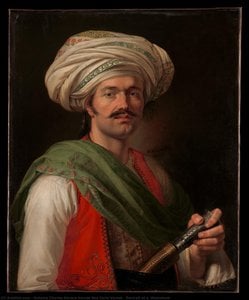
  80. Portrait of a "Mamelouk" by Carle Vernet, 1810, Metropolitan Museum of Art
    80

    1810Oil on canvas75 × 62 cmMetropolitan Museum of Art, New York

    The painting immediately draws the eye to the sitter, a Mameluk nobleman presented with an air of dignified composure, his gaze holding a hint of distant contemplation. To fully appreciate “Portrait of a Mamelouk,” one must understand the historical context of the Mamluks themselves.

    Look forturbandetailed attire

    Oil reproduction from $181 Canvas print from $47

  81. Young man sitting by the sea by Hippolyte Flandrin
    81

    Oil on canvas

    Young man sitting by the sea is an artwork by Hippolyte Flandrin. This piece is also known by the title Jeune homme nu assis au bord de la mer. It is sometimes referred to as Study (Young Male Nude Seated beside the Sea). The artist, Hippolyte Flandrin, was born in Lyon, France, in 1809. When considering the frame and its accompanying accessory, the total height reaches 1.25 m, while the width extends to 1.47 m. It was acquired in 1857 through the civil list of Napoléon III. It is housed in Salle 940, located in the Aile Sully on Niveau 2.

    Oil reproduction from $181 Canvas print from $47

  82. The Death of Saint Cecilia by Andrea Pozzi, Accademia di San Luca
    82

    Oil on paperAccademia di San Luca, Rome

    A bird perches quietly upon her shoulder, a small, living witness to the stillness of the martyr. The painting belongs to the collection of the Accademia di San Luca, a place where the precision of classical principles meets the dramatic requirements of religious history.

    Oil reproduction from $181 Canvas print from $47

  83. Lucretia Coffin Mott by Joseph Reid Kyle, National Portrait Gallery
    83

    Oil on canvas64 × 76 cmNational Portrait Gallery, London

    The painting adheres to Neoclassical principles prevalent during its creation, prioritizing realism and idealized beauty —a stylistic choice deliberately mirroring the artistic conventions of the era. For deeper insight into Kyle's artistic vision and the broader context of Quaker activism during the mid-19th century, consult Lucretia Coffin Mott | National Portrait Gallery - Smithsonian Institution.

    About this painting

  84. Carl Maria von Weber by Josephus Kendrick, 1826, Royal College of Music Museum
    84

    1826Marble sculptureRoyal College of Music Museum, London

    The marble bust of the composer Carl Maria von Weber gazes out from the sculptor Josephus Kendrick's hand, capturing a moment of quiet dignity. Josephus Kendrick, a sculptor who moved between the grandiosity of historical reliefs and the intimacy of portraiture, brings a sense of character to this piece.

    Oil reproduction from $181 Canvas print from $47

  85. Johann Wolfgang von Goethe by Joseph Karl Stieler, 1828, Neue Pinakothek
    85

    1828Oil paint on canvasNeue Pinakothek, Munich

    The subject sits with a quiet, intellectual gravity, his gaze meeting the viewer from a position of composed dignity. Through the careful rendering of the subject, Stieler ensures that the viewer feels the weight of Goethe's reputation. The arrangement feels formal and deliberate, characteristic of 19th-century Neoclassical portraiture. This portrait resides within the walls of the Neue Pinakothek in Munich, Germany.

    Oil reproduction from $181 Canvas print from $47

  86. Christ by Bertel Thorvaldsen, 1821, Музей Торвальдсена
    86

    Bertel ThorvaldsenNeoclassicism

    Christ

    1821Marble or plaster sculptureМузей Торвальдсена, Копенгаген

    The sculpture Christ is a work by the Danish-Icelandic artist Bertel Thorvaldsen. Created about 1821, this piece depicts Jesus Christ in a moment of quiet contemplation. While the statue is associated with Vor Frue Kirke in Copenhagen, it is also held at the Accademia di San Luca in Rome.

    Oil reproduction from $181 Canvas print from $47

  87. Portrait of William Young by James Peale, 1817
    87

    1817Oil paint on canvas

    William Young is positioned centrally, seated in a chair and angled slightly toward the viewer to establish a direct gaze. The background remains dark and indistinct, which serves to focus all attention on the figure.

    Oil reproduction from $181 Canvas print from $47

  88. The Earl of Aldborough Reviewing Volunteers at Belan House by Francis Wheatley, 1782
    88

    1782Oil on canvas

    This piece dates to 1782 and captures a specific moment of social and military significance. It depicts the second Earl reviewing the Aldborough Volunteers at Belan, a scene that places the viewer directly into the historical landscape of the late 18th century. Francis Wheatley, born in London, United Kingdom, was a figure of considerable skill during this period.

    Oil reproduction from $181 Canvas print from $47

  89. The Nymphs of Parthenope Led toward the Banks of the Seine by Charles Meynier, 1827, The Louvre
    89

    1827Oil on canvasThe Louvre, Paris

    Known in English as The Nymphs of Parthenope Led toward the Banks of the Seine, this piece functions as an allegory. The surface carries a signature and the date 1827 in the lower left corner. The piece is identified by the inventory number RF 1984 22 (INV. 6617).

    Oil reproduction from $181 Canvas print from $47

  90. MRS ISAAC CUTHBERT by Thomas Lawrence, 1817, The Louvre
    90

    1817Oil on canvas143 × 114 cmThe Louvre, Paris

    Sir Thomas Lawrence's "Mrs. Isaac Cuthbert” offers a glimpse into Regency society’s values and expectations. Furthermore, Lawrence’s meticulous attention to detail reveals a keen awareness of his subject's status.

    Look forelegant posebook

    Oil reproduction from $181 Canvas print from $47

  91. Sir Brooke Boothby by Joseph Wright of Derby, 1781, Tate Gallery
    91

    1781Oil on canvas207.6 × 148.6 cmTate Gallery, London

    The gentleman, seated amidst the suggestion of nature—the visible trees and expansive background hinting at a park or country estate—rests his hands thoughtfully upon his chin. This contrast—the sharp focus on the man against the softer suggestion of the outdoors—is a hallmark of Wright’s genius. In an era defined by burgeoning industry and scientific inquiry—the very spirit that animated Wright’s own career—this object anchors Sir Brooke Boothby within the tradition of the educated gentleman. It is a visual anchor, connecting the contemporary inhabitant with the sophisticated sensibilities of Georgian England.

    Oil reproduction from $181 Canvas print from $47

  92. Odysseus and Penelope by Johann Heinrich Wilhelm Tischbein
    92

    Oil painting

    The painting Odysseus and Penelope by Johann Heinrich Wilhelm Tischbein (Goethe Tischbein) depicts a specific scene from ancient Greek mythology. The composition focuses on the moment of reunion between the two central figures. The man is draped in a toga, a garment suggesting the status of a Greek or Roman leader.

    Oil reproduction from $181 Canvas print from $47

  93. Perseus and Andromeda by Anton Raphael Mengs, 1774, Hermitage Museum
    93

    1774Oil on canvas227 × 154 cmHermitage Museum, Saint Petersburg

    The composition prioritizes clarity and balance, mirroring the ideals of ancient Greek sculpture—a deliberate rejection of Rococo frivolity. The story recounts Andromeda’s abduction by Cetus, a terrifying sea monster, and Perseus' daring intervention—killing Medusa with her severed head—to save her life.

    Oil reproduction from $231 Canvas print from $47

  94. The Combat of Mars and Minerva by Joseph Benoit Suvée, 1771
    94

    1771Oil on canvas143 × 104 cm

    The canvas depicts a confrontation between the Roman deities Mars and Minerva. In the center of the action, a female figure holds a spear, positioned in direct opposition to another figure. The artist, Joseph-Benoît Suvée, utilized a Neoclassical approach to structure this mythological narrative.

    Oil reproduction from $181 Canvas print from $47

  95. The Death of Priam by Vincenzo Camuccini, 1795
    95

    1795Oil paint on canvas or panel

    The scene captures a violent intersection of fate and tragedy, drawn from the epic narratives of Virgil's Aeneid. At the center of the composition, the tension is palpable as Achilles confronts the aged King Priam. Created around 1795, this work reflects the academic rigor prevalent in Rome during the early 19th century.

    Oil reproduction from $356 Canvas print from $47

  96. The Triumph of Aemilius Paulus by Carle Vernet, 1789, Metropolitan Museum of Art
    96

    1789Oil on canvas130 × 438 cmMetropolitan Museum of Art, New York

    The Temple of Jupiter Capitolinus, with its imposing presence, symbolizes the gods' favor upon Rome and the stability of its rule. Furthermore, the painting was created during a period of significant political and social upheaval in France – the years leading up to the French Revolution.

    Look fortempleroman procession

    Oil reproduction from $181 Canvas print from $47

  97. Death of Masaccio by Auguste Couder, 1817, Hermitage Museum
    97

    1817Oil on canvas45 × 38 cmHermitage Museum, Saint Petersburg

    The backdrop features a stylized depiction of Calvary, referencing Jesus Christ’s crucifixion and establishing a parallel between Saint Denis’ sacrifice and divine redemption. Despite its adherence to classical conventions—balanced composition, sharp lines, subdued textures—“Death of Masaccio” possesses an undeniable emotional resonance that anticipates the burgeoning Romantic movement.

    Oil reproduction from $256 Canvas print from $47

  98. The Maison Carée by Hubert Robert, 1787, The Louvre
    98

    1787Oil on canvas243 × 244 cmThe Louvre, Paris

    Initially trained by sculptor Michel-Ange Slodtz, Robert quickly recognized his true passion lay in painting, specifically in capturing the subtle nuances of light and atmosphere. The Roman temple itself is laden with symbolism – representing not only the power and sophistication of the Roman Empire but also its eventual decline and fall.

    Look forroman ruinshazy sky

    Oil reproduction from $281 Canvas print from $47

  99. Le génie de la France anime les arts by Antoine-Jean Gros, 1827, The Louvre
    99

    1827Oil on canvas96 × 130 cmThe Louvre, Paris

    This piece emerged during the second quarter of the 19th century, specifically between 1830 and 1833. The artist, Antoine-Jean Gros, was a native of Paris, born there in 1771. While the project was initiated in the late 1820s, the execution of the central part of the composition began in 1830.

    Oil reproduction from $181 Canvas print from $47

  100. Princess Pauline-Eleonore de Broglie by Jean-Auguste-Dominique Ingres, 1853, Metropolitan Museum of Art
    100

    1853PaintingMetropolitan Museum of Art, New York

    The subject, draped in a luminous blue gown accented by a vibrant yellow sash, possesses a stillness that belies the life force captured within the oil paint. Whether placed above a grand mantelpiece or within a richly appointed drawing-room, Princess Pauline-Eleonore de Broglie commands attention with its sophisticated palette and unwavering commitment to formal beauty.

    Oil reproduction from $181 Canvas print from $47

By movement

Famous Neoclassicism paintings by movement

Plan your visit

Where to see the most famous Neoclassicism paintings

Paris leads with 22 of the 100; the The Louvre alone holds 16.

Paris (implied)1

Louvre Museum

The painters

The most famous Neoclassicism painters in the list

Portrait of Anne-Louis Girodet

Anne-Louis Girodet

1767–1824 · France · 3

French painter bridging Neoclassicism and Romanticism through dramatic, emotive, and sensual scenes.

37. The Sleep of Endymion, 44. Madame Cabanis (Charlotte Félicité Grouchy), 58. Four Seasons 03, Autumn

Portrait of Jean-Baptiste-Siméon Chardin

Jean-Baptiste-Siméon Chardin

1699–1779 · France · 2

French painter of quiet domestic scenes and still lifes rendered with tactile, granular impasto.

6. Basket of Peaches, 31. The kitchen maid

Portrait of George Stubbs

George Stubbs

1724–1806 · United Kingdom · 2

English Romanticist known for anatomical precision in equine portraits and visceral animal scenes.

8. A Bay Hunter with Two Spaniels, 67. The Grosvenor Hunt

Portrait of Benjamin West

Benjamin West

1738–1820 · United States · 2

American Neoclassical painter and Royal Academy president known for revolutionary history scenes.

10. The Death of General Wolfe, 54. King Lear

+49more painters in the list Famous Neoclassicism Artists The painters, ranked

Questions & answers

Questions about Neoclassicism paintings

Hover over a question to read the answer.

Which 10 Neoclassicism paintings should everyone know?

What materials did Neoclassicism painters use?

96 of the 100 are oil paintings, 0 use tempera and 0 are frescoes; 2 are painted on wood and 89 on canvas.

Can I buy a reproduction of a Neoclassicism painting?

Yes: 99 of the 100 can be ordered as a hand-painted oil reproduction, from $181, and 99 as a canvas print, from $47.

How was this list of Neoclassicism paintings ranked?

By recognition: Wikipedia articles in the most languages (Wikidata sitelinks), our manual ranking and page visits. Several records of one painting count once; details, copies and studies are excluded.

Bring one home

99 of the 100 as hand-painted oil reproductions

99 paintings of this list can be ordered as museum-grade, hand-painted oil reproductions, from $181.

The Grande Odalisque by Jean-Auguste-Dominique IngresNapoleon at the St. Bernard Pass by Jacques-Louis DavidSelf Portrait with Her Daughter, Julie by Élisabeth Louise Vigée Le BrunThe Oath of the Horatii by Jacques-Louis DavidWatson and the Shark by John Singleton Copley

Browse all Neoclassicism paintings

How this ranking is made

We started with every Neoclassicism painting in our catalogue and ranked them by how famous they are. Three clues decide the order: in how many languages Wikipedia has an article about the painting, where our curators place it, and how often people open its page on our site. Each painting appears only once, and details, copies and studies are left out.

Famous paintings of other movements

Famous paintings by period