
Famous paintings · Rococo

The 100 Most Famous Rococo Paintings

1711 – 1803

Ask for the most famous Rococo paintings and you will hear of Thomas Gainsborough's The Blue Boy (Jonathan Buttall) (1770, Henry E. Huntington Library), Jean-Antoine Watteau's Embarkation for Cythera (1717, The Louvre), Jean-Honoré Fragonard's The Swing_ (1767, Wallace Collection), Jean-Honoré Fragonard's A Young Girl Reading (1769, National Gallery of Art) and Jean-Antoine Watteau's Gilles (1719, The Louvre). Below, all 100 of them — painted from 1711 to 1803 by 42 artists — with their date, their size and the museum that keeps them.

The Blue Boy (Jonathan Buttall) by Thomas Gainsborough, 1770, Henry E. Huntington Library — famous Rococo painting
No. 1 · Thomas GainsboroughThe Blue Boy (Jonathan Buttall)1770 · Henry E. Huntington Library, San Marino
100paintings, ranked by fame
42painters · Donato Creti – Élisabeth Louise Vigée Le Brun
33museums in 19 cities
13at the The Louvre alone

The ranking

The 100 most famous paintings of the Rococo

Ranked by how widely each painting is known. The artist, the date, the size of the original, the museum that holds it today — and one detail to look for.

  1. The Blue Boy (Jonathan Buttall) by Thomas Gainsborough, 1770, Henry E. Huntington Library
    1

    1770Oil on canvas177.8 × 112.1 cmHenry E. Huntington Library, San Marino

    The subject is believed to be Jonathan Buttall, though recent scholarship suggests it may be Gainsborough’s nephew, Gainsborough Dupont. Created around 1770, this work reflects a shift towards greater naturalism and emotional depth within British art, moving away from rigid formality toward a more relaxed and expressive style. This painterly approach, characteristic of the Rococo and early Romantic periods, prioritizes capturing mood and character over precise detail.

    Look foratmospheric qualityblue silk clothingdramatic landscape background

    Oil reproduction from $181 Canvas print from $47

  2. Embarkation for Cythera by Jean-Antoine Watteau, 1717, The Louvre
    2

    1717Oil on canvas129 × 194 cmThe Louvre, Paris

    Jean-Antoine Watteau's "The Embarkation for Cythera" is a quintessential example of the Rococo style, capturing the playful and romantic spirit of 18th-century France. The artwork depicts a lively scene of aristocratic revelry set against a pastoral landscape. This genre celebrated the carefree and pleasure-seeking lifestyle of the French aristocracy following the death of Louis XIV.

    Look forfête galantecupid figuresstatue of Venusgolden boat

    Oil reproduction from $356 Canvas print from $47

  3. The Swing_ by Jean-Honoré Fragonard, 1767, Wallace Collection
    3

    1767Oil on canvas81 × 64.2 cmWallace Collection, London

    The Swing_ by Jean-Honoré Fragonard is an 18th-century oil painting. Following the execution of Marie-François Ménage de Pressigny by guillotine in 1794, the work was seized by the revolutionary government. In 1865, following the death of the Duc de Morny, the painting was sold at auction in Paris.

    Oil reproduction from $181 Canvas print from $47

  4. A Young Girl Reading by Jean-Honoré Fragonard, 1769, National Gallery of Art
    4

    1769Oil on canvas105 × 90 cmNational Gallery of Art, Washington

    Whether placed in a sunlit library or a sophisticated study, Young Girl Reading acts as a window into a bygone era of elegance and contemplation.

    Oil reproduction from $181 Canvas print from $47

  5. Gilles by Jean-Antoine Watteau, 1719, The Louvre
    5

    1719Oil on canvas (presumed)185 × 150 cmThe Louvre, Paris

    Watteau revolutionized French painting with his invention of the fête galante – a genre depicting elegant outdoor gatherings infused with a sense of playful romance and gentle melancholy. Executed with Watteau’s signature loose brushwork and delicate color palette, “Gilles” showcases his exceptional technical skill.

    Look fordonkeyatmospheric perspectivepierrot costume

    Oil reproduction from $256 Canvas print from $47

  6. An Experiment on a Bird in the Air Pump by Joseph Wright of Derby
    6

    Oil on canvas

    The figures’ expressive faces and gestures reveal a spectrum of reactions—from fascination and wonder to concern and empathy—drawing viewers into a narrative that explores human curiosity and the pursuit of knowledge. This painting exemplifies Joseph Wright of Derby’s signature use of chiaroscuro, a technique that emphasizes dramatic contrasts between light and dark.

    Look forchiaroscurodramatic lightingsocial gatheringscientific experiment

    Oil reproduction from $381 Canvas print from $47

  7. Pierrot by Jean-Antoine Watteau, 1718
    7

    1718Oil on canvas184 × 149 cm

    Despite facing rejection from established institutions like Académie Royale de peinture et de sculpture, Watteau persevered, driven by an unwavering belief in his artistic vision. Moreover, Watteau subtly incorporated symbolic elements—such as flowering trees representing fertility and renewal—enhancing the narrative depth of his canvases.

    Oil reproduction from $181 Canvas print from $47

  8. Miss Bowles by Joshua Reynolds, 1775
    8

    1775Oil on canvas91 × 70 cm

    This work is a significant example of the Grand Style, a method that sought to move portraiture beyond simple likeness toward a more idealized representation of character. The painting reflects the social and intellectual currents of 18th-century Britain, where the depiction of childhood began to incorporate themes of innocence and domestic tranquility.

    Oil reproduction from $181 Canvas print from $47

  9. The Young Schoolmistress by Jean-Baptiste-Siméon Chardin, 1740, National Gallery
    9

    1740Oil on canvas66 × 61 cmNational Gallery, London

    The scene exudes tenderness and focus, emphasizing the importance of nurturing relationships and the transmission of knowledge. The figures are centrally positioned, creating a harmonious interaction that draws viewers into their shared moment of concentration and trust.

    Look forsoft lightingtender depiction of a young girla woman engaged in educational activitymeticulous detail

    Oil reproduction from $206 Canvas print from $47

  10. Mr. and Mrs. Andrews by Thomas Gainsborough, 1748, National Gallery
    10

    1748Oil on canvas70 × 119 cmNational Gallery, London

    Painted during a period of significant economic growth and social change in 18th-century Britain, this artwork reflects the ideals of the rising landowning class. Consider pairing “Mr and Mrs Andrews” with complementary colors – muted greens, warm browns, and soft blues – to enhance its natural palette.

    Look forriflelandscapeportraituredog

    Oil reproduction from $206 Canvas print from $47

  11. Portrait of Jean-Jacques Rousseau by Maurice Quentin de La Tour, 1753, Musée d'Art et d'Histoire
    11

    1753Pastel47 × 38 cmMusée d'Art et d'Histoire, Женева

    De La Tour’s work exemplifies the Rococo movement's emphasis on elegance, charm, and a subtle play of light and shadow. A Portrait of an Icon: The commission itself speaks volumes about Rousseau’s standing at the time. As one of the leading philosophical voices of the era, his image was destined to be captured by a skilled artist like De La Tour. De La Tour's choice of pastel as the medium is crucial to understanding the work’s impact. Note the almost ethereal quality of Rousseau's skin tones – a hallmark of De La Tour’s technique.

    Look forattiresmiling subject

    Oil reproduction from $181 Canvas print from $47

  12. Song of the Angels by François Boucher
    12

    Oil on canvas

    Around them, a choir of heavenly beings gathers to perform. One angel rests on the left, another occupies the middle, while two more flank the right side.

    Oil reproduction from $181 Canvas print from $47

  13. Pierrot Content by Jean-Antoine Watteau, 1712, Thyssen-Bornemisza Museum
    13

    1712Oil on canvas35 × 31 cmThyssen-Bornemisza Museum, Madrid

    Five figures populate the scene—a gentleman, a lady, two actors, and Pierrot himself—each positioned with careful consideration for balance and visual harmony. The painting's influence can be discerned in subsequent generations of artists who embraced Impressionism and Symbolism, prioritizing atmosphere and subjective experience over literal representation.

    Oil reproduction from $181 Canvas print from $47

  14. Party of Four by Jean-Antoine Watteau, 1713, Fine Arts Museums of San Francisco
    14

    1713Oil on canvasFine Arts Museums of San Francisco

    “Party of Four” is deeply rooted in its historical context – the opulent yet understated leisure culture of 18th-century France. The delicate brushwork and evocative lighting in "Party of Four" can also be seen as precursors to Impressionism, foreshadowing the shift towards capturing fleeting moments and subjective experiences.

    Look forguitarred dress

    Oil reproduction from $181 Canvas print from $47

  15. The Setting of the Sun by François Boucher, 1752, Wallace Collection
    15

    1752Oil on canvas318 × 261 cmWallace Collection, London

    The central figures are Apollo, returning to his mother Leto, and Thetis, the sea goddess. “The Setting of the Sun” was created during a period of immense artistic patronage, particularly under Madame de Pompadour, Louis XV’s influential mistress.

    Look formythological scene

    Oil reproduction from $331 Canvas print from $47

  16. The Love Lesson by Jean-Antoine Watteau, 1715–1717, Nationalmuseum
    16

    1715–1717Oil on panel610 × 440 cmNationalmuseum, Stockholm

    The scene is filled with life as a man plays a Spanish guitar, while one of the girls breaks off roses and strews petals over the group. The painting is housed at the Nationalmuseum in Stockholm, Sweden, and was acquired by the museum in 1953 through fundraising efforts. 610 x 440 cm Date: 1717

    Oil reproduction from $181 Canvas print from $47

  17. The Rape of Europa by François Boucher, 1747, The Louvre
    17

    1747Oil on canvas160 × 193 cmThe Louvre, Paris

    As the viewer's eye wanders through the composition, one feels the palpable tension between divine will and human vulnerability. The painting breathes with the soft, blended strokes characteristic of the 18th-century French style, creating an atmosphere that feels almost ethereal.

    Oil reproduction from $181 Canvas print from $47

  18. The Chocolate Girl by Jean-Étienne Liotard, 1744, Gemäldegalerie
    18

    1744Unknown (likely pastel)82 × 52 cmGemäldegalerie, Dresden

    To stand before Jean-Étienne Liotard's The Chocolate Girl is to step directly into the luminous, delicate atmosphere of mid-eighteenth-century Parisian society. This portrait captures a moment suspended in time—a tableau vivant suggesting the quiet ritual of afternoon tea or intimate social gathering.

    Oil reproduction from $181 Canvas print from $47

  19. Man in a Green Coat Holding a Hare with Four Hounds at His Feet by George Smith
    19

    Oil

    A man in a green coat occupies the center of this composition, his figure anchored by the weight of a hare held firmly in his hands. At his feet, four hounds wait in a state of quiet anticipation. The scene is set within a dense thicket of trees and foliage, where deep greens and earthy browns create a sense of shadowed depth.

    Oil reproduction from $181 Canvas print from $47

  20. The Four Times of Day: Night by William Hogarth, 1738, Cleveland Museum of Art
    20

    1738Print (etching & engraving)Cleveland Museum of Art

    This remarkable work, now immortalized through WahooArt’s hand-painted reproductions, captures a moment of revelry – or perhaps reckless abandon – with an unparalleled level of detail and satirical observation that defines Hogarth's unique artistic legacy. Night” reflects the vibrant, yet turbulent, atmosphere of 18th-century London.

    Look forhorsenight scenefire

    Oil reproduction from $181 Canvas print from $47

  21. GALERIE de VUES de LA ROME MODERNE by Giovanni Paolo Panini, 1759, The Louvre
    21

    1759Oil on canvasThe Louvre, Paris

    Linear perspective dominates, guiding the gaze towards a vanishing point and creating depth through overlapping canvases and receding architectural details. Panini’s style seamlessly blends Baroque theatricality with Rococo elegance.

    Oil reproduction from $331 Canvas print from $47

  22. The Stolen Kiss by Jean-Honoré Fragonard, 1787, Hermitage Museum
    22

    1787Oil on canvas45 × 55 cmHermitage Museum, Saint Petersburg

    The composition itself is a carefully orchestrated dance of light and shadow, drawing the viewer into the heart of the narrative. “The Stolen Kiss” is deeply rooted in the cultural context of 18th-century France, a period characterized by aristocratic excess, courtly intrigue, and a fascination with pleasure.

    Look forrococo styleflirtation

    Oil reproduction from $231 Canvas print from $47

  23. The French Comedy by Jean-Antoine Watteau, 1716, Staatliche Museen zu Berlin
    23

    1716Oil on canvas37 × 48 cmStaatliche Museen zu Berlin

    “The French Comedy” emerged during a period of opulent extravagance in Louis XIV’s France – specifically, the reign of Versailles. The painting reflects a shift away from the formal grandeur of the Baroque toward a more intimate portrayal of aristocratic life —a fascination with pastoral landscapes and idealized figures reflecting an aspiration for harmony and tranquility.

    Oil reproduction from $181 Canvas print from $47

  24. Lady and Gentleman by Nicolas Lancret, 1742, National Gallery
    24

    1742Oil on canvas89 × 98 cmNational Gallery, London

    The scene unfolds within a secluded garden, a carefully constructed haven of beauty and leisure—a space deliberately removed from the bustling realities of Parisian society. At first glance, “Lady and Gentleman with Two Girls and a Servant” appears to be a straightforward depiction of a wealthy family enjoying an afternoon in their garden.

    Look forfamily scenegarden

    Oil reproduction from $181 Canvas print from $47

  25. The Apotheosis of Hercules by François Lemoyne, 1736, Château de Versailles
    25

    1736OilChâteau de Versailles

    The painting depicts the apotheosis – glorification – of Hercules, Roman hero revered for his strength and virtue. “The Apotheosis of Hercules” was conceived during a period of significant political and social change in France. "The Apotheosis of Hercules" overwhelms the viewer with its sheer scale and dazzling color palette —primarily warm hues of gold, crimson, and cream.

    Oil reproduction from $306 Canvas print from $47

  26. The Pleasures of LIfe by Jean-Antoine Watteau, 1716, Wallace Collection
    26

    1716Oil on canvas65 × 93 cmWallace Collection, London

    The painting's composition is meticulously crafted to convey specific meanings beyond mere visual appeal. The Islington Local History Centre and Museum in London also houses various artworks from different artists.

    Oil reproduction from $181 Canvas print from $47

  27. The Swing by Jean-Honoré Fragonard, 1777, The Louvre
    27

    1777Oil on canvas73 × 93 cmThe Louvre, Paris

    In the quiet, dimly lit chambers of 18th-century France, certain moments were meant to remain unseen, yet Jean-Honoré Fragonard possessed the singular ability to pull back the velvet curtain.

    Oil reproduction from $181 Canvas print from $47

  28. Diana getting out of her bath by François Boucher, 1742
    28

    1742Oil on canvas56 × 73 cm

    François Boucher created Diana getting out of her bath in 1742. The work centers on the Roman goddess Diana, portrayed in a state of nudity. His 1751 works, The Bath of Venus and The Toilet of Venus, demonstrate a continued fascination with the themes of beauty and intimacy.

    Oil reproduction from $181 Canvas print from $47

  29. The Declaration of Love by François de Troy, 1724, Metropolitan Museum of Art
    29

    1724Oil on canvas65 × 53 cmMetropolitan Museum of Art, New York

    Unlike the grand, heavy narratives favored by Baroque artists—which often focused on religious allegories or mythological tales— de Troy deliberately embraced the burgeoning interest in documenting everyday life and social customs.

    Oil reproduction from $181 Canvas print from $47

  30. The Education of Dionysus by Sebastiano Conca, 1730
    30

    1730Oil on canvas78 × 64 cm

    In 1720, the oil on canvas Adoration of the Shepherds unfolds, bringing a quiet reverence to the viewer. By 1725, the narrative shifts toward the story of Rinaldo and Armidaca, also rendered in oil on canvas. A Sibyl appears in 1726, captured in oil on canvas with a distinct sense of presence.

    Oil reproduction from $181 Canvas print from $47

  31. Susan Murrill (1717–1794), Mrs Henry Hill by Thomas Gainsborough, 1750, New York Historical Society
    31

    1750Oil75 × 62 cmNew York Historical Society, New York City

    The sitter, Susan Murrill, is presented in a moment of quiet composure. A yellow ribbon encircles her neck, providing a sharp point of color against the cool tones of her attire, while a pearl choker adds a subtle luster to her throat.

    Oil reproduction from $181 Canvas print from $47

  32. Saying Grace by Jean-Baptiste-Siméon Chardin, 1740, The Louvre
    32

    1740Oil on canvas49.5 × 38.5 cmThe Louvre, Paris

    Considering Chardin's background as a cabinetmaker, it’s not surprising that he possessed an innate understanding of form and material, translating this knowledge into his art with remarkable sensitivity.

    Look forprayerfamily scene

    Oil reproduction from $181 Canvas print from $47

  33. Mademoiselle Puvigné by Maurice Quentin de La Tour
    33

    Pastel

    This piece functions as an etude de tête d'une jeune personne, a study of a young person's head. Maurice Quentin de La Tour focused his attention on the subtle nuances of the sitter's features. The work is held within the Musée Antoine Lécuyer de Saint-Quentin.

    Oil reproduction from $181 Canvas print from $47

  34. Portrait of Louis XV of France and Maria Anna Victoria of Spain by François de Troy, 1723
    34

    1723Oil on canvas195 × 129 cm

    This piece belongs to the category of 18th-century portrait paintings of children at full length, a genre that allows the viewer to witness the scale and dignity of these young figures. Every detail, from the heavy folds of the garments to the placement of the furniture, contributes to the formal atmosphere of this moment captured in 1723.

    Oil reproduction from $181 Canvas print from $47

  35. The Love Letter by François Boucher, 1750, National Gallery of Art
    35

    1750Oil on canvas81 × 75 cmNational Gallery of Art, Washington

    The painting captures a moment of quiet intimacy within a verdant forest setting, depicting two young women seated on the ground, lost in conversation amidst scattered sheep, creating an atmosphere of serene beauty and subtle intrigue. Boucher was a pivotal figure in establishing the Rococo style, characterized by its emphasis on ornamentation, grace, and playful eroticism.

    Look forpastoral scene

    Oil reproduction from $181 Canvas print from $47

  36. Young Woman Playing with a Dog by Jean-Honoré Fragonard, 1765, Fondation Cailleux
    36

    1765Oil on canvas70 × 87 cmFondation Cailleux, Paris

    “Young Woman Playing with a Dog” emerged during a period of opulent artistic patronage within Louis XV’s court at Versailles. WahooArt.com offers exceptional reproductions of Jean-Honoré Fragonard's “Young Woman Playing with a Dog,” meticulously crafted to capture the original artwork’s luminous quality and textural richness.

    Oil reproduction from $181 Canvas print from $47

  37. Jupiter and Danae by Giovanni Battista Tiepolo, 1736
    37

    1736Oil on canvas41 × 53 cm

    The composition is a masterclass in Tiepolo’s signature use of light and movement. The way the light dances across the folds of the drapery and the pale skin of Danae creates a rhythmic flow that guides the eye through the drama of the encounter, making the scene feel as though it is unfolding in real-time.

    Oil reproduction from $181 Canvas print from $47

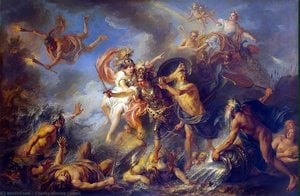
  38. Fury of Achilles by Charles Antoine Coypel, 1737, Hermitage Museum
    38

    1737Oil on canvas147 × 195 cmHermitage Museum, Saint Petersburg

    Coypel, serving as premier peintre du roi to Louis XV, was renowned for his ability to capture narrative power within a relatively small format. At its heart, “Fury of Achilles” is a retelling of Homer's Iliad, specifically focusing on the moment following Patroclus’s death.

    Look fordramatic scenefigures

    Oil reproduction from $181 Canvas print from $47

  39. Aeneas Carrying Anchises by Charles-André van Loo, 1729, The Louvre
    39

    1729Oil on canvas110 × 105 cmThe Louvre, Paris

    Van Loo skillfully employs atmospheric perspective – the subtle blurring of details in the background – to draw the viewer’s eye towards the central figures: Aeneas, the Trojan hero, and his aged father, Anchises. As a leading figure in the Rococo movement, Van Loo’s signature style is immediately recognizable.

    Look fortrojan hero scene

    Oil reproduction from $181 Canvas print from $47

  40. The Reception before a Wedding by Pietro Longhi
    40

    Oil paint on canvas

    At the center of the composition, a couple is positioned slightly forward, presumably the bride and groom. The arrangement of the figures is dense and theatrical, creating a sense of social intimacy within the room. The subject matter provides a specific glimpse into the customs and attire of 18th-century Venetian society.

    Oil reproduction from $581 Canvas print from $47

  41. Head of a Young Girl by Jean-Baptiste Greuze, 1750
    41

    1750Oil paint on canvas

    The subject of the painting is a young girl whose face is characterized by a contemplative expression. The portrait centers on the face, utilizing a warm and muted color palette to establish an intimate connection between the subject and the viewer. This specific work is held at Musée Fabre, Montpellier.

    Oil reproduction from $181 Canvas print from $47

  42. Girl with a book by Pietro Rotari, 1756–1762
    42

    1756–1762Oil on canvas

    The painting titled Girl with a book is a work by the artist Pietro Rotari. It once resided within the collection of the dealer Galerie van Diemen & Co in Berlin, where it was held alongside SK-A-3421. A final transition occurred in 1941, when the work entered its current home through a bequest from J.W.

    Oil reproduction from $181 Canvas print from $47

  43. Fêtes Vénitiennes by Jean-Antoine Watteau, 1718, National Gallery of Scotland
    43

    1718Oil on canvas56 × 46 cmNational Gallery of Scotland, Edinburgh

    Surrounding her are figures engaged in leisurely conversation and dance—a tableau typical of the ‘fête galante,’ Watteau's signature genre. Considered alongside Watteau’s other celebrated works like Venetian Pleasure (also at the National Gallery of Scotland), Fêtes Vénitiennes exemplifies his unparalleled ability to capture the essence of aristocratic life and artistic innovation. Discovering Masterpieces at the Scottish National Gallery: https://www.nationalgalleries.org/visit/scottish-national-gallery

    Oil reproduction from $181 Canvas print from $47

  44. Cornard Wood by Thomas Gainsborough, 1748, National Gallery
    44

    1748Oil on canvas122 × 155 cmNational Gallery, London

    Created in 1748, the work depicts a forest scene that integrates elements of nature and human presence. The piece eventually entered the collection of the National Gallery in London, where it has been held since 1875. The title Cornard Wood has been in use since 1828, originating from a publication associated with the first sale of the artist's works following his death.

    Oil reproduction from $181 Canvas print from $47

  45. The Grand Cascade at Tivoli by Jean-Honoré Fragonard
    45

    Oil reproduction from $181 Canvas print from $47

  46. Canvassing for Votes by William Hogarth, 1754–1755, Sir John Soane's Museum
    46

    1754–1755Oil on canvasSir John Soane's Museum

    The scene unfolds within a bustling tavern – a microcosm of the wider political landscape – where carefully orchestrated displays of flattery, bribery, and outright deception are laid bare for the viewer’s discerning eye. “Canvassing for Votes” cemented William Hogarth’s reputation as a pioneering social commentator and a master of satirical art.

    Look forsatirical tactics

    Oil reproduction from $181 Canvas print from $47

  47. The Gravenor Family by Thomas Gainsborough, 1752, Yale Center for British Art
    47

    1752Oil on canvas90 × 90 cmYale Center for British Art, New Haven

    The painting depicts the Gravenor family – a father, mother, and three daughters – seated beneath the dappled shade of an ancient tree. Gainsborough's style in The Gravenor Family exemplifies the Rococo tradition, yet with a distinctly English sensibility.

    Look forobjectsfamily scene

    Oil reproduction from $181 Canvas print from $47

  48. The Young Draughtsman by Jean-Baptiste-Siméon Chardin, 1737, The Louvre
    48

    1737Oil on canvas80 × 65 cmThe Louvre, Paris

    Through the subtle tilt of her head and the stillness of her posture, Chardin communicates the weight of intellectual endeavor. Technically, “The Young Draughtsman” is a triumph of the French Rococo and Neoclassical transition. While Chardin’s roots were planted in the formal elegance of the Enlightenment, his heart belonged to the humble and the real.

    Oil reproduction from $181 Canvas print from $47

  49. The Suicide of the Countess by William Hogarth, 1743–1745, National Gallery
    49

    1743–1745Oil on canvasNational Gallery, London

    William Hogarth's "The Suicide of the Countess," part of his renowned series "Marriage A-la-Mode," offers a stark and poignant commentary on the societal ills of 18th-century England. The artwork depicts the Countess in her final moments, lying lifeless upon a bed within an opulent room.

    Oil reproduction from $281 Canvas print from $47

  50. Jupiter and Antiope by Jean-Antoine Watteau, 1715, The Louvre
    50

    1715Oil on canvas73 × 107 cmThe Louvre, Paris

    Jean-Antoine Watteau (1684–1721), a luminary of the Rococo movement, irrevocably transformed eighteenth-century painting away from the grandeur of the Baroque towards an ethereal realm of refined pleasure and nuanced emotion. The artist’s meticulous attention to detail extends beyond mere representation; Watteau sought to convey an intangible sense of mood—a feeling of languid beauty and wistful contemplation—that permeates the entire scene.

    Oil reproduction from $181 Canvas print from $47

  51. The Toilet of Venus by François Boucher, 1751, Metropolitan Museum of Art
    51

    1751Oil on canvas108 × 85 cmMetropolitan Museum of Art, New York

    In the heart of the eighteenth century, amidst the gilded splendor of the French court, François Boucher captured a moment of pure, unadulterated grace. At the center of this luminous tableau lies Venus, the Roman goddess of love, reclining upon a lavish pink velvet canapé.

    Oil reproduction from $181 Canvas print from $47

  52. The Festival of Love by Jean-Antoine Watteau, 1717, Gemäldegalerie
    52

    1717Oil on canvas61 × 75 cmGemäldegalerie, Dresden

    At the heart of “The Festival of Love” stands a couple engaged in what appears to be a quiet conversation or perhaps a shared glance – a moment frozen in time. “The Festival of Love” is a quintessential example of Rococo art – characterized by its emphasis on lightness, elegance, and sensuality.

    Look forcoupleshorse

    Oil reproduction from $181 Canvas print from $47

  53. The Interrupted Sleep by François Boucher, 1750, Metropolitan Museum of Art
    53

    1750Oil on canvas82 × 75 cmMetropolitan Museum of Art, New York

    The painting measures 82 x 75 cm and features a man and woman in a serene forest setting. It was much admired at the Salon of 1753, showcasing Boucher's skill as a colorist and his ability to handle historical themes with precision. Boucher's work influenced many artists, including Jean-Honoré Fragonard, who also explored romantic gardens and Italian landscapes.

    Oil reproduction from $181 Canvas print from $47

  54. The Souvenir by Jean-Honoré Fragonard, 1775, Wallace Collection
    54

    1775Oil on panel25 × 19 cmWallace Collection, London

    This era, defined by the reign of Louis XV, championed elegance, frivolity, and a celebration of sensual pleasure. Though the canvas is intimate in scale—measuring just 25 x 19 cm—it possesses a magnetic presence that draws the viewer into a world of shimmering light and airy color.

    Oil reproduction from $181 Canvas print from $47

  55. Young Lady of the Le Blond Family by Rosalba Carriera, 1730, Gallerie dell'Accademia di Venezia
    55

    1730Oil34 × 27 cmGallerie dell'Accademia di Venezia, Venice

    The subject, a young lady with cascades of blonde hair, gazes out from the canvas with an almost knowing serenity.

    Oil reproduction from $181 Canvas print from $47

  56. Moses striking the Rock by Corrado Giaquinto, 1743, National Gallery
    56

    1743Oil on canvas136.5 × 95 cmNational Gallery, London

    Oil reproduction from $181 Canvas print from $47

  57. Astronomical Observations. Mars by Donato Creti, 1711
    57

    1711Oil on canvas51 × 35 cm

    The night air hangs heavy and still as two figures find themselves lost in the vastness of the dark. A large, luminous moon dominates the heavens, casting a pale glow over the landscape.

    Oil reproduction from $181 Canvas print from $47

  58. Allegory of France as Minerva is triumphing over Ignorance and Crowning the Virtue by Sebastiano Ricci, 1717
    58

    1717Oil on canvas113 × 85 cm

    Oil reproduction from $181 Canvas print from $47

  59. Count Giacomo Durazzo by Martin van Meytens, 1760, Metropolitan Museum of Art
    59

    1760Oil on canvas229 × 191 cmMetropolitan Museum of Art, New York

    At the heart of the composition are Count Giacomo Durazzo, a Genoese diplomat deeply embedded in Viennese society, and his wife, Ernestine Aloisia Ungnad von Weissenwolff. Count Giacomo Durazzo was serving as director of the imperial theaters from 1754 to 1764, playing a crucial role in promoting Gluck's innovative reforms within Italian opera.

    Look fordogsapplecouple

    Oil reproduction from $181 Canvas print from $47

  60. The Lagoon from the Fondamenta Nuove by Francesco Guardi
    60

    Oil reproduction from $181 Canvas print from $47

  61. The Gore Family with George, 3rd Earl Cowper by Johann Zoffany, 1775, Yale Center for British Art
    61

    1775Oil on canvas78.7 × 97.8 cmYale Center for British Art, New Haven

    The foreground figures, including Lord Cowper himself, his wife, Lady Henrietta, and their three daughters, are presented in a naturalistic pose, engaged in conversation or observation. The inclusion of the historical tableau is laden with symbolism, suggesting themes of virtue, honor, and marital fidelity – all highly prized qualities in 18th-century society. The painting also subtly comments on the complexities of courtship and marriage, as Lord Cowper’s engagement to Hannah Anne is depicted alongside a scene that alludes to the potential challenges he might face in securing her affections.

    Look forcelloconversation piece

    Oil reproduction from $181 Canvas print from $47

  62. Girl with a Dove by Antoine Pesne, 1754
    62

    1754Oil on canvas55 × 46 cm

    Painted in 1754, this work presents a woman in a moment of calm reflection. This peace is shattered in 1943 when German forces remove the work from the museum. The ownership of this 1754 oil-on-canvas remains caught in a complex tug-of-war between private possession and national restitution.

    Oil reproduction from $181 Canvas print from $47

  63. The 'Buckingham' on the Stocks at Deptford by John Cleveley the Elder, 1752, National Maritime Museum
    63

    1752Oil on canvas81 × 119 cmNational Maritime Museum, London

    The painting captures a third-rate ship positioned on the stocks at the Deptford dockyard. To the left, the River Thames flows past the Master Shipwright's house, a structure dating back to 1708. To the right, the dockyard offices, built around 1710, frame the scene, providing a sense of the established maritime infrastructure that surrounds the construction site.

    Oil reproduction from $181 Canvas print from $47

  64. Isabella Teotochi Marini by Élisabeth Louise Vigée Le Brun, 1792
    64

    1792Oil

    This work captures a specific moment of grace, frozen in oil. The subject faces the viewer with a quiet, steady gaze. It remains part of the collection at the Toledo Museum of Art in the United States. Élisabeth Louise Vigée Le Brun brought a particular sensitivity to her subjects.

    Oil reproduction from $181 Canvas print from $47

  65. Portrait of a Lady in Blue by Thomas Gainsborough, 1779, Hermitage Museum
    65

    1779Oil on canvas76 × 64 cmHermitage Museum, Saint Petersburg

    The subject herself remains an intriguing mystery – her identity lost to history, she exists as an idealized representation of feminine beauty and status within a rigidly defined societal framework. Gainsborough’s style firmly places “Portrait of a Lady in Blue” within the Rococo tradition, though with a distinctly neoclassical restraint.

    Look forloose brushworkrich texture

    Oil reproduction from $181 Canvas print from $47

  66. Madame de Pompadour by François Boucher, 1758, Scottish National Gallery
    66

    1758Oil on canvas37.9 × 46.3 cmScottish National Gallery, Edinburgh

    The context of this painting is inseparable from the cultural zenith of the Rococo period. Madame de Pompadour herself was a figure synonymous with royal patronage and artistic taste during the reign of Louis XV.

    Look forpearl braceletfan

    Oil reproduction from $181 Canvas print from $47

  67. John Murray, 4th Earl of Dunmore by Joshua Reynolds, 1765
    67

    1765Oil on canvas238 × 146 cm

    Oil reproduction from $181 Canvas print from $47

  68. The Triumph of Flora by Giovanni Battista Tiepolo, 1743–1744, Fine Arts Museums of San Francisco
    68

    1743–1744Oil on canvas72 × 69 cmFine Arts Museums of San Francisco

    The painting titled The Triumph of Flora is an oil on canvas work by the artist Giovanni Battista Tiepolo. In 1736, he painted Jupiter and Danae. His earlier compositions include Apollo and Marsyas from 1725, as well as Perseus and Andromeda from 1730. He created The Last Supper in 1745 and The Adoration of the Magi in 1750.

    Oil reproduction from $181 Canvas print from $47

  69. Self-Portrait Holding a Portrait of Her Sister by Rosalba Carriera, 1715, Galleria degli Uffizi
    69

    1715Oil71 × 57 cmGalleria degli Uffizi, Florence

    Carriera’s choice to depict herself holding a miniature portrait of her sister, Giovanna, is immediately arresting. The Medicis were renowned patrons of the arts, and their collection in Florence served as a showcase for artistic excellence.

    Oil reproduction from $181 Canvas print from $47

  70. Luncheon Party in a Park by Nicolas Lancret, 1735, Museum of Fine Arts
    70

    1735Oil on canvas54 × 46 cmMuseum of Fine Arts, Boston

    During the regency of the Duke of Orleans and the early reign of King Louis XV, the French elite sought art that reflected their values of wit, elegance, and the enjoyment of nature.

    Oil reproduction from $181 Canvas print from $47

  71. MADAME ROUSSEAU ET SA FILLE by Élisabeth Louise Vigée Le Brun, 1789, The Louvre
    71

    1789Oil on canvasThe Louvre, Paris

    The canvas is dominated by a vertical orientation, prioritizing the central figures—Madame Rousseau and her child—creating an immediate sense of intimacy. The color palette leans heavily into muted earth tones —creams, reds, and greens—accentuated by delicate highlights of white within Madame Rousseau's headscarf and shirt. Vigée Le Brun achieves remarkable textural depth through meticulous brushwork. This meticulous attention to detail underscores Vigée Le Brun’s commitment to capturing not just appearance but also emotional nuance. Madame Rousseau's gaze conveys protectiveness and affection, mirroring the artwork’s broader symbolic significance—a celebration of domestic harmony and idealized beauty.

    Oil reproduction from $206 Canvas print from $47

  72. Pilgrimage to Cythera by Jean-Antoine Watteau, 1717, The Louvre
    72

    1717Oil on canvas129 × 194 cmThe Louvre, Paris

    Created in 1717, during the height of the Rococo movement, this painting reflects the aristocratic fascination with leisure, love, and mythological allegories. The scene alludes to the ancient Greek myth of Cythera, the birthplace of Venus, goddess of love, symbolizing beauty, desire, and divine influence.

    Look forlively figuresmythological themesallegorical scenevibrant color palette

    Oil reproduction from $456 Canvas print from $47

  73. Lady Delm and her Children by Joshua Reynolds, 1780
    73

    1780Oil on canvas239 × 147 cm

    It is a composition that speaks volumes about connection, lineage, and the idealized life of the gentry during the late Georgian period. Reynolds, a towering figure of the Enlightenment, was celebrated for his command of the Grand Manner—a style rooted in classical ideals yet imbued with palpable naturalism.

    Oil reproduction from $181 Canvas print from $47

  74. Portrait of a Woman by Élisabeth Louise Vigée Le Brun, 1803, National Museum of Women in the Arts
    74

    1803Oil on canvas90.81 × 71.12 cmNational Museum of Women in the Arts, Washington, D.C.

    Painted during a turbulent period in European history – immediately following the French Revolution – the portrait captures a moment of quiet contemplation within a carefully constructed tableau. Vigée- Le Brun’s mastery is immediately apparent in her use of light. The story surrounding Aimée is steeped in sorrow; her marriage to Auguste Vestris, a renowned performer himself, proved unhappy, marked by infidelity.

    Look fordark eyesluminous skin

    Oil reproduction from $181 Canvas print from $47

  75. Scene in a tavern by William Hogarth, 1735, Sir John Soane's Museum
    75

    William HogarthRococo Decorative Style

    Scene in a tavern

    1735Oil on canvas62 × 75 cmSir John Soane's Museum, London

    Technically, "Scene in a Tavern" is a triumph of Rococo -influenced realism.

    Oil reproduction from $181 Canvas print from $47

  76. The Attributes of Painting and Sculpture by Jean-Baptiste-Siméon Chardin
    76

    Oil reproduction from $181 Canvas print from $47

  77. The Fountain of Love by Jean-Honoré Fragonard, 1785, J. Paul Getty Museum
    77

    1785Oil on canvas64 × 52 cmJ. Paul Getty Museum, Los Angeles

    Fragonard, a master of capturing fleeting moments of intimacy, employs his signature loose brushwork and delicate pastel hues to create an atmosphere of airy lightness. To understand “The Fountain of Love,” it’s crucial to consider its historical context. Painted in the twilight years of Louis XV's reign, the painting reflects the opulent lifestyle and decadent tastes of the French aristocracy.

    Look forfountainputtilovers

    Oil reproduction from $181 Canvas print from $47

  78. Portrait of Marquise de Pompadour by François Boucher, 1759, Wallace Collection
    78

    1759Oil on canvas91 × 68 cmWallace Collection, London

    Portrait of Marquise de Pompadour (1759) is an oil on canvas painting by François Boucher. This painting (91 x 68 cm) is Now in the collection of the Wallace Collection, London.

    Oil reproduction from $181 Canvas print from $47

  79. Soap Bubbles by Jean-Baptiste-Siméon Chardin, 1735, National Gallery of Art
    79

    1735Oil on canvas93 × 74 cmNational Gallery of Art, Washington

    This oil on canvas painting measures 93 x 74 cm and is currently housed at the National Gallery of Art in Washington, United States. This technique is reminiscent of the Renaissance period, where artists like Leonardo da Vinci used chiaroscuro to create dramatic effects. Chardin's work was influenced by various artistic movements, including Rococo and Baroque.

    Oil reproduction from $181 Canvas print from $47

  80. Self-Portrait with Pug-Dog by William Hogarth, 1745
    80

    1745Oil paint

    Adding a touch of warmth and personality to this scholarly setting is the presence of his beloved pug, Trump.

    Oil reproduction from $181 Canvas print from $47

  81. Meeting in the Open Air by Jean-Antoine Watteau, 1719, Staatliche Kunstsammlungen
    81

    1719Oil on canvas60 × 75 cmStaatliche Kunstsammlungen, Dresden

    Among his celebrated creations is Meeting in the Open Air (1719), currently housed at the Staatliche Kunstsammlungen Dresden, Germany—a painting that encapsulates the spirit of its era and Watteau’s unparalleled artistic vision. Measuring 60 x 75 cm, Meeting in the Open Air is executed in oil on canvas —a medium favored by Watteau for its capacity to capture subtle nuances of color and texture. Watteau’s canvases frequently featured members of French society from diverse social strata, reflecting the evolving dynamics of the monarchy's court and capturing the spirit of the age.

    Oil reproduction from $181 Canvas print from $47

  82. Diana and Endymion by Jean-Honoré Fragonard, 1753, National Gallery of Art
    82

    1753Oil on canvas95 × 137 cmNational Gallery of Art, Washington

    Fragonard skillfully portrays this pivotal encounter, placing Diana on a mossy rock adorned with blossoms, radiating serene composure as she gazes upon Endymion asleep beneath her watchful gaze.

    Oil reproduction from $181 Canvas print from $47

  83. Rake's Progress' the Gaming House by William Hogarth, 1735, Sir John Soane's Museum
    83

    1735Oil on canvas62 × 75 cmSir John Soane's Museum, London

    The scene portrays a lavish gaming room populated by men engaged in gambling activities—a practice considered scandalous and indicative of moral decay by the standards of respectable society. “Rake’s Progress” emerged during a period marked by growing anxieties regarding social morality.

    Oil reproduction from $181 Canvas print from $47

  84. Still Life with Two Rabbits by Jean-Baptiste-Siméon Chardin, 1750
    84

    1750Oil on canvas50 × 57 cm

    Two rabbits lie side by side upon the ground, their forms resting in a state of complete repose. Scattered around these central figures are bananas, some resting near the animals and others placed toward the edges of the frame.

    Oil reproduction from $181 Canvas print from $47

  85. Pleasures of the Ball by Jean-Antoine Watteau, 1717, Dulwich Picture Gallery
    85

    1717Oil on canvas52.5 × 65.2 cmDulwich Picture Gallery, London

    As the heavy, dramatic shadows of the Baroque era began to recede, Watteau ushered in an age of lightness, grace, and refined leisure.

    Oil reproduction from $181 Canvas print from $47

  86. Nude on a Sofa by François Boucher, 1751
    86

    1751

    This particular pose was one of Boucher's favorite themes. The painting represents the portrait of Louise O'Murphy, a young Irish woman who worked as Boucher's model and She was also the mistress (1753) of Louis XV. This painting (59.5 x 73.5 cm) is Now in the collection of the Wallraf-Richartz Museum, Cologne.

    Oil reproduction from $181 Canvas print from $47

  87. Pomeranian Bitch & Pup by Thomas Gainsborough, 1777, Tate Gallery
    87

    1777Oil on canvas111.8 × 83.2 cmTate Gallery, London

    The painting immediately draws the eye with its harmonious composition. While often categorized as Romantic, “Pomeranian Bitch and Pup” reveals a fascinating interplay with Rococo aesthetics.

    Look forsoft colorsdetail

    Oil reproduction from $181 Canvas print from $47

  88. Sarah Malcolm in Prison by William Hogarth, 1733
    88

    1733Oil on canvas

    Hogarth employed chiaroscuro—the dramatic interplay of light and shadow —to heighten the emotional impact of the scene. This technique skillfully isolates Sarah Malcolm’s face within the oppressive darkness of her cell, emphasizing her fear and vulnerability.

    Oil reproduction from $181 Canvas print from $47

  89. The Reception of the French Ambassador in Venice by Canaletto, 1745, Hermitage Museum
    89

    1745Oil on canvas181 × 259 cmHermitage Museum, Saint Petersburg

    As the eye wanders across the vast composition, one is immediately struck by the sheer scale of the event. The scene unfolds near a formidable, castle-like structure, where the shimmering waters of a moat reflect the bustling energy of an era defined by ceremony and prestige.

    Look forboatsgondolamoatcastle-like building

    Oil reproduction from $181 Canvas print from $47

  90. Robert Andrews and His Wife Frances by Thomas Gainsborough, 1748, National Gallery
    90

    1748Oil on canvasNational Gallery, London

    Influenced by the Rococo tradition, the artist eschews harsh realism in favor of an atmospheric luminosity that feels remarkably modern.

    Oil reproduction from $181 Canvas print from $47

  91. Portrait of Denis Diderot by Louis Michel van Loo, 1767, The Louvre
    91

    1767Oil on canvas81 × 65 cmThe Louvre, Paris

    The composition is meticulously balanced, with the ornate chair providing a grounding element while Diderot's figure occupies the central space. The fabrics of Diderot’s jacket are rendered with incredible realism, showcasing the intricate weave and subtle folds. The presence of multiple chairs—one occupied by Diderot, another further back—suggests a space dedicated to intellectual exchange and debate. Diderot’s association with the Encyclopédie is central to interpreting this portrait.

    Look forchairdeskbooks

    Oil reproduction from $181 Canvas print from $47

  92. Thomas and Henry Sergeant by Charles Willson Peale, 1787, Museum of Fine Arts
    92

    1787Oil on canvasMuseum of Fine Arts, Boston

    “Thomas and Henry Sergeant” finds kinship with several other notable portraits produced during the same period. Similarly, James Curnock's " Thomas Garrard " at Bristol Museum – Art Gallery captures the grandeur of aristocratic patronage while upholding standards of refinement. And John Partridge’s “Sir John Forbes” displayed at Royal College of Physicians exemplifies the meticulous craftsmanship characteristic of the era.

    Oil reproduction from $181 Canvas print from $47

  93. Portrait of Jean-Baptiste Le Gobien by Jean-Marc Nattier
    93

    Oil reproduction from $181 Canvas print from $47

  94. Portrait of E. N. Khruschova and Princess E. N. Khovanskaya by Dmitry Levitzky, 1773, The State Russian Museum
    94

    1773Oil on canvas164 × 129 cmThe State Russian Museum, St. Petersburg

    Oil reproduction from $181 Canvas print from $47

  95. Sir Thomas Rumbold (1736–1791), Bt by George Romney, 1777
    95

    1777Oil on canvas127 × 101 cm

    A man sits anchored in an armchair, his presence defined by the heavy drape of a crimson coat. There is a stillness in his posture, a quiet composure that suggests a life of settled authority. In 1777, this work emerged from the Rococo tradition, favoring grace over dramatic artifice.

    Oil reproduction from $181 Canvas print from $47

  96. Apotheosis of Hercules by Giovanni Domenico Tiepolo, Thyssen-Bornemisza Museum
    96

    Oil on canvas102 × 86 cmThyssen-Bornemisza Museum, Madrid

    Housed within the Museo Thyssen-Bornemisza in Madrid, this monumental canvas—measuring approximately 102 x 86 cm—commands attention with its sheer scale and exuberant composition. The influence of his father, Giovanni Battista Tiepolo, is undeniable, particularly in the grand scale and theatricality of the composition. Painted during the mid-18th century, “Apotheosis of Hercules” reflects the prevailing artistic trends of the Rococo period.

    Look forgodsangelsfigures

    Oil reproduction from $181 Canvas print from $47

  97. The Lady with the Veil by Alexander Roslin, 1768, Nationalmuseum
    97

    1768Oil on canvasNationalmuseum, Stockholm

    The painting immediately draws the eye to the central figure, draped in luxurious fabrics that shimmer with an almost palpable sheen. The way Suzanne holds the fan, with one hand elegantly poised, speaks volumes about her composure and self-assurance. Roslin’s work reflects his time, blending Classicist influences with the opulent colors and decorative flourishes of Rococo.

    Look forchiaroscuroveil prop

    Oil reproduction from $181 Canvas print from $47

  98. Seascape: Tempest by Joseph Vernet, 1735, The Louvre
    98

    1735Oil on canvas78 × 156 cmThe Louvre, Paris

    The painting's loose brushwork and dramatic lighting, combined with its focus on the overwhelming force of nature, foreshadowed the Romantic fascination with untamed landscapes and the emotional experience of confronting the sublime. Interestingly, Vernet’s background as a horse painter subtly informs his seascape.

    Look forshipwreckstorm

    Oil reproduction from $181 Canvas print from $47

  99. Still-Life by Luis Egidio Meléndez, 1770
    99

    1770Oil on canvas

    This work captures a quiet arrangement of foodstuffs and the essence of domestic tranquility. It exists as a precise study of the material world, focusing on the textures of sustenance and the stillness of the kitchen. A second version of this work resides at the National Gallery of Art. This piece is held through the Patrons’ Permanent Fund.

    Oil reproduction from $181 Canvas print from $47

  100. The Pleasures of Love by Jean-Antoine Watteau, 1719, Staatliche Kunstsammlungen
    100

    1719Oil on canvas61 × 75 cmStaatliche Kunstsammlungen, Dresden

    The scene is set against a backdrop of trees, adding to the natural atmosphere of the park. Some of his notable paintings include La Boudeuse (42 x 34 cm, The Hermitage, St. Petersburg, Russia) and Savoyard with a Marmot (41 x 33 cm, The Hermitage, St. Petersburg, Russia).

    Oil reproduction from $181 Canvas print from $47

By movement

Famous Rococo paintings by movement

Plan your visit

Where to see the most famous Rococo paintings

London leads with 17 of the 100; the The Louvre alone holds 13.

The painters

The most famous Rococo painters in the list

Portrait of William Hogarth

William Hogarth

1697–1764 · United Kingdom · 7

British satirist known for modern moral subjects and biting narrative engravings of London life.

20. The Four Times of Day: Night, 46. Canvassing for Votes, 49. The Suicide of the Countess, 75. Scene in a tavern, 80. Self-Portrait with Pug-Dog, 83. Rake's Progress' the Gaming House, 88. Sarah Malcolm in Prison

Portrait of Jean-Baptiste-Siméon Chardin

Jean-Baptiste-Siméon Chardin

1699–1779 · France · 6

French painter of quiet domestic scenes and still lifes rendered with tactile, granular impasto.

9. The Young Schoolmistress, 32. Saying Grace, 48. The Young Draughtsman, 76. The Attributes of Painting and Sculpture, 79. Soap Bubbles, 84. Still Life with Two Rabbits

Portrait of Joshua Reynolds

Joshua Reynolds

1723–1792 · United Kingdom · 3

British portraitist and Royal Academy founder known for his dignified Grand Style of painting.

8. Miss Bowles, 67. John Murray, 4th Earl of Dunmore, 73. Lady Delm and her Children

+35more painters in the list Famous Rococo Artists The painters, ranked

Questions & answers

Questions about Rococo paintings

Hover over a question to read the answer.

What are the 10 most famous Rococo paintings?

Were Rococo paintings done in oil?

91 of the 100 are oil paintings, 0 use tempera and 0 are frescoes; 2 are painted on wood and 82 on canvas.

How much is a reproduction of a famous Rococo painting?

100 of these 100 paintings are available hand-painted in oil, from $181, and 100 as a canvas print, from $47.

How was this list of Rococo paintings ranked?

Each painting is ranked by how widely it is known: the number of Wikipedia language editions with an article on it (Wikidata sitelinks), its place in our catalogue's manual ranking and the visits its page receives. The same painting catalogued several times counts once, and details, copies and studies are left out.

Bring one home

100 of the 100 as hand-painted oil reproductions

100 paintings of this list can be ordered as museum-grade, hand-painted oil reproductions, from $181.

The Blue Boy (Jonathan Buttall) by Thomas GainsboroughEmbarkation for Cythera by Jean-Antoine WatteauThe Swing_ by Jean-Honoré FragonardA Young Girl Reading by Jean-Honoré FragonardGilles by Jean-Antoine Watteau

Browse all Rococo paintings

How this ranking is made

We started with every Rococo painting in our catalogue and ranked them by how famous they are. Three clues decide the order: in how many languages Wikipedia has an article about the painting, where our curators place it, and how often people open its page on our site. Each painting appears only once, and details, copies and studies are left out.

Famous paintings of other movements

Famous paintings by period