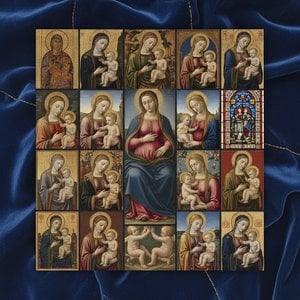
A Refined Sensibility: The Life and Art of Parmigianino
Girolamo Francesco Maria Mazzola, known to history as Parmigianino – “the little one from Parma” – emerged during the High Renaissance, yet swiftly became a defining figure of the burgeoning Mannerist style. Born in Parma on January 11, 1503, his early life was marked by familial loss; his father, Filippo Mazzola, died when Girolamo was just two years old. Raised by his uncles, Michele and Pier Ilario, both modestly skilled artists themselves, the young Parmigianino received his initial artistic training within this familial circle. This foundation, however, proved merely a springboard for an exceptional talent that would soon eclipse even his mentors. By the astonishing age of eighteen, he had already completed the Bardi Altarpiece, a work demonstrating a maturity and sophistication far beyond his years, signaling the arrival of a truly remarkable artist.Florence, Rome, and the Shaping of a Mannerist Vision
Parmigianino’s artistic journey led him to Florence around 1524, where he absorbed the influence of masters like Raphael and Leonardo da Vinci, though he quickly began to forge his own distinct path. He presented Pope Clement VII with three paintings, including a striking self-portrait in a convex mirror – a testament to his technical skill and burgeoning self-awareness. This act secured commissions in Rome, but the city’s artistic landscape was soon disrupted by the tumultuous Sack of 1527. Forced to flee, Parmigianino sought refuge in Bologna, where he painted one of his most celebrated works, the *Holy Family*. It was during this period that his signature style truly crystallized: elongated forms, graceful poses, and a refined sensuality became hallmarks of his art. He wasn’t merely depicting reality; he was reimagining it through a lens of elegance and idealized beauty. This departure from the High Renaissance's emphasis on naturalism marked him as a key innovator of Mannerism, an artistic movement characterized by its artificiality, sophistication, and deliberate distortion of classical forms.Masterpieces of Elongation and Grace
Parmigianino’s legacy rests upon a relatively small but profoundly influential body of work. The *Madonna with the Long Neck* (1534) remains perhaps his most iconic creation. Its unsettling yet captivating composition, featuring figures with elongated necks and limbs, challenges conventional notions of beauty and proportion. This deliberate distortion isn't simply stylistic; it conveys a sense of spiritual yearning and otherworldly grace. Similarly, *Vision of Saint Jerome* (1527), completed during his time in Rome, showcases his mastery of anatomy and perspective, while simultaneously embracing the Mannerist penchant for dramatic compositions and emotional intensity. Beyond these celebrated paintings, Parmigianino’s drawings reveal an extraordinary level of skill and sensitivity. His studies of figures, drapery, and architectural elements demonstrate a meticulous attention to detail and a profound understanding of form. Even his lesser-known works, such as *Bow-Carving Amor*, display the same refined sensibility and technical virtuosity that define his oeuvre.A Legacy Interrupted: Parmigianino’s Final Years
Tragically, Parmigianino's promising career was cut short by his untimely death in Casalmaggiore in 1540 at the age of thirty-seven. The circumstances surrounding his demise remain somewhat mysterious; some accounts suggest he succumbed to a fever, while others hint at complications from a fall. Despite his brief life, Parmigianino left an indelible mark on Italian Renaissance art. He stands as one of the most important representatives of Mannerism, influencing generations of artists with his elegant style and innovative approach to form and composition. His work continues to captivate viewers today, offering a glimpse into a world where beauty is not merely observed but actively created – a testament to the enduring power of artistic vision. The frescoes he left unfinished in Parma and Fontanellato serve as poignant reminders of what might have been, yet even in their incomplete state, they reveal the brilliance of a master whose legacy continues to resonate through the centuries.Questions & Answers
Where are Parmigianino's artworks grouped by technique?
Parmigianino's works can be browsed by medium on the artist's All Medium page.
Where are Parmigianino's artworks organized by color?
Parmigianino's works can be explored by color on the artist's Spectral Index page.
In which historical period did Parmigianino work?
Parmigianino worked in the Renaissance period. The period situates the artist's activity in history.