
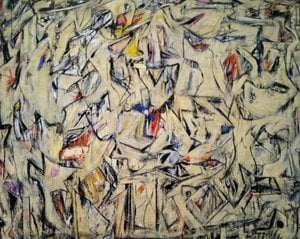
Famous paintings · Abstract Expressionism

The 100 Most Famous Abstract Expressionism Paintings

1929 – 1995

The most famous Abstract Expressionism paintings are Jackson Pollock's Number 1, 1949 (1950), Willem de Kooning's Woman I (1950–1952), Jackson Pollock's Autumn Rhythm. Number 30, 1950 (1947–1950), Paul Klee's To Parnassus (1932, Kunstmuseum Bern) and Mark Rothko's No.1 (n.d.). The list runs to 100 paintings by 25 artists, from 1929 to 1995, each with the collection that holds it today.

Number 1, 1949 by Jackson Pollock, 1950 — famous Abstract Expressionism painting
No. 1 · Jackson PollockNumber 1, 19491950
100paintings, ranked by fame
25painters · Paul Klee – Cy Twombly
26museums in 10 cities
3at the MOMA - Museum of Modern Art alone

The ranking

The 100 most famous paintings of the Abstract Expressionism

Ranked by how widely each painting is known. The artist, the date, the size of the original, the museum that holds it today — and one detail to look for.

  1. Number 1, 1949 by Jackson Pollock, 1950
    1

    Jackson PollockAbstract Expressionism

    Number 1, 1949

    1950Paint on canvas240 × 120 cm

    Rejecting traditional easel painting, Pollock laid his canvases directly on the floor, allowing him to approach the work from all sides. This radical shift in perspective is fundamental to understanding the piece – it’s not a window onto another world, but an arena where the act of creation is the subject matter. Emerging in post-World War II America, Abstract Expressionism reflected a cultural shift towards individualism and existential questioning. Pollock’s work, in particular, broke free from European artistic traditions, establishing New York as a new center for avant-garde art.

    Look forsplattersall-over compositionlayering of paintinterwoven lines

    Oil reproduction from $181 Canvas print from $47

  2. Woman I by Willem de Kooning, 1950–1952
    2

    Willem de KooningAbstract Expressionism

    Woman I

    1950–1952Oil on canvas147 × 192 cm

    De Kooning was a leading figure in this movement, often dubbed the “New York School,” which shifted the center of the art world from Paris to America. “Woman I” remains one of the most significant and influential paintings of the 20th century.

    Look forvibrant color palettedistorted formenergetic brushwork

    About this painting

  3. Autumn Rhythm. Number 30, 1950 by Jackson Pollock, 1947–1950
    3

    1947–1950Oil and enamel paint on canvas (likely)

    Created during Pollock’s most celebrated “drip period” (1947-1950), this artwork exemplifies his revolutionary technique. Despite its seemingly chaotic appearance, "Autumn Rhythm" reveals a sophisticated control over color and composition. Emerging in the post-World War II era, Abstract Expressionism reflected a broader cultural shift – a rejection of traditional values and an exploration of inner experience.

    Look fordripped linesall-over compositionearthy color palettetextural depth

    Oil reproduction from $181 Canvas print from $47

  4. To Parnassus by Paul Klee, 1932, Kunstmuseum Bern
    4

    Paul KleeAbstract Expressionism

    To Parnassus

    1932Tempera126 × 100 cmKunstmuseum Bern

    Central to the composition is a luminous orange circle, reminiscent of a sun or moon, symbolizing energy, enlightenment, and the passage of time. Paul Klee, the artist behind this piece, was a pioneering figure at the Bauhaus school, renowned for his innovative use of color and form.

    Look forsun/moonmountain/pyramidarchway/portalgeometric shapes

    Oil reproduction from $181 Canvas print from $47

  5. No.1 by Mark Rothko
    5

    Mark RothkoAbstract Expressionism

    No.1

    Oil on canvas

    The artwork's rich palette of warm tones —deep reds, oranges, and yellows—blends seamlessly with cooler shades of green, blue, and white. Artists like Mark Rothko and Barnett Newman pioneered this style, focusing on emotional content and spontaneous creation over representational accuracy.

    Look forbold, vibrant colorsfluid shapesdynamic composition

    About this painting

  6. False Start by Jasper Johns, 1959
    6

    Jasper JohnsAbstract Expressionism

    False Start

    1959Oil on canvas137 × 170 cm

    The artwork is divided into sections filled with overlapping layers of paint, creating a sense of depth and complexity. Inspired by Marcel Duchamp's ready-mades and John Cage's experiments with chance, Johns used random movements rather than premeditated composition to guide his brushstrokes.

    Look forbold colors and dynamic brushstrokesstenciled color labels with mismatched namesexplosive, frenetic patches of color

    About this painting

  7. Abstract Painting 780-1 by Gerhard Richter, 1992
    7

    1992Oil on canvas

    Gerhard Richter's " Abstract Painting 780-1" is a mesmerizing exploration of color, texture, and movement. In " Abstract Painting 780-1," he employs a vertical orientation, dividing the canvas into two distinct sections. The subject matter of " Abstract Painting 780-1" is abstract, with no clear narrative or representational elements.

    Look forcontrast between cool and warm colorsthick, layered brushstrokes creating depthbold use of color and texture

    About this painting

  8. Mahoning by Franz Kline, 1956, Whitney Museum of American Art
    8

    Franz KlineAbstract Expressionism

    Mahoning

    1956Oil on canvas203 × 254 cmWhitney Museum of American Art, New York

    In “Mahonoming,” the heavy, black muscularity of the brushwork is balanced by the luminous white voids that press back against the dark forms. During the height of the Cold War, as the world grappled with technological shifts and societal anxieties, Kline’s work offered an alternative language—one rooted in primal instinct rather than the sterile rationality of the age.

    About this painting

  9. Map by Jasper Johns, 1961, Museum of Modern Art (MoMA)
    9

    Jasper JohnsAbstract Expressionism

    Map

    1961Oil on canvasMuseum of Modern Art (MoMA), New York City

    While often associated with Pop Art due to its use of recognizable imagery, Map exists in a fascinating liminal space between movements. The painting’s energetic brushwork and bold palette – splashes of red, yellow, blue, black, and white – echo the gestural freedom of Abstract Expressionism, particularly the later works of Paul Cézanne.

    Look forvibrant colorsfragmented map outlines

    About this painting

  10. Convergence by Jackson Pollock
    10

    Jackson PollockAbstract Expressionism

    Convergence

    Oil on canvas

    Abstract Expressionism signaled a move away from European artistic dominance and embraced American innovation and individualism. Strategic lighting can highlight the texture and depth created by Pollock’s technique.

    Look fordrip techniquevibrant color paletteall-over composition

    Oil reproduction from $181 Canvas print from $47

  11. Vir Heroicus Sublimis by Barnett Newman, 1950
    11

    Barnett NewmanAbstract Expressionism

    Vir Heroicus Sublimis

    1950Oil paint on canvas242 × 513 cm

    Created by the American painter Barnett Newman, this work carries a title that translates from Latin as "Man, Heroic and Sublime." It is a massive expanse, reaching nearly 8 feet in height and stretching 18 feet wide, a scale that envelops the viewer's field of vision. As a significant work of this movement, it belongs to the New York School, where artists push against traditional boundaries to find a new visual language. The presence of this massive canvas remains anchored in New York City.

    About this painting

  12. Red and Orange by Mark Rothko
    12

    Mark RothkoAbstract Expressionism

    Red and Orange

    Oil on canvas

    This painting, a cornerstone of his mature style, exemplifies Rothko’s revolutionary approach to color field abstraction – a deliberate move away from representational imagery towards pure feeling expressed through the luminous interaction of hues. Unlike the gestural brushstrokes favored by Pollock or the fragmented figures of de Kooning, Rothko’s paintings are defined by their smooth, almost meditative surfaces.

    Look forbold colorslayered paint

    About this painting

  13. Three Studies of Lucian Freud by Francis Bacon, 1969
    13

    1969Oil on canvas

    Painted in 1969 at the Royal College of Art in London, this triptych is part of a series of large-scale portraits that Bacon created during the 1960s. The work reflects the artistic rivalry and deep friendship between Bacon and Freud, who were introduced in 1945 by artist Graham Sutherland.

    Look forbright color palette compared to typical Bacon worksgeometric cage-like structure enclosing the figureexaggerated facial features and melancholic expression

    About this painting

  14. False Start by Jasper Johns, 1959
    14

    Jasper JohnsAbstract Expressionism

    False Start

    1959Oil on canvas

    The color palette consists of primary and secondary tones, including deep blues, bright yellows, bold reds, and accents of orange and white. Along the central vertical axis, stenciled numerical markings ranging from 10 to 120 run parallel to the thermometer's scale. Created in 1959, this mixed-media assemblage moves beyond a static representation of temperature by incorporating a live measuring tool.

    Look forbold Colorsdynamic Brushstrokesvertical Divisionnumbers

    About this painting

  15. Quattro Stagioni, Autunno by Cy Twombly, 1995
    15

    Cy TwomblyAbstract Expressionism

    Quattro Stagioni, Autunno

    1995Mixed media

    Quattro Stagioni, Autunno is a painting by Cy Twombly. Created in 1995, this work exists as a single movement within a larger cycle. Born on April 25, 1928, in Lexington, Virginia, he eventually settled in Italy, where he remained until his death in Rome on July 5, 2011.

    About this painting

  16. Abstract Painting 805-4 by Gerhard Richter
    16

    Oil on canvas

    The painting is dominated by a warm palette of reds, oranges, and browns, creating an intense and energetic atmosphere. Subtle hints of blue, green, and white add contrast and visual interest, enhancing the overall vibrancy.

    Look fordynamic textureslayered paintorganic linesbold colors

    About this painting

  17. Three by Mark Rothko, 1951
    17

    Mark RothkoAbstract Expressionism

    Three

    1951

    Born Markus Yakovlevich Rothkowitz in Latvia, Rothko (1903-1970) immigrated to the United States as a child. Influenced by European movements such as Futurism, the Bauhaus, and Synthetic Cubism, Abstract Expressionism marked a decisive break from the past, establishing New York as a global art center.

    Look formaroonblack) on a dark backgroundthree rectangular blocks of color (deep red

    About this painting

  18. Number 1A by Jackson Pollock
    18

    Jackson PollockAbstract Expressionism

    Number 1A

    Oil on canvas

    Jackson Pollock's "Number 1A" is a quintessential example of Abstract Expressionism, a movement that redefined American art in the mid-20th century. The artwork's historical significance lies in its contribution to the Abstract Expressionist movement, which challenged conventional norms and paved the way for future generations of artists.

    Look forchaotic brushstrokesdense accumulation of linestexturesearthy color palette

    Oil reproduction from $181 Canvas print from $47

  19. PH-247 by Clyfford Still, 1951
    19

    Clyfford StillAbstract Expressionism

    PH-247

    1951Oil on canvas

    In this work, Clyfford Still confronts the viewer with a massive scale, measuring 117 inches in height and 192 inches in width. The rights to this work belong to the City and County of Denver. This careful preservation ensures the blues remain as bright as they were when the work was first created in 1951.

    About this painting

  20. The Liver is the Cock's Comb by Arshile Gorky, 1944, Buffalo AKG Art Museum
    20

    1944Oil on canvas186 × 249 cmBuffalo AKG Art Museum

    Moving beyond recognizable forms, Gorky crafts a vibrant and chaotic scene brimming with energy, hinting at figures engaged in a festive, yet unsettling, gathering. It’s not a depiction of something, but rather an evocation of feeling – a visual representation of collective experience filtered through personal trauma and artistic innovation.

    Oil reproduction from $181 Canvas print from $47

  21. Excavation by Willem de Kooning, 1950, Art Institute of Chicago
    21

    Willem de KooningAbstract Expressionism

    Excavation

    1950Oil on canvas205.7 × 254.6 cmArt Institute of Chicago

    De Kooning boldly rejects conventional artistic boundaries in Excavation. This influential group of artists – including Jackson Pollock, Mark Rothko, and Franz Kline – shifted the center of the art world from Paris to New York, prioritizing spontaneous gesture, subjective expression, and a rejection of established artistic conventions. De Kooning's work, while fiercely individual, shared this commitment to emotional honesty and formal innovation. Critics have often interpreted the fragmented forms as allusions to the female figure, a recurring motif in De Kooning’s work, though he consistently resisted definitive interpretations.

    About this painting

  22. Liberation by Marc Chagall, 1952
    22

    Marc ChagallAbstract Expressionism

    Liberation

    1952Oil on canvas168 × 88 cm

    The painting’s fragmented forms and multiple perspectives echo Cubist principles, while its bold, non-naturalistic color palette —dominated by fiery oranges, passionate reds, and luminous golds—draws heavily from Fauvism. Created in the aftermath of World War II, this artwork can be interpreted as a hopeful expression of renewal and resilience within the Jewish community.

    Look formusiciansbride and Groomwinged Figuremenorah

    About this painting

  23. Music, Pink and Blue No. 2 by Georgia O'Keeffe
    23

    Oil on canvas

    The painting exemplifies O'Keeffe's signature abstract expressionism, characterized by organic forms that seem to dance across the canvas. Large, sweeping curves create a rhythmic flow, with a prominent blue oval serving as an anchor amidst undulating lines. This piece predates her famous flower paintings and New Mexico landscapes, offering a glimpse into the evolution of her artistic vision.

    Look forfluid, organic formsharmonious blend of cool and warm colorscentral blue oval shaperhythmic flow across the canvas

    About this painting

  24. AUTUMN by Mark Rothko
    24

    Mark RothkoAbstract Expressionism

    AUTUMN

    Mark Rothko's ‘Autumn’ is not a depiction of the season in any traditional sense; it is, rather, an exploration of emotional resonance through the simplest of forms. His family’s immigration to America in 1913 instilled a sense of otherness that perhaps fueled his lifelong exploration of universal themes.

    About this painting

  25. The Gold of the Azure by Joan Miró, 1967, Fundació Joan Miró
    25

    Joan MiróAbstract Expressionism

    The Gold of the Azure

    1967Oil on canvas205 × 173 cmFundació Joan Miró, Barcelona

    Created in 1967, this monumental oil on canvas measuring 205 x 173 cm resides at the Fundació Joan Miró in Barcelona, Spain—a location that underscores its significance within the artist’s legacy and the broader canon of modern art. Painted during the mid-1960s, The Gold of the Azure exemplifies Miró’s unwavering commitment to artistic experimentation and his refusal to conform to prevailing trends.

    About this painting

  26. No. 5, 1948 by Jackson Pollock, 1948
    26

    Jackson PollockAbstract Expressionism

    No. 5, 1948

    1948Synthetic resin paints on fiberboard panel243 × 121 cm

    No. 5, 1948 was created using his signature “drip” technique – pouring and flinging synthetic resin paints (often referred to as enamel) onto a fiberboard canvas laid horizontally on the floor. While devoid of recognizable imagery, No. 5, 1948 is rich in symbolic potential.

    Oil reproduction from $181 Canvas print from $47

  27. Blue and Gray by Mark Rothko, 1970, National Gallery of Art
    27

    Mark RothkoAbstract Expressionism

    Blue and Gray

    1970203 × 176 cmNational Gallery of Art, Washington

    Mark Rothko, one of the 20th century's most influential figures in art, is inextricably linked with his monumental color field paintings. At its core, ‘Blue and Gray’ is defined by its stark simplicity and deliberate ambiguity. This aligns directly with the tenets of Abstract Expressionism, the movement Rothko is most closely associated with.

    Look fordichotomycolor field

    About this painting

  28. Fire evening by Paul Klee, 1929
    28

    Paul KleeAbstract Expressionism

    Fire evening

    1929Oil on cardboard37 × 36 cm

    “Fire Evening,” while not directly depicting a Tunisian landscape, reflects this newfound freedom in its expressive use of color. A Return to Reality: Interestingly, Klee himself stated that his abstract works weren’t departures from nature but rather ways of returning to reality through a more essential and symbolic representation.

    Oil reproduction from $181 Canvas print from $47

  29. Women Singing II by Willem de Kooning, 1966
    29

    Willem de KooningAbstract Expressionism

    Women Singing II

    1966Oil on canvas

    The artwork resides within the Tate Collection, offering visitors an unparalleled opportunity to experience firsthand the legacy of one of America's most influential artists. De Kooning’s technique is instantly recognizable: thick impasto—a layering of paint applied with aggressive brushstrokes—dominates the surface of this monumental paper on canvas.

    About this painting

  30. Self-Portrait I by Joan Miró
    30

    Joan MiróAbstract Expressionism

    Self-Portrait I

    The frontal perspective ensures an intimate connection, making it a compelling centerpiece for any space. Inspired by the groundbreaking works of Joan Miró, this piece echoes the artist’s fascination with the subconscious, symbolism, and the childlike spirit.

    Look forexpressive Linesvibrant Accentssymbolic Detailslayered Composition

    About this painting

  31. The Flowing Hair by Henri Matisse, 1952
    31

    Henri MatisseAbstract Expressionism

    The Flowing Hair

    1952Gouache108 × 80 cm

    The painting depicts a woman bathed in shades of vibrant blue—a hue characteristic of Matisse's signature style—whose elongated limbs are outstretched in a gesture that suggests both repose and dynamic energy. Expressionism – Matisse deliberately eschewed academic conventions, favoring bold colors and simplified forms to convey feeling rather than precise observation. Created during Matisse’s prolific period following his relocation to Nice, “The Flowing Hair” reflects a shift towards a more lyrical and decorative aesthetic—a departure from the geometric abstractions that marked his earlier work. Like other masterpieces by Matisse – Vénus Gouache découpée wtngoa and Anfitrite – “The Flowing Hair” exemplifies his unwavering commitment to expressive color and simplified shapes.

    Oil reproduction from $181 Canvas print from $47

  32. Clouds by Gerhard Richter, 1982, Museum of Modern Art (MoMA)
    32

    Gerhard RichterAbstract Expressionism

    Clouds

    1982Oil on canvas200 × 206 cmMuseum of Modern Art (MoMA), New York City

    “Clouds” is a significant work within Richter’s oeuvre and modern art history. It has been exhibited at prestigious institutions like the Tate Modern in London and currently resides in the collection of the Museum of Modern Art (MoMA) in New York City, solidifying its importance.

    Look forlayered colorsbold brushstrokesabstract forms

    About this painting

  33. No. 5 No. 22 by Mark Rothko, 1949–1950, Museum of Modern Art (MoMA)
    33

    Mark RothkoAbstract Expressionism

    No. 5 No. 22

    1949–1950Oil on canvasMuseum of Modern Art (MoMA), New York

    Rothko's path to abstraction was a deliberate one. What sets No. 5/No. 22 apart is Rothko’s unique application of paint. Created in the aftermath of World War II, No. 5/No. 22 reflects a broader cultural mood of anxiety and existential questioning. Ultimately, the meaning of ‘No. 5/No. 22’ is deeply personal and subjective, shaped by each viewer's own experiences and emotional landscape.

    Look forgouged texture with white linesrectangular color fields

    About this painting

  34. Number 6 by Jackson Pollock, 1949
    34

    Jackson PollockAbstract Expressionism

    Number 6

    1949Oil on canvas112 × 137 cm

    Emerging in post-World War II America, this style rejected traditional representational art, instead prioritizing spontaneous gesture and emotional expression. What truly sets Number 6 apart is Pollock’s groundbreaking “drip” or "pouring" technique. While seemingly chaotic at first glance, Number 6 possesses an underlying structure and rhythm.

    Oil reproduction from $181 Canvas print from $47

  35. Number 3 by Jackson Pollock, 1948, MOCA
    35

    Jackson PollockAbstract Expressionism

    Number 3

    1948Enamel & oil77 × 57 cmMOCA, Los Angeles

    “Number 3” gained considerable acclaim upon its debut at the Museum of Modern Art (MoMA) retrospective exhibition in New York City in 1956—a recognition that underscored Pollock’s impact on the art world and solidified his status as a visionary artist. For more information on Jackson Pollock and his works, visit Jackson Pollock:Number 3 at AllPaintingsStore.com.

    Oil reproduction from $181 Canvas print from $47

  36. Abstract painting by Mark Rothko
    36

    Mark RothkoAbstract Expressionism

    Abstract painting

    Oil on canvas

    While seemingly simple – a large canvas dominated by deep gray – this piece is a powerful exploration of color, form, and emotional resonance. It’s not about what is depicted, but rather how the viewer feels in its presence. Born in Latvia and immigrating to the United States as a child, Rothko’s early work evolved from figurative painting towards abstraction.

    Look forlack of texturegrayscale tonefull-field application of paint

    About this painting

  37. The Visit by Willem de Kooning, 1966, Tate Gallery
    37

    Willem de KooningAbstract Expressionism

    The Visit

    1966Oil paint on canvasTate Gallery

    Executed in 1966-7, The Visit emerged during a period of intense artistic experimentation following World War II. The purchase of The Visit by Tate Gallery in 1969 solidified its place within the institution's collection—a pivotal moment in British art history. Delving deeper into Willem de Kooning's oeuvre reveals a prolific artist who consistently pushed the boundaries of artistic convention.

    About this painting

  38. White Light by Jackson Pollock, 1954, MOMA - Museum of Modern Art
    38

    Jackson PollockAbstract Expressionism

    White Light

    1954Oil on canvas122 × 97 cmMOMA - Museum of Modern Art, New York City

    The work’s energetic presence makes it an ideal centerpiece for modern interiors, inspiring both contemplation and conversation. Created with thick impasto layers, this piece showcases the artist’s physical engagement with the canvas.

    Look forchaotic compositionvigorous linestextured impasto surfacevibrant color palette

    Oil reproduction from $181 Canvas print from $47

  39. Four Darks in Red by Mark Rothko, 1958
    39

    Mark RothkoAbstract Expressionism

    Four Darks in Red

    1958

    This work isn’t about depicting a scene; it is the feeling itself – an immersive experience built from layers of color and subtle tonal shifts. Emerging in post-World War II America, Abstract Expressionism represented a radical departure from representational art.

    Look forrectangular blocks of colorblurred lozenge shapes

    About this painting

  40. Seated Woman by Willem de Kooning, 1940
    40

    Willem de KooningAbstract Expressionism

    Seated Woman

    1940Oil on canvas

    Created just before the outbreak of World War II, it reflects a broader preoccupation with themes of vulnerability and psychological struggle prevalent in the artistic milieu of the era. However, De Kooning pushed the boundaries of technique by employing aggressive brushstrokes and layering paint extensively to achieve unparalleled textural depth.

    About this painting

  41. No. 10 by Mark Rothko, 1950, Tate Gallery
    41

    Mark RothkoAbstract Expressionism

    No. 10

    1950Oil on canvas141 × 81 cmTate Gallery

    Rothko's distinctive approach—characterized by monumental canvases dominated by amorphous color fields—was rooted in his belief that art should bypass intellect and speak directly to the viewer’s subconscious. No. 10 emerged during the Second World War, a period marked by anxiety and uncertainty. As documented in Wikipedia, Rothko’s work has been subjected to extensive scholarly debate and interpretation.

    About this painting

  42. Ancient Sound, Abstract on Black by Paul Klee, Kunstmuseum Bern
    42

    Oil on cardboardKunstmuseum Bern

    Ancient Sound, Abstract on Black (1924) is a remarkable example of Klee's exploration of abstraction. Abstract expressionism emerged in the United States in the aftermath of World War II and gained mainstream acceptance in the 1950s.

    Oil reproduction from $181 Canvas print from $47

  43. Numbers in Color by Jasper Johns
    43

    Jasper JohnsAbstract Expressionism

    Numbers in Color

    Likely oil paints on canvas

    This piece isn't about depicting reality; it’s an exploration of perception, representation, and the very act of painting itself. The artwork presents a dense field populated by repeated numbers encased within irregularly shaped, overlapping squares. It's a deliberate move away from the emotional intensity of earlier abstract expressionists like Pollock or Rothko, opting for a more intellectual and analytical approach.

    Look forredblue color schemerepetition of numbers within square blocks

    About this painting

  44. PH-160 by Clyfford Still, 1957
    44

    Clyfford StillAbstract Expressionism

    PH-160

    1957Oil on canvas

    Created in 1957, PH-160 by Clyfford Still exists as a field of pure color. The canvas holds a dialogue between blue and yellow. The blue carries a weight that anchors the composition, while the yellow provides a sharp, sudden light.

    About this painting

  45. PH-223 by Clyfford Still, 1956
    45

    Clyfford StillAbstract Expressionism

    PH-223

    1956Oil on canvas

    Created in 1956, this oil on canvas composition operates through a language of fractured planes and intense chromatic tension. A sharp, white line cuts across the upper register, creating a stark boundary that disrupts the visual flow. This work belongs to the era of Abstract Expressionism, a period defined by a shift toward non-figurative visual languages.

    About this painting

  46. Untitled (Seagram Mural) by Mark Rothko, 1953, Guggenheim Museum Bilbao
    46

    Mark RothkoAbstract Expressionism

    Untitled (Seagram Mural)

    1953Oil on canvas442 × 299 cmGuggenheim Museum Bilbao

    Rothko’s formative years instilled within him a sensitivity to suffering that would permeate his entire oeuvre. Growing up in Dvinsk, Latvia, amidst the anxieties surrounding Jewish life under Tsarist rule and the looming threat of pogroms, he witnessed firsthand the fragility of existence.

    About this painting

  47. A Tree in Naples by Willem de Kooning, 1960
    47

    Willem de KooningAbstract Expressionism

    A Tree in Naples

    1960Oil on canvas

    De Kooning described his inspiration: "Just coming around roads, some place, and having the sensation of a piece of it, a piece of nature, like a fence, something on the road. “A Tree in Naples” emerged during a pivotal period in art history – the post-World War II era.

    About this painting

  48. Dark by Gerhard Richter, 1968
    48

    Gerhard RichterAbstract Expressionism

    Dark

    1968Painting

    The Blur – A Key Element: The blurred areas are not simply stylistic choices; they represent the subjective nature of perception and the difficulty of accessing objective truth.

    Look forcolor & texturebold brushstrokes

    About this painting

  49. Door to the River by Willem de Kooning, 1960, Whitney Museum
    49

    Willem de KooningAbstract Expressionism

    Door to the River

    1960Oil on canvasWhitney Museum, NY

    Initially conceived as a study for a larger mural project, its scale—a substantial 80 x 70 inches—amplifies the sense of immersion and immediacy that defines de Kooning's style. For those seeking to experience the power and dynamism of Willem de Kooning’s “Door to the River” firsthand, high-quality reproductions are available through AllPaintingsStore.com and AllPaintingsStore.com.

    Look forexpressive brushwork

    About this painting

  50. Number 23, 1951 by Jackson Pollock, 1951, Chrysler Museum of Art
    50

    Jackson PollockAbstract Expressionism

    Number 23, 1951

    1951Enamel on canvas148 × 119 cmChrysler Museum of Art, Norfolk

    The stark monochrome palette immediately commands attention, stripping away any pretense of representational art and forcing the viewer to confront the raw materiality of paint itself. The period coincided with a renewed interest in surrealism, fueled by his exposure to the works of artists like Joan Miró and Max Ernst. The recurring presence of faces within “Number 23” is particularly intriguing.

    Look fordrip techniquefigures

    Oil reproduction from $231 Canvas print from $47

  51. With the Mauve Triangle by Paul Klee, 1937, Franz Marc Museum
    51

    Paul KleeAbstract Expressionism

    With the Mauve Triangle

    1937Watercolor on paper15 × 9 cmFranz Marc Museum, Kochel am See

    These shapes subtly bleed into one another, fostering a sense of fluidity and spontaneity that aligns perfectly with Klee’s expressive vision. The painting’s genesis within the Bauhaus Dessau school—a bastion of modernist design and artistic experimentation—further illuminates its significance. Founded in 1925 by Walter Gropius, Bauhaus championed a holistic approach to art education, integrating craftsmanship with theoretical inquiry. Klee's involvement at Bauhaus solidified his belief that art should serve as a tool for social betterment, fostering creativity and promoting harmonious relationships between humanity and nature.

    Oil reproduction from $181 Canvas print from $47

  52. Beasts of the Sea by Henri Matisse, 1950
    52

    Henri MatisseAbstract Expressionism

    Beasts of the Sea

    1950Paper collage on canvas296 × 154 cm

    The title, translating to “The Beasts of the Sea,” hints at an aquatic theme, though Matisse eschews literal representation. “Beasts of the Sea” is executed using Matisse’s signature technique of papiers découpés (cut papers). Following surgery in 1947, Matisse was largely confined to a wheelchair.

    Oil reproduction from $181 Canvas print from $47

  53. Saint by Jackson Pollock, MoMA
    53

    Jackson PollockAbstract Expressionism

    Saint

    Oil on canvasMoMA

    Jackson Pollock is widely regarded as one of the most influential artists of the 20th century, and his painting Saint is a quintessential example of his unique style. Saint is characterized by Pollock’s signature drip painting technique, where he poured or splashed household paint onto an unstretched canvas laid on the floor.

    Oil reproduction from $181 Canvas print from $47

  54. Curious to How Plants Grow by Paul Klee, 1937–1940
    54

    Paul KleeAbstract Expressionism

    Curious to How Plants Grow

    1937–1940Watercolor and gouache

    At first glance, the painting presents a deceptively simple scene – a stylized depiction of plant growth. However, Klee eschews literal representation, opting instead for an evocative arrangement of circles, ovals, and intersecting lines that suggest movement and interconnectedness. Klee's engagement with Surrealism, alongside Expressionism, demonstrates his willingness to push boundaries and challenge conventional aesthetic norms.

    Oil reproduction from $181 Canvas print from $47

  55. Untitled (Peonias series) by Cy Twombly, 1970, Galleria Civica di Arte Moderna e Contemporanea Torino
    55

    Cy TwomblyAbstract Expressionism

    Untitled (Peonias series)

    1970Oil based house paint and wax crayon241 × 200 cmGalleria Civica di Arte Moderna e Contemporanea Torino, Turin

    In 2012, it was sold at a Sotheby’s auction in New York for $17.4 million. Subsequently, the piece reached a high point at a Christie's auction in London, where it realized approximately $30 million. This transition is evident in Untitled (20), a work from 1970 that shares a temporal and stylistic proximity to the current piece.

    About this painting

  56. No. 10 (Brown Black Sienna on Dark Wine by Mark Rothko, 1958
    56

    1958Oil on canvas

    The composition is defined by its verticality, where large, rectangular fields of color appear to hover and vibrate against a dark, atmospheric background. A deep, wine-colored red anchors the top and bottom of the frame, sandwiching a central band of textured black that seems to pull the viewer into an infinite depth.

    About this painting

  57. Mural by Jackson Pollock, 1943, University of Iowa Museum
    57

    Jackson PollockAbstract Expressionism

    Mural

    1943Oil on canvas247 × 605 cmUniversity of Iowa Museum

    Commissioned by Peggy Guggenheim as a centerpiece for her Manhattan townhouse, this monumental work – measuring a commanding 247 x 605 cm – immediately announces Pollock’s arrival as a revolutionary force in the art world. A Pivotal Moment – “Mural” arrived during a period of intense artistic experimentation following World War II.

    Look forstampededrip painting

    Oil reproduction from $181 Canvas print from $47

  58. Untitled 146 by Mark Rothko
    58

    Mark RothkoAmerican Abstract Expressionism

    Untitled 146

    Canvas

    Rothko emerged during the height of Abstract Expressionism, alongside artists like Willem de Kooning and Jackson Pollock. The symbolism embedded within “Untitled 146” is subtle yet powerful. Reproductions of “Untitled 146” can bring a contemplative atmosphere into any space, particularly when paired with neutral backgrounds and soft lighting.

    About this painting

  59. Untitled (verso: Untitled) by Willem de Kooning, 1949, Art Institute of Chicago
    59

    1949Oil on canvas203 × 178 cmArt Institute of Chicago

    De Kooning utilizes a variety of textures that suggest a heavy, tactile presence, pulling the eye across the canvas through intricate details that reward prolonged contemplation.

    About this painting

  60. Wallace Bournes by Gerhard Richter
    60

    Gerhard RichterAbstract Expressionism

    Wallace Bournes

    Oil painting

    Abstract expressionism emerged in post-war America as a reaction against formalism and championed spontaneity and intuition as guiding principles.

    About this painting

  61. Abstraction by Willem de Kooning, 1950
    61

    Willem de KooningAbstract Expressionism

    Abstraction

    1950Oil and metallic paint46 × 37 cm

    Thick impasto technique —applying paint thickly onto the surface—is central to De Kooning’s style, resulting in textured surfaces that capture the physicality of his brushstrokes. “Abstraction” emerged during a pivotal moment in artistic history—the rise of Abstract Expressionism as a reaction against European Surrealism and Cubism. The horses symbolize power and untamed energy—mirroring De Kooning’s own artistic vision. De Kooning's influence extended far beyond Abstract Expressionism, impacting subsequent movements like Pop Art and shaping the aesthetic sensibilities of artists across generations.

    About this painting

  62. Number 1 by Jackson Pollock, 1948, MOMA - Museum of Modern Art
    62

    Jackson PollockAbstract Expressionism

    Number 1

    1948Oil & enamel paintMOMA - Museum of Modern Art, New York City

    The painting’s genesis lies within Pollock’s revolutionary “drip” technique – a method he meticulously developed over years. At first glance, “Number 1” appears to be an explosion of color and form – a swirling vortex of seemingly random marks. The frenetic energy of “Number 1” can be seen as a reflection of this turbulent inner world.

    Look forblack linesdrip technique

    Oil reproduction from $181 Canvas print from $47

  63. Marilyn Monroe by Willem de Kooning, 1954
    63

    Willem de KooningAbstract Expressionism

    Marilyn Monroe

    1954Oil on canvas

    This painting offers a fascinating glimpse into De Kooning’s approach to figuration and his ability to convey complex emotions through abstract means. De Kooning’s engagement with Marilyn Monroe reflects a broader trend in post-war art – the incorporation of popular imagery and themes into high art.

    Look forgestural brushstrokesimpasto textureintense color palette (redsyellows

    About this painting

  64. Storm Cloud by William McTaggart
    64

    William McTaggartAbstract Expressionism

    Storm Cloud

    Oil on paper (presumed)

    McTaggart, though often associated with the Scottish Impressionists for his vibrant landscapes, demonstrates a clear leaning towards Abstract Expressionism in this piece. William McTaggart (1835-1910) was a leading figure in Scottish painting, renowned for his emotive depictions of rural life and landscapes.

    Look foremotional intensityturbulent brushstrokesdramatic color palette

    Oil reproduction from $181 Canvas print from $47

  65. Untitled 142 by Mark Rothko, National Gallery of Art
    65

    Mark RothkoAbstract Expressionism

    Untitled 142

    Oil on canvasNational Gallery of Art, Washington

    Mark Rothko, born Marcus Rothkowitz in Dvinsk, Russia (now Latvia) on September 25, 1903, was a prominent figure in the Abstract Expressionist movement. Untitled 142, painted in 1968, exemplifies Rothko's mature style and his exploration of emotional depth through color. Untitled. 1969-70 | MoMA Mark Rothko - An Overview of Rothko's Abstract Expressionism … ‘Untitled‘, Mark Rothko, 1969 | Tate

    About this painting

  66. Three Flowers by Paul Klee, 1937–1940
    66

    Paul KleeAbstract Expressionism

    Three Flowers

    1937–1940Painting

    Characteristic of Klee’s oeuvre, “Three Flowers” exemplifies his distinctive style—a blend of geometric abstraction and lyrical expressionism. Klee's decision to relocate to Murnau in 1937 coincided with a resurgence of interest in Germanic folklore and mythology. This period witnessed a flourishing of Expressionist influences—artists like Wassily Kandinsky and Franz Marc —who sought to communicate emotion through non-figurative forms.

    Oil reproduction from $181 Canvas print from $47

  67. Seated woman 2,1940 by Willem de Kooning, 1940
    67

    Willem de KooningAbstract Expressionism

    Seated woman 2,1940

    1940Oil on canvas

    To understand the soul of “Seated Woman 2,” one must look toward the historical shadows cast by 1940. Created during the early, anxious years of World War II, the painting breathes the atmosphere of global upheaval.

    About this painting

  68. Antigone by Mark Rothko, 1960, National Gallery of Art
    68

    Mark RothkoAbstract Expressionism

    Antigone

    1960Oil on canvasNational Gallery of Art

    This approach was influenced by his time at the Rothko Chapel in Houston, Texas, where he created fourteen monumental paintings designed to create a contemplative space. The Rothko Chapel’s influence is particularly evident in “Antigone,” where the use of color and scale aims to create a similarly immersive experience for the viewer.

    Look fornude figurescolor field

    About this painting

  69. Castle with Setting Sun by Paul Klee, 1937–1940
    69

    Paul KleeAbstract Expressionism

    Castle with Setting Sun

    1937–1940

    Painted sometime between 1937 and 1940, during his prolific period in Murnau, Bavaria—a location deeply imbued with the spirit of Expressionism —this artwork exemplifies Klee's signature approach to abstraction, prioritizing feeling over precise representation. The artistic landscape of Bavaria in the late 1930s was dominated by Expressionism, a movement concerned with capturing subjective experience and conveying emotional intensity.

    Oil reproduction from $181 Canvas print from $47

  70. Merritt Parkway by Willem de Kooning, 1959
    70

    Willem de KooningAbstract Expressionism

    Merritt Parkway

    1959Oil on canvas179 × 203 cm

    Abstract Expressionism arose as a reaction against the formalism of European Modernism, rejecting intellectual abstraction for visceral emotional expression. Artists like De Kooning sought to liberate art from representational constraints, prioritizing subjective experience over objective observation. While devoid of explicit narrative content, “Merritt Parkway” is laden with symbolic significance.

    About this painting

  71. Amorpha. Fugue in Two Colors 2 by František Kupka
    71

    About this painting

  72. Berkeley No. 20 by Richard Diebenkorn
    72

    Richard DiebenkornAbstract Expressionism

    Berkeley No. 20

    About this painting

  73. Arabs - The Death of Raimundus Lullus by Salvador Dalí, 1963, Reynolds Morse Foundation
    73

    1963Oil on canvasReynolds Morse Foundation

    The style prioritizes gesture and spontaneity—a deliberate rejection of academic conventions—resulting in a dynamic composition dominated by swirling shapes and textures. "Arabs - The Death of Raimundus Lullus" isn’t intended to elicit a specific emotion but rather to induce a state of meditative contemplation.

    About this painting

  74. Burning Merit by Richard Art Hambleton, 1985
    74

    Richard Art HambletonAbstract Expressionism

    Burning Merit

    1985

    About this painting

  75. Last Piece by Philip Guston, 1958
    75

    Philip GustonAbstract Expressionism

    Last Piece

    1958

    Last Piece is not Guston's last Abstract Expressionist painting, but it represents a transition away from the shimmering forms of the early 1950s towards the recognizable motifs of his later, more figurative works. If Buddhism, and concepts of nothingness, had informed his earlier abstractions, this represents a move away from those inspirations.

    About this painting

  76. Number 17 by Ad Reinhardt, 1953, Whitney Museum of American Art
    76

    Ad ReinhardtAbstract Expressionism

    Number 17

    1953Oil & tempera198 × 198 cmWhitney Museum of American Art, New York

    Unlike the thick, expressive impasto often associated with his contemporaries in the Abstract Expressionist movement, Reinhardt sought a surface of unparalleled tonal purity and flatness. To understand “Number 17,” one must understand Reinhardt’s radical philosophical mission.

    Look foryellow squaresblue background

    About this painting

  77. Aquatic Garden by Hans Hofmann, 1960
    77

    Hans HofmannAbstract Expressionism

    Aquatic Garden

    1960244 × 122 cm

    About this painting

  78. Entrance to Subway by Mark Rothko, 1938
    78

    Mark RothkoAbstract Expressionism

    Entrance to Subway

    1938Oil on canvas

    Painted in 1938 during a period of intense social and political upheaval – a time when the anxieties of war were beginning to surface – this large-scale oil painting captures not just a physical space but also an emotional landscape. “Entrance to Subway” was created during a time of significant social and political change in America.

    Look forgeometric formsbold colors

    About this painting

  79. Heroic Fiddling by Paul Klee, 1938, MOMA - Museum of Modern Art
    79

    Paul KleeAbstract Expressionism

    Heroic Fiddling

    1938Pigmented paste on newspaperMOMA - Museum of Modern Art, New York City

    Paul Klee, a Swiss-born German painter (1879-1940), was celebrated for his unique blend of expressionism, cubism, and surrealism. The painting is a visual representation of his internal musicality and adoration for playing the violin. Born on December 18, 1879, in Munchenbuchsee, Switzerland, Paul Klee was the second child of two musical parents.

    Oil reproduction from $181 Canvas print from $47

  80. Reflection of the Big Dipper by Jackson Pollock, 1947
    80

    1947

    This piece, measuring 111 x 91.5 cm, is housed in the Stedelijk Museum in Amsterdam, Netherlands. Pollock was a key figure in the Abstract Expressionist movement, which emerged in New York after World War II. This movement borrowed from Surrealism and featured two main types of artists: action painters and color field painters.

    Oil reproduction from $181 Canvas print from $47

  81. Blue and red vertical planes by František Kupka
    81

    About this painting

  82. Untitled (Cubist Figure) by Arshile Gorky, 1944
    82

    Arshile GorkyAbstract Expressionism

    Untitled (Cubist Figure)

    194476 × 50 cm

    Oil reproduction from $181 Canvas print from $47

  83. Night in the Hotel by Salvador Dalí, 1965, Dalí Theatre-Museum
    83

    Salvador DalíAbstract Expressionism

    Night in the Hotel

    1965Oil on canvasDalí Theatre-Museum

    The central figure, a towering, elongated black shape reminiscent of a melting clock – a motif deeply rooted in Dalí’s exploration of time and memory – dominates the upper left quadrant. “Night in the Hotel” is not about literal representation; it’s about conveying a specific mood, a feeling—a sense of disorientation and unease.

    Look fordripping black figures

    About this painting

  84. Magic Man by Richard Art Hambleton, 1993
    84

    Richard Art HambletonAbstract Expressionism

    Magic Man

    1993111 × 64 cm

    About this painting

  85. Store poster by Claes Oldenburg
    85

    Claes OldenburgAbstract Expressionism

    Store poster

    Likely ink, watercolor, or mixed media on paper

    Through an abstract or semi-abstract approach, the piece explores the interplay of everyday objects, rendered with vigorous line work and a bold, colorful palette. Created using a combination of loose, swirling lines and watercolor washes, this piece exemplifies a gestural and expressive style reminiscent of abstract expressionism.

    Look forvibrant color palettelayered formsgestural styleenergetic line work

    About this painting

  86. The She Wolf by Jackson Pollock, 1943, MoMA
    86

    Jackson PollockAbstract Expressionism

    The She Wolf

    1943Gouache, oil, pastel106 × 170 cmMoMA, New York City

    It subtly references the legendary wolf who suckled Romulus and Remus, the twin founders of Rome – a potent symbol of birth, survival, and the very foundation of civilization. "The She Wolf" represents a crucial moment in Pollock’s artistic development and is considered one of the earliest examples of his groundbreaking approach to abstraction.

    Look fordrip techniquelayered

    Oil reproduction from $181 Canvas print from $47

  87. Maqueta núm. 15 de la sèrie Gaudí by Joan Miró, 1962–1963
    87

    Joan MiróSurrealist Abstract Expressionism

    Maqueta núm. 15 de la sèrie Gaudí

    1962–1963Painting

    Thickly applied paint creates textured surfaces that pulsate with energy, mirroring the dynamism found within Gaudí’s buildings—particularly Sagrada Familia—where natural forms dominate the structural elements. Simultaneously, Miró was deeply engaged with Surrealist ideas championed by André Breton, exploring dreamlike imagery and subconscious associations as pathways to artistic expression.

    About this painting

  88. Tulips and Oysters on Black Background by Henri Matisse
    88

    Oil paints on canvas

    This striking still life presents a fascinating anomaly within Henri Matisse's prolific oeuvre. The artwork depicts a classic still life arrangement: flowers (predominantly tulips and roses), fruit (apples and oranges), and glassware are arranged on a table against a stark black backdrop. Born in 1869, Henri Matisse initially trained in traditional academic painting.

    Oil reproduction from $181 Canvas print from $47

  89. Untitled Part VIII by Cy Twombly, 1988
    89

    Cy TwomblyAbstract Expressionism

    Untitled Part VIII

    1988

    About this painting

  90. Maqueta per a la sèrie Els gossos 2 by Joan Miró
    90

    The composition is characterized by irregular shapes, expressive lines, and textured surfaces that create a sense of movement and vitality. While the exact date of creation remains unknown, the work echoes the revolutionary spirit of mid-20th-century abstract and modernist movements.

    Look forblack ink-like linestextured backgroundbold colorsirregular shapes

    About this painting

  91. The Book Lover I by František Kupka
    91

    František KupkaAbstract Expressionism

    The Book Lover I

    About this painting

  92. Untitled 67 by Mark Rothko, 1948–1953
    92

    Mark RothkoAbstract Expressionism

    Untitled 67

    1948–1953Oil on canvas (presumed)

    Rothko's technique in Untitled 67 showcases his mastery of oil paint. Initially working with figurative subjects, he gradually moved towards abstraction following World War II. As a piece by one of the 20th century's most influential artists, owning or displaying Untitled 67 is an investment in artistic legacy and emotional power.

    Look forlayered texturesfragmented compositiongestural brushstrokesmuted reddish-brown tones

    About this painting

  93. Watchman by Jasper Johns, 1967, The Art Institute of Chicago
    93

    Jasper JohnsAbstract Expressionism

    Watchman

    1967Graphite wash, metallic pigment, pencil & pastelThe Art Institute of Chicago

    Johns employs graphite wash, metallic pigment, pencil, and pastel on paper—techniques borrowed from both Abstract Expressionism and Surrealist experimentation—to achieve a deceptively serene surface. The artwork emerged during a period marked by significant social upheaval—the Vietnam War protests, civil rights struggles, and burgeoning countercultural movements—creating an atmosphere of palpable anxiety and questioning established norms.

    About this painting

  94. Quattro Stagioni, Estate by Cy Twombly, 1995
    94

    Cy TwomblyAbstract Expressionism

    Quattro Stagioni, Estate

    1995Paint on canvas

    Cy Twombly, born Edwin Parker Twombly Jr. in 1928, was an American painter, sculptor, and photographer who spent much of his career living and working in Italy. 'Quattro Stagioni, Estate' demonstrates Twombly's mastery of abstract expressionism, a style that emerged in New York in the 1940s and 1950s.

    About this painting

  95. Bird's Flight in Moonlight by Joan Miró, 1967, Fundació Joan Miró
    95

    Joan MiróSurrealist Abstract Expressionism

    Bird's Flight in Moonlight

    1967OilFundació Joan Miró, Barcelona

    Rooted in the Catalan Surrealist tradition, Miró’s work often seeks to unlock the creative potential of the mind, moving away from rationalism toward a more primal, instinctive truth.

    About this painting

  96. Girl with a Ball by František Kupka
    96

    František KupkaAbstract Expressionism

    Girl with a Ball

    About this painting

  97. Still Life by Willem de Kooning, 1945
    97

    Willem de KooningAbstract Expressionism

    Still Life

    1945Oil on canvas

    “Still Life” emerged during a pivotal moment in art history, coinciding with the ascendancy of Jackson Pollock and other pioneers of action painting. For those seeking a deeper understanding of Willem de Kooning's artistic vision, exploring Willem De Kooning on Wikipedia offers invaluable insights into his life and oeuvre.

    About this painting

  98. Untitled 74 by Mark Rothko, 1953, Israel Museum
    98

    Mark RothkoAbstract Expressionism

    Untitled 74

    1953Oil on canvasIsrael Museum, Jerusalem

    Rothko is celebrated as a master of Color Field painting, a style characterized by large areas of flat, solid color spread across the canvas. Emerging in the aftermath of World War II, Rothko’s work reflects a broader cultural shift towards introspection and existential questioning.

    About this painting

  99. Abstract Painting by Gerhard Richter, 1978
    99

    Gerhard RichterAbstract Expressionism

    Abstract Painting

    1978Oil on canvas (likely)201 × 336 cm

    Richter firmly established himself as a leading figure in Abstract Expressionism, yet his approach is uniquely his own. As a work by one of the most important artists of the 20th and 21st centuries, this painting represents not only an aesthetic investment but also a significant cultural one.

    About this painting

  100. Untitled by Jasper Johns, 1971
    100

    Jasper JohnsAbstract Expressionism

    Untitled

    1971Painting

    At first glance, the viewer is presented with a deceptively simple scene: a room bathed in a soft, diffused light, where two vases stand as silent sentinels on either side of the canvas. Emerging from a period where artists were reacting against the spontaneous, "action painting" style of figures like Jackson Pollock, Johns introduced a more deliberate, cerebral approach.

    About this painting

By movement

Famous Abstract Expressionism paintings by movement

Plan your visit

Where to see the most famous Abstract Expressionism paintings

New York City leads with 6 of the 100; the MOMA - Museum of Modern Art alone holds 3.

The painters

The most famous Abstract Expressionism painters in the list

Portrait of Paul Klee

Paul Klee

1879–1940 · Switzerland · 8

Swiss-German Bauhaus artist of rhythmic abstraction, delicate watercolors, and musical forms.

4. To Parnassus, 28. Fire evening, 42. Ancient Sound, Abstract on Black, 51. With the Mauve Triangle, 54. Curious to How Plants Grow, 66. Three Flowers, 69. Castle with Setting Sun, 79. Heroic Fiddling

Portrait of Gerhard Richter

Gerhard Richter

· Germany · 6

German artist known for blurring photorealism and gestural abstraction using squeegees and grids.

7. Abstract Painting 780-1, 16. Abstract Painting 805-4, 32. Clouds, 48. Dark, 60. Wallace Bournes, 99. Abstract Painting

Portrait of Joan Miró

Joan Miró

1893–1983 · Spain · 5

Spanish Surrealist known for biomorphic shapes and a symbolic, dreamlike visual language that bridges the gap between the seen and the imagined.

25. The Gold of the Azure, 30. Self-Portrait I, 87. Maqueta núm. 15 de la sèrie Gaudí, 90. Maqueta per a la sèrie Els gossos 2, 95. Bird's Flight in Moonlight

+18more painters in the list Famous Abstract Expressionism Artists The painters, ranked

Questions & answers

Questions about Abstract Expressionism paintings

Hover over a question to read the answer.

Who was the greatest painter of the Abstract Expressionism?

Judged by this ranking, Mark Rothko: 17 of the 100 most famous Abstract Expressionism paintings are from this painter's hand, including No.1, Red and Orange and Three.

What materials did Abstract Expressionism painters use?

60 of the 100 are oil paintings, 2 use tempera and 0 are frescoes; 1 are painted on wood and 56 on canvas.

Can I own a copy of a famous Abstract Expressionism painting?

Yes: 28 of the 100 can be ordered as a hand-painted oil reproduction, from $181, and 28 as a canvas print, from $47.

How is this ranking made?

Each painting is ranked by how widely it is known: the number of Wikipedia language editions with an article on it (Wikidata sitelinks), its place in our catalogue's manual ranking and the visits its page receives. The same painting catalogued several times counts once, and details, copies and studies are left out.

Bring one home

28 of the 100 as hand-painted oil reproductions

28 paintings of this list can be ordered as museum-grade, hand-painted oil reproductions, from $181.

Number 1, 1949 by Jackson PollockWoman I by Willem de KooningAutumn Rhythm. Number 30, 1950 by Jackson PollockTo Parnassus by Paul KleeNo.1 by Mark Rothko

Browse all Abstract Expressionism paintings

How this ranking is made

We started with every Abstract Expressionism painting in our catalogue and ranked them by how famous they are. Three clues decide the order: in how many languages Wikipedia has an article about the painting, where our curators place it, and how often people open its page on our site. Each painting appears only once, and details, copies and studies are left out.

Famous paintings of other movements

Famous paintings by period