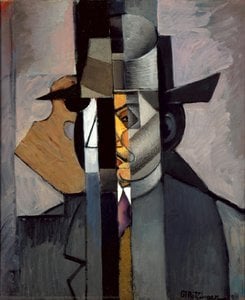
Cubist masters, in order

47 Famous Cubist Painters: The Definitive Ranking

The most famous Cubist painter is Pablo Picasso (1881–1973), known for Guernica and The Old Guitarist. Next come Georges Braque, Fernand Léger, Juan Gris and Robert Delaunay. This ranking of the 47 most famous Cubist painters runs from Carl Newman (born 1858) to Dia al-Azzawi (born 1939), across 20 countries.

How this list is ranked. Artists whose works our catalogue files under Cubist, in the order of our fame ranking of artists. Artists without a Wikidata identifier born after 1955 are left out until verified. The Wikipedia figure next to each name is the number of our 32 languages in which Wikipedia has an article on the artist.

  1. Guernica by Pablo Picasso1Pablo Picasso
  2. Houses At L'estaque by Georges Braque2Georges Braque
  3. Nudes in the Forest by Fernand Léger3Fernand Léger

The essentials

Cubist at a glance

  • 47Artists
  • 1858–1939Years of birth
  • 20Countries of birth
  • 4Women
  • 1Living artists
  • 7,389Works in our catalogue
Cities with most births
New York City (2), London (2), Málaga (1), Argenteuil (1)

Ranked, with their masterpieces

The ranking: 47 Cubist Painters and their key works

1of 47

Pablo Picasso

Spanish Born in Málaga Cubism, Surrealism Wikipedia in 32/32 languages

Pablo Picasso

In 1967, he gifted the city of Chicago an untitled monumental sculpture made of COR-TEN steel. This massive, fifty-foot structure, which he suggested represented the head of his Afghan Hound, Kabul, transformed the urban landscape of Daley Plaza. The ripples of his creative life reached far beyond the walls of his studios in Paris and the South of France.

Where to see To walk through the halls of the Musée Picasso in Paris is to enter a sanctuary where the artist's restless spirit remains palpable.

Key works · The 100 most famous works

2of 47

Georges Braque

French Born in Argenteuil ['Fauvism', 'Cubism', 'Analytical Cubism', 'Synthetic Cubism'] Wikipedia in 31/32 languages

Georges Braque

Braque’s approach to the canvas was defined by a restless curiosity regarding the physical properties of his materials. He moved beyond the traditional boundaries of oil painting by introducing elements that challenged the illusion of depth. The results of this synthesis are visible in his 1908 work, Houses at L'Estaque.

Key works · The 100 most famous works

3of 47

Fernand Léger

French Born in Argentan ['Cubism', 'Tubism', "Section d'Or", 'Purism', 'Dadaism', 'Constructivism'] Wikipedia in 27/32 languages

Fernand Léger

His brush moved with a rhythmic, almost industrial precision, seeking to capture the pulse of a changing era. He did not merely paint objects; he sought to find their essential, structural logic. By 1909, his presence in the creative circles of Paris grew as he met figures such as Alexander Archipenko, Jacques Lipchitz, Marc Chagall, and Robert Delaunay.

Where to see To encounter the physical presence of his vision, one might travel to the south of France, specifically to Biot in the Alpes-Maritimes.

Key works · The 100 most famous works

4of 47

Juan Gris

Spanish Born in Madrid Cubism, Synthetic Cubism, Analytical Cubism Wikipedia in 31/32 languages

Juan Gris

There is a certain mathematical logic to how he builds a canvas. In many of his works, he moves away from the chaotic, shattering abstraction seen in earlier Cubism, opting instead for a more organized and legible structure. He was one of the three leading figures of Cubism, working in the same orbit as Pablo Picasso and Georges Braque.

Where to see Tracing the physical presence of his work requires a trip through several major collections.

Key works · The 100 most famous works

5of 47

Robert Delaunay

French Born in Paris Orphism, Cubism Wikipedia in 27/32 languages

Robert Delaunay

He initially engaged with Neo-Impressionism, or Divisionism, absorbing its principles of applying small, distinct dots of color to create a shimmering effect. Simultaneous Contrasts: Sun and Moon, exemplifies this approach, showcasing Delaunay’s masterful manipulation of color to convey a sense of energy and movement. Delaunay’s theories resonated deeply with other artists of his time, influencing figures like Paul Klee, Franz Marc, August Macke, and even Russian avant-garde movements.

Teacher of Lyonel Feininger #7

Key works · The 100 most famous works

6of 47

Vladimir Tatlin

Ukrainian/Russian Born in Moscow Constructivism Wikipedia in 26/32 languages

Vladimir Tatlin

His journey began not within the hallowed halls of artistic academies – though he would later attend the Moscow School of Painting, Sculpture, and Architecture – but with the practical grounding of his father’s profession as a railway engineer and the literary inclinations of his mother. The ripples of his ideas were felt in Germany’s Bauhaus school, where similar explorations of form, function, and materials took place, as well as in various other forms of modern design.

Key works · The 100 most famous works

7of 47

Lyonel Feininger

German-American Born in New York City Expressionism, Cubism Wikipedia in 23/32 languages

Lyonel Feininger

Notable Works: Some of his significant works include " Werder I " (watercolor), " Gaberndorf II " (paper), and " Boats " (cubism, oil on canvas). Photographic Works: Between 1928 and the mid-1950s, Feininger produced a substantial body of photographic works, demonstrating his versatility as an artist. First Solo Exhibition: His first solo exhibition at the Sturm Gallery in Berlin (1917) was a pivotal moment, establishing him as a prominent figure in the art world.

Pupil of Robert Delaunay #5

Key works · The 100 most famous works

8of 47

Gino Severini

Italian Born in Cortona Futurism, Cubism Wikipedia in 19/32 languages

Gino Severini

Gino Severini emerged into the world on April 7, 1883, in the picturesque Tuscan town of Cortona, Italy. Formal education proved ill-fitting for the young Severini’s restless spirit. Gino Severini passed away in Paris on February 26, 1966, at the age of 83, leaving behind a rich and multifaceted body of work.

Key works · The 100 most famous works

9of 47

Alexander Archipenko

Ukrainian-American Born in Kyiv Cubism, Avant-Garde Wikipedia in 30/32 languages

Alexander Archipenko

Walking Woman (1912) exemplifies his innovative use of voids, creating a dynamic impression of movement as if the figure is perpetually in motion. Boxing Match (1913), with its abstract cubic and ovoid forms, powerfully conveys the energy and brutality of the sport. After emigrating to the United States in 1923 and becoming a citizen in 1928, Archipenko continued to create and teach, introducing Cubist ideas and experimental techniques to a wider audience.

Key works · The 100 most famous works

10of 47

Jacques Lipchitz

Lithuanian-French-American Born in Druskininkai Cubism, Crystal Cubism Wikipedia in 17/32 languages

Jacques Lipchitz

As the Nazi regime tightened its grip on France and persecution of Jews intensified, he was compelled to flee his adopted homeland. He created monumental sculptures like “Birth of the Muses” (1944-1950), commissioned in memory of Jerome Wiesner, which demonstrated his mastery of bronze and his ability to convey profound emotion through abstract forms. Harvard Arnason and published in 1972 alongside an exhibition at the Metropolitan Museum of Art, offered a poignant reflection on his life and artistic journey.

Key works · The 100 most famous works

11of 47

Ben Nicholson

British Born in Buckinghamshire ['Abstract art', 'Cubism', 'Constructivism'] Wikipedia in 13/32 languages

Ben Nicholson

Ben Nicholson was born into an artistic family; his father, Sir William Nicholson, and mother, Mabel Pryde, were both accomplished painters. Nicholson formally studied at the Slade School of Fine Art (1910-1911), where he was a contemporary of notable artists like Paul Nash, Stanley Spencer, Mark Gertler, and Edward Wadsworth. Neoplasticism & Primitive Style: A meeting with Piet Mondrian introduced him to Neoplasticism, while his encounter with Henri Rousseau sparked an interest in a primitive style.

Key works · The 100 most famous works

12of 47

Marie Laurencin

French Born in 10ᵗʰ arrondissement of Paris Cubism, Art Deco Wikipedia in 23/32 languages

Marie Laurencin

While deeply influenced by Cubism, Laurencin ultimately transcended its rigid structures, developing a style distinctly her own. Her work began to bridge Cubism with emerging movements like Art Deco and Impressionism, creating a unique synthesis of modern styles. The outbreak of World War I disrupted Laurencin’s life and career.

Key works · The 100 most famous works

13of 47

Olga Rozanova

Russian Born in Melenki ['Suprematism', 'Cubo-Futurism', 'Neo-Primitivism'] Wikipedia in 17/32 languages

Olga Rozanova

Olga Vladimirovna Rozanova, a name resonating with increasing force in the annals of 20th-century art, was a Russian avant-garde artist whose tragically short life belied an astonishingly prolific and innovative career. Sadly, Rozanova’s promising career was cut short by illness; she succumbed to diphtheria in Moscow in 1918 at just thirty-two years old.

Key works · The 100 most famous works

14of 47

Jean Metzinger

French Born in Nantes ['Neo-Impressionism', 'Fauvism', 'Cubism', 'Crystal Cubism'] Wikipedia in 22/32 languages

Jean Metzinger

Early Influences: Metzinger's early works (1900-1904) were heavily influenced by the Neo-Impressionism of Georges Seurat and Henri-Edmond Cross, evident in his use of pointillist techniques. He also associated with prominent artists like Robert Delaunay and later Max Jacob, Guillaume Apollinaire, Georges Braque, and Pablo Picasso. Recognition: Metzinger’s work is featured in major international collections including MoMA, The Metropolitan Museum of Art, and the Tate Collection.

Key works · The 100 most famous works

15of 47

Lyubov Popova

Russian Born in Krasnovidovo Avant-Garde, Constructivism Wikipedia in 19/32 languages

Lyubov Popova

Influence on Design: Her designs contributed significantly to the movement's focus on functional design and social utility. A Unique Synthesis: She masterfully blended diverse artistic influences, creating a style that was both intellectually rigorous and emotionally resonant.

Key works · The 100 most famous works

16of 47

Carl Newman

American Figurative art, Cubism

Carl Newman

Pinpointing specific artistic influences on Newman is complex, yet the echoes of European academic painting are clearly discernible in his early work. This can be seen in pieces like “ Abstract Flowers in Left,” where geometric forms and muted tones suggest a move away from purely representational art.

Key works · The 100 most famous works

18of 47

Amadeo de Souza-Cardoso

Portuguese Born in Mancelos Cubism, Futurism, Modernism Wikipedia in 16/32 languages

Amadeo de Souza-Cardoso

The influence of Cubism and Futurism became increasingly apparent in his work around 1910, establishing him as one of Portugal's first true modern painters. He participated in key exhibitions, including the Salon des Indépendants and, crucially, the groundbreaking 1913 Armory Show in New York, bringing his innovative work to an international audience. Entrada (1917) and Pintura (1917), created during a period of renewed engagement with Portugal, demonstrate this synthesis, showcasing an increasing tendency towards abstraction while retaining a distinctly Portuguese flavor.

Key works · The 100 most famous works

19of 47

Rufino Tamayo

Mexican Born in Oaxaca de Juárez Figurative Abstraction, Surrealism Wikipedia in 16/32 languages

Rufino Tamayo

While contemporaries like Diego Rivera, José Clemente Orozco, and David Alfaro Siqueiros were consumed by creating large-scale murals brimming with overt political messages, Tamayo charted a different course. A sojourn in New York City from 1926 to 1929 proved transformative. Beyond his paintings, Rufino Tamayo made significant contributions to the field of graphic arts through the development of “Mixografia,” a unique fine art printing process he pioneered with Mexican painter and engineer Luis Remba.

Key works · The 100 most famous works

20of 47

Arthur Segal

Romanian Born in Iași ['Expressionism', 'Dadaism']

Arthur Segal

Segal’s formative years were spent in Romania, absorbing the artistic traditions of the region while simultaneously encountering the burgeoning avant-garde currents emanating from Berlin. A subsequent period in Paris and Italy allowed him to immerse himself in the vibrant artistic scene of the time, encountering the innovations of Post-Impressionism and early Modernism.

Key works · The 100 most famous works

21of 47

Max Weber

American Born in Białystok Cubism, Expressionism Wikipedia in 15/32 languages

Max Weber

The 1911 exhibition at the 291 Gallery, organized by Alfred Stieglitz, proved to be a watershed moment—and a deeply bruising one for Weber. His work was subjected to what many consider “one of the most merciless critical whippings” ever endured by an American artist. Key Movements: Cubism, Modern Art, Expressionism, Jewish Art.

Key works · The 100 most famous works

22of 47

Joaquín Torres García

Uruguayan-Spanish Born in Montevideo Constructivism, Abstraction Wikipedia in 13/32 languages

Joaquín Torres García

He was a dedicated mentor, nurturing numerous artists who would become prominent figures in their own right—among them Joan Miró, Helion, and Pere Daura, all of whom considered him “maestro.” Major retrospectives of his work were held in Paris (1955) and Amsterdam (1961), cementing his place in the history of abstract art.

Key works · The 100 most famous works

23of 47

Nathan Altman

Ukrainian, Russian, Soviet Born in Vinnytsia Cubism, Cubo-Futurism, Constructivism Wikipedia in 12/32 languages

Nathan Altman

As the revolutionary fervor of the Soviet Union took hold, his work evolved to meet the demands of a new era, often blending the structural rigor of Cubism with the burgeoning aesthetics of Constructivism and later, elements of Art Deco. He remained a pioneer who: Integrated Jewish cultural motifs with Western European modernism. Nathan Isaachevich Altman stands as a monumental figure in the annals of Russian avant-garde art, embodying a unique confluence of Jewish heritage, Cubist experimentation, and fervent engagement with the shifting tides of Soviet ideology.

Key works · The 100 most famous works

24of 47

André Lhote

French Born in Bordeaux Cubism, Section d'Or

André Lhote

André Lhote, born in Bordeaux in 1885 and passing away in Paris in 1962, stands as a pivotal figure in the evolution of French Cubism. His early works, such as Port of Bordeaux (1911), demonstrate this initial foray into Cubism, showcasing a bold departure from traditional perspective and a nascent interest in dissecting forms to reveal their underlying structure. He recognized the importance of educating future generations of artists and established his own school, the Académie André Lhote, in Montparnasse in 1922.

Key works · The 100 most famous works

25of 47

María Blanchard

Spanish Born in Santander Cubism, Expressionism Wikipedia in 14/32 languages

María Blanchard

Blanchard’s paintings are not merely exercises in geometric abstraction; they are imbued with a raw honesty and empathy that sets them apart. Her canvases resonate with a melancholic energy, often depicting scenes of loneliness and vulnerability. A major retrospective exhibition at the Botín Foundation in Santander (2012-2013) further cemented her place in art history, ensuring that her powerful and moving work will continue to inspire generations to come.

Key works · The 100 most famous works

26of 47

Julio González

Spanish Born in Barcelona Cubism Wikipedia in 15/32 languages

Julio González

Though he remained largely unrecognized by the mainstream during much of his lifetime, the historical significance of Julio González cannot be overstated.

Key works · The 100 most famous works

27of 47

Louis Marcoussis

Polish-French Born in Warsaw Cubism, School of Paris, Impressionism Wikipedia in 11/32 languages

Louis Marcoussis

Marcoussis's contribution to Cubism is undeniable, though often overshadowed by Picasso and Braque. Collaboration With Miró: Marcoussis maintained a fruitful creative partnership with Joan Miró, exploring shared interests in Surrealism and experimenting with expressive abstraction. Despite his relatively modest output compared to Picasso or Braque, Louis Marcoussis’s artistic vision endured.

Key works · The 100 most famous works

28of 47

Raymond Duchamp-Villon

French Born in Damville Cubism Wikipedia in 18/32 languages

Raymond Duchamp-Villon

Coming from a remarkably creative family—brothers Jacques Villon, Marcel Duchamp, and sister Suzanne Duchamp -Crotti all achieved prominence as artists—Raymond initially pursued medicine at the Sorbonne.

Key works · The 100 most famous works

30of 47

Gabriel Portillo Del Toro

Mexican Cubism

Gabriel Portillo Del Toro

His monumental murals, which adorned public spaces across Mexico, solidified his reputation as an artist capable of commanding large-scale narratives, while his smaller paintings offered a more intimate dialogue with the viewer. Through his death in 2013, a significant chapter of Mexican modernism closed, yet his legacy remains vibrant. Born in 1927 in the culturally rich landscape of Colima, Mexico, his life and work served as a bridge between the monumental social realism of the muralist movement and the fragmented, rhythmic beauty of Cubism.

Key works · The 100 most famous works

31of 47

C. R. W. Nevinson

British Born in London Futurism, Cubism Wikipedia in 9/32 languages

C. R. W. Nevinson

Born in 1889 in Hampstead, London, his upbringing was steeped in intellectual and progressive ideals. Early influences included the work of Augustus John, but it was his encounter with the Italian Futurists and Wyndham Lewis that truly ignited his artistic trajectory. A trip to the United States in 1920 inspired a series of paintings depicting New York City’s skyscrapers and bustling streets, but he struggled to recapture the critical acclaim he had achieved during the war.

Key works · The 100 most famous works

32of 47

Alfred Maurer

Born in New York City Wikipedia in 9/32 languages

Alfred Maurer

He joined a community of American and French artists, absorbing new ideas and experimenting with different styles. It garnered first prize at the prestigious Carnegie International Exhibition, establishing Maurer as a rising talent. In 1897, Maurer embarked on a pivotal journey to Paris, where he spent four years immersed in the vibrant art scene.

Key works · The 100 most famous works

33of 47

Dia al-Azzawi

Iraqi Born in Baghdad Hurufiyya, Abstract Expressionism

Dia al-Azzawi

Al-Azzawi's artistic journey began with explorations in abstract expressionism, but this phase proved merely a stepping stone towards something far more distinctive. His canvases began to pulse with the energy of ancient scripts, transformed into dynamic shapes and patterns that resonated with both historical weight and contemporary relevance. His work is exhibited internationally and held in numerous prestigious collections, solidifying his place as a significant figure not only within the context of Middle Eastern art but also within the broader narrative of global art history.

Key works · The 100 most famous works

34of 47

Emilio Pettoruti

Argentine Born in La Plata ['Cubism', 'Futurism', 'Constructivism'] Wikipedia in 8/32 languages

Emilio Pettoruti

Family Background: Born into a prosperous Italian immigrant family in La Plata, Pettoruti's early environment fostered an appreciation for modern design and urban aesthetics. Italian Renaissance Influence: In Florence, Pettoruti immersed himself in the study of Renaissance masters like Fra Angelico, Masaccio, and Giotto. Friendship with Jose Carlos Mariategui: A long-standing friendship developed with the Peruvian writer Jose Carlos Mariategui, further enriching his intellectual and artistic perspectives.

Key works · The 100 most famous works

35of 47

Aurelio Arteta Errasti

Spanish Born in Bilbao ['Symbolism', 'Cubism', 'Social Realism'] Wikipedia in 5/32 languages

Aurelio Arteta Errasti

Aurelio Arteta Errasti, born in the bustling port city of Bilbao, Spain, in 1879, emerged as a pivotal figure in early 20th-century Spanish Modernism. The allure of Paris beckoned Arteta, and between 1902 and 1906, he immersed himself in the heart of the European avant-garde.

Key works · The 100 most famous works

37of 47

Lajos Vajda

Hungarian Born in Zalaegerszeg Avant-garde, Cubism, Surrealism Wikipedia in 7/32 languages

Lajos Vajda

His artistic journey began under the rigorous tutelage of István Csók at the Hungarian Academy of Fine Arts in Budapest, a period that established his foundational mastery of composition. However, it was his time in Paris between 1930 and 1934, studying within the atelier of Fernand Léger alongside Dezső Korniss, that truly ignited his creative spirit. Cultural Preservation: His vital role in documenting and elevating Hungarian and Jewish cultural motifs within high art.

Key works · The 100 most famous works

38of 47

István Farkas

Hungarian Born in Budapest École de Paris, Cubism Wikipedia in 5/32 languages

István Farkas

Farkas’s artistic development during his time in Paris is particularly fascinating. The influence of André Salmon is particularly evident in Farkas’s later work. He became a significant figure within the École de Paris, an umbrella term encompassing artists from across Europe who flocked to the city seeking inspiration and recognition.

Key works · The 100 most famous works

39of 47

William Roberts

British Born in London English Cubism Wikipedia in 6/32 languages

William Roberts

The evolution of Roberts’ work is inextricably linked to the historical tremors of his era. Whether depicting the quiet intimacy of a portrait, such as Sarah, or the bustling, structured chaos of street scenes like Les Routiers, he maintained a commitment to emotional depth. Throughout his long career, which spanned until 1980, Roberts earned prestigious recognition, including frequent exhibitions at the Royal Academy.

Key works · The 100 most famous works

40of 47

Vilhelm Lundstrøm

Norwegian Born in Sundby ['Symbolism', 'Expressionism'] Wikipedia in 4/32 languages

Vilhelm Lundstrøm

lundstrøm's artistic journey began at the royal danish academy of art, where he studied under the guidance of rostrup böyesen. this foundational period laid the groundwork for his future explorations in cubism and modern art.

Key works · The 100 most famous works

41of 47

William Dobell

Born in Cooks Hill Wikipedia in 6/32 languages

William Dobell

Gillies’ artistic journey began with an exploration of Cubism after studying under André Lhote in Paris (1923) and traveling to Italy (1924). A pivotal moment came in 1934 when he encountered the work of Paul Klee, inspiring him to adopt a more imaginative use of colour and childlike qualities in his compositions. Early works, like “ Two Pots, Saucer and Fruit ” (1933), demonstrate this influence, showing a Cézanne-inspired arrangement with Braque and Picasso’s understated color palettes.

Key works · The 100 most famous works

42of 47

Karl Knaths

American Born in Eau Claire Cubism, Modernism Wikipedia in 3/32 languages

Karl Knaths

The watershed moment in his development arrived with the 1913 Armory Show in Chicago. There, he found a vibrant artistic community and forged crucial connections with Agnes and Helen Weinrich, sisters who had studied art in Europe; Agnes, in particular, played a vital role in refining his personal style. Gale facilitated an introduction to Dudley Crafts Watson at the Milwaukee Art Institute, providing Knaths with formal training and setting him on a course toward professional artistry.

Key works · The 100 most famous works

44of 47

Franco Gentilini

Italian Born in Faenza Roman School; Archaic Style Wikipedia in 5/32 languages

Franco Gentilini

Gentilini’s oeuvre is characterized by a striking stylistic approach—one that deliberately draws inspiration from pre- Renaissance Italian art. Textured Canvases: Perhaps Gentilini’s most distinctive technique involved incorporating sand and pigment onto his canvases—a method that resulted in surfaces imbued with palpable texture. Following World War II, Gentilini experienced considerable acclaim among private collectors—a testament to the enduring appeal of his understated aesthetic.

Key works · The 100 most famous works

45of 47

Robert Colquhoun

Scottish Born in Kilmarnock Expressionism Wikipedia in 3/32 languages

Robert Colquhoun

His formal education at Glasgow School of Art cemented a lifelong partnership with fellow artist Robert MacBryde, forging a creative alliance that shaped their careers and intellectual discourse. Together they embarked on a transformative journey to France and Italy in 1937–39, absorbing the influence of Picasso’s cubism and experimenting with innovative techniques.

Key works · The 100 most famous works

46of 47

Cliff Rowe

British Socialist Realism; New Realism Wikipedia in 1/32 languages

Cliff Rowe

Born in the heart of Wimbledon, South London, to working-class parents, Clifford Rowe’s life was a profound tapestry woven from threads of social conviction and artistic mastery. As he navigated the turbulent economic landscapes marked by hunger marches and the global tremors of the Wall Street Crash, his art began to find its political voice. A pivotal moment occurred in 1930 when he traveled to the Soviet Union.

Key works · The 100 most famous works

47of 47

Emilio Tadini

Spanish Born in Milan Catalan Modernisme Wikipedia in 1/32 languages

Emilio Tadini

Emilio Tadini was far more than a painter; he was a profound architect of meaning within the Italian cultural landscape. Born in Milan in 1927, his journey began not with a brush, but with the written word. A poet, novelist, and essayist, Tadini first emerged onto the prestigious literary stage in 1947 through Elio Vittorini's magazine, Politecnico.

Key works · The 100 most famous works

The paintings behind the names

Famous Cubist works and the artists who made them

  1. Guernica by Pablo Picasso

    Guernica

    Pablo Picasso

    1937 · Museo Nacional Centro de Arte Reina Sofía, Madrid

  2. Houses At L'estaque by Georges Braque

    Houses At L'estaque

    Georges Braque

  3. Nudes in the Forest by Fernand Léger

    Nudes in the Forest

    Fernand Léger

    1910 · Kröller-Müller Museum, Otterlo

  4. Still Life with Flowers by Juan Gris

    Still Life with Flowers

    Juan Gris

    1912 · MOMA - Museum of Modern Art, New York City

  5. Eiffel Tower by Robert Delaunay

    Eiffel Tower

    Robert Delaunay

    1914 · Solomon R. Guggenheim Museum, New York City

  6. Artist's model by Vladimir Tatlin

    Artist's model

    Vladimir Tatlin

    1910

  7. The honeymooners by Lyonel Feininger

    The honeymooners

    Lyonel Feininger

Through time

A Cubist timeline in masterpieces

  1. 1900
  2. 1910
  3. 1910
  4. 1910
  5. 1911
  6. 1911
  7. 1912
  8. 1912
  9. 1913
  10. 1913
  11. 1914
  12. 1914
  13. 1914
  14. 1915

In figures

By the numbers

All of them, in order

List of the 47 famous Cubist painters

  1. 1Pablo PicassoPablo PicassoSpanish · 1881–1973
  2. 2Georges BraqueGeorges BraqueFrench · 1882–1963
  3. 3Fernand LégerFernand LégerFrench · 1881–1955
  4. 4Juan GrisJuan GrisSpanish · 1887–1927
  5. 5Robert DelaunayRobert DelaunayFrench · 1885–1941
  6. 6Vladimir TatlinVladimir TatlinUkrainian/Russian · 1885–1953
  7. 7Lyonel FeiningerLyonel FeiningerGerman-American · 1871–1956
  8. 8Gino SeveriniGino SeveriniItalian · 1883–1966
  9. 9Alexander ArchipenkoAlexander ArchipenkoUkrainian-American · 1887–1964
  10. 10Jacques LipchitzJacques LipchitzLithuanian-French-American · 1891–1973
  11. 11Ben NicholsonBen NicholsonBritish · 1894–1982
  12. 12Marie LaurencinMarie LaurencinFrench · 1883–1956
  13. 13Olga RozanovaOlga RozanovaRussian · 1886–1918
  14. 14Jean MetzingerJean MetzingerFrench · 1883–1956
  15. 15Lyubov PopovaLyubov PopovaRussian · 1889–1924
  16. 16Carl NewmanCarl NewmanAmerican · 1858–1932
  17. 17Roger de La FresnayeRoger de La FresnayeFrench · 1885–1925
  18. 18Amadeo de Souza-CardosoAmadeo de Souza-CardosoPortuguese · 1887–1918
  19. 19Rufino TamayoRufino TamayoMexican · 1899–1990
  20. 20Arthur SegalArthur SegalRomanian · 1875–1944
  21. 21Max WeberMax WeberAmerican · 1881–1961
  22. 22Joaquín Torres GarcíaJoaquín Torres GarcíaUruguayan-Spanish · 1874–1949
  23. 23Nathan AltmanNathan AltmanUkrainian, Russian, Soviet · 1889–1970
  24. 24André LhoteAndré LhoteFrench · 1885–1962
  25. 25María BlanchardMaría BlanchardSpanish · 1881–1932
  26. 26Julio GonzálezJulio GonzálezSpanish · 1876–1942
  27. 27Louis MarcoussisLouis MarcoussisPolish-French · 1878–1941
  28. 28Raymond Duchamp-VillonRaymond Duchamp-VillonFrench · 1876–1918
  29. 29Armand SchonbergerArmand SchonbergerFrench · 1885–1974
  30. 30Gabriel Portillo Del ToroGabriel Portillo Del ToroMexican · 1927–2013
  31. 31C. R. W. NevinsonC. R. W. NevinsonBritish · 1889–1946
  32. 32Alfred MaurerAlfred Maurer1868–1932
  33. 33Dia al-AzzawiDia al-AzzawiIraqi · born 1939
  34. 34Emilio PettorutiEmilio PettorutiArgentine · 1892–1971
  35. 35Aurelio Arteta ErrastiAurelio Arteta ErrastiSpanish · 1879–1940
  36. 36Morris KantorMorris KantorRussian · 1896–1974
  37. 37Lajos VajdaLajos VajdaHungarian · 1908–1941
  38. 38István FarkasIstván FarkasHungarian · 1887–1944
  39. 39William RobertsWilliam RobertsBritish · 1895–1980
  40. 40Vilhelm LundstrømVilhelm LundstrømNorwegian · 1893–1950
  41. 41William DobellWilliam Dobell1899–1970
  42. 42Karl KnathsKarl KnathsAmerican · 1891–1971
  43. 43Nikos Hadjikyriakos-GhikasNikos Hadjikyriakos-GhikasGreek · 1906–1994
  44. 44Franco GentiliniFranco GentiliniItalian · 1909–1981
  45. 45Robert ColquhounRobert ColquhounScottish · 1914–1962
  46. 46Cliff RoweCliff RoweBritish · 1904–1988
  47. 47Emilio TadiniEmilio TadiniSpanish · 1927–2002

Your questions, answered

Frequently asked questions

Keep reading

Further reading on WahooArt.com

Other movements

Famous artists of other movements

Other periods

Famous artists of other periods

Famous paintings

Famous masterpieces by movement

More rankings

Explore more