


What is the best-known Orientalism painting?
No. 1 is Ágoston Schoefft's Court of Lahore (1855). Next come Osman Hamdi Bey's The Tortoise Trainer (1906, Pera Museum), Paul Leroy's Idle Moments (1899) and Ludwig Deutsch's The Musician (n.d.).

Famous paintings · Orientalism
1838 – 1919
Ask for the most famous Orientalism paintings and you will hear of Ágoston Schoefft's Court of Lahore (1855), Osman Hamdi Bey's The Tortoise Trainer (1906, Pera Museum), Paul Leroy's Idle Moments (1899), Ludwig Deutsch's The Musician (n.d.) and Jean-Léon Gérôme's Public Prayer in the Mosque of Amr, Cairo (1870, Metropolitan Museum of Art). The list runs to 100 paintings by 73 artists, from 1838 to 1919, each with the collection that holds it today.

The ranking
Ranked by how widely each painting is known. The artist, the date, the size of the original, the museum that holds it today — and one detail to look for.
Ágoston SchoefftOrientalism
1855Oil painting
In Court of Lahore, Ágoston Schoefft captures a frozen moment of political gravity. This massive painting functions as a visual census of the Punjab, documenting the specific faces that governed a shifting era. Within the frame, the hierarchy of the Sikh Darbar is laid bare. The lineage of this canvas traces back to an exhibition in Vienna in 1855. She held the work within her private collection until her death in Lahore in 1957. In 1961, the paintings were sold to the government of Pakistan.

Osman Hamdi BeyOrientalism
1906Oil on canvas120 × 221 cmPera Museum, Istanbul
The Tortoise Trainer, painted by the visionary Osman Hamdi Bey in 1906, is far more than a mere depiction of an elderly man and his slow-moving companions; it is a meditative study on the nature of reform, time, and the human spirit.

Paul LeroyOrientalism
1899Oil on canvas
The sun hangs low, casting a diffused light across a quiet shoreline. Three women and a child rest upon the sand, their forms clustered in a soft, horizontal arrangement. The sea meets the sky in a wash of gold and blue, while the waves swell gently against the coast.

Ludwig DeutschOrientalism
Oil on canvas
The figure is playing a stringed instrument, which appears to be a lute or a guitar. The setting is an indoor environment, likely a room within a house or a public space designed for relaxation or entertainment.

1870Oil on canvas75 × 89 cmMetropolitan Museum of Art, New York
Jean-Léon Gérôme's "Public Prayer in the Mosque of Amr, Cairo" (1870) is a captivating Orientalist painting that transports viewers to the heart of Islamic devotion. "Public Prayer in the Mosque of Amr, Cairo" exemplifies his ability to capture both cultural authenticity and emotional resonance.
Look forrich architectural details and human activitycentral perspective drawing the viewer into the scene

1894Oil on canvas60 × 81 cm
The artwork depicts a lively scene set in an intricately designed courtyard, reminiscent of traditional Middle Eastern architecture. This artwork reflects the romanticized and detailed approach characteristic of Orientalist art, which often depicted scenes from the Middle East with a focus on cultural heritage and tradition.
Look forbalanced composition with central column as focal pointrich, earthy color palette with vibrant clothing huesnatural lighting creating warm, inviting atmosphere

1872Oil on canvas156 × 128.8 cmNational Museum of Western Art, Tokyo
Painted during a period when Renoir was experimenting with Orientalist motifs, this piece pays homage to Eugène Delacroix’s iconic works while offering a playful, Parisian reinterpretation. Although Renoir never visited North Africa, he was inspired by the exotic allure of Orientalist art and French colonial influences.
Look forintimate moodthree female figuresluxurious textileswarm earthy color palette

1841
The scene captures Maharaja Sher Singh seated amidst his council, a gathering that feels less like a staged portrait and more like a captured fragment of daily governance. One can almost sense the stillness of the air in the Lahore Fort during such a meeting.

Otto PilnyOrientalism
Oil on canvas
One man holds a hookah, the smoke likely curling into the warm, dim light of dawn or dusk. Beside him, another man handles a small object, perhaps a coin purse or a piece of jewelry, his fingers steady in the quiet commerce of the scene. The composition captures a specific, gritty reality of the Middle East or North Africa.

1876Oil on canvas31 × 39 cmMetropolitan Museum of Art, New York
This painting, created in 1876, carries several names that whisper of its complex subject matter. It is known as Three Figures in an Interior (Un Envoi de Serbie) and also bears the alternative title The Serbian Concubine (Un Envoi de Serbie). It arrived at the museum in 2017, entering the collection through the generosity of Kenneth Jay Lane.

Gabriel FerrierOrientalism
Oil114 × 81 cm
In this large-scale portrait, we find ourselves in the presence of a woman whose very posture commands the space. There is a stillness here, yet it is a heavy, charged silence. The subject, Judith, is rendered with a realism that avoids mere caricature, focusing instead on the gravity of her decision.

Jean-Léon GérômeOrientalism
1870Oil on canvas81.9 × 65.6 cmRhode Island School of Design Museum of Art, Providence
Around her, the space is alive with detail: the cool, glazed surfaces of decorative tiles, the smooth curve of a ceramic sink, and various vases scattered across the stone floor. This scene emerges from a period of intense fascination with the East, a time when European artists sought to reconstruct the perceived mysteries of the Ottoman Empire and North Africa.

Jean-Joseph Benjamin-ConstantOrientalism
1902OilArt Palace of Georgia - Museum of Cultural History, Tbilisi
The painting depicts a young girl positioned as the central figure. Created during the late 19th and early 20th centuries, this piece aligns with the Orientalist movement. The artist, Jean-Joseph Benjamin-Constant, was trained at the École des Beaux-Arts in Toulouse.

James Peter QuinnOrientalism
1914Oil on canvas97 × 77 cmWalker Art Gallery, Liverpool
A Japanese Lady is a portrait executed by James Peter Quinn in 1914. The work focuses on a woman characterized by her dark hair and traditional Asian attire. Quinn, an Australian portraitist born in Melbourne, established a significant presence in the art world through his academic training in Paris and his later service as an official war artist.

Arthur FerrarisOrientalism
Oil painting
The oil painting reproduction titled The coffee house, Cairo features the work of Arthur Ferraris. He also produced Visit of the Great Sheikh to the University of Cairo (1890) and Bedouin at the arms dealer (1893). Additionally, he created The wise monkey (1892), which was executed in oil on a wooden panel.

1849OilMusée d'art et d'histoire de Narbonne
We find ourselves in a room that feels suspended between sleep and waking, a space where the boundaries of reality have begun to fray. At the center, a woman rests upon a bed, her eyes closed in a deep, perhaps troubled, slumber.

Gyula TornaiOrientalism
Oil on canvas
This oil on canvas is attributed to the Hungarian painter Gyula Tornai. The artist lived until 1928. Other paintings from his collection include The Connoisseurs and The Duet. The artist also documented various figures and trades through works like African Woman and Moroccan Goldsmith.

Antonio Muñoz DegrainOrientalism
Oil
In this composition, we find ourselves witnessing a moment of profound suspension. The scene is populated by other figures, some navigating boats upon the waves, while the presence of two clocks—one central and one to the right—introduces a subtle, perhaps unsettling, layer of temporal awareness to the scene.

Théodore FrèreOrientalism
Oil
In 1864, Scène de marché au caire brings the energy of a crowded market to life. Earlier, in 1841, Vue de la ville de constantine captures the architecture and terrain of North Africa. Later, around 1881, Jérusalem vue de la vallée de jéhosafat focuses on the light and atmosphere of the Levant.

Jean-Léon GérômeOrientalism
Oil on canvas
This work is a refined example of the Orientalism art movement, a style that emerged during the 19th century in Europe. This interest in the domestic and the ritualistic is further reflected in Prayer in the Mosque, a piece held in the Metropolitan Museum of Art in New York.

Ludwig DeutschOrientalism
Oil on canvas
In this oil on canvas, we find ourselves within a space of profound stillness. A man stands at the center of the composition, his hands raised in a gesture of prayer, draped in a long robe and a green turban that provides a singular point of color against the warm, earthy tones of the room. Around him, the architecture speaks of a deep, patterned history. The walls are adorned with intricate geometric shapes and arabesque motifs, while calligraphic elements trace the surfaces, suggesting a space dedicated to both intellect and devotion.

Josephe Theodore DeckOrientalism
1876Fresco79 × 31 cmZimmerli Art Museum at Rutgers University, New Brunswick
A woman sits in stillness, her arms crossed over her chest in a gesture of quiet composure. The work, titled La Japonaise, was rendered in 1876 by Josephe Theodore Deck. This was an era when the lines of Japanese woodblock prints and the silhouettes of Eastern dress began to reshape the European eye.

Henri Adrien TanouxOrientalism
1887Oil on canvasChi, Taipei
The air in the room feels heavy and warm, thick with the scent of a life lived behind closed doors. The palette is deeply rooted in the hues of North Africa, utilizing a spectrum of rich reds, deep oranges, and earthy browns that mirror the landscapes of Morocco and Algeria.

Giulio RosatiOrientalism
Oil on canvas
The standing figures are dressed in patterned Middle Eastern attire; one wears a headdress, while the other has loose hair adorned with jewelry. The painting depicts a specific social ritual or ceremony, indicated by the title "Picking The Favourite," which suggests a moment of selection or decision-making among the group.

1868–1871PhotographMAK – Museum of Applied Arts, Vienna
This work, titled Photograph Cochinchina und China:, was produced by the artist Wilhelm Joseph Burger in 1871. Born in Vienna, Austria, in 1844, Wilhelm Joseph Burger developed a technical precision that defined his approach to both painting and photography. It was acquired by the museum in 1883.

Vasily VereshchaginOrientalism
1876Oil
The Taj Mahal, Evening emerges from the canvas as a quiet encounter with the Taj Mahal Mausoleum. Vasily Vereshchagin captures this monumental structure in India, freezing a moment where the light begins to soften. It is a vision of the landmark as it exists in the stillness of the twilight hour.

Eugen BrachtOrientalism
1884Oil on canvas76 × 121 cm
If you look toward the bottom right, you will find the inscription where Eugen Bracht signed the work and noted the year, 1884, alongside the location of Berlin. In 1881, he produced Dusk on the Dead Sea, a work that captures the unearthly quality of the shoreline, where the parched land is strewn with the desiccated remains of trees.

Gabriel Morcillo RayaOrientalism
Oil on canvas
Three figures occupy the frame, arranged in a tight, triangular formation that emphasizes their physical proximity. A woman is centered between two men, creating a focal point of interaction. While the technique is rooted in the realism taught in the academies of Granada and Madrid, the subject matter leans toward the Orientalist.

Adolf SchreyerOrientalism
Oil on canvas
He remained active in his profession until his death in 1899. Other oil paintings by Schreyer include Arabian Horseman Near A Watering Place, which depicts riders and horses gathered at a water source. Additionally, the oil on canvas work An Arab Horseman On The March shows a man in traditional attire on a hillside.

Georges ClairinOrientalism
1872Oil on canvas108 × 100 cm
Born in Paris, France, in 1843, Georges Clairin emerged as a significant figure in Orientalist art. He remained active in the Parisian art scene until his death in 1919 in Pouldu, Clohars-Carnoët, France. This relationship resulted in a notable portrait of her in 1876.

Oil paints on canvas
One figure carries a child, while another looks toward the viewer, and a third sits amidst flowers. The scene is framed by a tree laden with fruit, likely lemons, under a hazy sky that suggests the soft light of dusk. The composition utilizes a sense of depth through the layering of these figures and the architectural elements of the background. By prioritizing essence over precise detail, the work focuses on the emotional weight of the scene—the presence of motherhood and the stillness of a shared moment in a North African setting.

1850Oil on panel80 × 62.2 cm
A man, holding a staff, stands at the forefront, his body oriented toward the viewer while his gaze remains directed elsewhere. Behind him, a woman stands in close proximity, her presence completing the central pair. The skin of both figures is rendered with smooth, pale tones that contrast against the darker, textured surfaces of the surrounding stones.

Rudolf WeissOrientalism
Oil
The Dice Players is a painting by the artist Rudolf Weiss. Rudolf Weiss was born in Basel, Switzerland. Several figures in the composition wear turbans, suggesting a Middle Eastern cultural context.

1876Painting
The work belongs to the Orientalist movement, a style characterized by the detailed depiction of Eastern subjects, architecture, and customs. While the exact date of its creation remains unknown, the work reflects the technical precision and interest in North African and Ottoman motifs that defined Ernst's career.

1838Oil paint on canvas
In this landscape composition, we encounter Philae, Temple of Isis, the Court and the Second Pylon, a work by the Scottish painter David Roberts. The scene focuses on the architectural remains of the Temple of Isis at Philae. His fascination with monumental structures also extended to different eras and locations, seen in works like The Forum, Rome, Italy, about 1859.

José NavarroOrientalism
Oil on canvas
A straw hat rests upon the infant's head, casting a gentle shade over a face that radiates pure innocence. There is a profound sense of stillness here, as if the world has paused to watch this solitary soul.

Prosper MarilhatOrientalism
1844Oil on panel28 × 50 cmCondé Museum, Chantilly
The work titled Arabes syriens en voyage was painted by Prosper Marilhat. Created about 1844, this oil on wood captures a specific moment of movement through a desert landscape. This painting was presented to the public at the Salon des artistes français in Paris in 1844. In 1886, the work entered the Musée Condé.

Charles Robertson, born in 1844 in Walton-on-Thames, brings a seasoned eye to this depiction. A single trip to Algeria in 1862 sparks a lifetime of wandering, setting a path that leads him far from the familiar streets of the United Kingdom. By 1876, he finds himself navigating the ancient settings of Egypt and Morocco.

Oil on panel
The painting titled Heads of the Rebel Beys at the Mosque of El Hasanein, Cairo, was executed by the artist Jean-Léon Gérôme. In 1847, he produced The Cock Fight, an early work that contributed to his growing recognition in the Parisian art scene. This was followed by Pollice Verso in 1872, a painting that captures a specific moment within the Roman Colosseum.

Antonio Muñoz DegrainOrientalism
Oil on canvas
A lone man occupies a hillside, his presence anchoring the viewer to the high ground. The city is not a silent stone mass; it is softened by the presence of several trees that dot the cityscape, adding pockets of greenery to the built environment.

Arthur FerrarisOrientalism
Oil painting
The composition centers on a man standing beside a white horse, its red bridle providing a sharp, singular point of focus against the muted tones of the surroundings. Around them, the marketplace breathes with life; people sit under awnings or wander through the stalls, their traditional attire grounding the scene in a specific, lived-in reality.

Edwin Lord WeeksOrientalism
1899Oil on canvas46 × 56 cm
The artwork's composition is structured with a central focus on an elephant carrying a prominent figure, drawing the viewer's eye immediately to this point. "An Indian Hunting Party" conveys a sense of reverence and importance, making it a powerful piece that evokes a deep emotional response.
Look forcentral figure on an elephantwarm and earthy color palettedynamic composition with a sense of movement

1919Oil
There is a palpable sense of warmth in the way they occupy the space together, a fleeting second of intimacy captured before the world intrudes. The work reflects a period of transition in French painting, moving away from the rigid structures of academicism toward a more emotive and atmospheric approach.

Walter Charles HorsleyOrientalism
1878Oil on canvas124 × 185 cmVictoria Memorial Hall, Calcutta
Soldiers, clad in military uniforms, gather near the train, some appearing to wait for boarding while others stand in quiet preparation. This assembly reflects the strategic importance of the North-West Frontier Province during the late 19th century, specifically the period when the Punjab Northern State Railway was expanding its reach toward Peshawar.

James McbeyOrientalism
1918Oil43 × 60 cm
The painting titled Tul Keram A Retreating Turkish Column Bombed and Machine Gunned by Airmen in the Defile at Tul Keram, 26 September 1918 is a work by James Mcbey. Created about 1918, the piece functions as a historical representation of the Battle of Tul Keram.

Frederic LeightonOrientalism
1873Oil on canvas
The canvas bears the title Old Damascus: Jew's Quarter (also known as Gathering Citrons). The oil on canvas captures a courtyard in Damascus, Syria. Sunlight filters through the open space, illuminating the stone paving and the architecture of the Jew's Quarter. In our catalog, the shadows of the Levant are revisited in Old Damascus.

Ernest NormandOrientalism
1897Oil128 × 225 cm
In "Moorish Scene with Women" by Ernest Normand, a lively moment from the late 19th century unfolds before the eyes. The scene captures a Moorish setting that feels deeply rooted in history, perhaps drawing inspiration from the arched grandeur of the Alhambra palace in Granada, Spain.

Frederick Arthur BridgmanOrientalism
1873Oil
The sun hangs heavy over a stone-walled courtyard, casting a warm glow upon a scene of quiet, everyday movement. A woman stands at the center of this lived-in world, her arms cradling a baby against her chest.

1874Oil99 × 155 cmVictoria and Albert Museum, London
The composition centers on the defensive maneuvers of the British 5th Division under Sir Thomas Picton. Following its creation, the work was presented to the public at the Royal Academy Summer Exhibition in 1875. The painting was acquired by Francis Reubell Bryan around 1875.

Margaret ThomasOrientalism
Oil72 × 57 cm
A portrait of an elderly man, characterized by a long, white beard and a contemplative gaze, occupies the center of this composition. The subject does not meet the viewer's eyes, looking instead toward an unseen point to the side, lending the work a sense of quiet solemnity.

Alberto PasiniOrientalism
Oil on canvas
An Eastern Market is a painting by Alberto Pasini that pulls the viewer directly into a bustling marketplace in the Middle East. The scene pulses with the energy of an oriental city, where the rhythm of daily life unfolds amidst a crowd of many individuals. People move through the thoroughfare, some carrying handbags and others wearing backpacks, as they navigate the narrow spaces between buildings and grand archways. A dog wanders through the throng, adding a touch of spontaneous life to the busy setting.

Caroline Emily Gray HillOrientalism
1912Oil44 × 54 cm
Created about 1912, this work captures a specific vista of the desert terrain. Caroline Emily Gray Hill, born in 1843, brought a particular sensitivity to the light and color of the Palestinian landscape. One such work is Mountainous Desert Landscape with an Oasis and Figures, painted in 1912.

Alexandre JacovleffOrientalism
Oil
In the painting Afghans, Alexandre Jacovleff captures a gathering within the vastness of the desert. At least thirteen figures occupy the sun-drenched expanse, some kneeling upon the earth while others stand in quiet repose. A sense of communal life settles over the group as they interact amidst the sand and heat.

Felice BeatoOrientalism
1860Black and white photography24 × 29 cm
In this 1860 photograph, we find ourselves standing before a stone monument, a structure defined by two sturdy pillars that frame a scene of quietude. It is a place marked by the heavy history of the Second Opium War, specifically identified as the site where guns and ammunition were left when the army marched toward the city.

José Herrerilla Cruz HerreraOrientalism
There is a quiet sense of companionship shared among them, a feeling that we have happened upon a private moment of joy. Each woman is draped in a head scarf, a detail that grounds the portrait in a specific sense of place and tradition. The artist, José Herrerilla Cruz Herrera, focuses his attention on the subtle expressions of his subjects.

John Frederick LewisOrientalism
Oil
At least twelve people fill the space, their presence creating a sense of immediate, shared experience. Born in London, this English Orientalist painter possesses a rare ability to render the smallest textures, from the intricate patterns of a rug to the heavy grain of architectural elements.

Théodore RalliOrientalism
The composition centers on a nude woman seated upon a stone bench. Small flowers are tucked into her hair, adding a delicate, natural element to her presence.

Victor HuguetOrientalism
Oil on canvas
In this scene, we find ourselves drawn to a quiet corner of the landscape where the heat of the day seems to soften against the water. Some figures sit in repose, while others stand near the water's edge, perhaps engaged in the simple, rhythmic task of fishing or the quiet intimacy of conversation.

1858Large-format wet-plate collodion23 × 17 cm
This piece was captured by Francis Frith, an English photographer who became a central figure in documenting the landscapes and architecture of the Orient during the mid-nineteenth century. The composition of this particular work follows a portrait style. This black and white photograph captures the entrance to the Church of the Holy Sepulchre in Jerusalem.

Hermann David Salomon CorrodiOrientalism
The sun hangs heavy over a bustling market scene, casting deep shadows beneath the wide, protective canopy of a massive tree. This work belongs to the tradition of Orientalism, reflecting a deep fascination with the cultures of the East through a lens of realism.

Oil painting
In his hands, he holds a golden tray, a weight of metal and status. Ambrose Dudley brings a sense of historical weight to this composition through a careful arrangement of figures and light. Dudley, a British artist born in Kensington, used his mastery of composition to translate historical chronicles into visual form.

Charles BargueOrientalism
1875Oil on canvas46 × 33 cmMetropolitan Museum of Art, New York
In his right hand, he holds a bow, while his left hand rests upon a book. The work is an oil on canvas painted in 1875. This painting belongs to the Orientalist movement, a style characterized by a focus on the customs and people of North Africa and the Balkans.

Jacques MajorelleOrientalism
The artist, born in 1886 in Nancy, France, spent much of his life translating the light of North Africa onto canvas. In 1918, he captured the gate of Bab Agnaou. Later, his focus shifted toward West Africa, resulting in Marché sur la place du village, Côte d’Ivoire, in 1952.

Julius LeBlanc StewartOrientalism
1882Oil
The scene unfolds within the quiet, heavy atmosphere of 1882, captured in the painting titled Disappointment. Julius LeBlanc Stewart presents a moment of profound stillness, where the weight of a single message seems to hang in the air. Born in Philadelphia, United States, in 1855, Julius LeBlanc Stewart developed a keen eye for the nuances of human emotion and social standing.

Amédée RosierOrientalism
Oil on canvas
There is a particular stillness that settles over the Venetian lagoon as the day retreats. In Soleil couchant dans la lagune, Amédée Rosier captures this fleeting transition, focusing on the soft, hazy atmosphere that defines the intersection of water and sky.

Oil on canvas
Muted earth tones —browns, grays, and creams—dominate the palette, establishing a somber and dignified atmosphere. The lighting is naturalistic, casting soft shadows that emphasize the texture of the skin and the deep wrinkles of age. The portrait functions as a historical document, capturing the specific attire and bearing of an Egyptian dignitary through a Western lens.

William James MüllerOrientalism
The young anglers captures a quiet, pastoral scene centered on the intersection of human leisure and the natural world. A solitary bird cuts through the air above them, while a large tree casts shade over the water's edge.

Thomas AllomOrientalism
The artwork titled A Coffee House in Tophane is a depiction of a social setting from the 18th century. These tables are distributed throughout the interior, with several positioned in the foreground and others receding into the background of the room. The artist responsible for this work is Thomas Allom.

Oil
The sun begins its ascent, casting a soft, pale glow across the desert sands. A single bird cuts through the air, a tiny speck of life against the vast, silent geometry of the monuments. The painting avoids mere documentation, opting instead to capture the specific atmosphere of a morning in Egypt.

Fausto ZonaroOrientalism
Oil on canvas
Two figures occupy a wooden pier that extends into a sea of blue and green. While much of his career involved the study of Ottoman life after his move to Istanbul, his earlier works often focused on the essential routines of coastal and everyday existence.

The painting titled The Gate Of Huldah The Prophetess, Jerusalem is a work by the artist William Simpson. The subject of the piece is the gate of Huldah the prophetess located in Jerusalem. This architectural feature serves as the central focus of the composition. The scene depicts several people gathered around the entrance to the temple.

Raphael KirchnerOrientalism
Painting
Beside him, a woman in traditional Asian dress, characterized by high collars and long sleeves, directs her eyes downward in a gesture of modesty or contemplation. The man's uniform and the woman's attire create a visual dialogue between Western military structure and Eastern tradition.

Albert AubletOrientalism
1888Oil on canvas
In this composition, we find ourselves in a private, shadowed space where a single figure commands the viewer's attention. Following a transformative period in Constantinople in 1881, the artist's focus shifted toward the light and culture of the Ottoman Empire and North Africa. This specific piece, titled Une Beaute Orientale, is a product of that fascination.

Frederick GoodallOrientalism
Oil
Davids Promise to Bathsheba by Frederick Goodall depicts a scene centered on a large bed within a room. This central grouping establishes the narrative focus of the work. Frederick Goodall uses these figures and the interior setting to represent the biblical subject of King David's promise to Bathsheba.

Gustav BauernfeindOrientalism
Oil
Street Scene in Jerusalem by Gustav Bauernfeind presents a view of a thoroughfare within the city. The arrangement of these people suggests a moment of daily activity within the urban environment. His oil painting Die Klagemauer, Jerusalem was produced in 1890. He also executed Jaffa, Einziehung der türkischen Landwehr in Palästina in 1888.

1899Oil on canvas
The painting titled Le Serpent (also known as Salammbô) is a work by the French academic painter Gabriel Joseph Marie Augustin Ferrier. This piece was executed about 1899. The artist, Gabriel Joseph Marie Augustin Ferrier, was a prominent figure in the French art establishment, eventually becoming a member of the Académie des Beaux-Arts and a Knight in the Légion d'honneur.

Writing Lesson in a Koranic School in an Algerian is a work by the French orientalist painter Nasreddine Dinet. Dinet's life was marked by a profound connection to North Africa. After moving beyond the classical French academic tradition, he embraced the culture and faith of the region, eventually adopting the name Nasreddine.

Adrien Henri TanouxOrientalism
Oil
One arm is tucked behind her head, while the other arm rests downward over the edge of the couch. The painting reflects the late 19th-century European fascination with the aesthetics of North Africa and the Middle East, utilizing a blend of European realism and Eastern decorative principles.

Painting
There is a profound stillness here, a quietude that settles over the landscape like dust. Figures dressed in the attire of a classical age move among the fallen masonry, their presence suggesting a moment of discovery or perhaps a solemn pilgrimage through the remnants of antiquity.

Theodore LeblancOrientalism
Oil
Four figures occupy a quiet, sunlit room, gathered around a central wooden chest that functions as a communal table. The scene captures a moment of stillness within an Algerian interior.

Théodore RavanatOrientalism
Oil paint
In this work, titled Rivière dans un paysage d'Orient, we encounter a serene river scene that transports the viewer to an Eastern setting. The French landscape painter Théodore Ravanat captures a moment of quietude, where a river flows past organic banks toward a distant horizon marked by minarets and towers. He eventually moved to Proveysieux, where he remained until his death in 1883. These structures, along with other buildings, emerge from the horizon to suggest an Oriental or Middle Eastern setting.

Hovsep PushmanOrientalism
Oil on canvas
Pushman was born in 1877 in Silvan, Turkey, and his background deeply informed the specific atmosphere found in his portraits and still lifes. The artist, Hovsep Pushman, spent much of his life navigating the artistic centers of the United States, having emigrated from Turkey to settle in Philadelphia.

Oil on canvas
The artist, Georges Antoine Rochegrosse, was born in 1859. In 1882, he produced Vitellius Dragged Through the Streets of Rome by the Populace. Later, his output included The Death of the Emperor Geta in 1899. In 1920, he produced a painting titled Oriental beauty.

Gabriel FerrierOrientalism
1874Oil
A woman hangs suspended in the midnight air, her arms outstretched as if grasping at the very essence of the breeze. Around her, the air is alive with the movement of birds, some darting close to her silhouette and others drifting toward the distant horizon.

1846–1849Oil35 × 51 cm
Interview with the Viceroy of Egype at His Palace in Alexandria by David Roberts captures a specific moment of diplomatic or social encounter. This meeting occurred on May 12th, 1839. The work is associated with the broader series titled The Holy Land, Syria, Idumea, Arabia, Egypt and Nubia.

Edwin Lord WeeksOrientalism
1885Oil on canvas73.3 × 60.2 cm
In this street scene, motion is the only constant. Horses move with a steady gait through the thoroughfare, their coats catching the light, while pedestrians weave through the shifting crowd.

1869Oil on canvas28.7 × 40.8 cmTretyakov Gallery, Moscow
Painted by Vasily Vereshchagin in 1869, this work captures a specific moment within the ancient city of Samarkand. In 1869, he produced the Shah-i-Zinda Mausoleum in Samarkand, focusing on the region's structural scale. He created the Gallery in the Samarkand Ark (Fortress) in 1869, a scene that captures a moment of stillness within the stone corridors of the citadel.

Oil on linen canvas
Arabian Horseman Near A Watering Place is an oil painting by Adolf Schreyer. This work reflects the specific focus of Schreyer, a German Orientalist artist who spent his life observing the light and movement of the East. Born in Frankfurt, Germany, in 1828, Adolf Schreyer developed a deep understanding of the anatomy of the horse.

Théodore RalliOrientalism
1881Oil
The composition presents a crowded interior scene rendered in a black and white palette. Within this space, at least nine figures are positioned in various states of repose and activity. Some individuals sit upon chairs or couches, while others remain standing throughout the room.

Rudolf ErnstOrientalism
Oil on canvas
This work is an example of Orientalism, a movement focused on the depiction of Eastern subjects, architecture, and customs. The painting reflects an interest in the specificities of North African and Ottoman motifs. The subject matter, centered on a sage and his companions, aligns with the ethnographic interest seen in nineteenth-century European depictions of the Middle East and North Africa.

Hermann David Salomon CorrodiOrientalism
Oil
A group of individuals gathers on a rocky hillside, their presence marked by the heavy weight of impending action. The scene is set within a rugged, arid landscape where the stillness of the desert is interrupted by the presence of armed men. Some figures hold guns, their postures suggesting a state of readiness or a quiet meeting before a strike. The work reflects the meticulous realism characteristic of 19th-century academic painting, focusing on the textures of the natural world and the specificities of human activity.

John Frederick LewisOrientalism
Oil on panel
The painting titled Girl with Two Caged Doves is an oil on panel by the English Orientalist artist John Frederick Lewis. The work is currently held in a Private Collection. John Frederick Lewis rendered this scene with a focus on the textures of a domestic setting.

Giulio RosatiOrientalism
Oil
The rider wears a turban and traditional garments, holding a sword in his right hand. The standing man is dressed in a red robe and a fez-like hat, holding a scroll or document in his left hand. The setting suggests a Mediterranean or North African locale, characterized by the specific architecture and vegetation.

Gabriel Morcillo RayaOrientalism
Oil on canvas
A smiling man in a detailed red robe poses with a bird on his shoulder, surrounded by two other birds in this evocative orientalist scene.

Oil paint on canvas
The subject gazes out from a sea of muted greens and deep browns, his presence commanding a quiet, heavy authority. This work is part of a larger series of likenesses intended to document the individuals who served in the Divan, the governing council established during the Egyptian campaign.

Fausto ZonaroOrientalism
Oil on canvas
Men and women in long coats and dresses pass one another, their colorful attire of reds, blues, and yellows providing a sharp contrast against the earth-toned ground. In the distance, the architecture of a mosque rises, its dome and minaret anchoring the movement of the crowd to a specific, urban landscape.

Oil on canvas
In In a Village, El Biar, Algeria, dated 1889, the composition focuses on a sun-drenched stone patio. By 1874, he was an Associate member of the National Academy of Design. Frederick Arthur Bridgman was born on November 10, 1847, in Tuskegee, Alabama. Bridgman died in Rouen, France, on January 13, 1928.

Otto PilnyOrientalism
Oil on canvas
The composition centers on a transaction involving three primary figures: a woman in a white dress and red headscarf, a seated man in a patterned robe and turban, and a standing figure gesturing toward the discussion. There is a quiet tension in the way the men engage, their attention fixed upon the woman or the small object she holds.

Oil painting
Teherkess Of The Soubash is a work by the artist William Simpson. In another work, a watercolor titled Retreat of the Russians from Sebastopol, the focus shifts to the grim, unromanticized realities of the battlefield. Group Near The Great Wall Of China., a scene that balances cultural observation with the scale of the landscape.

Oil
Small boats drift upon the surface, their hulls cutting through the gentle movement of the tide. One larger vessel occupies the center of the river, a heavy presence amidst the lighter, smaller crafts scattered near the shore. People move along the water's edge and across the land, tiny figures within a vast, breathing landscape.
Plan your visit
New York leads with 3 of the 100; the Metropolitan Museum of Art alone holds 3.
The painters

1824–1904 · France · 5
A single gesture in Pollice Verso determines the fate of a gladiator in the Roman Colosseum, a scene that inspired the film Gladiator.
5. Public Prayer in the Mosque of Amr, Cairo, 6. Harem Women Feeding Pigeons in a Courtyard, 12. Moorish Bath, 20. The Harem on the Terrace, 39. Heads of the Rebel Beys at the Mosque of El Hasanein
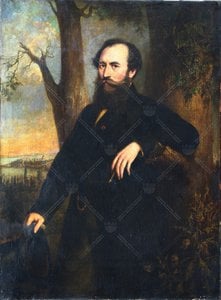
1809–1888 · Hungary · 2
August Schoefft (1809-1888) was a Hungarian painter renowned for his detailed portraits & scenes of 19th-century India's Sikh Empire, Mughal courts, and exotic subjects.
1. Court of Lahore, 8. Maharaja Sher Singh (1807-1843) seated


1866–1936 · Czech Republic · 2
Czech-Swiss Orientalist painter of Bedouin life and desert landscapes, known for intimate depictions of Muslim prayer and vibrant marketplaces.

1845–1902 · France · 2
10. Scene in a Harem (Un Envoi de Serbie), 13. Caucasian Boy

1847–1914 · France · 2
French Orientalist and portrait painter known for luminous Algerian scenes and elegant Third Republic figures rendered with meticulous detail.

1856–1940 · Hungary · 2
Arthur von Ferraris (1856-1936) was a Hungarian artist renowned for his Orientalist paintings & society portraits.
15. The coffee house, Cairo, 41. Negotiations in the Market Place
Questions & answers
Hover over a question to read the answer.
No. 1 is Ágoston Schoefft's Court of Lahore (1855). Next come Osman Hamdi Bey's The Tortoise Trainer (1906, Pera Museum), Paul Leroy's Idle Moments (1899) and Ludwig Deutsch's The Musician (n.d.).
The 10 most famous Orientalism paintings are Court of Lahore (Ágoston Schoefft), The Tortoise Trainer (Osman Hamdi Bey), Idle Moments (Paul Leroy), The Musician (Ludwig Deutsch), Public Prayer in the Mosque of Amr, Cairo (Jean-Léon Gérôme), Harem Women Feeding Pigeons in a Courtyard (Jean-Léon Gérôme), The Harem (also known as Parisian Women Dresses as Algerians) (Pierre-Auguste Renoir), Maharaja Sher Singh (1807-1843) seated (Ágoston Schoefft), Slave Market (Otto Pilny) and Scene in a Harem (Un Envoi de Serbie) (Jean-Joseph Benjamin-Constant).
Judged by this ranking, Jean-Léon Gérôme: 5 of the 100 most famous Orientalism paintings are from this painter's hand, including Public Prayer in the Mosque of Amr, Cairo, Harem Women Feeding Pigeons in a Courtyard and Moorish Bath.
The Metropolitan Museum of Art holds 3 of the 100, followed by the Pera Museum (1) and the National Museum of Western Art (1). New York is the city with the most: 3.
Start with New York (3), Istanbul (1) and Tokyo (1): together they hold 5 of the 100, at the Metropolitan Museum of Art, the Pera Museum and the National Museum of Western Art.
Ranked by the number of their works among the 100 most famous Orientalism paintings: Jean-Léon Gérôme (5), Ágoston Schoefft (2), Ludwig Deutsch (2), Otto Pilny (2) and Jean-Joseph Benjamin-Constant (2).
The earliest is David Roberts's Philae, Temple of Isis, the Court and the Second Pylon (1838) (1838); the latest, Georges Antoine Rochegrosse's The Flirt of Yesteryear (1919) (1919).
Ernest Normand's Moorish Scene with Women (1897), 128 × 225 cm. The smallest is Francis Frith's Entrance of the Church of the Holy Sepulchre (1858), 23 × 17 cm.
Of the 100 paintings, 83 are in oil, 0 in tempera or tempera and oil, and 1 are frescoes painted on the wall. 4 are on wooden panels and 45 on canvas.
They are: 1 of these 100 were painted in fresco, such as La Japonaise (Zimmerli Art Museum at Rutgers University).
89 of these 100 paintings are available hand-painted in oil, from $199, and 89 as a canvas print, from $49.
Each painting is ranked by how widely it is known: the number of Wikipedia language editions with an article on it (Wikidata sitelinks), its place in our catalogue's manual ranking and the visits its page receives. The same painting catalogued several times counts once, and details, copies and studies are left out.
Bring one home
89 paintings of this list can be ordered as museum-grade, hand-painted oil reproductions, from $199.


We started with every Orientalism painting in our catalogue and ranked them by how famous they are. Three clues decide the order: in how many languages Wikipedia has an article about the painting, where our curators place it, and how often people open its page on our site. Each painting appears only once, and details, copies and studies are left out.
 Famous Impressionism paintings
Water Lilies · Claude Monet
 Famous Baroque paintings
Las Meninas · Diego Velázquez
 Famous Romanticism paintings
Liberty Leading the People · Eugène Delacroix
 Famous Realism paintings
Nighthawks · Edward Hopper
 Famous Dutch Golden Age paintings
The Girl with a Pearl Earring · Johannes Vermeer
 Famous Neoclassicism paintings
Napoleon at the St. Bernard Pass · Jacques-Louis David
 Famous Expressionism paintings
The Scream · Edvard Munch
 Famous Academic Art paintings
The Birth of Venus · Alexandre Cabanel
 Famous Post-Impressionism paintings
Starry Night · Vincent van Gogh
 Famous Rococo paintings
The Swing · Jean-Honoré Fragonard
 Famous Surrealism paintings
The Persistence of Memory · Salvador Dalí
 Famous Symbolism paintings
The Wounded Angel · Hugo Simberg
 1000–1300
Famous High Medieval paintings
Crucifix · Cimabue
 1300–1400
Famous Late Medieval paintings
Madonna in Maest · Giotto
 1400–1600
Famous Renaissance paintings
Mona Lisa · Leonardo da Vinci
1600–1800
Famous Early Modern paintings
The Girl with a Pearl Earring · Johannes Vermeer
1800–1900
Famous 19th Century paintings
Starry Night · Vincent van Gogh
 1900–1980
Famous Modern paintings
Guernica · Pablo Picasso
 1980–
Famous Contemporary paintings
Girl with Balloon · Banksy