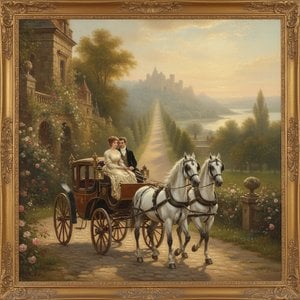
A Life Immersed in Equine Grace and Eastern Light
Adolf Schreyer, born in Frankfurt in 1828, was a painter whose life became inextricably linked to the powerful beauty of horses and the evocative landscapes of the East. His artistic journey began within the structured walls of the Städel Institute in his hometown, followed by formative studies in Stuttgart and Munich—a classical foundation upon which he would build a remarkably distinctive style. However, it was Schreyer’s travels that truly ignited his creative spirit and defined his enduring legacy. He wasn't merely observing these lands; he immersed himself within them, accompanying Prince Maximilian Karl of Thurn and Taxis on extensive journeys through Hungary, Wallachia, Russia, and Turkey. These weren’t superficial visits but deep dives into diverse cultures, allowing Schreyer to absorb the atmosphere, the light, and most importantly, the lives of the people he encountered. This early exposure instilled in him a fascination with both the grandeur of equestrian life and the vibrant tapestry of Eastern cultures—themes that would dominate his oeuvre for decades to come.From Battlefield Sketches to Orientalist Visions
Schreyer’s artistic development took a pivotal turn in 1854 when he documented the Austrian army's movements across the Wallachian frontier. This experience, far from being solely a military commission, provided him with invaluable insight into the realities of conflict and the role of horses within it. He wasn’t simply recording events; he was capturing the energy, the chaos, and the raw power of battle—a skill that would later manifest in compelling depictions of imperial guard artillery charges. Yet, his artistic heart lay elsewhere. Following this period, Schreyer ventured further afield, to Egypt and Syria in 1856, and then Algeria in 1861. It was in North Africa that he truly found his muse. He didn’t remain a detached observer; he learned Arabic, rode with Bedouin horsemen, and became deeply integrated into their way of life. This intimate understanding allowed him to portray these cultures with an authenticity rarely seen in Orientalist paintings of the time. His canvases weren't simply exotic representations but heartfelt tributes to a world that had captivated his imagination.A Master of Equine Anatomy and Atmospheric Detail
Schreyer’s technical skill was as remarkable as his adventurous spirit. He possessed an exceptional understanding of equine anatomy, born not just from observation but also from personal experience as a rider. His horses weren't merely props within a scene; they were dynamic, living creatures rendered with meticulous detail and anatomical precision. This mastery extended to his landscapes, which are often imbued with a palpable sense of atmosphere—the shimmering heat of the desert, the vastness of the Russian steppe, or the dramatic skies over Wallachian plains. He employed a rich palette and a confident brushstroke, creating paintings that were both visually stunning and emotionally resonant. His work stands apart from some of his contemporaries through its avoidance of overly romanticized depictions; instead, he strived for realism grounded in genuine observation.Recognition and Enduring Legacy
Throughout his career, Schreyer received considerable recognition for his talent. He exhibited regularly at the Paris Salon, earning medals in 1864, 1865, 1867, and 1876—a testament to the esteem in which his work was held by the French art establishment. His paintings found their way into prestigious collections across Europe and America, including the Metropolitan Museum of Art in New York, the Kunsthalle in Hamburg, and the Städel Institute in Frankfurt. Notably, several prominent American collectors – members of families like the Rockefellers, Vanderbilts, and Astors – eagerly acquired his works, recognizing their unique quality and artistic merit. Today, Schreyer’s paintings continue to captivate audiences with their blend of historical detail, cultural sensitivity, and technical brilliance. He remains a significant figure in 19th-century art, celebrated for his ability to capture the essence of both equine grace and the allure of distant lands. His legacy endures not only through the beauty of his canvases but also as a reminder of the power of travel, observation, and genuine cultural immersion to inspire artistic greatness.Questions & Answers
Where is Adolf Schreyer from?
Adolf Schreyer was born in Germany.
Is there a 3D virtual tour of Adolf Schreyer's works?
The 3D Museum of Adolf Schreyer is a page that displays the artist's artworks in a virtual three-dimensional gallery.
Can I browse Adolf Schreyer's works by mood?
Adolf Schreyer's works can be browsed by mood on the artist's Mood Room page, which arranges the artworks by their recorded moods.
How popular are Adolf Schreyer's artworks?
Statistics about Adolf Schreyer's works are available on the artist's Stats page.
Where are Adolf Schreyer's artworks grouped by art movement?
The movements Adolf Schreyer worked in can be seen on the artist's All Movements page, which groups the artworks by movement.
What are the birth city and country of Adolf Schreyer?
Adolf Schreyer was born in Frankfurt, in Germany.
What are the birthplace and birth year of Adolf Schreyer?
Adolf Schreyer was born in Frankfurt in 1828.