Museum-quality giclée or canvas print with fast production and flexible finish options. ( Buy Hand Made Painting Switch to Digital Image)





























Pick from our preset sizes that match the artwork's original proportions.

You may enter your own dimensions to fit a specific frame or space. If your selected size does not match the original image's proportions, we will either crop the artwork or extend the image with a mirrored or solid-fill edge. A digital mockup will be sent for your approval before production begins.
Please note that the on-screen preview does not reflect the actual cropping or extension. Only the mockup will accurately show the final composition.
While custom sizes are available, we recommend selecting a dimension from the predefined list to preserve the original proportions.
Worldwide Delivery () in 2 weeks instead of standard 4/5 weeks. (12 September)


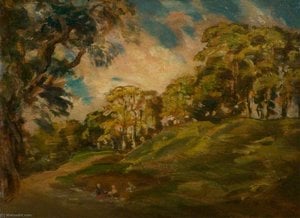
Chepstow Castle
Reproduction Size
Philip Wilson Steer's "Chepstow Castle" isn’t merely a depiction of a medieval fortress; it’s an immersion into the very essence of the Welsh landscape and the evocative power of memory. Painted in 1905, this watercolour captures more than just the physical structure of Chepstow Castle perched dramatically upon its limestone cliffs overlooking the River Wye. Instead, Steer offers us a shimmering, almost dreamlike vision—a testament to his profound understanding of light, atmosphere, and the enduring connection between man and nature. The castle itself, rendered with delicate washes of grey and ochre, seems to dissolve into the misty backdrop, becoming less a solid monument and more a spectral presence within the scene.
Steer’s artistic journey was one of constant evolution. Initially influenced by French Impressionism – particularly Manet and Whistler – he later sought inspiration in the works of John Constable and J.M.W. Turner, embracing a style that prioritized capturing fleeting moments and atmospheric effects over precise detail. This shift is powerfully evident here; the painting isn’t concerned with photographic accuracy but rather with conveying a specific mood—a sense of quiet contemplation and timelessness. The artist's deliberate blurring of edges and his masterful use of color create an ethereal quality, inviting the viewer to step into the scene and experience it as if they were standing beside the river themselves.
Steer’s decision to revisit the styles of Constable and Turner was a deliberate one, representing a conscious move away from the Parisian art world and back towards his British heritage. Constable's focus on the rural landscape—particularly the interplay of light and shadow in fields and waterways—provided Steer with a model for capturing the subtle nuances of the Welsh countryside. Similarly, Turner’s exploration of atmospheric perspective and his ability to evoke mood through color informed Steer’s approach to depicting the misty Wye Valley. The painting's silvery palette, reminiscent of Turner’s seascapes, suggests a sense of mystery and melancholy, while the composition echoes Constable’s emphasis on capturing the beauty of ordinary subjects.
Notably, Steer’s work during this period was heavily influenced by his travels in search of the picturesque. He sought out sites that were popular with eighteenth-century travelers—locations where the natural world could be experienced as a sublime and awe-inspiring spectacle. This pursuit is vividly reflected in "Chepstow Castle," which captures not just the castle itself but also the surrounding landscape, creating a harmonious whole. The inclusion of the River Wye, rendered with delicate washes of blue and grey, adds to the painting’s sense of tranquility and timelessness.
Beyond its purely visual qualities, "Chepstow Castle" is rich in symbolic meaning. The castle itself represents not only a physical structure but also a symbol of power, history, and resilience—a reminder of the enduring legacy of Norman England in Wales. The misty atmosphere surrounding the castle evokes a sense of nostalgia and longing, suggesting that the past is never truly gone but continues to resonate within the present. The figures on the boats add a human element to the scene, hinting at the ongoing connection between people and place.
Steer’s masterful use of light—particularly its ability to transform the landscape—creates an emotional resonance that transcends mere representation. The painting evokes a sense of quiet contemplation and invites the viewer to reflect on their own relationship with history, memory, and the natural world. It's a piece that speaks not just to the eye but also to the heart, offering a glimpse into the artist’s profound understanding of beauty and its power to inspire.


1860 - 1942 , United Kingdom

Discover the ethereal beauty of watercolor through an art-historical lens. Master the delicate balance of light, fluidity, and pigment to capture the luminous essence of nature, inspired by the legendary techniques of the Old Masters and Impressionist greats.

Discover the ethereal beauty of premium watercolor reproductions and bespoke commissions at WahooArt. From museum-quality landscapes to custom AI-enhanced portraits, our master artists deliver unparalleled craftsmanship and white-glove service for discerning collectors worldwide.

Master the nuances of Impressionism vs. Post-Impressionism with our expert guide. Explore the revolutionary shift from Monet’s fleeting light to Van Gogh’s emotional depth. Discover how these iconic movements continue to inspire fine art collectors and modern interiors today.

 Preview
 Send
Send Share
Share
 Details

 Download
 Similars
 X-Ray
X-Ray Diaporama
 Stats
Stats


 Read More







 Glass option is only available in size under 110 CM