Anteprima in scala reale Anteprima in AR Acquista il dipinto realizzato a mano Passa all'immagine digitale Invia
Dettagli opera Guida Aggiungi ai preferiti Scarica Simili Radiografia Slideshow Statistiche

Venus Anadyomene

Experience Titian's 'Venus Anadyomene'! This iconic Renaissance masterpiece depicts the goddess rising from the sea, showcasing exquisite detail and beauty. Explore its rich history & symbolism.

Tiziano Vecellio, il gigante della pittura veneziana e del Rinascimento italiano, rivoluzionò l'uso del colore con opere immortali come Venere Urbino e la Scuola Grande dei Maestri.

Giclée / Stampe d'arte

Stampa giclée o su tela di qualità museale, con produzione rapida e diverse opzioni di finitura. ( Acquista il dipinto realizzato a mano Passa all'immagine digitale)

Corner sample of the P118B picture frame: polistirene stampato, 5 cm wide and 3 cm thick
P118B €10
Corner sample of the P118H picture frame: polistirene stampato, 5 cm wide and 3 cm thick
P118H €10
Corner sample of the P118W picture frame: polistirene stampato, 5 cm wide and 3 cm thick
P118W €10
Corner sample of the P438Z picture frame: polistirene stampato, 5.5 cm wide and 3.5 cm thick
P438Z €10
Corner sample of the P508JH picture frame: polistirene stampato, 7 cm wide and 3.5 cm thick
P508JH €12
Corner sample of the P508YH picture frame: polistirene stampato, 7 cm wide and 3.5 cm thick
P508YH €12
Corner sample of the P805H picture frame: polistirene stampato, 5 cm wide and 3.5 cm thick
P805H €10
Corner sample of the P805Z picture frame: polistirene stampato, 5 cm wide and 3.5 cm thick
P805Z €10
Corner sample of the P919BZ picture frame: polistirene stampato, 7 cm wide and 3.5 cm thick
P919BZ €10
Corner sample of the P919G picture frame: polistirene stampato, 7 cm wide and 3.5 cm thick
P919G €10
Corner sample of the P919XJ picture frame: polistirene stampato, 7 cm wide and 3.5 cm thick
P919XJ €10
Corner sample of the P959ZH picture frame: polistirene stampato, 5 cm wide and 3 cm thick
P959ZH €10
Corner sample of the P968JZ picture frame: polistirene stampato, 6 cm wide and 4 cm thick
P968JZ €12
Corner sample of the W106C picture frame: legno massello, 5 cm wide and 3 cm thick
W106C €8
Corner sample of the W218G picture frame: legno massello, 5 cm wide and 3 cm thick
W218G €10
Corner sample of the W218JH picture frame: legno massello, 5 cm wide and 3 cm thick
W218JH €8
Corner sample of the W218Y picture frame: legno massello, 5 cm wide and 3 cm thick
W218Y €10
Corner sample of the W307PJ picture frame: legno massello, 6 cm wide and 3 cm thick
W307PJ €10
Corner sample of the W316G picture frame: legno massello, 6 cm wide and 3 cm thick
W316G €10
Corner sample of the W316PJ picture frame: legno massello, 6 cm wide and 3 cm thick
W316PJ €8
Corner sample of the W316Y picture frame: legno massello, 6 cm wide and 3 cm thick
W316Y €10
Corner sample of the W398PJ picture frame: legno massello, 5 cm wide and 3 cm thick
W398PJ €8
Corner sample of the W4111J picture frame: legno massello, 6.5 cm wide and 3.5 cm thick
W4111J €10
Corner sample of the W500HY picture frame: legno massello, 7 cm wide and 5 cm thick
W500HY €15
Corner sample of the W500JH picture frame: legno massello, 7 cm wide and 5 cm thick
W500JH €15
Corner sample of the W692G picture frame: legno massello, 8 cm wide and 4 cm thick
W692G €12
Corner sample of the W849H picture frame: legno massello, 5 cm wide and 3 cm thick
W849H €8
Corner sample of the W940BG picture frame: legno massello, 7.5 cm wide and 4.5 cm thick
W940BG €15
Corner sample of the W953PJ picture frame: legno massello, 6 cm wide and 3.5 cm thick
W953PJ €8

Formato standard
su misura
CM
INCH

Scegli tra le nostre dimensioni predefinite, che rispettano le proporzioni originali dell'opera d'arte.

larghezza
altezza

Inserisci la larghezza e l'altezza desiderate, per adattarle alla tua cornice o alla tua parete. Una stampa può essere solo ritagliata, mai resa più grande dell'immagine originale; pertanto, un formato con una forma differente comporterà la perdita di una parte dell'opera. Ti invieremo un mockup digitale da approvare prima di procedere con la stampa. L'immagine mostrata in questa pagina non rappresenta il ritaglio reale — solo il mockup lo mostra.

Consegna in tutto il mondo () in 2 settimane invece delle normali 4/5 settimane. (27 Ottobre)

Spedizione espressa gratuita in tutto il mondo
Tela in lino di alta qualità
Assicurazione completa sulla spedizione
Garanzia di rimborso dei dazi doganali
Garanzia di fedeltà cromatica assoluta
Politica di reso entro 100 giorni (solo per difetti di fabbricazione)
Garanzia di rimborso al 100%
Offerta per acquisti multipli

Prezzo totale

€ 60

Venus Anadyomene

Giclée / Stampe d'arte

Dimensioni riproduzione

-

Prezzo finale calcolato

€ 60

The Divine Emergence: Titian’s “Venus Anadyomene”

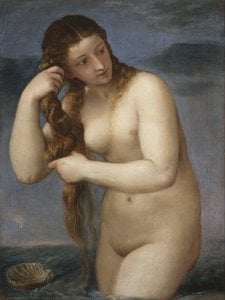
Titian’s “Venus Anadyomene,” painted around 1520, isn't merely a depiction of the goddess; it’s an embodiment of Renaissance ideals—a vibrant celebration of beauty, mythology, and the mastery of color. This oil on canvas masterpiece, now residing in the Scottish National Gallery, captures a pivotal moment: Venus rising from the sea, her hair cascading down as she sheds the remnants of her birth, a gesture simultaneously vulnerable and triumphant. The painting immediately draws the eye with its luminous palette—a symphony of blues, pinks, and golds that evoke both the depths of the ocean and the radiant glow of dawn. It’s a testament to Titian's unparalleled ability to render light and texture, creating an illusion of palpable wetness on Venus’ skin and the shimmering surface of the water.

A Myth Reimagined: The Story Behind the Scene

The title itself, “Anadyomene,” translates to "one who has risen from the sea," referencing a key episode in Greek mythology. According to Hesiod and other classical sources, Venus was born fully-grown from the sea foam—the result of Cronus’s discarded genitals thrown into the ocean. This birth wasn't gentle; it was an emergence, a forceful rising from the depths. Titian brilliantly captures this dynamic moment, portraying Venus not as a passive figure but as an active participant in her own creation. The inclusion of the small scallop shell—a symbol of femininity and fertility—reinforces this narrative, grounding the divine birth within the tangible world. Interestingly, the shell is smaller than in other depictions of Venus’s birth, suggesting that Titian isn't simply illustrating a mythological event but rather emphasizing the goddess’s inherent power and self-sufficiency.

Technique and Style: A Masterclass in Color and Form

Titian’s genius lies not just in his subject matter, but also in his revolutionary approach to painting. He employed a technique known as “alla prima,” meaning he worked directly on the canvas without underdrawing or preparatory sketches. This resulted in loose, vibrant brushstrokes that contribute significantly to the painting's dynamism and immediacy. Notice how Titian builds up layers of color—thin washes of pigment layered over each other to create depth and luminosity. The use of warm, saturated hues contrasts sharply with the cool blues of the sea, creating a captivating visual tension. Furthermore, his masterful handling of drapery – or rather, the *suggestion* of drapery – adds to the sense of movement and fluidity. Venus’s hair isn't rigidly defined; it flows organically around her form, mirroring the waves of the ocean.

Symbolism and Emotional Resonance: More Than Just a Pretty Picture

Beyond its aesthetic beauty, “Venus Anadyomene” is rich in symbolic meaning. Venus herself represents love, beauty, and fertility—powerful forces that have captivated artists and audiences for centuries. Her act of wringing her hair can be interpreted as a shedding of the past, a release from the primal chaos of her birth. It’s an assertion of her independence and her dominion over the natural world. The painting also subtly references classical sculpture, particularly the Crouching Venus and Cnidian Venus—statues that depicted Venus in a similar pose, emphasizing her graceful form and serene expression. Titian's deliberate inclusion of these echoes from antiquity demonstrates his ambition to not only capture a mythological scene but to engage with the artistic traditions of the past.

Ultimately, “Venus Anadyomene” is more than just a beautiful painting; it’s a profound meditation on birth, beauty, and the enduring power of myth. It invites us to contemplate the goddess's emergence from the depths—a potent symbol of renewal, transformation, and the eternal allure of the feminine ideal.

Domande e risposte

In quale fase della carriera di Tiziano Vecellio si colloca "Venus Anadyomene", considerando la sua datazione?

La data del 1520 colloca "Venus Anadyomene" nel Mature Period della carriera di Tiziano Vecellio.

Qual è la luminosità di "Venus Anadyomene" di Tiziano Vecellio?

"Venus Anadyomene" di Tiziano Vecellio ha una luminanza di Soft Shadow. La luminanza descrive quanta luce sembrano riflettere i colori.

Il copyright di "Venus Anadyomene" di Tiziano Vecellio consente la riproduzione dell'opera?

"Venus Anadyomene" di Tiziano Vecellio, conservata presso Galleria Nazionale di Scozia, è di pubblico dominio - il copyright è scaduto. Questo stato determina se sia possibile realizzare riproduzioni dell'immagine.


Biografia dell'artista

Tiziano Vecellio: The Venetian Titan

Tiziano Vecellio, universally known as Titian, stands as a monumental figure of the Italian Renaissance—perhaps its most celebrated colorist and a master who redefined the possibilities of oil painting. Born around 1490 in Pieve di Cadore, nestled amidst the dramatic landscapes of the Venetian Alps, his journey from humble beginnings to international acclaim is a testament to prodigious talent and an unwavering dedication to artistic innovation. The exact date of Titian’s birth remains elusive, debated by scholars, but contemporary sources and his early stylistic development suggest that he emerged into the world sometime between 1488 and 1490.

His father, Gregorio Vecellio, was a military man—a profession that instilled in young Tiziano a disciplined spirit and an appreciation for observation. Lucia, his mother, nurtured him with a love of beauty and fostered his artistic inclinations. Recognizing their sons’ potential, the family arranged for Tiziano and Francesco to apprentice under Sebastiano Zuccato, a renowned mosaicist—a decision that would irrevocably steer them toward a path of artistic excellence.

Venice at the turn of the 16th century was a vibrant hub of commerce, culture, and artistic ferment. Titian’s initial training took place within the workshop of Giovanni Bellini—the most influential painter in Venice at the time—where he absorbed the stylistic precepts of his elder mentor. This formative experience instilled in him a profound understanding of Venetian painting traditions and established the foundation for his own distinctive style.

A Meeting with Giorgione: The Seeds of Innovation

However, it was through contact with Giorgione—a fellow Venetian painter whose work possessed an ethereal poetic quality—that Titian truly embarked on his artistic odyssey. The two artists collaborated on several ambitious projects, including the decoration of the exterior walls of the Fondaco dei Tedeschi—a bustling trading post for German merchants—and their partnership cemented a bond that would shape the trajectory of Venetian art.

Giorgione’s influence is palpable in Titian’s early canvases—characterized by hazy atmospheric effects, muted colors, and an emphasis on capturing mood rather than precise detail. Paintings like *A Man with a Quilted Sleeve* exemplify this stylistic approach, demonstrating Titian’s burgeoning talent for portraiture while simultaneously reflecting Giorgione’s pioneering exploration of perceptual illusion.

From Pastel Dreams to Bold Luminosity

As Titian matured, he gradually distanced himself from Giorgione’s delicate aesthetic and embraced a bolder, more dramatic style—one marked by vibrant hues, expressive brushstrokes, and an unwavering commitment to conveying emotion. *The Visitation of Mary and Elizabeth*, now housed in the Accademia di Venezia, exemplifies this stylistic shift, showcasing Titian’s mastery of composition and color to create a scene brimming with psychological depth.

Throughout his prolific career, Titian consistently pushed the boundaries of artistic convention—experimenting with innovative techniques and exploring diverse subjects ranging from mythological narratives to religious iconography. His portraits became renowned for their uncanny realism—capturing not only physical likeness but also subtle nuances of character and emotion—establishing him as one of the foremost portraitists of his era.

A Legacy Illuminated

Titian’s artistic legacy extends far beyond his lifetime, profoundly influencing generations of painters who followed in his footsteps. His pioneering use of color—particularly his masterful manipulation of tonal harmonies—established a new paradigm for oil painting and inspired artists across Europe to embrace luminous palettes and expressive brushwork.

From Rubens to Rembrandt to Delacroix, Titian’s influence permeated the artistic landscape of the Baroque period and beyond. His paintings continue to captivate audiences today with their breathtaking beauty—a testament to his unparalleled skill as a colorist and a painter—solidifying his place among the titans of Western art history.

Tiziano Vecellio

Tiziano Vecellio

1490 - 1576 , Italia

Dettagli rapidi

  • Artistic Movement Or Style: Venetian painting
  • Artists Who Influenced This Artist:
    • Giovanni Bellini
    • Giorgione
  • Date Of Birth: c. 1490
  • Date Of Death: 1576
  • Full Name: Tiziano Vecellio
  • Nationality: Italian
  • Notable Artworks:
    • A Man with a Quilted Sleeve
    • The Visitation
    • Bearded Young Man
  • Place Of Birth: Pieve di Cadore, Italia
Esplora le opere d'arte organizzate per temi, stili e caratteristiche.