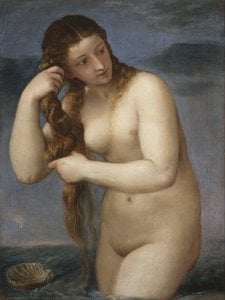
Venus Anadyomene (1520) di Tiziano, riproduzione di un dipinto a olio realizzato a mano da un maestro d'arte
Anteprima in scala reale Anteprima in AR Passa alle stampe Passa all'immagine digitale Invia
Dettagli opera Guida Aggiungi ai preferiti Scarica Simili Radiografia Slideshow Domande e risposte Scarica presentazione Statistiche

Venus Anadyomene Riproduzione di un dipinto a olio dipinto a mano

Dimensioni
76.0 x 57.0 cm

Experience Titian's 'Venus Anadyomene'! This iconic Renaissance masterpiece depicts the goddess rising from the sea, showcasing exquisite detail and beauty. Explore its rich history & symbolism.

Maestro del colore del Rinascimento veneziano, celebre per la Venere di Urbino. Scopri oggi i capolavori di Tiziano.

Riproduzione a olio fatta a mano

Olio su tela dipinto a mano nelle tue dimensioni e con la tua cornice, realizzato su ordinazione dai nostri artisti. ( Passa alle stampe Passa all'immagine digitale)

Corner sample of the P118B picture frame: polistirene stampato, 5 cm wide and 3 cm thick
P118B €10
Corner sample of the P118H picture frame: polistirene stampato, 5 cm wide and 3 cm thick
P118H €10
Corner sample of the P118W picture frame: polistirene stampato, 5 cm wide and 3 cm thick
P118W €10
Corner sample of the P438Z picture frame: polistirene stampato, 5.5 cm wide and 3.5 cm thick
P438Z €10
Corner sample of the P508JH picture frame: polistirene stampato, 7 cm wide and 3.5 cm thick
P508JH €12
Corner sample of the P508YH picture frame: polistirene stampato, 7 cm wide and 3.5 cm thick
P508YH €12
Corner sample of the P805H picture frame: polistirene stampato, 5 cm wide and 3.5 cm thick
P805H €10
Corner sample of the P805Z picture frame: polistirene stampato, 5 cm wide and 3.5 cm thick
P805Z €10
Corner sample of the P919BZ picture frame: polistirene stampato, 7 cm wide and 3.5 cm thick
P919BZ €10
Corner sample of the P919G picture frame: polistirene stampato, 7 cm wide and 3.5 cm thick
P919G €10
Corner sample of the P919XJ picture frame: polistirene stampato, 7 cm wide and 3.5 cm thick
P919XJ €10
Corner sample of the P959ZH picture frame: polistirene stampato, 5 cm wide and 3 cm thick
P959ZH €10
Corner sample of the P968JZ picture frame: polistirene stampato, 6 cm wide and 4 cm thick
P968JZ €12
Corner sample of the W106C picture frame: legno massello, 5 cm wide and 3 cm thick
W106C €8
Corner sample of the W218G picture frame: legno massello, 5 cm wide and 3 cm thick
W218G €10
Corner sample of the W218JH picture frame: legno massello, 5 cm wide and 3 cm thick
W218JH €8
Corner sample of the W218Y picture frame: legno massello, 5 cm wide and 3 cm thick
W218Y €10
Corner sample of the W307PJ picture frame: legno massello, 6 cm wide and 3 cm thick
W307PJ €10
Corner sample of the W316G picture frame: legno massello, 6 cm wide and 3 cm thick
W316G €10
Corner sample of the W316PJ picture frame: legno massello, 6 cm wide and 3 cm thick
W316PJ €8
Corner sample of the W316Y picture frame: legno massello, 6 cm wide and 3 cm thick
W316Y €10
Corner sample of the W398PJ picture frame: legno massello, 5 cm wide and 3 cm thick
W398PJ €8
Corner sample of the W4111J picture frame: legno massello, 6.5 cm wide and 3.5 cm thick
W4111J €10
Corner sample of the W500HY picture frame: legno massello, 7 cm wide and 5 cm thick
W500HY €15
Corner sample of the W500JH picture frame: legno massello, 7 cm wide and 5 cm thick
W500JH €15
Corner sample of the W692G picture frame: legno massello, 8 cm wide and 4 cm thick
W692G €12
Corner sample of the W849H picture frame: legno massello, 5 cm wide and 3 cm thick
W849H €8
Corner sample of the W940BG picture frame: legno massello, 7.5 cm wide and 4.5 cm thick
W940BG €15
Corner sample of the W953PJ picture frame: legno massello, 6 cm wide and 3.5 cm thick
W953PJ €8

Formato standard
su misura
CM
INCH

Scegli tra le nostre dimensioni predefinite, che rispettano le proporzioni originali dell'opera d'arte.

larghezza
altezza

Inserisci la larghezza e l'altezza desiderate, per adattarle alla tua cornice o alla tua parete. Trattandosi di un'opera dipinta a mano, in caso di dimensioni con un formato differente, l'artista può estendere leggermente il dipinto oltre i bordi dell'immagine o ritagliare una piccola parte — la scelta spetta a te. Ti invieremo un mockup digitale da approvare prima che la realizzazione abbia inizio. L'immagine mostrata in questa pagina non rappresenta il risultato finale — solo il mockup lo fa.

Esempi di ciò che può essere modificato: sostituire il volto con una foto del cliente; aggiungere un animale domestico (ad esempio, sostituire un gatto con un cane); inserire un messaggio nascosto nello sfondo; cambiare il paesaggio o gli elementi dello sfondo.
Dopo l'ordine, il team di WahooArt.com contatterà il cliente via e-mail per ricevere le istruzioni e fornirà un'anteprima del mockup

Consegna in tutto il mondo () in 3/4 settimane anziché nelle normali 5 settimane. (11 Novembre). Nessun compromesso sulla qualità.

Spedizione espressa gratuita in tutto il mondo
Tela in lino di alta qualità
Assicurazione completa sulla spedizione
Garanzia di rimborso dei dazi doganali
Garanzia di fedeltà cromatica assoluta
Politica di reso entro 100 giorni (solo per difetti di fabbricazione)
Garanzia di rimborso al 100%
Offerta per acquisti multipli

Prezzo totale

€ 243

Venus Anadyomene

Tecnica di riproduzione

Dimensioni riproduzione

-

Prezzo finale calcolato

€ 243

The Divine Emergence: Titian’s “Venus Anadyomene”

Titian’s “Venus Anadyomene,” painted around 1520, isn't merely a depiction of the goddess; it’s an embodiment of Renaissance ideals—a vibrant celebration of beauty, mythology, and the mastery of color. This oil on canvas masterpiece, now residing in the Scottish National Gallery, captures a pivotal moment: Venus rising from the sea, her hair cascading down as she sheds the remnants of her birth, a gesture simultaneously vulnerable and triumphant. The painting immediately draws the eye with its luminous palette—a symphony of blues, pinks, and golds that evoke both the depths of the ocean and the radiant glow of dawn. It’s a testament to Titian's unparalleled ability to render light and texture, creating an illusion of palpable wetness on Venus’ skin and the shimmering surface of the water.

A Myth Reimagined: The Story Behind the Scene

The title itself, “Anadyomene,” translates to "one who has risen from the sea," referencing a key episode in Greek mythology. According to Hesiod and other classical sources, Venus was born fully-grown from the sea foam—the result of Cronus’s discarded genitals thrown into the ocean. This birth wasn't gentle; it was an emergence, a forceful rising from the depths. Titian brilliantly captures this dynamic moment, portraying Venus not as a passive figure but as an active participant in her own creation. The inclusion of the small scallop shell—a symbol of femininity and fertility—reinforces this narrative, grounding the divine birth within the tangible world. Interestingly, the shell is smaller than in other depictions of Venus’s birth, suggesting that Titian isn't simply illustrating a mythological event but rather emphasizing the goddess’s inherent power and self-sufficiency.

Technique and Style: A Masterclass in Color and Form

Titian’s genius lies not just in his subject matter, but also in his revolutionary approach to painting. He employed a technique known as “alla prima,” meaning he worked directly on the canvas without underdrawing or preparatory sketches. This resulted in loose, vibrant brushstrokes that contribute significantly to the painting's dynamism and immediacy. Notice how Titian builds up layers of color—thin washes of pigment layered over each other to create depth and luminosity. The use of warm, saturated hues contrasts sharply with the cool blues of the sea, creating a captivating visual tension. Furthermore, his masterful handling of drapery – or rather, the *suggestion* of drapery – adds to the sense of movement and fluidity. Venus’s hair isn't rigidly defined; it flows organically around her form, mirroring the waves of the ocean.

Symbolism and Emotional Resonance: More Than Just a Pretty Picture

Beyond its aesthetic beauty, “Venus Anadyomene” is rich in symbolic meaning. Venus herself represents love, beauty, and fertility—powerful forces that have captivated artists and audiences for centuries. Her act of wringing her hair can be interpreted as a shedding of the past, a release from the primal chaos of her birth. It’s an assertion of her independence and her dominion over the natural world. The painting also subtly references classical sculpture, particularly the Crouching Venus and Cnidian Venus—statues that depicted Venus in a similar pose, emphasizing her graceful form and serene expression. Titian's deliberate inclusion of these echoes from antiquity demonstrates his ambition to not only capture a mythological scene but to engage with the artistic traditions of the past.

Ultimately, “Venus Anadyomene” is more than just a beautiful painting; it’s a profound meditation on birth, beauty, and the enduring power of myth. It invites us to contemplate the goddess's emergence from the depths—a potent symbol of renewal, transformation, and the eternal allure of the feminine ideal.

Domande e risposte

Quale colore risalta di più in "Venus Anadyomene"?

Il colore che risalta maggiormente in "Venus Anadyomene" è Grigio tortora (#d8b696). Il colore dominante è utile per abbinare un'opera d'arte a un ambiente interno.

A chi è consigliato "Venus Anadyomene" come regalo e per quale occasione?

"Venus Anadyomene" è un'idea regalo ideale per Anniversario, pensata per Pezzo forte.

Quali sono le dimensioni dell'originale "Venus Anadyomene"?

"Venus Anadyomene" misura 76 x 57 cm nella sua forma originale. Le dimensioni originali sono un utile riferimento per scegliere la dimensione di una riproduzione.


Biografia dell'artista

Il Pittore di Luce e Ombra

Nelle aspre e montuose regioni di Pieve di Cadore, un ragazzo di nome Tiziano Vecellio iniziò una vita che avrebbe infine plasmato il linguaggio stesso dell'olio su tela. Nato intorno al 1490, era figlio di Gregorio Vecellio, un uomo di mondo militare, e di una donna di nome Lucia. La famiglia viveva in una regione dove le vette drammatiche delle Alpi Venete proiettavano ombre lunghe e mutevoli sul territorio, un paesaggio che forse sussurrava i segreti della luce a una mente giovane. Riconoscendo la scintilla del talento nei propri figli, la famiglia guardò verso la grande città di Venezia, organizzando l'ingresso del giovane Tiziano e di suo fratello Francesco nelle botteghe dei maestri. Questo passaggio dalle tranquille montagne ai vivaci canali veneziani, intrisi di salsedine, cambiò tutto.

I suoi primi anni furono trascorsi ad assorbire l'atmosfera di una città che pulsava di commerci e colori. Apprese inizialmente il mestiere sotto Sebastiano Zuccato, un mosaicista, prima di entrare nelle cerchie di Gentile Bellini e di suo fratello Giovanni. Eppure, fu il tempo trascorso accanto a Giorgione a definire veramente il suo cammino. Insieme, lavorarono agli affreschi esterni del Fondaco dei Tedeschi, un frenetico avamposto commerciale per i mercanti tedeschi. In quei primi tempi, il suo pennello cercava un certo lirismo, un modo per catturare l'aria stessa attraverso toni sottili e un tocco gentile e poetico.

L'Evoluzione di uno Stile Veneziano

Con il passare degli anni, le qualità morbide ed eteree della giovinezza lasciarono il posto a qualcosa di molto più muscolare e drammatico. Si allontanò dalla quiete della sua formazione iniziale per abbracciare un approccio più audace al colore. La sua pennellata divenne uno strumento di immenso potere, passando da superfici lisce e sfumate a segni sciolti ed espressivi che sembravano pulsare di vita. Imparò a stratificare sottili velature di pigmento sopra le pitture sottostanti, una tecnica che gli permise di raggiungere una luminosità che pochi potevano replicare. Non si trattava solo di raffigurare un soggetto, ma di catturarne il peso del velluto, il bagliore della pelle e l'atmosfera stessa che avvolgeva una figura.

I suoi soggetti erano vari quanto le persone che percorrevano le strade di Venezia. Divenne un maestro del ritratto, catturando la profondità psicologica dei suoi modelli, dal somiglianza fisica di un uomo al carattere nascosto nel suo intimo. Le sue scene mitologiche e le sue composizioni religiose erano imbevute di una sensualità e di una tensione che rapivano lo spettatore. In opere come Venere Urbino, ridefinì il modo in cui la forma umana veniva presentata, usando il colore per creare un senso di presenza quasi tattile. Era un uomo che aveva compreso che la luce non si limita a cadere su un oggetto; essa interagisce con esso, creando un dramma di ombra e splendore.

Una Vita di Grandezza e Influenza

La fama di Tiziano Vecellio raggiunse infine le più alte corti d'Europa. Divenne il preferito di uomini potenti, servendo come pittore dell'Imperatore Carlo V, del Re Filippo II di Spagna e di Papa Paolo III. Questo patronato di alto livello gli permise di lavorare su una scala monumentale, creando tele immense che riempivano le sale dei palazzi e gli altari di grandi chiese. Possedeva una rara finezza diplomatica, adattando il suo stile ai gusti delle diverse corti reali senza mai perdere la voce distintiva che lo rese un titano della sua epoca.

Quando morì a Venezia nel 1576, lasciò un'eredità che avrebbe riverberato attraverso i secoli. La sua influenza fu percepita da coloro che lo seguirono, dalla pennellata densa di Rubens alla luce drammatica di Rembrandt e ai tratti audaci di Delacroix. Agì come un ponte tra il Rinascimento maturo e l'imminente era barocca, dimostrando che il colore poteva essere altrettanto espressivo della linea. I suoi dipinti rimangono nelle grandi collezioni del mondo, dal Prado di Madrid alla National Gallery di Londra, testimoniando permanentemente l'opera di un uomo che ha dominato l'arte del vedere.

Tiziano

Tiziano

1490 - 1576 , Italia

Dettagli rapidi

  • Artistic Movement Or Style: Rinascimento veneziano
  • Artists Or Movements Influenced By This Artist:
    • Peter Paul Rubens
    • Rembrandt
    • Eugène Delacroix
    • Édouard Manet
  • Artists Who Influenced This Artist:
    • Sebastiano Zuccato
    • Gentile Bellini
    • Giovanni Bellini
    • Giorgione
  • Date Of Birth: 1490
  • Date Of Death: 1576
  • Full Name: Tiziano Vecellio
  • Nationality: Italiana
  • Notable Artworks:
    • Un uomo con una manica trapuntata
    • La Visitazione di Maria ed Elisabetta
    • Venere di Urbino
    • Diana e Atteone
    • Concert Champêtre
  • Place Of Birth: Pieve di Cadore, Italia
Esplora le opere d'arte organizzate per temi, stili e caratteristiche.