The Vision of Ezekiel: A Renaissance Revelation
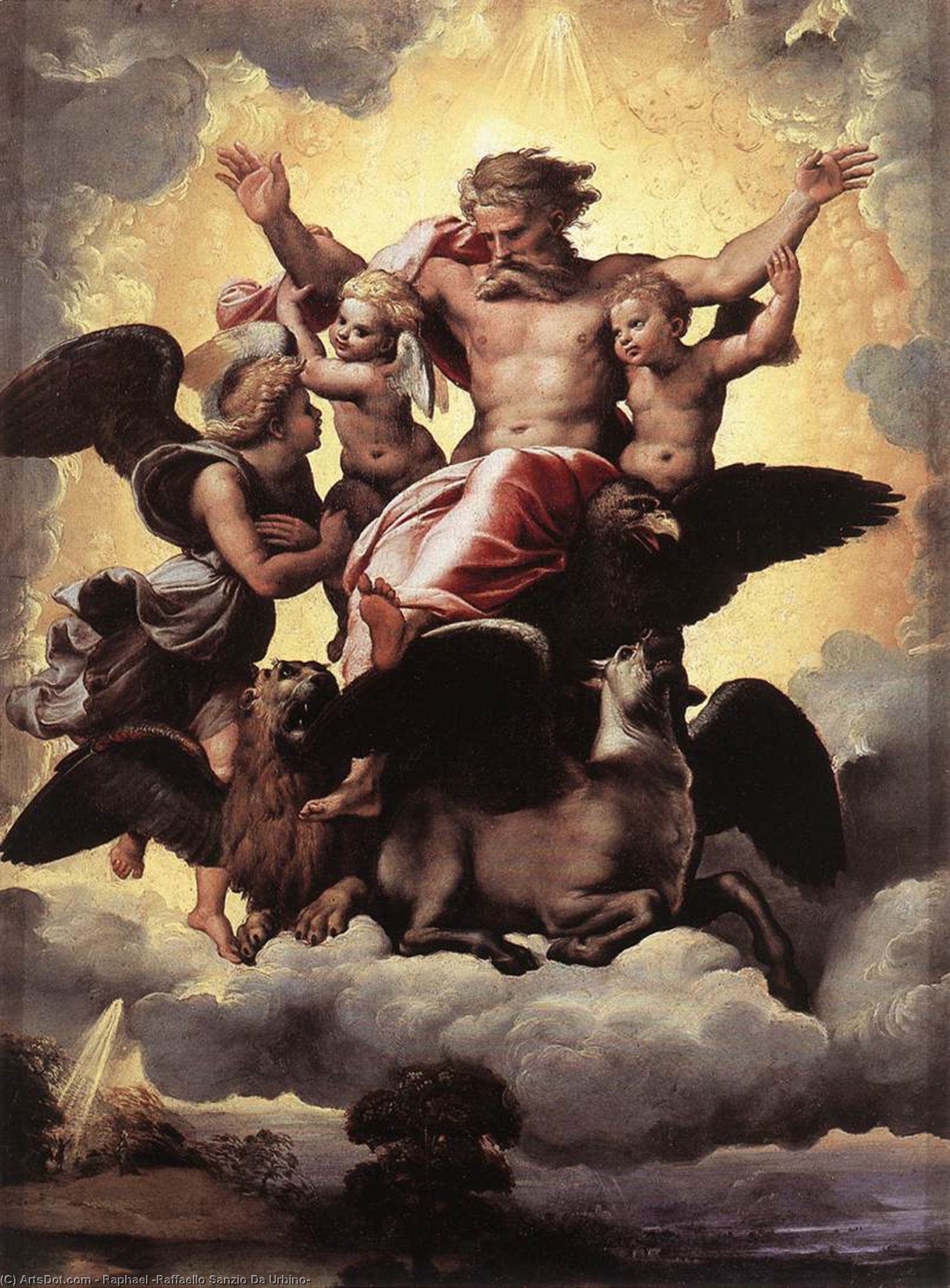
Raphael’s “Vision of Ezekiel,” painted in 1518, is more than just a depiction of a biblical prophecy; it’s a profound meditation on divine presence and the human capacity for awe. Housed within the Palatine Gallery of Palazzo Pitti in Florence, this small panel—measuring a modest 40 by 30 centimeters—bursts with an almost overwhelming sense of spiritual intensity. It’s a work that immediately draws you in, inviting contemplation on themes of faith, judgment, and the sublime beauty of God’s majesty. The painting masterfully blends elements of High Renaissance idealism with the dramatic dynamism influenced by his contemporary, Michelangelo, creating a visual experience both serene and powerfully emotive.
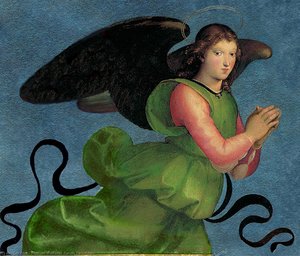
At its heart lies Jesus Christ, rendered in exquisite detail within a swirling vortex of clouds – a direct reference to Ezekiel’s vision of God ascending from his throne. His outstretched arms, seemingly reaching towards an unseen realm, convey a sense of vulnerability and surrender before the divine. Surrounding him are angels, not depicted as imposing warriors but rather as graceful, almost ethereal figures, their wings shimmering with light. The inclusion of children adds a poignant layer to the scene, suggesting innocence and a connection between God’s grace and humanity’s future. This carefully orchestrated composition—a testament to Raphael’s genius—isn’t merely a narrative illustration; it’s an invitation to consider the relationship between earthly existence and the eternal.
The Artist: Raphael Sanzio – A Master of Harmony
Raphael Sanzio da Urbino, born Raffaello Sanzio in 1483, stands as one of the titans of the High Renaissance. Alongside Leonardo da Vinci and Michelangelo—a triumvirate that shaped the course of Western art—Raphael possessed a rare gift for capturing beauty, grace, and emotional depth. His early training under his father, Giovanni Santi, a court painter to Duke Federico da Montefeltro in Urbino, instilled in him an appreciation for both artistic skill and humanist ideals. This upbringing fostered a deep understanding of classical forms and a sensitivity to the nuances of human expression.
Raphael’s career unfolded across Italy, culminating in his time in Rome. He quickly established himself as a sought-after artist, commissioned by Popes Julius II and Leo X to create some of the most iconic works of the era. His workshop was remarkably productive, employing talented assistants who helped him execute complex projects, including the magnificent frescoes adorning the Raphael Rooms within the Vatican Palace. His ability to seamlessly blend technical mastery with a profound understanding of human psychology is what truly sets his work apart.
A Synthesis of Styles: Echoes of Michelangelo and the Divine
“The Vision of Ezekiel” reveals a fascinating interplay of influences, most notably from Michelangelo’s Sistine Chapel ceiling. The dramatic composition—the swirling clouds, the dynamic figures, and the sense of overwhelming scale—bears a clear resemblance to Michelangelo's monumental work. However, Raphael tempers this dynamism with his characteristic elegance and restraint, creating a more harmonious and balanced image. The use of light is particularly striking, bathing the scene in a golden glow that emphasizes the spiritual nature of the event.
Beyond Michelangelo, Raphael’s style reflects the artistic traditions of Florence, where he spent several formative years. The influence of Florentine perspective and naturalism is evident in the meticulous detail of the figures and the realistic portrayal of their expressions. Yet, unlike the often-earthy realism of his contemporaries, Raphael imbues his work with a sense of idealized beauty—a testament to his belief in the inherent goodness of humanity and the power of divine grace. The painting’s palette is rich and vibrant, dominated by warm hues of gold, crimson, and azure, creating a visually stunning experience.
Historical Context & Symbolism: A Window into Faith
Originally owned by Vincenzo Ercolani, a Bolognese nobleman, “The Vision of Ezekiel” has traversed a fascinating history. While records indicate payment to Raphael in 1510, but this is generally considered just a down payment, since stylistically the work cannot be dated before 1518.
In Florence since as early as 1589, it was ceded to Francesco I de’ Medici and was placed at the Uffizi. In 1799 it was robbed by the French, who kept it in Paris until returning it back in 1816.
The scene itself draws directly from the Book of Ezekiel in the Hebrew Bible, where the prophet receives a series of visions of God’s glory. The imagery—the throne-like figure surrounded by angels and children—is laden with symbolic meaning.
The four creatures flanking the central figure – man, ox, lion, and eagle – are traditional representations of the four evangelists, each associated with a specific symbol in Ezekiel’s vision. The presence of children underscores the promise of salvation and renewal for future generations.
“The Vision of Ezekiel” is not simply a depiction of a biblical event; it’s an invitation to contemplate humanity’s place within the divine order—a timeless masterpiece that continues to resonate with viewers centuries after its creation.



 Acquista stampa
 Invia
Invia Condividi
 Dettagli

 Scarica
 Simili
 Radiografia
 Slideshow

 Scopri di più






































 L'opzione vetro è disponibile solo per dimensioni inferiori a 110 cm