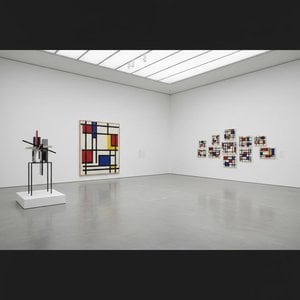
Lozenge Composition 3 Lines Blue Gray Yellow - Piet Mondrian
Piet Mondrian’s “Lozenge Composition 3 Lines Blue Gray Yellow” isn't merely pigment on canvas; it’s a crystallized declaration of artistic conviction—a distillation of Neoplasticism, the stylistic cornerstone he championed as a pathway to spiritual and aesthetic purity. Emerging from the vibrant crucible of early 20th-century abstraction, this artwork embodies the core tenets of De Stijl, reflecting Mondrian's unwavering belief in the universality of geometric forms and primary colors.
A Journey Towards Reduction
To grasp the essence of “Lozenge Composition,” one must consider Mondrian’s artistic evolution. Born Pieter Cornelis Mondriaan in 1872, in Amersfoort, Netherlands, he began his artistic journey with landscapes imbued with Impressionistic hues—influenced by the Hague School and Dutch Impressionism. However, a profound dissatisfaction with representing visual reality propelled him toward abstraction. This pivotal shift culminated in Neoplasticism: a style predicated on stripping away superfluous ornamentation to reveal the fundamental order of existence. The painting isn’t an isolated gesture but rather the culmination of years dedicated to refining this vision—a meticulous process of minimizing artistic vocabulary to its purest components.
Decoding the Visual Language
The composition itself presents a deceptively simple façade. Thick black lines delineate a network of rectangles and triangles on a predominantly white background, creating an arresting visual equilibrium. A cool blue triangle anchors the upper left quadrant, while a vibrant yellow square punctuates the lower right corner. The central space is dominated by a large lozenge shape filled with subtle shades of gray and white—intersected by those defining black lines. This isn’t random; every element is deliberately positioned to achieve dynamic harmony.
Symbolism and Spiritual Resonance
Mondrian believed that the three primary colors – red, blue, and yellow – alongside their counterparts in value – black, white, and gray – represented the bedrock of reality. These hues weren’t chosen arbitrarily; they were selected to express a profound spiritual aspiration—a desire to transcend subjective experience and connect with universal principles. The straight lines, devoid of curves or ornamentation, symbolize clarity, order, and objectivity—mirroring Mondrian's conviction that art should reflect this fundamental harmony.
A Legacy Enduring Through Time
“Lozenge Composition 3 Lines Blue Gray Yellow” stands as a testament to Mondrian’s unwavering commitment to abstraction. Its influence extends far beyond painting, shaping architecture, design, and fashion—demonstrating the enduring relevance of his vision. Owning a reproduction captures not merely an aesthetic appreciation but embodies the spirit of simplification and harmonious balance—a subtle yet powerful statement for any space.



 Anteprima in scala reale
 Ordina la riproduzione dipinta a mano
 Condividi
 Condividi
 Dettagli
 Guida
Guida

 Scarica
 Articoli simili
 Radiografia
 Slideshow
 Statistiche

 Leggi tutto






































 L'opzione vetro è disponibile solo per dimensioni inferiori a 110 cm