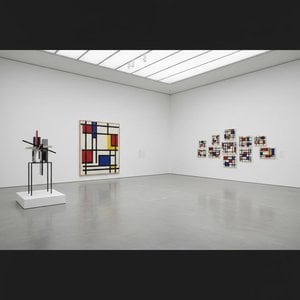
Composition with Red, Blue and Yellow
Composition with Red, Blue and Yellow is arguably Piet Mondrian’s most iconic work, embodying the very essence of Neoplasticism—a radical departure from representational art that sought to express universal harmony through pure geometric abstraction. Painted in 1930 during a period of intense artistic experimentation, this canvas stands as a testament to Mondrian's unwavering belief in the transformative power of form and color.
Style and Technique: Mondrian’s approach was meticulously calculated. He adhered strictly to his manifesto of 1920, declaring that “Art is higher than reality and has no direct relation to reality.” This conviction fueled his relentless pursuit of a visual language devoid of illusionistic elements—a language based solely on vertical and horizontal lines intersecting at right angles and utilizing only the primary colors: red, blue, and yellow. The painting’s surface is covered in thick black brushstrokes that delineate the boundaries of these colored rectangles, creating a stark contrast between darkness and illumination.
Historical Context: Mondrian's artistic journey began with landscapes imbued with Impressionistic influences—a reflection of his formative years in Holland. However, he swiftly embraced Cubism’s fragmentation technique, recognizing its potential to challenge traditional perspectives. Yet, it was through this encounter that he discovered his own distinctive style – Neoplasticism – which emerged as a reaction against the prevailing artistic trends of the time. De Stijl, the movement Mondrian co-founded with Theo van Doesburg, championed geometric abstraction as a means of achieving spiritual enlightenment.
Symbolism and Emotional Impact: Beyond its formal precision, Composition with Red, Blue and Yellow carries profound symbolic significance. The intersecting lines represent opposing forces—horizontal and vertical—that strive for equilibrium, mirroring the cosmic order Mondrian envisioned. The primary colors themselves symbolize fundamental elements of existence—representing fire, water, and earth—and their harmonious arrangement conveys a sense of serenity and balance. Viewing this painting evokes contemplation and invites viewers to consider the underlying structure of reality.
References:
External Links:
Additional Information:
Domande e risposte
Quanto è satura la tavolozza di "Composition con Rosso, Blu e Giallo"?
"Composition con Rosso, Blu e Giallo" di Piet Mondrian è registrato con una saturazione Saturazione colore.
Quali sono le dimensioni reali di "Composition con Rosso, Blu e Giallo" di Piet Mondrian?
"Composition con Rosso, Blu e Giallo" misura 45 x 45 cm nella sua forma originale. Le dimensioni originali sono un utile riferimento quando si sceglie la dimensione di una riproduzione.
"Composition con Rosso, Blu e Giallo" di Piet Mondrian è un'opera dai toni chiari o scuri?
In termini di luminosità percepita, "Composition con Rosso, Blu e Giallo" di Piet Mondrian è luminoso.



 Anteprima in scala reale
 Passa alle stampe
 Condividi
 Condividi
 Dettagli
 Guida stampabile

 Scarica
 Articoli simili
 Radiografia
 Slideshow
 Statistiche


 Leggi tutto






































 L'opzione vetro è disponibile solo per dimensioni inferiori a 110 cm