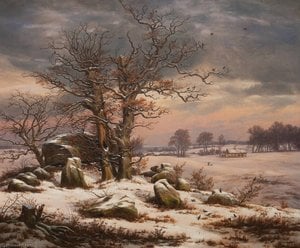
Oil On CanvasWallArtRomanticism
 1832
1832 25.0 x 28.0 cm
 Neue Nationalgalerie
Acquista un'immagine digitale ad alta risoluzione e ottimizzata, di qualità nettamente superiore all'anteprima online.
Ogni file è meticolosamente preparato dai nostri specialisti interni attraverso l'uso di strumenti avanzati e un sapiente ritocco manuale. Garantiamo che ogni immagine presenti una chiarezza eccezionale, una precisione cromatica impeccabile e dettagli raffinati.
Il file finale viene consegnato via e-mail entro 72 ore, ottimizzato per un uso immediato in contesti professionali, editoriali e di stampa. Si tratta della stessa qualità affidata ai più prestigiosi studi di design, editori e gallerie d'arte.
Scarica un file ad alta risoluzione per uso personale, per la stampa e per progetti creativi. ( Acquista stampa Acquista il dipinto realizzato a mano)
Quando scegli WahooArt.com, non riceverai solo un'immagine: riceverai un'opera d'arte digitale professionalmente ottimizzata, realizzata con la massima precisione e accompagnata da una garanzia di soddisfazione. Ecco tutto ciò che include il tuo ordine, automaticamente:

Riceverai il file dell'immagine digitale ad alta risoluzione via email entro 72 ore dall'ordine, pronto per un uso immediato.

La tua opera d'arte viene ottimizzata professionalmente attraverso l'uso di strumenti avanzati di intelligenza artificiale e una revisione manuale, garantendo il massimo livello di dettaglio, nitidezza e accuratezza cromatica.

Hai eliminato o perso accidentalmente il tuo file? Non preoccuparti: te lo invieremo di nuovo in qualsiasi momento, gratuitamente.

Goditi la tua opera d'arte istantaneamente senza costi doganali, dazi o spese di spedizione: i download digitali sono sempre esenti da tasse.

Garantiamo che la tua immagine digitale rifletta i colori originali con la massima fedeltà, grazie all'uso di strumenti professionali e a una gestione accurata del colore.

Se non sei soddisfatto della tua immagine digitale, la revisioneremo o ti rimborseremo il 100% entro 100 giorni, senza domande.

Non sei soddisfatto? Ricevi un rimborso completo entro 100 giorni dal ricevimento del tuo file digitale, senza dover fornire spiegazioni.

Acquista 3 immagini, risparmia il 10% - Acquista 5, risparmia il 15% - Acquista 10+, risparmia il 20%. Ideale per progetti creativi, gallerie e agenzie.
Johan Christian Dahl's "Cloud Study with Horizon," painted in 1832, isn’t merely a depiction of a landscape; it’s a profound meditation on the sublime—a concept central to the Romantic movement and deeply rooted in the Norwegian psyche. This work, rendered in oil on cardboard measuring 25 x 28 cm, transcends simple observation, inviting the viewer into a realm where nature's power and beauty converge with an almost palpable sense of melancholy and awe. Dahl, often hailed as Norway’s “father of landscape painting,” masterfully captures the dramatic interplay of light and shadow across a vast, brooding sky, establishing himself as a pivotal figure in shaping Norwegian artistic identity.
Dahl's artistic journey began humbly, working as a decorative painter in Bergen. However, his exposure to the works of Jens Juel and Christoffer Wilhelm Eckersberg ignited within him a passion for capturing the essence of nature. He sought not just to replicate what he saw, but to convey the *feeling* of being immersed in the Norwegian wilderness—a landscape imbued with both grandeur and vulnerability. This pursuit led him to meticulously study the techniques of Dutch masters like Allaert Everdingen, who had previously documented the stark beauty of the Nordic region, laying a crucial foundation for Dahl’s own style.
The painting's power resides in its masterful manipulation of light and shadow. The dark, almost bruised sky dominates the composition, punctuated by swirling clouds that seem to writhe with an inner energy. These aren’t static formations; they are dynamic entities, constantly shifting and transforming under the unseen influence of the elements. Dahl employs a technique known as *sfumato*, blurring the edges of forms and creating a hazy atmosphere—a characteristic often associated with the Venetian Renaissance masters but brilliantly adapted to evoke the ruggedness and remoteness of the Norwegian mountains. Notice how the light catches on the distant peaks, lending them an ethereal glow while simultaneously deepening the shadows that cling to the valleys below.
The horizon line itself is deliberately ambiguous, receding into a misty distance that suggests both limitlessness and profound mystery. The placement of the trees in the foreground—dark, skeletal forms reaching upwards—further emphasizes this sense of scale and isolation. They are not merely decorative elements; they serve as anchors, grounding the viewer within the scene while simultaneously drawing their gaze towards the infinite expanse above.
“Cloud Study with Horizon” is deeply intertwined with the concept of the “sublime”—a term coined by Edmund Burke to describe an aesthetic experience characterized by awe, terror, and a sense of insignificance in the face of overwhelming natural forces. Dahl’s painting doesn't offer a comforting or idyllic view of nature; instead, it confronts the viewer with its raw power and inherent unpredictability. The dark clouds, the vastness of the landscape, and the subtle hints of danger all contribute to this unsettling yet captivating effect.
The recurring motif of cloud formations in Dahl’s work—as seen also in his “Winter Landscape near Vordingborg”—represents more than just atmospheric conditions. They symbolize mortality, transience, and the cyclical nature of life and death. The shifting clouds mirror the ephemeral quality of human existence against the backdrop of an enduring natural world. This symbolic depth elevates the painting beyond a simple landscape depiction, transforming it into a profound meditation on the human condition.
Dahl’s “Cloud Study with Horizon” stands as a cornerstone of Norwegian Romanticism—a movement that sought to capture the spirit of the nation through its landscapes. His work profoundly influenced subsequent generations of Norwegian artists, establishing a distinct national style characterized by dramatic lighting, evocative color palettes, and an unwavering commitment to portraying the beauty and power of the natural world. The painting’s enduring appeal lies not only in its technical brilliance but also in its ability to evoke a powerful emotional response—a sense of wonder, melancholy, and ultimately, a deep connection to the sublime forces that shape our planet.


1788 - 1857 , Norvegia

 Anteprima in scala reale
 Invia
Invia Condividi
 Dettagli opera

 Scarica immagine
 Simili
 Radiografia
 Slideshow
 Espandi i dettagli