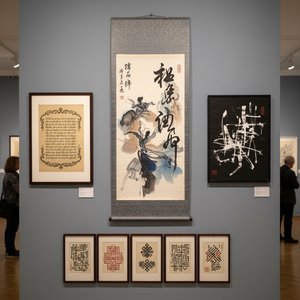
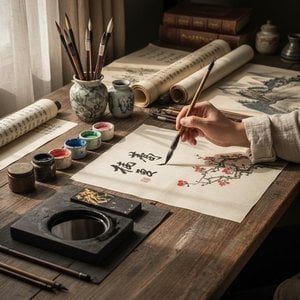
Katso seinällä Esikatsele AR-tilassa Tilaa käsinmaalattu jäljennös Siirry digitaaliseen kuvaan Lähetä
Tarkemmat tiedot Opas Lisää suosikkeihin Lataa kuva Samanlaisia kohteita Röntgenkuvaus Diaesitys Tilastot

Calligraphy (Bokuseki)

Striking black ink characters define this profound Zen calligraphy by the iconoclastic monk Ikkyū Sōjun from the Muromachi Period, offering a rare glimpse into spiritual mastery available for your collection.

Ikkyū Sōjun (1394-1481) was a renowned Japanese Zen Buddhist monk, poet & calligrapher. Explore his iconoclastic art, infused with Zen ideals, challenging monastic norms and impacting Japanese literature.

Giclée- ja taideprintit

Museolaatuisia giclée- tai kankaitaulun tulosteita nopealla tuotannolla ja joustavilla viimeistelyvaihtoehdoilla. ( Tilaa käsinmaalattu jäljennös Siirry digitaaliseen kuvaan)

Corner sample of the P118B picture frame: valettu polystyreeni, 5 cm wide and 3 cm thick
P118B €10
Corner sample of the P118H picture frame: valettu polystyreeni, 5 cm wide and 3 cm thick
P118H €10
Corner sample of the P118W picture frame: valettu polystyreeni, 5 cm wide and 3 cm thick
P118W €10
Corner sample of the P438Z picture frame: valettu polystyreeni, 5.5 cm wide and 3.5 cm thick
P438Z €10
Corner sample of the P508JH picture frame: valettu polystyreeni, 7 cm wide and 3.5 cm thick
P508JH €12
Corner sample of the P508YH picture frame: valettu polystyreeni, 7 cm wide and 3.5 cm thick
P508YH €12
Corner sample of the P805H picture frame: valettu polystyreeni, 5 cm wide and 3.5 cm thick
P805H €10
Corner sample of the P805Z picture frame: valettu polystyreeni, 5 cm wide and 3.5 cm thick
P805Z €10
Corner sample of the P919BZ picture frame: valettu polystyreeni, 7 cm wide and 3.5 cm thick
P919BZ €10
Corner sample of the P919G picture frame: valettu polystyreeni, 7 cm wide and 3.5 cm thick
P919G €10
Corner sample of the P919XJ picture frame: valettu polystyreeni, 7 cm wide and 3.5 cm thick
P919XJ €10
Corner sample of the P959ZH picture frame: valettu polystyreeni, 5 cm wide and 3 cm thick
P959ZH €10
Corner sample of the P968JZ picture frame: valettu polystyreeni, 6 cm wide and 4 cm thick
P968JZ €12
Corner sample of the W106C picture frame: massiivipuu, 5 cm wide and 3 cm thick
W106C €8
Corner sample of the W218G picture frame: massiivipuu, 5 cm wide and 3 cm thick
W218G €10
Corner sample of the W218JH picture frame: massiivipuu, 5 cm wide and 3 cm thick
W218JH €8
Corner sample of the W218Y picture frame: massiivipuu, 5 cm wide and 3 cm thick
W218Y €10
Corner sample of the W307PJ picture frame: massiivipuu, 6 cm wide and 3 cm thick
W307PJ €10
Corner sample of the W316G picture frame: massiivipuu, 6 cm wide and 3 cm thick
W316G €10
Corner sample of the W316PJ picture frame: massiivipuu, 6 cm wide and 3 cm thick
W316PJ €8
Corner sample of the W316Y picture frame: massiivipuu, 6 cm wide and 3 cm thick
W316Y €10
Corner sample of the W398PJ picture frame: massiivipuu, 5 cm wide and 3 cm thick
W398PJ €8
Corner sample of the W4111J picture frame: massiivipuu, 6.5 cm wide and 3.5 cm thick
W4111J €10
Corner sample of the W500HY picture frame: massiivipuu, 7 cm wide and 5 cm thick
W500HY €15
Corner sample of the W500JH picture frame: massiivipuu, 7 cm wide and 5 cm thick
W500JH €15
Corner sample of the W692G picture frame: massiivipuu, 8 cm wide and 4 cm thick
W692G €12
Corner sample of the W849H picture frame: massiivipuu, 5 cm wide and 3 cm thick
W849H €8
Corner sample of the W940BG picture frame: massiivipuu, 7.5 cm wide and 4.5 cm thick
W940BG €15
Corner sample of the W953PJ picture frame: massiivipuu, 6 cm wide and 3.5 cm thick
W953PJ €8

Vakiokoko
mittatilaustyö
CM
INCH

Valitse valmiista mitoistamme sellaiset, jotka vastaavat teoksen alkuperäisiä mittasuhteita.

leveys
korkeus

Kirjoita tarvitsemasi leveys ja korkeus, jotta tuloste sopii kehyskokoon tai seinällesi. Tulostetta voidaan vain leikata, sitä ei voi koskaan tehdä suuremmaksi kuin alkuperäinen kuva, joten eri muotoinen koko aiheuttaa osan kuvasta katoamisen. Lähetämme sinulle digitaalisen mallikuvan hyväksyttäväksi ennen kuin aloitamme tulostuksen. Tällä sivulla näkyvä kuva ei näytä lopullista leikkausta — vain mallikuva näyttää sen.

Maailmanlaajuinen toimitus () 2 viikossa tavallisen 4–5 viikon sijaan. (24 lokakuu)

Ilmainen pikatoimitus ympäri maailman
Korkealaatuinen pellavakangas
Kattava kuljetusvakuutus
Tulliveron palautustakuu
Takuu täydellisestä värien vastaavuudesta
100 päivän palautusoikeus valmistusvirhetapauksissa
100% rahat takaisin -takuu
Määräalennus saatavilla

Kokonaishinta

€ 60

Calligraphy (Bokuseki)

Giclée- ja taideprintit

Replikaatin koko

-

Kokonaishinta

€ 60

Pikaista tietoa

  • Title: Calligraphy (Bokuseki)
  • Location: Tokugawa Art Museum, Nagoya, Japan
  • Artist: Ikkyū Sōjun
  • Subject or theme: Zen Buddhist ideals

The Soul in Ink: The Raw Power of Ikkyū Sōjun’s Calligraphy

In the quiet, contemplative spaces of a curated collection, few pieces command attention with such visceral intensity as the Calligraphy (Bokuseki) by the legendary Zen master Ikkyū Sōjun. This work is not merely an arrangement of characters on paper; it is a direct transmission of spirit, a moment of profound enlightenment captured in the rhythmic dance of black ink. To behold this piece is to witness the "traces of ink" that define the Bokuseki tradition, where the brushstroke serves as a mirror to the artist's internal state. The composition, characterized by its striking contrast and spontaneous energy, invites the viewer into a meditative dialogue with the Muromachi period, offering a window into a time when art and spiritual practice were inextricably linked.

The technique employed here is a masterclass in controlled spontaneity. Each character emerges from the aged, textured paper with a weight that suggests both permanence and fleetingness. The ink varies in density, from deep, saturated blacks that anchor the composition to lighter, more translucent washes that suggest movement and breath. This interplay of light and shadow within the strokes creates a three-dimensional quality, making the calligraphy feel alive, as if the energy of the monk’s hand is still vibrating upon the surface. For the discerning collector or interior designer, this piece offers a sophisticated focal point, bringing an organic, historical gravity to modern minimalist settings or classical East Asian-inspired interiors.

A Legacy of Rebellion and Zen Truth

To understand the emotional depth of this calligraphy, one must understand the man behind the brush. Ikkyū Sōjun was no ordinary monk; he was a radical iconoclast who famously challenged the rigid, often hypocritical, monastic structures of his era. His life was a whirlwind of poetry, eccentricity, and profound spiritual inquiry. This rebellious spirit is etched into every line of his calligraphy. Unlike the more formal, disciplined styles of courtly calligraphy, Ikkyū’s work embraces a certain ruggedness and unvarnished truth. It reflects the Zen ideal of mushin, or "no-mind," where the ego vanishes, leaving only the pure, unfiltered expression of the present moment.

The historical significance of this piece is further elevated by its provenance and cultural weight. Held within prestigious institutions like the Tokugawa Art Museum, such works are recognized as vital artifacts of Japanese heritage. For those seeking to incorporate art into their homes that transcends mere decoration, this reproduction offers more than aesthetic beauty; it provides a connection to a lineage of profound philosophical thought. It is an invitation to embrace imperfection, to find beauty in the weathered and the worn, and to cultivate a space of deep, resonant peace.

Kysymykset ja vastaukset

Mitkä värit hallitsevat teosta Ikkyū Sōjun:n "Calligraphy (Bokuseki)"?

Ikkyū Sōjun:n "Calligraphy (Bokuseki)"-teoksessa käytetään Neutrals väripalettia, jossa Phthalo Green (#1d231f) on hallitseva väri.

Mitä tunnetta Zen-tyylisuunnan teos "Calligraphy (Bokuseki)" välittää?

"Calligraphy (Bokuseki)" teoksen Spiritual tunne kulkee käsi kädessä sen Zen tyylin kanssa.

Mistä löydän oppaan teokseen "Calligraphy (Bokuseki)"?

Ikkyū Sōjun:n "Calligraphy (Bokuseki)" -teoksen Opas -sivu tarjoaa tulostettavan kahden sivun tietolomakkeen: teoksen ja sen tunnistetiedot, aikajanan, joka sijoittaa teoksen taiteilijan elinaikaan, muita taiteilijan teoksia, mitatun väripaletin sekä neljällä eri tyylillä valmiiksi muotoillut lähdeviitteet.


Taiteilijan elämäkerta

The Rebel Monk: The Life and Spirit of Ikkyū Sōjun

Ikkyū Sōjun (1394–1481) remains one of the most captivating and paradoxical figures in the history of Japanese Zen Buddhism. A man of profound contradictions, he was simultaneously a high-ranking monk and a wandering iconoclast, a scholar of deep philosophical insight and a poet of raw, uninhibited emotion. Born into the turbulent era of the Muromachi Period, Ikkyū’s very existence was marked by social complexity; as the illegitimate son of Emperor Go-Komatsu, his lineage placed him at the intersection of imperial prestige and monastic exile. This early life of displacement and struggle deeply informed his later rejection of rigid institutional hierarchies, leading him to seek a spiritual truth that resided not in the sterile confines of a monastery, but in the messy, vibrant reality of human experience. His formative years were shaped by the rigorous Gozan Zen tradition, an intellectual movement heavily influenced by Chinese culture and classical literature. Under the tutelage of esteemed masters, Ikkyū mastered the delicate arts of calligraphy, poetry, and Chinese scholarship. Yet, even as he ascended through the ranks of the Zen hierarchy, a spirit of rebellion began to take root. He famously challenged the very foundations of monastic discipline, most notably his vocal opposition to the requirement of celibacy. To Ikkyū, true enlightenment could not be achieved by suppressing the natural human condition; instead, he believed that the sacred and the profane were inextricably linked, a philosophy that would later define the radical aesthetic of his creative output.

A Calligraphy of Chaos and Clarity

The artistic legacy of Ikkyū Sōjun is most vibrantly expressed through his calligraphy and poetry, works that serve as a direct mirror to his turbulent soul. His calligraphic style often eschewed the polished, formal perfection demanded by traditional monastic training in favor of something far more visceral and spontaneous. In his brushstrokes, one can sense the tension between disciplined technique and an irrepressive urge for freedom. This approach was not merely a stylistic choice but a spiritual manifestation—a way to capture the fleeting, ungraspable nature of Zen realization. His works, such as the evocative Portrait of Daruma, often utilize bold, sweeping motions that convey a sense of urgency and existential weight. Beyond the ink on paper, Ikkyū’s poetic voice revolutionized Japanese literature by infusing it with a raw, often provocative honesty. He utilized the medium to critique the hypocrisy of the religious establishment and to celebrate the beauty found in the ephemeral and the earthly. His poetry often dances between the profound and the playful, much like his own persona. This duality allowed him to bridge the gap between high intellectualism and popular culture, leaving an indelible mark on the development of Japanese lyrical expression. Through his verses, he invited his readers to look past the veneer of social decorum and confront the essential truths of life, death, and desire.

Legacy of an Iconoclast

The historical significance of Ikkyū Sōjun extends far beyond the boundaries of Zen monasticism. He was a pivotal figure in shaping the cultural landscape of the Muromachi Period, influencing how art, literature, and spirituality would interact for centuries to come. By dismantling the wall between the sacred monastery and the secular world, he paved the way for a more integrated and humanistic approach to Japanese aesthetics. His influence can be traced through the development of subsequent poetic movements and the evolution of Zen-inspired arts that prioritize spontaneity and directness over rigid adherence to form. Today, Ikkyū is remembered not just as a monk, but as a cultural icon whose spirit of rebellion continues to resonate. While popular culture sometimes reduces him to the whimsical character seen in animated legends, the true Ikkyū was a formidable intellectual force who dared to redefine the boundaries of faith and art. His life serves as a powerful testament to the idea that true spiritual mastery lies in the courage to embrace one's whole humanity—flaws, passions, and all. Through his enduring works, he continues to challenge us to find the extraordinary within the ordinary and the divine within the human.
Ikkyū Sōjun

Ikkyū Sōjun

1394 - 1481 , Japan

Tietoa taiteilijasta

  • Full Name: Ikkyū Sōjun
  • Nationality: Japanese
  • Date Of Birth: 1394
  • Date Of Death: 1481
  • Place Of Birth: Echizen, Japan
  • Notable Artworks:
    • Portrait of Daruma
    • Title(Japanese): 木彫根付 蛸壺
  • Artistic Movement Or Style: Zen Buddhism
  • Artists Who Influenced This Artist:
    • Botetsu
    • Ken’ō Sōi
    • Kasō Sōdon
  • Artists Or Movements Influenced By This Artist: ['Rinzai Zen']