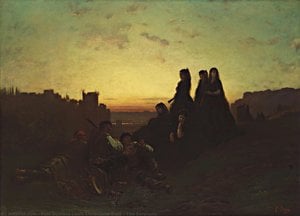
Gustave Doré, 1832 – 1883

The 100 Most Famous Paintings by Gustave Doré

The painting that made Gustave Doré famous is The Acrobats; it hangs in the Musée d'Art Roger-Quilliot, Clermont-Ferrand. The Christian Martyrs and The Inferno, Canto 9, lines 87-89. To the gate He came, and with his wand touch’d it, whereat Open without impediment it flew. follow it in the hearts of collectors and museum visitors. Of the 1,501 works by Gustave Doré in our catalogue, these 100 are the most admired, each presented with its date, its museum and what sets it apart.

Ranked by our popularity score, which combines the searches, visits and orders for each work. Updated October 2026. Every masterpiece on this page can be ordered as a museum-quality, hand-painted oil reproduction or a fine art print, at the size you choose.

Portrait of Gustave Doré
Gustave Doré · 1832 – 1883
Born · died
1832 – 1883, Strasbourg
Movement
Romanticism
Works in our catalogue
1,501
Most famous
The Acrobats
Most works at
Musée d'Art Moderne et Contemporain de Strasbourg

Gustave Doré: the ten masterpieces

The Acrobats by Gustave Doré
1

The Acrobats

Acrylic On Canvas · Musée d'Art Roger-Quilliot, Clermont-Ferrand

Paul Gustave Doré's "The Acrobats" is not merely a depiction of a scene; it’s an immersion into a world brimming with theatricality, melancholy, and the quiet drama of everyday life. Painted in his signature style – a masterful blend of Romanticism and burgeoning Realism – this work captures a fleeting moment, likely intended for illustration within a larger narrative, yet possessing a profound emotional resonance that transcends its original purpose.…

The Christian Martyrs by Gustave Doré
2

The Christian Martyrs

Paul Gustave Doré's "The Christian Martyrs" is a powerful and emotionally charged painting that vividly portrays the suffering of early Christians facing persecution. Rooted in the Romantic style, this artwork emphasizes dramatic intensity, emotional expression, and a sense of awe-inspiring grandeur. The scene depicts a group of fallen martyrs under a dark, star-studded night sky, with three angelic figures hovering above, observing or perhaps intervening in their plight.

The Inferno, Canto 9, lines 87-89. To the gate He came, and with his wand touch’d it, whereat Open without impediment it flew. by Gustave Doré
3

The Inferno, Canto 9, lines 87-89. To the gate He came, and with his wand touch’d it, whereat Open without impediment it flew.

Engraving

Paul Gustave Doré’s “The Inferno, Canto 9, lines 87-89,” is more than just an illustration; it’s a visceral plunge into the heart of Dante Alighieri’s epic poem. Executed as a meticulously detailed black and white engraving, this artwork captures a pivotal moment – the arrival of an angel who opens the gate to Hell itself. Born in Strasbourg in 1832, Doré was a master of dramatic illustration, renowned for his…

Paradise Lost by Gustave Doré
4

Paradise Lost

Acrylic On Canvas

Gustave Doré’s “Paradise Lost,” etched onto a copper plate with meticulous precision, stands as an unparalleled testament to Romantic artistic fervor. Created in 1867, this monumental engraving isn't merely a depiction of Milton’s epic poem; it’s a visceral embodiment of its core themes – rebellion against divine authority and the devastating consequences of pride – rendered with breathtaking dramatic realism.

Gd 0001 Red Riding Hood meets old Father Wolf GustaveDore sqs by Gustave Doré
5

Gd 0001 Red Riding Hood meets old Father Wolf GustaveDore sqs

Engraving

In this monochrome scene, we find ourselves drawn into a dense, wooded thicket where the boundaries between innocence and danger feel remarkably thin. A young girl, draped in her characteristic attire, stands positioned slightly off-center, facing the imposing presence of a large wolf. The creature dominates the left side of the frame, its massive form emerging from the gloom of the forest. There is a quiet tension in their proximity,…

The Inferno, Canto 22, line 70. In pursuit He therefore sped, exclaiming. “Thou art caught.” by Gustave Doré
6

The Inferno, Canto 22, line 70. In pursuit He therefore sped, exclaiming. “Thou art caught.”

Engraving

Shadows stretch and collide within a turbulent, monochromatic landscape where the very air seems heavy with the weight of eternal struggle. A central, colossal figure dominates the chaos, suspended mid-air with massive, powerful wings that cut through the gloom. This entity, a manifestation of absolute power, reaches out to claim its prize. Below, the terrain is a jagged mess of rocky outcrops and churning, dark waters that reflect a sense…

Souvenir of Loch Lomond (1875) by Gustave Doré
7

Souvenir of Loch Lomond

1875 · Acrylic On Canvas · National Gallery of Canada, Ottawa

Gustave Doré's "Souvenir of Loch Lomond," painted in 1875, isn’t merely a landscape; it’s a meticulously crafted distillation of Victorian romanticism and the burgeoning fascination with the sublime. More than just depicting a picturesque Scottish loch, this work invites us into a world steeped in atmosphere, emotion, and a profound sense of melancholy. The scene unfolds beneath a brooding sky, heavy with suggestion rather than explicit detail – a hallmark…

Satan's Flight Through Chaos (1868) by Gustave Doré
8

Satan's Flight Through Chaos

1868 · Engraving

Satan's Flight Through Chaos: A Descent into Romantic Turmoil Paul Gustave Doré’s “Satan’s Flight Through Chaos,” created around 1868, is not merely an illustration; it’s a visceral plunge into the heart of despair and defiance. Born from the depths of Milton’s *Paradise Lost*, this black-and-white engraving captures a pivotal moment – Satan's tumultuous descent after his expulsion from Heaven. The artwork transcends its literary origins, becoming a powerful exploration of…

The Valley of Tears by Gustave Doré
9

The Valley of Tears

Oil On Canvas

Gustave Doré’s “The Valley of Tears” is not merely a painting; it's an immersive experience, a plunge into the depths of human sorrow and redemption. Completed in 1883, this monumental canvas – measuring a staggering 413.5 cm x 627 cm – transcends its physical dimensions to become a profound meditation on faith, suffering, and the universality of pain. Doré, a master of dramatic composition and evocative light, achieves an unparalleled…

Dante and Pope Adrian V (1868) by Gustave Doré
10

Dante and Pope Adrian V

1868 · Engraving

Created in 1868, Dante and Pope Adrian V is a significant engraving by the French artist Gustave Doré. This work functions as a visual translation of a specific moment within the Divine Comedy. Through his precise hand, Doré captures the encounter between Dante and Pope Adrian V, situating them amidst the souls burdened by avarice. It is a quiet, intense study of a meeting between the mortal and the spiritual…

More Gustave Doré masterpieces, 11 to 100

Paradise Lost (11) by Gustave Doré
#11

Paradise Lost (11)

Paradise Lost (11) by Gustave Doré presents a landscape characterized by desolation and a sense of foreboding. The scene depicts an infernal or hellish environment, populated by various…

Bring it home →
dore gustave - (66) by Gustave Doré
#13

dore gustave - (66)

A Descent into Darkness: Gustave Doré’s Dramatic Interpretation of Dante's Inferno Paul Gustave Doré, a titan amongst Romantic illustrators, possessed an unparalleled ability to translate literature into visceral…

Order a reproduction →
paradise lost - (15) by Gustave Doré
#14

paradise lost - (15)

In the hauntingly beautiful engraving “Paradise Lost,” created in 1865 by the legendary French master Paul Gustave Doré, we are invited to witness a moment of profound cosmic…

Bring it home →
Condemned Christ (1877) by Gustave Doré
#15

Condemned Christ

1877 · Musée d'Art Moderne et Contemporain de Strasbourg

The air feels heavy, thick with the weight of an impending judgment. A single, piercing light source cuts through the darkness from the upper left, striking the subject…

Commission a hand-painted copy →
The Styx-The Irascible by Gustave Doré
#17

The Styx-The Irascible

The Styx-The Irascible is a profound work by Gustave Doré. This piece functions as an illustration for Canto VII of Dante's Inferno. It captures a specific, harrowing moment…

Order a reproduction →
The Giant Antaeus (1868) by Gustave Doré
#20

The Giant Antaeus

1868

To encounter Paul Gustave Doré’s "The Giant Antaeus" is to step directly into the heart of a mythological storm. Created in 1868, this monumental engraving does not merely…

Bring it home →
Purgatorio Canto 30 by Gustave Doré
#23

Purgatorio Canto 30

The engraving captures a surge of movement toward the heavens. Angelic figures rise through the frame, their bodies caught in a state of upward momentum. Below them, smaller…

Order a reproduction →
Ecce Homo (1877) by Gustave Doré
#24

Ecce Homo

1877

Paul Gustave Doré’s “Ecce Homo,” completed in 1877, is not merely a depiction of the biblical scene; it’s an immersive experience, a plunge into the heart of human…

Order a reproduction →
Don Quixote by Gustave Doré
#25

Don Quixote

The scene unfolds in a moment of sudden, jarring chaos. Don Quixote lies fallen upon the earth, cast down from his horse following a crushing defeat. This depiction…

Bring it home →
dore gustave - (36) by Gustave Doré
#26

dore gustave - (36)

Gustave Doré’s engraving, “(36),” stands as a testament to the Romantic spirit—a preoccupation with dramatic landscapes, psychological depth, and moral contemplation. Executed in meticulously crafted black and white,…

Bring it home →
dsjslafls by Gustave Doré
#28

dsjslafls

The air feels heavy, thick with the scent of damp stone and ancient dread. Within this monochromatic realm, a colossal rock formation looms on the right, an impenetrable…

Bring it home →
The Hypocrites by Gustave Doré
#32

The Hypocrites

The engraving presents a monochromatic scene defined by a steep, diagonal slope that leads the eye downward into a dark, cavernous opening. On a slightly elevated plateau in…

Bring it home →
The Penny Gaff In Whitechapel by Gustave Doré
#37

The Penny Gaff In Whitechapel

Gustave Doré's “The Penny Gaff In Whitechapel” isn’t merely an illustration; it’s a meticulously crafted distillation of Victorian society, captured in stark monochrome and imbued with a palpable…

Order a reproduction →
untitled (4172) by Gustave Doré
#38

untitled (4172)

The scene unfolds within the dramatic lines of untitled (4172), a work that carries the unmistakable hand of the artist Gustave Doré. This piece emerges from a life…

Order a reproduction →
Forest at Twilight (1865) by Gustave Doré
#40

Forest at Twilight

1865

In Forest at Twilight by Gustave Doré, the composition centers on a forest scene captured during the twilight hours. A stream runs through the middle of the scene,…

Bring it home →
The Serenade (1863) by Gustave Doré
#42

The Serenade

1863 · Museo de Arte de Ponce

Paul Gustave Doré's "The Serenade," completed in 1863, transcends mere depiction; it embodies a profound exploration of human connection and the melancholic beauty inherent in fleeting moments. Painted…

Commission a hand-painted copy →
crusades battle of nicaea by Gustave Doré
#43

crusades battle of nicaea

Crusades Battle of Nicaea: A Symphony in Gray A chilling tableau of medieval conflict, Gustave Doré’s “Crusades Battle of Nicaea” transcends mere illustration; it's a visceral embodiment of…

Bring it home →
Don Quixote (146) by Gustave Doré
#47

Don Quixote (146)

Gustave Doré’s “Don Quixote” isn't merely an illustration; it’s a distillation of Cervantes’ epic tale into a powerfully emotive monochrome print. Executed in the Romantic style, Doré captures…

Commission a hand-painted copy →
Don Quixote (83) by Gustave Doré
#48

Don Quixote (83)

In Don Quixote (83), Gustave Doré presents a moment of profound tension drawn from the narrative of Cervantes. The scene focuses on a direct confrontation between the protagonist…

Bring it home →
Death of Almoadam (1877) by Gustave Doré
#50

Death of Almoadam

1877

Death of Almoadam: A Symphony in Shadow and Line The artwork, “Death of Almoadam,” by Gustave Doré, stands as a testament to Romanticism’s fascination with dramatic narrative and…

Order a reproduction →
The Eagle by Gustave Doré
#52

The Eagle

Gustave Doré's 'The Eagle,' a monumental wood engraving, isn’t merely an illustration; it’s a visceral experience. Completed in 1883, this artwork, originally conceived as part of the lavish…

Commission a hand-painted copy →
Ugolino and Gaddo by Gustave Doré
#53

Ugolino and Gaddo

In the engraving titled Ugolino and Gaddo, the artist Gustave Doré depicts a specific scene from Canto IX of Dante Alighieri's Inferno. The work illustrates the final moments…

Bring it home →
The Race by Gustave Doré
#54

The Race

Gustave Doré’s “The Race,” completed in 1872, isn't merely an illustration; it’s a meticulously crafted tableau vivant—a living picture—that captures the fervent energy of a Victorian seaside spectacle.…

Commission a hand-painted copy →
Myrrha by Gustave Doré
#55

Myrrha

In the vast, shadowy corridors of nineteenth-century imagination, few images possess the visceral power of Paul Gustave Doré’s Myrrha. This is not merely an illustration; it is a…

Bring it home →
The Courage of a Mother by Gustave Doré
#56

The Courage of a Mother

In this monochromatic engraving, a mother shields her child from an impending threat, creating a pyramidal composition that anchors the viewer's gaze. The scene draws from the Second…

Bring it home →
Lambeth Gas Works by Gustave Doré
#61

Lambeth Gas Works

Captivating Urban Industrial Scene Immerse yourself in a powerful depiction of London's industrial heart, vividly brought to life through Gustave Doré’s masterful engraving. This artwork captures the bustling…

Bring it home →
Don Quixote (81) by Gustave Doré
#62

Don Quixote (81)

Gustave Doré’s “Don Quixote” (81) isn't merely an illustration; it’s a visceral plunge into the heart of Cervantes’ epic tale. Executed in stark black and white, this double-page…

Bring it home →
The Vision Of Death by Gustave Doré
#65

The Vision Of Death

To encounter Paul Gustave Doré's "The Vision of Death" is to step beyond the veil of the tangible world and into a realm where the boundaries between life…

Bring it home →
Tumult and Escape by Gustave Doré
#66

Tumult and Escape

To encounter Paul Gustave Doré’s Tumult and Escape is to stand upon the precipice of a profound psychological landscape, where the boundaries between the physical world and the…

Order a reproduction →
Ruth and Boaz by Gustave Doré
#79

Ruth and Boaz

The sun hangs suspended over a sprawling agricultural landscape, casting a soft, diffused light that settles upon the heavy stalks of grain. In this quiet corner of the…

Bring it home →
Don Quixote (87) by Gustave Doré
#84

Don Quixote (87)

In the quiet, evocative realm of nineteenth-century printmaking, few works capture the tension between delusion and reality as poignantly as Paul Gustave Doré’s 1883 engraving, Don Quixote. This…

Order a reproduction →
Thieves by Gustave Doré
#87

Thieves

In "Thieves," executed in 1873, Gustave Doré presents a scene of profound struggle. The monochrome engraving captures figures caught in a desperate movement amidst a rugged, mountainous terrain.…

Bring it home →
Thais by Gustave Doré
#88

Thais

Gustave Doré’s engraving, “Thais,” stands as a cornerstone of Romantic illustration and embodies the movement's preoccupation with intense emotion and theatrical storytelling. Created in 1867, this monumental print…

Commission a hand-painted copy →
Brunetto Latini by Gustave Doré
#92

Brunetto Latini

Brunetto Latini: A Descent Into Hell’s Grip Paul Gustave Doré's *Brunetto Latini* isn’t merely an engraving; it’s a visceral plunge into Dante Alighieri’s Inferno, meticulously rendered with the…

Order a reproduction →
Don Quixote (26) by Gustave Doré
#98

Don Quixote (26)

Paul Gustave Doré's “The Don and Sancho Approach the Sierra Morena” is more than just an illustration; it’s a meticulously crafted window into the heart of Cervantes’ timeless…

Bring it home →

Gustave Doré's paintings by period

The subjects Gustave Doré painted most

The four subjects that return most often among these masterpieces, with the finest example of each.

Where to see Gustave Doré's paintings

The 6 museums that hold the most of the paintings on this page.

Museum City Works by Gustave Doré Paintings from this list
Musée d'Art Moderne et Contemporain de Strasbourg, StrasbourgMusée d'Art Moderne et Contemporain de Strasbourg Strasbourg 10 The Christian Martyrs, Condemned Christ
National Gallery of Canada, OttawaNational Gallery of Canada Ottawa 2 Souvenir of Loch Lomond
Art Gallery of Hamilton, HamiltonArt Gallery of Hamilton Hamilton 2 Le reve du moine (The Dream of a Monk)
Musée d'Art Roger-Quilliot, Clermont-FerrandMusée d'Art Roger-Quilliot Clermont-Ferrand 1 The Acrobats
Chrysler Museum of Art, NorfolkChrysler Museum of Art Norfolk 1 The Neophyte (First Experience of the Monastery)
Museo de Arte de Ponce, PonceMuseo de Arte de Ponce Ponce 1 The Serenade

Gustave Doré, decade by decade: the defining painting of each

  1. 1860s
    Satan's Flight Through Chaos (1868) by Gustave Doré
    #8 of 100

    Satan's Flight Through Chaos

    Age 28 – 37

    Satan's Flight Through Chaos: A Descent into Romantic Turmoil Paul Gustave Doré’s “Satan’s Flight Through Chaos,” created around 1868, is not merely an illustration; it’s a visceral plunge…

  2. 1870s
    Souvenir of Loch Lomond (1875) by Gustave Doré
    Rank 7 / 100

    Souvenir of Loch Lomond

    Age 38 – 47 · National Gallery of Canada

    Gustave Doré's "Souvenir of Loch Lomond," painted in 1875, isn’t merely a landscape; it’s a meticulously crafted distillation of Victorian romanticism and the burgeoning fascination with the sublime.…

  3. 1880s
    Le reve du moine (The Dream of a Monk) (1880) by Gustave Doré
    #36 of 100

    Le reve du moine (The Dream of a Monk)

    Age 48 – 51 · Art Gallery of Hamilton

    A single shaft of sunlight pierces through the stained glass windows, cutting through the heavy gloom of a Gothic cathedral interior. This beam of light finds its mark…

Gustave Doré's masterpieces: questions and answers

Which painting is Gustave Doré best known for?Show the answer

The Acrobats, Musée d'Art Roger-Quilliot, Clermont-Ferrand. Next come The Christian Martyrs and The Inferno, Canto 9, lines 87-89. To the gate He came, and with his wand touch’d it, whereat Open without impediment it flew..

What are Gustave Doré's ten greatest paintings?Show the answer

The Acrobats, The Christian Martyrs, The Inferno, Canto 9, lines 87-89. To the gate He came, and with his wand touch’d it, whereat Open without impediment it flew., Paradise Lost, Gd 0001 Red Riding Hood meets old Father Wolf GustaveDore sqs, The Inferno, Canto 22, line 70. In pursuit He therefore sped, exclaiming. “Thou art caught.”, Souvenir of Loch Lomond, Satan's Flight Through Chaos, The Valley of Tears and Dante and Pope Adrian V. The ranking above gives the year and the museum of each.

How many works did Gustave Doré paint?Show the answer

Our catalogue lists 1,501 works by Gustave Doré, dated from 1860 to 1880.

In which museums can I see Gustave Doré's masterpieces?Show the answer

Most of them are in Musée d'Art Moderne et Contemporain de Strasbourg (Strasbourg), National Gallery of Canada (Ottawa) and Art Gallery of Hamilton (Hamilton). The table above lists the museums one by one.

When did Gustave Doré paint the masterpieces?Show the answer

In 1860s: 9 of the 100 works on this page date from then, among them Satan's Flight Through Chaos.

What are the first and last famous paintings of Gustave Doré?Show the answer

The earliest on this page is Portrait of Dante Alighieri (1860), the latest Le reve du moine (The Dream of a Monk) (1880).

What were Gustave Doré's favourite subjects?Show the answer

Dramatic lighting (15), Biblical narrative (14) and Hellscape (13), among the 100 works on this page.

Which technique did Gustave Doré favour?Show the answer

Engraving: 52 of the 100 works on this page.

What art movement is Gustave Doré part of?Show the answer

Romanticism, as the paintings on this page show.

Which masterpieces by Gustave Doré hang at the Musée d'Art Moderne et Contemporain de Strasbourg?Show the answer

The Christian Martyrs and Condemned Christ are among the 2 works on this page held by the Musée d'Art Moderne et Contemporain de Strasbourg, Strasbourg.

Can I own a reproduction of a Gustave Doré masterpiece?Show the answer

Yes. Every painting on this page can be ordered as a museum-quality, hand-painted oil reproduction or a fine art print, in the size you choose, from the painting's own page.

The life of Gustave Doré

The Life of Paul Gustave Doré

Strasbourg, France, 6 January 1832. This is where the life of Paul Gustave Louis Christophe Doré begins. He enters a world of shifting artistic currents, moving from the Rhine to the bustling streets of Paris. By age fifteen, he is already navigating the satirical landscape of Le Journal pour rire, working as a caricaturist. The boy who draws with precocious talent quickly transitions into a professional force, his hands moving from simple sketches to the complex demands of large-scale wood engravings.

His career moves with a sudden, intense momentum. He moves between the roles of designer, painter, and sculptor, never settling into a single lane. He establishes a presence in London, opening the Doré Gallery in Bond Street, and his name becomes a staple of the Victorian era. He navigates the high-pressure world of mass production, employing teams of block-cutters to translate his visions into the wood-engravings that flood the international market. The scale of his output is immense, driven by a relentless pace that carries him through the mid-to-late 19th century.

The momentum breaks in Paris. On 23 January 1883, Paul Gustave Doré dies following a short illness and a heart attack. He leaves behind a massive body of work that spans the spectrum of human emotion, from the divine to the grotesque.

Early Life and Artistic Beginnings

Strasbourg, France, provides the setting for the beginning of a life defined by visual precision. By the age of ten, the boy is already a self-taught draftsman. He does not wait for formal instruction to master the line. Instead, he develops a technical facility that bypasses the traditional classroom. This early autonomy marks the start of a prolific output that will eventually span multiple mediums.

The transition from private practice to professional labor arrives with sudden speed. At fifteen, he enters the bustling, satirical atmosphere of the French journal Le Journal pour rire. He works as a caricaturist, using his pen to navigate the social and political tensions of the era. This period of work hones his ability to observe and distill complex human expressions into sharp, immediate imagery. It is a training ground in economy and impact.

While his pen finds success in the world of print, his formal training takes a different, more tactile direction. He focuses his studies on sculpture. This pursuit of three-dimensional form informs his understanding of volume and weight, even as his career moves toward the two-dimensional world of engraving and illustration. The discipline of the sculptor remains a foundational element of his technical approach.

Patrons, Workshop and Major Commissions

The scale of Doré’s output required a massive industrial operation. He did not work alone in a quiet studio; instead, he directed a specialized workshop to meet the demands of global publishing. At the height of his productivity, he employed a team of approximately 40 block-cutters. These craftsmen were responsible for the grueling task of translating his intricate designs into wood engravings, carving the lines that would eventually be run off by the millions on cylinder presses. This assembly line of talent allowed his visual narratives to reach audiences in Paris, London, and New York simultaneously.

Commercial success followed his ability to bridge the gap between fine art and mass media. In 1853, a commission to illustrate the works of Lord Byron marked a significant ascent in his professional standing. This momentum continued through his collaborations with major publishers, leading to high-stakes projects that commanded significant fees. By 1883, he was working on an oversized edition of Edgar Allan Poe’s “The Raven,” a project that secured him 30,000 francs from Harper & Brothers. This final, massive undertaking remains a marker of the immense commercial value his vision held for the international publishing industry.

  • The Legend of The Wandering Jew (1856)
  • Don Quixote (1860s)
  • The Divine Comedy (1860)

Technique and Artistic Style

The wood-engraving process defines his visual language. He functions primarily as a designer, creating intricate drawings that teams of block-cutters translate onto wooden printing blocks. This method allows for a massive scale of reproduction. To meet the demands of international publishing, the electrotype process is utilized for mass reproduction. The results are characterized by a heavy reliance on chiaroscuro, where deep blacks and piercing whites create a sense of dramatic tension. Every line serves a purpose in building texture and depth.

Meticulous detail anchors his compositions. He uses hatching and cross-hatching to render surfaces, such as the fur of a creature or the ruggedness of stone, with tactile precision. This technical rigor extends to his work in other media. During a trip to Scotland in 1873, he develops a specific expertise in watercolor. His approach often prioritizes expressive power and bold compositions over strict academic realism. He builds entire environments through the interplay of light and shadow, creating a cinematic atmosphere that feels heavy and physical.

Key Works and Literary Illustrations

The scale of his output often matched the epic nature of his subjects. In 1856, he produced twelve folio-size illustrations for The Legend of The Wandering Jew. This work helped establish his ability to handle large-scale narratives. By the 1860s, his vision moved toward the characters of Cervantes. His depictions of Don Quixote and Sancho Panza became the definitive visual standard for these figures, influencing how readers and artists alike imagined the knight and his squire.

The shadows deepen as his work moves into the realms of the divine and the damned. He translated the terrifying visions of Dante’s Divine Comedy into wood engravings, including the harrowing scenes of Dante's Inferno. These designs were not merely sketches; they were blueprints for a massive production of prints. In 1866, he turned his attention to Milton’s Paradise Lost, applying the same dramatic intensity to the fallen angels and celestial struggles of the epic poem.

Later Years and Death

The year 1861 marks a significant shift in his standing, as the French government named him a Knight of the Legion of Honour. This recognition arrived as his influence expanded beyond the borders of France. By 1868, the focus of his professional life shifted toward London. There, he established the Doré Gallery in Bond Street, a space that would become a central hub for his work and his presence in the British art scene.

His creative output remained relentless until the very end. At the time of his death, he was actively engaged in a new series of illustrations for the plays of Shakespeare. The work was still in progress when his health failed. He died in Paris following a short illness, the cause being a heart attack.

Legacy and Enduring Influence

The impact of his work reaches far beyond the printed page, occupying a space where fine art and storytelling intersect. His 1866 illustrations for the Bible achieved massive success, cementing a visual language for sacred texts that persists in the public imagination. This ability to translate complex narratives into visceral imagery left a mark on the giants of the next generation. Vincent van Gogh, for instance, found deep inspiration in Doré’s depictions of human suffering and hardship.

His influence often dictates how we visualize literary archetypes. The specific physical appearance of Don Quixote and Sancho Panza, as rendered in his 1860s illustrations, became the standard for subsequent readers and artists alike. He did not merely illustrate characters; he defined their visual identity for the modern era. This legacy continues through the survival of his original designs and the enduring presence of his dramatic compositions in global collections.

  • The Legend of The Wandering Jew (1856)
  • Don Quixote (1860s)
  • The Divine Comedy (1860)

Where to See the Works Today

The physical remnants of Doré’s prolific output are scattered across several continents, preserved in institutions that hold his diverse range of media. In France, the Musée de Grenoble maintains a collection of his watercolor paintings. These works offer a different perspective than the high-contrast wood engravings that defined his commercial success. The artist's presence in major public collections extends to the National Gallery of Canada in Ottawa, where his catalog is represented.

In the United Kingdom, the Walker Art Gallery in Liverpool preserves pieces from his extensive body of work. His reach continues into the Americas, with the Museo de Arte de Ponce holding works from his catalog. These collections provide a way to observe the scale and detail of his compositions in person.

All 1501 works by Gustave Doré →