Hand-painted oil on canvas in your size and frame, made to order by our artists. ( Switch to Print Switch to Digital Image)





























Pick from our preset sizes that match the artwork's original proportions.

You may enter your own dimensions to fit a specific frame or space. If your selected size does not match the original image's proportions, we will either crop the artwork or extend the painting with additional hand-painted elements. A digital mockup will be sent for your approval before production begins.
Please note that the on-screen preview does not reflect the actual cropping or extension. Only the mockup will accurately show the final composition.
While custom sizes are available, we recommend selecting a dimension from the predefined list to preserve the original proportions.
Worldwide Delivery () in 3/4 weeks instead of standard 5 weeks. (22 September). No compromise on quality.


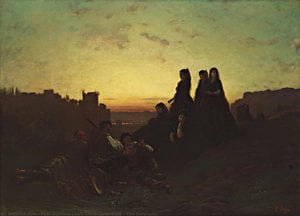
Don Quixote (87)
Reproduction Size
In the quiet, evocative realm of nineteenth-century printmaking, few works capture the tension between delusion and reality as poignantly as Paul Gustave Doré’s 1883 engraving, Don Quixote. This masterpiece is far more than a mere illustration of Miguel de Cervantes' legendary knight; it is a visual poem distilled into the stark, dramatic language of copper plate etching. As one gazes upon the scene, there is an immediate sense of being transported to a world where the boundaries between myth and truth are perpetually blurred. Doré, working in the twilight of his illustrious career, manages to transform raw metal into a breathtaking narrative of human spirit, capturing that pivotal moment when the fervent, chivalric pronouncements of Don Quixote pierce through the heavy slumber of Sancho Panza.
The emotional weight of the piece lies in its profound juxtaposition. On one side, we see the upright, commanding posture of the knight—a figure of unyielding idealism and armored defiance. Opposite him, the horizontal repose of Sancho Panza serves as a grounded, skeptical counterpoint, representing the encroaching reality of the physical world. This duality is not merely a character study but a symbolic struggle between the vast, untamed landscapes of our dreams and the heavy, often mundane confines of our lived experience. For the collector or the designer, this artwork offers a window into the human psyche, making it a profound centerpiece for any space that values depth, storytelling, and intellectual resonance.
To appreciate this work is to marvel at Doré’s unparalleled command over the medium of engraving. The technique itself is a testament to patience and precision; through the meticulous process of transferring drawings onto copper and utilizing acid to etch recessed lines, Doré achieved a tonal range that feels almost cinematic. He employs an intricate web of hatching and cross-hatching to build texture and form, creating a sense of atmosphere that breathes within the paper. The shadows are not merely dark areas but are dense, textured reservoirs of ink that suggest the rough bark of trees and the heavy weight of metal armor.
The composition is masterfully balanced through a dynamic use of light and shadow, characteristic of the Romantic tradition tempered by a gritty realism. Light appears to descend from an unseen source above, casting dramatic highlights across Don Quixote’s face and armor, while simultaneously plunging the background foliage into mysterious, receding depths. This interplay of light creates a sense of movement and three-dimensional space, drawing the viewer's eye through the wooded setting and into the very heart of the narrative. The monochromatic palette—a sophisticated arrangement of blacks, whites, and infinite grays—strips away the distraction of color to focus entirely on the raw power of form and light.
For those seeking to infuse an interior with a sense of history and dramatic flair, Doré’s Don Quixote offers an incomparable aesthetic advantage. Its stylistic roots in nineteenth-century Romanticism provide a timeless elegance that complements both classical and contemporary decor. The artwork's ability to evoke themes of adventure, absurdity, and the enduring strength of belief makes it a conversation piece of the highest order. Whether displayed in a study filled with leather-bound books or as a striking focal point in a minimalist gallery-style room, this reproduction brings with it the haunting grandeur of an era defined by its legendary illustrators.
Owning a high-quality reproduction of such a significant work allows one to inhabit the "architect of dreams" himself. It is an invitation to contemplate the shadows and light of our own lives, much like the master who so expertly etched them onto the plate. This piece is not just a decoration; it is an enduring tribute to the power of the imagination and a sophisticated addition for any connoisseur of fine art history.


1832 - 1883 , France

Explore the profound mastery of engraving and intaglio printmaking. Delve into the rich history, technical precision of the burin, and the enduring legacy of fine art techniques that shaped the world's most iconic masterpieces.

 Preview
 Send
Send Share
Share
 Details
 Guide
Guide

 Download
 Similars
 X-Ray
X-Ray Diaporama
 Stats
Stats

 Read More







 Glass option is only available in size under 110 CM