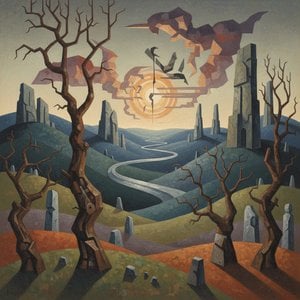
Arnold Topp: A Landscape of Shadows
Arnold Topp’s artistic journey began in Germany, nurtured by a fascination with the Romantic tradition and its exploration of emotion and sublime beauty. Unlike many artists of his era who sought to capture idealized visions of nature, Topp consistently confronted darkness—both literal and metaphorical—within his canvases.
- Early Influences: The works of Caspar David Friedrich profoundly impacted Topp’s aesthetic sensibilities. Friedrich's depictions of solitary figures dwarfed by monumental landscapes instilled a desire to convey profound psychological states alongside visual grandeur.
- Technique: Topp honed his skills in oil painting, favoring thick impasto—a technique where paint is applied heavily onto the canvas—to create textured surfaces that seemed to pulsate with inner energy. This deliberate layering of pigment allowed him to build up layers of color and shadow, capturing subtle nuances of light and atmosphere.
- Recurring Themes: Topp’s oeuvre centers around landscapes imbued with an unsettling stillness. Mountains loom ominously against bruised skies; forests conceal hidden dangers; bodies of water reflect distorted images of reality. These scenes are populated by solitary figures—often rendered in muted tones—who appear to grapple with existential anxieties.
The Emergence of Surrealism and Psychological Depth
As Topp’s artistic vision matured, he embraced the principles of Surrealism, recognizing its capacity to liberate the imagination from rational constraints. Influenced by artists like Giorgio Morandi and Yves Klein, he began experimenting with geometric abstraction alongside his continued exploration of landscape imagery.
- Geometric Abstraction: Topp’s foray into geometric forms wasn't merely stylistic; it represented a conscious effort to distill emotion into its purest form. He sought to capture the essence of feeling—often melancholy or apprehension—through simplified shapes and precise color palettes.
- Klein Blue: The use of Yves Klein Blue – a pigment created by Klein himself – became a signature element in Topp’s work. This intensely saturated ultramarine hue conveyed a sense of profound isolation and spiritual yearning, mirroring the artist's own preoccupation with psychological introspection.
- Symbolic Resonance: Despite its apparent simplicity, Topp’s art is replete with symbolic resonance. Recurring motifs—such as barren trees, desolate plains, and fragmented figures—suggested themes of loss, decay, and the confrontation with mortality.
Notable Achievements and Artistic Legacy
Topp's dedication to his craft resulted in a prolific output of paintings spanning several decades. His landscapes continue to resonate with viewers who appreciate their haunting beauty and psychological complexity.
- ZWEI WELTEN (TWO WORLDS): Topp’s collaborative project with filmmaker Werner Herzog—titled “ZWEI WELTEN” (“Two Worlds”)—solidified his reputation as an artist capable of conveying profound emotional truths through visual storytelling. The film captured the desolate grandeur of Patagonia, mirroring Topp's artistic preoccupation with confronting darkness within seemingly serene environments.
- Critical Recognition: Topp’s work has garnered acclaim from prominent art critics and curators who recognized its distinctive blend of Romantic tradition and Surrealist experimentation. His paintings are held in collections worldwide, testifying to their enduring appeal.
Historical Significance
Arnold Topp stands apart as an artist who refused to succumb to conventional artistic conventions. He prioritized conveying psychological depth alongside visual splendor—a commitment that distinguishes his oeuvre from many of his contemporaries. His legacy resides in the profound contemplation he provoked within viewers and fellow artists alike, reminding us that true beauty can be found not only in idealized representations but also in confronting the shadowed recesses of human experience.