

 Acrylic On CanvasWallArtDe Stijl
 1917
1917 27.0 x 27.0 cm
Museum-quality giclée or canvas print with fast production and flexible finish options. ( Buy Hand Made Painting Switch to Digital Image)





























Pick from our preset sizes that match the artwork's original proportions.

You may enter your own dimensions to fit a specific frame or space. If your selected size does not match the original image's proportions, we will either crop the artwork or extend the image with a mirrored or solid-fill edge. A digital mockup will be sent for your approval before production begins.
Please note that the on-screen preview does not reflect the actual cropping or extension. Only the mockup will accurately show the final composition.
While custom sizes are available, we recommend selecting a dimension from the predefined list to preserve the original proportions.
Worldwide Delivery () in 2 weeks instead of standard 4/5 weeks. (4 October)


Composition
Reproduction Size
Theo van Doesburg’s “Composition,” painted in 1917, stands as a cornerstone of De Stijl and Neo-Plasticism—a movement that irrevocably altered the trajectory of modern art. More than just pigment on canvas; it embodies a radical reimagining of visual perception and an unwavering commitment to distilling artistic expression to its purest form.
Style & Technique: The painting’s aesthetic is defined by geometric abstraction, prioritizing horizontal and vertical lines over organic contours. Van Doesburg meticulously applied black, white, and mustard yellow squares—the foundational colors of De Stijl—creating a deceptively simple yet profoundly complex visual experience. Unlike traditional oil paintings characterized by brushstrokes and textural variation, “Composition” presents a flawlessly flat surface, achieved through precise layering and meticulous attention to detail. This deliberate rejection of illusionistic representation underscores the movement’s philosophical aim: to transcend subjective experience and capture an objective reality rooted in mathematical harmony.
Historical Context & Influence: Born Christian Emil Marie Küpper in Utrecht, Netherlands, Van Doesburg emerged from the artistic milieu influenced by Impressionism and Post-Impressionism. However, his encounter with Wassily Kandinsky’s *Rückblicke* proved transformative, propelling him toward a more conceptual approach. Inspired by Kandinsky's exploration of spirituality through color and form, Van Doesburg established De Stijl in 1917 alongside Piet Mondrian—a collaborative effort that cemented the movement’s core tenets.
Symbolism & Optical Illusion: The painting’s arrangement isn’t merely decorative; it actively engages the viewer's perception. Employing the Müller-Lyer illusion – where converging lines create an apparent distortion of distance – Van Doesburg subtly manipulates visual cues to evoke a sense of dynamism and ambiguity. This technique reflects De Stijl’s belief in harnessing optical phenomena to communicate universal truths, mirroring the movement’s broader ambition to express spiritual concepts through geometric abstraction.
Emotional Impact & Legacy: “Composition” transcends mere visual representation, conveying an underlying feeling of serenity and balance—a testament to Van Doesburg's unwavering dedication to achieving aesthetic harmony. Its minimalist elegance continues to inspire artists and designers today, demonstrating the enduring power of reductive artistic principles. The painting’s influence extends beyond painting into architecture and design, shaping the visual language of subsequent generations.
Size: 12 x 16 cm
Date: 1917
"Composition" by Theo van Doesburg depicts geometric abstraction, primary colors, optical illusion, minimalism, bauhaus influence, composition, grid pattern, in a minimalist mood. Subject and atmosphere together describe the work.
"Composition" dates from 1917. The date places the work within Theo van Doesburg's career and its era.
Among Theo van Doesburg's recorded themes - geometric harmony, bauhaus vision, abstract expressionism, minimalist aesthetic, pioneering style - "Composition" brings its own focus on geometric abstraction, primary colors, optical illusion, minimalism, bauhaus influence, composition, grid pattern.
"Composition" by Theo van Doesburg is recorded as balanced, with a soft shadow luminance.
"Composition" by Theo van Doesburg shows a statement contrast between its light and dark areas.
"Composition" is attributed to Theo van Doesburg.
Theo van Doesburg was 34 years old when creating "Composition" in 1917. The age is computed from the artist's birth year, 1883.


1883 - 1931 , Netherlands

Explore the profound spiritual depth of geometric abstraction. From Malevich's Suprematism to modern masters, our expert guide reveals how pure form and color command presence in fine art collections.
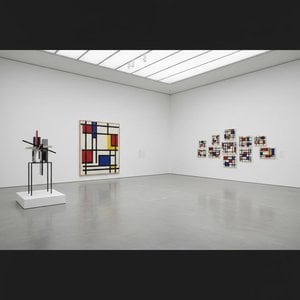
Explore the profound essence of Neoplasticism. Discover how Piet Mondrian and De Stijl masters used pure color and geometric form to redefine modern art. An essential guide for collectors seeking to understand the enduring power of abstract harmony and universal order.

 Preview
 Send
Send Share
Share
 Details
 Guide
Guide

 Download
 Similars
 X-Ray
X-Ray Diaporama
 Stats
Stats Read More







 Glass option is only available in size under 110 CM


