

Hand-painted oil on canvas in your size and frame, made to order by our artists. ( Switch to Print Switch to Digital Image)





























Pick from our preset sizes that match the artwork's original proportions.

Type the width and the height you need, to fit your frame or your wall. This is hand-painted, so for a size with a different shape the artist can paint a bit more around the picture, or cut a bit — you choose. We send you a digital mockup to approve before the painting starts. The picture shown on this page does not show the real result — only the mockup does.
Worldwide Delivery () in 3/4 weeks instead of standard 5 weeks. (25 October). No compromise on quality.
Counter composition V
Reproduction Size
Step closer and observe how the canvas breathes through its very lack of traditional form. In Counter composition V, created in 1924, there is no attempt to mimic the physical world or provide a window into a landscape. Instead, we find ourselves facing a deliberate arrangement of nine colored shapes. A large red rectangle dominates the center, anchoring the composition with its weight. To its left, a smaller yellow rectangle sits in quiet proximity, while to the right, a blue square is framed by a thin white border. Below these primary elements, two black rectangles—one larger than the other—are also bordered in white, resting against a light gray background. The lines are clean, and the colors remain flat, stripped of any shading or perspective.
The arrangement feels balanced yet restless. There is a subtle energy here that comes from the way these shapes interact without the use of traditional intersecting lines. It is an exercise in equilibrium, where each block of color holds its ground against the others. The eye moves across the gray expanse, caught by the sudden shifts between the primary hues and the dark, heavy presence of the black forms.
To understand this work, one must consider the friction that birthed it. This piece belongs to a period of profound change within the De Stijl movement. While much of the era's art relied on the rigid stability of horizontal and vertical lines, this specific composition introduces a sense of rotation. The rectangles and squares appear tilted at exactly forty-five degrees, a technique that defines the artist's move toward Elementarism. This shift was more than a stylistic choice; it was a reaction to the perceived limitations of Neoplasticism. By rotating the elements, the artist sought to inject a dynamic movement into the work, breaking away from the static nature of purely orthogonal compositions.
< p>This method creates a subtle illusion of depth and motion that contradicts the flatness of the paint itself. The inclusion of a single small grey shape at the bottom right edge further disrupts the expected primary palette, adding a quiet note of complexity to the arrangement. It is a study in how much change can be introduced before the fundamental harmony of the composition is lost. Through these tilted planes, the artist explores a new visual language, one that favors energy and rotation over the strict, unmoving grids of his contemporaries.In "Counter composition V", dark colors accompany a tranquil feeling.
With its square shape, a reproduction of "Counter composition V" is suggested for a coworking.
"Counter composition V" is classified as iconic.


1883 - 1931 , Netherlands

Explore the profound spiritual depth of geometric abstraction. From Malevich's Suprematism to modern masters, our expert guide reveals how pure form and color command presence in fine art collections.
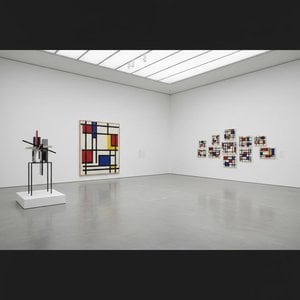
Explore the profound essence of Neoplasticism. Discover how Piet Mondrian and De Stijl masters used pure color and geometric form to redefine modern art. An essential guide for collectors seeking to understand the enduring power of abstract harmony and universal order.

Explore the profound elegance of De Stijl. Discover how Piet Mondrian and the masters of Neoplasticism utilized geometric harmony and primary colors to redefine modern abstraction. An authoritative guide for the discerning collector seeking timeless, structured beauty.

 Preview
 Send
Send Share
Share
 Details
 Guide
Guide

 Download
 Similars
 X-Ray
X-Ray Diaporama
 Stats
Stats

 Read More









 Glass option is only available in size under 110 CM


