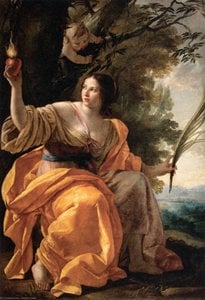
Oil On CanvasWallArtFrench Baroque
 1622Early Modern
 375.0 x 225.0 cm
 Chiesa del Gesù
Museum-quality giclée or canvas print with fast production and flexible finish options. ( Buy Hand Made Painting Switch to Digital Image)





























Pick from our preset sizes that match the artwork's original proportions.

Type the width and the height you need, to fit your frame or your wall. A print can only be cut, never made bigger than the picture, so a size with a different shape loses a part of the image. We send you a digital mockup to approve before we print anything. The picture shown on this page does not show the real cut — only the mockup does.
Worldwide Delivery () in 2 weeks instead of standard 4/5 weeks. (25 October)
Crucifixion
Reproduction Size
In the annals of French art history, few works capture the raw, visceral pulse of the Baroque era as profoundly as Simon Vouet’s Crucifixion. Completed in 1622, this monumental canvas serves as a breathtaking window into an age defined by spiritual fervor and dramatic realism. At its heart, the painting presents the pivotal moment of Christ's sacrifice, yet it transcends mere religious iconography to become a profound study of human suffering and divine grace. Vouet, a pioneer who bridged the gap between the stylized abstractions of Mannerism and the emotive power of the Baroque, utilizes the scene to invite the viewer into a state of deep, spiritual contemplation.
The composition is a masterclass in orchestrated tension. Christ dominates the vertical axis, his body rendered with an anatomical precision that honors humanist ideals while emphasizing the physical toll of the crucifixion. Surrounding him, a constellation of mourners creates a sea of grief that anchors the divine event to the earthly realm. On the left, Mary Magdalene kneels in a posture of heartbreaking devotion, her red robes providing a striking visual anchor amidst the somber tones. Nearby, the Virgin Mary embodies maternal agony, her blue drapery and sorrowful gaze reflecting a universal experience of loss. Through this carefully arranged pyramidal structure, Vouet guides the eye upward, from the heavy, earth-bound grief of the disciples to the luminous, transcendent figure of Christ.
Technically, the Crucifixion is a triumph of chiaroscuro. Vouet employs a dramatic interplay of light and shadow to sculpt form and heighten the painting's emotional intensity. This technique, heavily influenced by his formative years in Italy and the works of Caravaggio, allows the light to strike the figures with a theatrical brilliance, pulling them out from the surrounding darkness. The shadows are not merely absences of light but are deep, velvety textures that add weight and mystery to the atmosphere. By utilizing sophisticated glazing techniques, Vouet achieved a luminous quality in the skin tones and a rich, tactile depth in the folds of the heavy fabrics, making the scene feel almost tangible to the observer.
The color palette is intentionally somber, dominated by deep earth tones, rich ochres, and the symbolic blues and reds of the holy figures. This restrained use of color ensures that the viewer's focus remains on the emotional narrative and the dramatic lighting. For the discerning collector or interior designer, this painting offers a profound sense of gravitas. It is a piece that does not merely decorate a space but transforms it, providing a focal point of immense historical significance and aesthetic sophistication. Whether placed in a grand gallery or a curated private study, Vouet’s work commands attention through its ability to evoke a visceral, emotional response, making it an enduring inspiration for those who appreciate the intersection of technical mastery and spiritual depth.
Simon Vouet's recurring themes include italian baroque style, religious devotion, emotional drama, artist legacy, roman tradition; "Crucifixion" focuses on religious art, crucifixion scene, mary magdalene, virgin mary, italian baroque, renaissance painting, emotional expression.
"Crucifixion" is deep_shadow overall, and its luminance is dark.
Considering its earthy colors, "Crucifixion" is suggested for a living room.

Simon Vouet was a pivotal figure in the transition of French painting from Mannerism to the Baroque style. Born into an artistic family – his father Laurent was a painter and his brother Aubin also pursued art – Vouet received early training that laid the foundation for his future success. His grandson, Ludovico Dorigny, would continue the family’s artistic legacy.
During his Italian sojourn, Vouet absorbed a diverse range of influences. He studied the dramatic lighting techniques pioneered by Caravaggio, embraced elements of Italian Mannerism, and meticulously analyzed the color palettes and di sotto in su (foreshortened perspective) employed by Paolo Veronese. He also drew inspiration from the works of Carracci, Guercino, Lanfranco, and Guido Reni, synthesizing these diverse styles into a unique artistic vision.
Simon Vouet's legacy rests on his pivotal role as a bridge between Italian and French art. He successfully imported the dynamism and grandeur of the Italian Baroque, transforming it into a style that resonated with the tastes of the French court and aristocracy. His influence is undeniable in the development of French painting during the 17th century, and his contributions continue to be recognized by art historians today.

1590 - 1649 , France

Explore the dramatic world of Baroque art! Discover iconic artists like Caravaggio & Rubens, defining techniques, and its lasting impact on art history. Expert insights for collectors & enthusiasts at WahooArt.
Explore the life & art of Simon Vouet, a pivotal French Baroque painter who introduced Italian styles to France. Discover his masterpieces and lasting influence on 17th-century art.

Explore the dramatic world of Baroque art! Discover iconic masters like Caravaggio & Rembrandt, their techniques, and the movement's lasting impact. Expert insights for collectors & enthusiasts at WahooArt.

Explore the opulent world of Baroque interior design! Discover key elements, modern applications & how to bring dramatic elegance into your home with WahooArt.com's authentic reproductions.
Explore the profound elegance of Baroque Classicism. Discover how 17th-century masters synthesized dramatic emotion with classical order through the lens of the Counter-Reformation and the works of legends like Carlo Maratta and Andrea Sacchi.

 Preview
 Send
Send Share
Share
 Details
 Guide
Guide

 Download
 Similars
 X-Ray
X-Ray Diaporama
 Stats
Stats Read More









 Glass option is only available in size under 110 CM