Oil On CanvasWallArtBaroque
 1640
1640 121.0 x 86.0 cm
 Galleria degli Uffizi
Museum-quality giclée or canvas print with fast production and flexible finish options. ( Buy Hand Made Painting Switch to Digital Image)





























Pick from our preset sizes that match the artwork's original proportions.

Type the width and the height you need, to fit your frame or your wall. A print can only be cut, never made bigger than the picture, so a size with a different shape loses a part of the image. We send you a digital mockup to approve before we print anything. The picture shown on this page does not show the real cut — only the mockup does.
Worldwide Delivery () in 2 weeks instead of standard 4/5 weeks. (21 October)
Annunciation
Reproduction Size
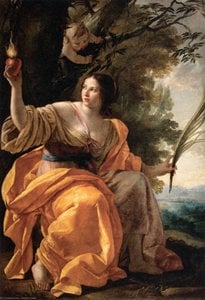
Simon Vouet's "Annunciation," painted in 1640, is more than just a religious depiction; it’s a masterful orchestration of light, shadow, and human emotion. This captivating work transports the viewer to an intimate interior space, where the momentous announcement of Mary’s divine conception unfolds with breathtaking drama. The painting immediately draws the eye to the kneeling figure of the Virgin Mary, bathed in a warm, golden glow emanating from the right side of the composition – a deliberate choice that emphasizes her purity and receptivity to the divine message. The angel Gabriel, rendered with elegant grace and poised authority, delivers the news, his gestures conveying both reverence and urgency. Beyond this central narrative, the painting is populated by a multitude of smaller angels ascending towards the upper reaches of the canvas, creating an atmosphere of celestial presence and overwhelming grace – a visual representation of the vastness and importance of the event.
Vouet’s “Annunciation” firmly establishes itself within the Baroque style, yet it transcends simple imitation. He skillfully absorbed the innovations of the Italian Renaissance – particularly the dramatic use of light and shadow championed by Caravaggio – while adapting them to the evolving aesthetic sensibilities of 17th-century France. The strong directional lines, guiding the viewer’s eye from the architectural details in the background towards the central figures, are a hallmark of Baroque composition. The dynamic arrangement of bodies, the billowing drapery, and the carefully sculpted faces all contribute to a sense of movement and theatricality. This isn't merely a static representation; it’s an experience—a carefully constructed tableau designed to evoke awe and contemplation.
The painting is rich in symbolic elements, each contributing to the overall narrative and spiritual depth. The dove, a potent symbol of the Holy Spirit, ascends gracefully above the scene, signifying divine intervention. Mary’s red robe, a traditional color associated with royalty and purity, further emphasizes her elevated status as the Mother of God. Notice the subtle diagonal that runs from the window on the right, down through Mary's robes – this compositional device mirrors the angel Gabriel’s descent and reinforces the pivotal nature of the event. The use of perspective is deliberately flattened, prioritizing emotional impact over strict realism; Vouet sought to capture the *feeling* of the moment rather than a photographic likeness.
Painted in oil on canvas, “Annunciation” showcases Vouet’s exceptional technical skill. The smooth surfaces of Mary’s robes and the angel’s wings contrast with the textured appearance of the background walls, creating a tactile richness within the image. The artist's mastery of glazing techniques is evident in the luminous quality of the light and the subtle blending of colors. It’s likely that gold leaf was employed to embellish certain elements – perhaps the halo or decorative details – adding further opulence and grandeur to the scene. The meticulous attention to detail, from the delicate folds of drapery to the intricate patterns on the architecture, speaks volumes about Vouet's dedication to his craft. This painting is a testament to the artist’s ability to transform pigments into a vibrant and emotionally resonant work of art.
WahooArt offers meticulously hand-painted reproductions of Simon Vouet’s “Annunciation,” capturing the essence of this Baroque masterpiece with unparalleled fidelity. Each reproduction is created by skilled artists using traditional techniques, ensuring that you receive an authentic representation of this iconic artwork for your home or collection.
Overall, "Annunciation" is recorded as deep_shadow. Perceived brightness describes how light or dark the work appears.
Hand-painted copies of "Annunciation" by Simon Vouet are sold on this website: a hand-painted oil reproduction on linen canvas, ordered from its Hand-Painted Reproduction page.
"Annunciation" carries a spiritual emotional tone within the Baroque movement.

Simon Vouet was a pivotal figure in the transition of French painting from Mannerism to the Baroque style. Born into an artistic family – his father Laurent was a painter and his brother Aubin also pursued art – Vouet received early training that laid the foundation for his future success. His grandson, Ludovico Dorigny, would continue the family’s artistic legacy.
During his Italian sojourn, Vouet absorbed a diverse range of influences. He studied the dramatic lighting techniques pioneered by Caravaggio, embraced elements of Italian Mannerism, and meticulously analyzed the color palettes and di sotto in su (foreshortened perspective) employed by Paolo Veronese. He also drew inspiration from the works of Carracci, Guercino, Lanfranco, and Guido Reni, synthesizing these diverse styles into a unique artistic vision.
Simon Vouet's legacy rests on his pivotal role as a bridge between Italian and French art. He successfully imported the dynamism and grandeur of the Italian Baroque, transforming it into a style that resonated with the tastes of the French court and aristocracy. His influence is undeniable in the development of French painting during the 17th century, and his contributions continue to be recognized by art historians today.

1590 - 1649 , France
Explore the life & art of Simon Vouet, a pivotal French Baroque painter who introduced Italian styles to France. Discover his masterpieces and lasting influence on 17th-century art.

Explore the captivating world of Baroque Classicism! Discover its history, key artists like Caravaggio & Rubens, and defining characteristics. Expert insights & high-quality reproductions at WahooArt.

Explore the dramatic world of Baroque art! Discover iconic artists like Caravaggio & Rubens, defining techniques, and its lasting impact on art history. Expert insights for collectors & enthusiasts at WahooArt.

Explore the breathtaking drama of 17th-century Baroque art. Our expert guide decodes the use of chiaroscuro, emotional intensity, and historical grandeur to help you appreciate and curate timeless masterpieces for your collection.
Explore the profound elegance of Baroque Classicism. Discover how 17th-century masters synthesized dramatic emotion with classical order through the lens of the Counter-Reformation and the works of legends like Carlo Maratta and Andrea Sacchi.

 Preview
 Send
Send Share
Share
 Details
 Guide
Guide

 Download
 Similars
 X-Ray
X-Ray Diaporama
 Stats
Stats Read More









 Glass option is only available in size under 110 CM