Preview AR preview Switch to Print Switch to Digital Image Send
Details Guide Add to favorites Download Similars X-Ray Diaporama Stats

Primavera

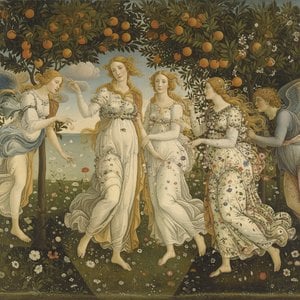
An ethereal dance of mythological figures unfolds in Botticelli's Primavera, a masterpiece of the Florentine Renaissance that captures the lush beauty of spring and invites you to bring this timeless grace into your home.

Discover Sandro Botticelli (1445-1510), Renaissance master of 'Birth of Venus' & 'Primavera'. Explore his elegant style, mythological themes, and lasting influence on art history!

Hand Made Oil Reproduction

Hand-painted oil on canvas in your size and frame, made to order by our artists. ( Switch to Print Switch to Digital Image)

Corner sample of the P118B picture frame: moulded polystyrene, 5 cm wide and 3 cm thick
P118B $10
Corner sample of the P118H picture frame: moulded polystyrene, 5 cm wide and 3 cm thick
P118H $10
Corner sample of the P118W picture frame: moulded polystyrene, 5 cm wide and 3 cm thick
P118W $10
Corner sample of the P438Z picture frame: moulded polystyrene, 5.5 cm wide and 3.5 cm thick
P438Z $10
Corner sample of the P508JH picture frame: moulded polystyrene, 7 cm wide and 3.5 cm thick
P508JH $12
Corner sample of the P508YH picture frame: moulded polystyrene, 7 cm wide and 3.5 cm thick
P508YH $12
Corner sample of the P805H picture frame: moulded polystyrene, 5 cm wide and 3.5 cm thick
P805H $10
Corner sample of the P805Z picture frame: moulded polystyrene, 5 cm wide and 3.5 cm thick
P805Z $10
Corner sample of the P919BZ picture frame: moulded polystyrene, 7 cm wide and 3.5 cm thick
P919BZ $10
Corner sample of the P919G picture frame: moulded polystyrene, 7 cm wide and 3.5 cm thick
P919G $10
Corner sample of the P919XJ picture frame: moulded polystyrene, 7 cm wide and 3.5 cm thick
P919XJ $10
Corner sample of the P959ZH picture frame: moulded polystyrene, 5 cm wide and 3 cm thick
P959ZH $10
Corner sample of the P968JZ picture frame: moulded polystyrene, 6 cm wide and 4 cm thick
P968JZ $12
Corner sample of the W106C picture frame: solid wood, 5 cm wide and 3 cm thick
W106C $8
Corner sample of the W218G picture frame: solid wood, 5 cm wide and 3 cm thick
W218G $10
Corner sample of the W218JH picture frame: solid wood, 5 cm wide and 3 cm thick
W218JH $8
Corner sample of the W218Y picture frame: solid wood, 5 cm wide and 3 cm thick
W218Y $10
Corner sample of the W307PJ picture frame: solid wood, 6 cm wide and 3 cm thick
W307PJ $10
Corner sample of the W316G picture frame: solid wood, 6 cm wide and 3 cm thick
W316G $10
Corner sample of the W316PJ picture frame: solid wood, 6 cm wide and 3 cm thick
W316PJ $8
Corner sample of the W316Y picture frame: solid wood, 6 cm wide and 3 cm thick
W316Y $10
Corner sample of the W398PJ picture frame: solid wood, 5 cm wide and 3 cm thick
W398PJ $8
Corner sample of the W4111J picture frame: solid wood, 6.5 cm wide and 3.5 cm thick
W4111J $10
Corner sample of the W500HY picture frame: solid wood, 7 cm wide and 5 cm thick
W500HY $15
Corner sample of the W500JH picture frame: solid wood, 7 cm wide and 5 cm thick
W500JH $15
Corner sample of the W692G picture frame: solid wood, 8 cm wide and 4 cm thick
W692G $12
Corner sample of the W849H picture frame: solid wood, 5 cm wide and 3 cm thick
W849H $8
Corner sample of the W940BG picture frame: solid wood, 7.5 cm wide and 4.5 cm thick
W940BG $15
Corner sample of the W953PJ picture frame: solid wood, 6 cm wide and 3.5 cm thick
W953PJ $8

Standard
custom
CM
INCH

Pick from our preset sizes that match the artwork's original proportions.

width
height

Type the width and the height you need, to fit your frame or your wall. This is hand-painted, so for a size with a different shape the artist can paint a bit more around the picture, or cut a bit — you choose. We send you a digital mockup to approve before the painting starts. The picture shown on this page does not show the real result — only the mockup does.

Examples of what can be changed: Replace face with customer photo; Add pet (e.g., replace cat with dog); Include hidden message in background; Change background landscape or elements.
After order, WahooArt.com team will email client for instructions and provide a mockup preview

Worldwide Delivery () in 3/4 weeks instead of standard 5 weeks. (18 October). No compromise on quality.

Free Worldwide Express Shipping
High-Quality Linen Canvas
Full Shipping Insurance
Customs Tax Refund Guarantee
True Color Matching Guarantee
100-Day Return Policy (Defects Only)
100% Money-Back Guarantee
Bulk Discount Offer

Total Price

$ 272

Primavera

Reproduction Medium

Reproduction Size

-

Total Price

$ 272

Quick Facts

  • Artist: Sandro Botticelli
  • Notable elements or techniques: Floral wreath, Key motif
  • Title: Primavera
  • Dimensions: 73 × 68 cm
  • Location: Uffizi Gallery, Florence
  • Movement: Early Renaissance

Art Quiz

There is only one correct answer for each question.

Question 1:
In which city was the 'Primavera' painted during the reign of Lorenzo de' Medici?
Question 2:
Which goddess is depicted in the painting as embodying feminine beauty and love?
Question 3:
What medium did Botticelli use to achieve luminosity and vibrancy in this work?
Question 4:
Which of these trees is specifically mentioned as being part of the blossoming scene?
Question 5:
What is a primary characteristic of Botticelli's style in this painting?

A Bloom of Mythological Grace: Exploring Sandro Botticelli’s Primavera

Botticelli's “Primavera,” completed around 1482, stands as an emblem of the Florentine Renaissance—a moment when artistic innovation flourished alongside humanist ideals. Painted during Lorenzo de Medici’s reign, this fresco adorns the Villa Medici in Florence and embodies a profound engagement with classical mythology and philosophical contemplation. More than just a visually stunning depiction of springtime, it's a carefully crafted allegory designed to communicate complex ideas about rebirth, fertility, and divine harmony.
  • Subject Matter: The painting portrays a lush garden scene populated by figures representing Venus (Aphrodite), Flora (the goddess of flowers), Zephyr (the west wind), Mercury (Hermes), and Cupid (Eros). These deities intertwine amidst blossoming trees—specifically almond blossoms, cherry blossoms, peach blossoms, and orange blossoms—creating an immersive tableau of springtime’s fecundity.
  • Style: Botticelli's style is characterized by its ethereal beauty and delicate lines—a hallmark of Florentine Mannerism that prioritizes grace and elegance over anatomical realism. The figures are rendered with a serene composure, conveying a sense of idealized perfection rarely seen in contemporary art.
  • Technique: Employing tempera paint on plaster, Botticelli achieved remarkable luminosity and vibrancy despite the limitations of the medium. His meticulous attention to detail—evident in the intricate floral arrangements and the subtle drapery folds—demonstrates his mastery of artistic craftmanship.

Symbolism Unveiled: Layers of Meaning Beyond Beauty

The Primavera’s symbolism extends far beyond its picturesque depiction of springtime. Each figure carries significant allegorical weight, reflecting humanist concerns about the cyclical nature of life and the pursuit of virtue. Venus embodies feminine beauty and love, while Flora symbolizes blossoming fertility and renewal. Zephyr brings forth the gentle breezes that herald spring's arrival, Mercury represents intellect and divine inspiration, and Cupid signifies desire and passion—all forces essential for achieving spiritual enlightenment. The key held by the central woman is interpreted as representing knowledge and unlocking potential – a subtle nod to humanist thought.

Historical Context: Renaissance Florence and Patronage

Botticelli’s Primavera was commissioned by Lorenzo de Medici, ruler of Florence and a fervent supporter of artistic endeavors. This patronage reflects the broader cultural climate of the time—a period marked by renewed interest in classical antiquity and a belief in human reason as a path to understanding the universe. The fresco served not only as decoration for Villa Medici but also as a powerful statement about Florentine humanist values, aligning with the intellectual currents shaping Renaissance Europe.

Emotional Impact: A Vision of Ideal Perfection

“Primavera” transcends mere visual representation; it evokes a profound emotional response in viewers. Its serene beauty and harmonious composition inspire contemplation on themes of love, rebirth, and divine grace. Botticelli’s masterful technique captures the fleeting splendor of springtime—a reminder of humanity's capacity for wonder and aspiration. It continues to captivate audiences centuries later as an enduring testament to the artistic genius of the Renaissance.

Questions & Answers

Why is "Primavera" by Sandro Botticelli recommended as a gift?

"Primavera" carries an ethereal feeling, and its recorded gift recommendation is seasonal gift.

Who is the artist behind "Primavera"?

"Primavera" is attributed to Sandro Botticelli.

What subjects appear in "Primavera" by Sandro Botticelli?

The subjects of "Primavera" are mythology, floral arrangement, female figure, fruit trees, allegory, renaissance art, symbolism, garden scene.


Artist Biography

Early Life and Florentine Beginnings

Sandro Botticelli, born Alessandro di Mariano di Vanni Filipepi around 1445 in Florence, Italy, emerged during a period of extraordinary cultural ferment—the Early Renaissance. His life was deeply rooted in the city’s artistic and social fabric; he never strayed far from his neighborhood of Ognissanti, a testament to both familial ties and the vibrant creative ecosystem that nurtured him. His father, Mariano Filipepi, initially a goldsmith and later a tanner, provided an early exposure to craftsmanship and meticulous detail—qualities that would profoundly influence Botticelli’s artistic approach. Though initial reports suggested training as a goldsmith, he soon found his calling under the tutelage of Fra Filippo Lippi, a leading painter of the time. This apprenticeship proved pivotal, immersing him in the techniques and aesthetics of the Florentine school while also connecting him to influential patrons like the Medici family.

A Style Defined by Grace and Myth

Botticelli’s artistic style is instantly recognizable for its lyrical beauty, characterized by elegant linearity, flowing contours, and a delicate use of color. He masterfully bridged the gap between the late Gothic traditions and the burgeoning Renaissance aesthetic, absorbing influences from masters like Fra Angelico and Paolo Uccello yet forging a uniquely personal vision. His figures possess an ethereal quality, often depicted with elongated proportions and graceful poses that convey both serenity and a subtle melancholy. A defining feature of his work is the frequent incorporation of classical mythology—a reflection of the humanist interests sweeping through Renaissance Florence. He didn’t merely illustrate these ancient tales; he imbued them with new layers of meaning, exploring themes of love, beauty, and spiritual longing.

Botticelli's technique was innovative for its time. He often employed a silverpoint drawing method underpainting his canvases, contributing to the luminosity and delicate detail seen in his finished works. His use of tempera paint allowed for precise rendering and vibrant colors, while his later experiments with oil paints broadened his expressive possibilities.

Iconic Masterpieces and Artistic Development

Botticelli’s legacy rests upon a handful of iconic paintings that continue to captivate audiences centuries later. The Birth of Venus, completed around 1486, stands as perhaps his most celebrated work—an allegorical depiction of the goddess emerging from a seashell, embodying Renaissance ideals of beauty and harmony. Its graceful composition, delicate color palette, and evocative symbolism have made it an enduring symbol of the era. Equally renowned is Primavera, created around 1482, a complex and enigmatic painting celebrating spring and love, populated with symbolic figures drawn from classical mythology. These works showcase Botticelli’s mastery of composition, his ability to create atmospheric depth, and his profound understanding of human emotion.

His artistic journey unfolded in distinct phases. The early 1470s saw him focusing on religious subjects, honing his technical skills and establishing a reputation for skillful execution. The 1480s marked the peak of his creative powers, with the creation of his most famous mythological paintings. However, the late 1490s witnessed a shift in his style, influenced by the fervent preaching of Girolamo Savonarola—a Dominican friar who condemned what he saw as the decadence and moral corruption of Florence. This period resulted in more austere and emotionally charged works, reflecting a growing spiritual intensity.

Legacy and Rediscovery

Following his death in 1510, Botticelli’s reputation gradually faded into obscurity. For nearly three centuries, his work was largely forgotten, overshadowed by the achievements of High Renaissance masters like Leonardo da Vinci and Michelangelo. However, a remarkable rediscovery occurred in the late 19th century with the rise of the Pre-Raphaelite Brotherhood—a group of English artists who rejected academic conventions and sought inspiration in the art of the early Italian Renaissance. They were captivated by Botticelli’s linear grace, vibrant colors, and poetic sensibility, recognizing him as a kindred spirit.

This renewed appreciation sparked a widespread reassessment of his work, establishing him as one of the most important artists of the Early Renaissance. Today, Botticelli is celebrated for his unique artistic vision, his masterful technique, and his enduring ability to evoke beauty, emotion, and spiritual contemplation. His influence can be seen in subsequent generations of artists who have sought to capture the same sense of grace and elegance in their own work. He remains a symbol of Florentine artistic achievement and a testament to the power of Renaissance humanism.

Major Works

  • The Birth of Venus (c. 1486): An iconic depiction embodying Renaissance ideals of beauty.
  • Primavera (c. 1482): A complex allegorical painting celebrating spring and love.
  • Adoration of the Magi (1475-1476): Demonstrates early mastery of composition and perspective.
  • Mystic Nativity (1501): Reflects a shift towards spiritual themes in his later career.
Sandro Botticelli

Sandro Botticelli

1445 - 1510 , Italy

Quick Facts

  • Full Name: Alessandro di Mariano Filipepi
  • Nationality: Italian
  • Date Of Birth: 1445
  • Date Of Death: 1510
  • Place Of Birth: Florence, Italy
  • Notable Artworks:
    • Birth of Venus
    • Primavera
    • Adoration of the Magi
    • Mystic Nativity
  • Artistic Movement Or Style: Early Renaissance
  • Artists Who Influenced This Artist:
    • Fra Angelico
    • Paolo Uccello
  • Artists Or Movements Influenced By This Artist: ['Pre-Raphaelites']
Explore artworks organized by themes, styles, and characteristics.