

Museum-quality giclée or canvas print with fast production and flexible finish options. ( Buy Hand Made Painting Switch to Digital Image)





























Pick from our preset sizes that match the artwork's original proportions.

Type the width and the height you need, to fit your frame or your wall. A print can only be cut, never made bigger than the picture, so a size with a different shape loses a part of the image. We send you a digital mockup to approve before we print anything. The picture shown on this page does not show the real cut — only the mockup does.
Worldwide Delivery () in 2 weeks instead of standard 4/5 weeks. (27 October)
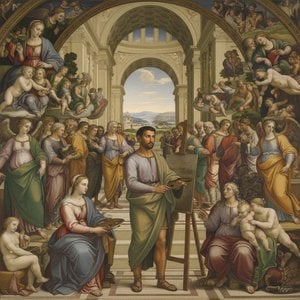
The sibyls (detail)
Reproduction Size
Raphael's "The Sibyls," a captivating detail from the larger fresco cycle adorning the chapel at Santa Maria della Pace in Rome, offers a profound meditation on prophecy, knowledge, and the human condition. Completed around 1514, this section of the work stands as a testament to Raphael’s mastery of composition, color, and his deep understanding of classical ideals – all rendered with an exquisite grace that belies the weighty themes it explores. The painting isn't merely a decorative element; it’s a carefully constructed visual narrative, inviting viewers into a world where ancient wisdom intersects with divine inspiration.
The scene depicts four Sibyls—figures from Greek mythology renowned for their prophetic abilities—each poised in a moment of intense contemplation. These women, originating from Cumae, Persia, Phrygia, and Tibute, were believed to have possessed the gift of foresight, delivering oracles to rulers and mortals alike. Raphael’s depiction transcends simple portraiture; he imbues these figures with an almost ethereal quality, their long hair cascading around them like liquid moonlight, their faces etched with a mixture of solemnity and intense concentration. The red dress worn by the central Sibyl immediately draws the eye, creating a focal point within the composition while simultaneously hinting at both passion and divine authority.
Raphael’s approach to this subject matter is deeply rooted in the High Renaissance tradition, yet subtly departs from earlier Mannerist styles. He skillfully blends elements of classical sculpture—particularly the contrapposto stance evident in the figures' postures—with a heightened sense of realism and emotional depth. The use of *sfumato*, a technique perfected by Leonardo da Vinci, is particularly noticeable here; it softens the edges of the forms, creating an atmospheric haze that contributes to the overall sense of mystery and timelessness. The color palette is restrained yet luminous, dominated by rich reds, blues, and golds—colors associated with royalty, divinity, and wisdom.
Notably, Raphael’s workshop executed much of the fresco cycle, including these Sibyls, based on his original drawings. While some stylistic differences exist between Raphael's designs and the final execution, the core composition and thematic intent remain remarkably consistent. The architectural setting—a trabeated loggia reminiscent of Roman architecture—further reinforces the connection to classical antiquity, suggesting that the Sibyls’ prophecies are not merely divinely inspired but also rooted in a deep understanding of human history and fate.
The Sibyls themselves are potent symbols. Each represents a different region of the ancient world and, consequently, a distinct source of prophecy. Their presence within the chapel at Santa Maria della Pace—a space dedicated to prayer and contemplation—underscores the importance of seeking guidance from the divine. The angel holding a lighted torch above them is a crucial element, symbolizing the illumination that comes through prophetic insight – dispelling darkness and revealing the future. The Sibyls’ gazes, directed towards an unseen point beyond the frame, invite viewers to contemplate their own role in interpreting the signs of the times.
Furthermore, the Sibyls' connection to the *Stanza della Segnatura*, another fresco cycle within the Vatican Palace, reveals a deliberate thematic continuity. The figures here share similarities with the Virtues depicted in that room—each associated with a specific branch of knowledge and virtue. This reinforces the idea that prophecy is not simply about predicting the future but also about cultivating wisdom and understanding.
WahooArt offers meticulously crafted, hand-painted reproductions of Raphael’s “The Sibyls,” capturing the essence of this iconic artwork with unparalleled detail and fidelity. Whether you seek a stunning addition to your personal collection or a sophisticated piece for interior design, our reproductions provide an authentic representation of Raphael's genius. Each reproduction is created using traditional techniques and archival-quality materials, ensuring its longevity and beauty for generations to come. Explore the available sizes and options on our website to bring this timeless masterpiece into your space.
"The sibyls (detail)" belongs to the High Renaissance movement, and its creator worked in the Renaissance era.
The palette of "The sibyls (detail)" is balanced soft in saturation.
Regarding copyright, "The sibyls (detail)" is in the public domain - its copyright has expired.

In the quiet, intellectual halls of Urbino, a young boy named Raffaello Sanzio grew up surrounded by the scent of ink and the rhythms of courtly life. His father, Giovanni Santi, was a man of letters and a painter for the Duke, ensuring that the child’s earliest memories were steeped in the humanist traditions of the Italian courts. This environment provided more than just a home; it offered a window into the advanced artistic ideas flowing through central Italy. When tragedy struck and his father passed away when Raphael was only eleven, the boy found himself managing the family workshop. He learned the weight of responsibility alongside the delicate touch of the brush.
His early training led him to the workshop of Pietro Perugino in Perugia. Under this master, he absorbed the Umbrian style, a method defined by soft modeling and serene religious scenes. By the time he was recognized as an independent master around 1500, his hand already showed a certain clarity and ease. He moved through the cities of northern Italy, gathering knowledge like a traveler collecting coins, before the pull of larger artistic centers began to reshape his vision.
When Raphael arrived in Florence in 1504, he entered a city pulsing with the energy of new discoveries. He did not merely observe the works of Leonardo da Vinci and Michelangelo; he studied them with an insatiable hunger. From Leonardo, he learned the subtle gradations of light and shadow known as sfumato. From Michelangelo, he drew an understanding of anatomical precision and the power of dramatic composition. This period was a transformation. His earlier, gentler Madonnas began to take on a new psychological depth and physical presence.
The Florentine influence allowed him to synthesize these diverse techniques into something uniquely his own. He possessed a rare ability to take the scientific shadows of one master and the muscular strength of another, blending them into a style characterized by balance and luminous color. His portraits from this era reflect a growing sophistication, capturing not just the likeness of his subjects but a sense of their inner dignity.
A summons from Pope Julius II in 1508 brought Raphael to Rome, an event that changed the trajectory of his life. The Eternal City offered him the grandest stage imaginable. Tasked with decorating the papal apartments in the Vatican, he began work on the Stanze della Segnatura. It was here that he produced the School of Athens, a vast fresco where he brought together the great thinkers of antiquity—Plato, Aristotle, and Euclid—into a single, harmonious space. This work celebrated human reason through a masterful use of perspective and classical allegory.
His productivity in Rome was immense. Working for successive Popes, including Leo X, he expanded his reach from painting to architecture, even overseeing projects at St. Peter's basilica. His hands decorated the halls of the Vatican with scenes that spoke of justice, prudence, and fortitude. Even as he managed an unusually large workshop to meet these monumental demands, the clarity of his original vision remained intact. He became a central figure in the High Renaissance, a painter whose work embodied the Neoplatonic ideal of human grandeur.
The sudden end of his life in 1520, at only thirty-seven years of age, left the papal court in deep mourning. Though his career was cut short, the foundation he laid was unshakable. His emphasis on order, proportion, and idealized beauty became a standard for European painting for centuries. While later movements would occasionally reject his polished grace, his influence remained a cornerstone of the academic tradition.
The impact of his work can be seen in several key areas:

1483 - 1520 , Italy

Explore the profound mastery of fresco painting, from the technical alchemy of buon fresco to the legendary narratives of Renaissance masters like Ghirlandaio. Discover how this timeless medium shaped art history and continues to inspire architectural grandeur today.

Discover the timeless art of fresco painting. Explore the profound history, technical mastery of buon fresco, and the enduring legacy of Renaissance masters like Michelangelo in this expert guide to painting on wet plaster.
Elevate your home with the sublime harmony of Raphael’s masterpieces. Explore iconic High Renaissance works, from St. George to The School of Athens, and discover how premium, hand-painted reproductions can transform your space into a sanctuary of classical elegance and timeless beauty.

 Preview
 Send
Send Share
Share
 Details
 Guide
Guide

 Download
 Similars
 X-Ray
X-Ray Diaporama
 Stats
Stats
 Read More









 Glass option is only available in size under 110 CM


