Preview AR preview Switch to Print Switch to Digital Image Send
Details Guide Add to favorites Download Similars X-Ray Diaporama Stats

The Virtues

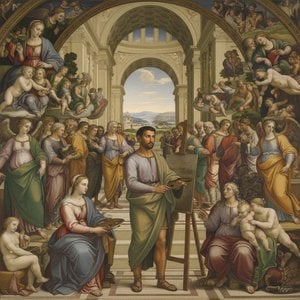
Raphael’s breathtaking fresco ‘The Virtues,’ part of the Stanza della Segnatura in Vatican City, embodies High Renaissance grace with idealized figures representing faith, hope, charity, prudence and fortitude. Explore this masterpiece and bring Raphael's timeless vision home.

High Renaissance master of the School of Athens. Discover his legendary Madonnas and breathtaking Vatican frescoes today.

Hand Made Oil Reproduction

Hand-painted oil on canvas in your size and frame, made to order by our artists. ( Switch to Print Switch to Digital Image)

Corner sample of the P118B picture frame: moulded polystyrene, 5 cm wide and 3 cm thick
P118B $10
Corner sample of the P118H picture frame: moulded polystyrene, 5 cm wide and 3 cm thick
P118H $10
Corner sample of the P118W picture frame: moulded polystyrene, 5 cm wide and 3 cm thick
P118W $10
Corner sample of the P438Z picture frame: moulded polystyrene, 5.5 cm wide and 3.5 cm thick
P438Z $10
Corner sample of the P508JH picture frame: moulded polystyrene, 7 cm wide and 3.5 cm thick
P508JH $12
Corner sample of the P508YH picture frame: moulded polystyrene, 7 cm wide and 3.5 cm thick
P508YH $12
Corner sample of the P805H picture frame: moulded polystyrene, 5 cm wide and 3.5 cm thick
P805H $10
Corner sample of the P805Z picture frame: moulded polystyrene, 5 cm wide and 3.5 cm thick
P805Z $10
Corner sample of the P919BZ picture frame: moulded polystyrene, 7 cm wide and 3.5 cm thick
P919BZ $10
Corner sample of the P919G picture frame: moulded polystyrene, 7 cm wide and 3.5 cm thick
P919G $10
Corner sample of the P919XJ picture frame: moulded polystyrene, 7 cm wide and 3.5 cm thick
P919XJ $10
Corner sample of the P959ZH picture frame: moulded polystyrene, 5 cm wide and 3 cm thick
P959ZH $10
Corner sample of the P968JZ picture frame: moulded polystyrene, 6 cm wide and 4 cm thick
P968JZ $12
Corner sample of the W106C picture frame: solid wood, 5 cm wide and 3 cm thick
W106C $8
Corner sample of the W218G picture frame: solid wood, 5 cm wide and 3 cm thick
W218G $10
Corner sample of the W218JH picture frame: solid wood, 5 cm wide and 3 cm thick
W218JH $8
Corner sample of the W218Y picture frame: solid wood, 5 cm wide and 3 cm thick
W218Y $10
Corner sample of the W307PJ picture frame: solid wood, 6 cm wide and 3 cm thick
W307PJ $10
Corner sample of the W316G picture frame: solid wood, 6 cm wide and 3 cm thick
W316G $10
Corner sample of the W316PJ picture frame: solid wood, 6 cm wide and 3 cm thick
W316PJ $8
Corner sample of the W316Y picture frame: solid wood, 6 cm wide and 3 cm thick
W316Y $10
Corner sample of the W398PJ picture frame: solid wood, 5 cm wide and 3 cm thick
W398PJ $8
Corner sample of the W4111J picture frame: solid wood, 6.5 cm wide and 3.5 cm thick
W4111J $10
Corner sample of the W500HY picture frame: solid wood, 7 cm wide and 5 cm thick
W500HY $15
Corner sample of the W500JH picture frame: solid wood, 7 cm wide and 5 cm thick
W500JH $15
Corner sample of the W692G picture frame: solid wood, 8 cm wide and 4 cm thick
W692G $12
Corner sample of the W849H picture frame: solid wood, 5 cm wide and 3 cm thick
W849H $8
Corner sample of the W940BG picture frame: solid wood, 7.5 cm wide and 4.5 cm thick
W940BG $15
Corner sample of the W953PJ picture frame: solid wood, 6 cm wide and 3.5 cm thick
W953PJ $8

Standard
custom
CM
INCH

Pick from our preset sizes that match the artwork's original proportions.

width
height

Type the width and the height you need, to fit your frame or your wall. This is hand-painted, so for a size with a different shape the artist can paint a bit more around the picture, or cut a bit — you choose. We send you a digital mockup to approve before the painting starts. The picture shown on this page does not show the real result — only the mockup does.

Examples of what can be changed: Replace face with customer photo; Add pet (e.g., replace cat with dog); Include hidden message in background; Change background landscape or elements.
After order, WahooArt.com team will email client for instructions and provide a mockup preview

Worldwide Delivery () in 3/4 weeks instead of standard 5 weeks. (20 October). No compromise on quality.

Free Worldwide Express Shipping
High-Quality Linen Canvas
Full Shipping Insurance
Customs Tax Refund Guarantee
True Color Matching Guarantee
100-Day Return Policy (Defects Only)
100% Money-Back Guarantee
Bulk Discount Offer

Total Price

$ 272

The Virtues

Reproduction Medium

Reproduction Size

-

Total Price

$ 272

Quick Facts

  • Artistic style: Idealized realism
  • Movement: High Renaissance
  • Year: 1509-1511
  • Location: Stanza della Segnatura, Vatican City
  • Artist: Raphael
  • Influences: Michelangelo

A Symphony of Virtue: Exploring Raphael’s “The Virtues” Fresco

The fresco "The Virtues," painted by Raphael Sanzio da Urbino between 1509 and 1511 as part of the Stanza della Segnatura in Vatican City, stands as an unparalleled achievement of High Renaissance art. More than just a decorative embellishment of papal chambers, it’s a profound meditation on moral philosophy—a visual embodiment of Christian virtues designed to inspire contemplation and guide spiritual understanding. Commissioned by Pope Julius II during a period of ambitious artistic patronage, Raphael undertook this monumental task with unwavering dedication, transforming an unremarkable hallway into a breathtaking panorama of humanist ideals.

The Compositional Harmony: Michelangelo’s Influence

Raphael's masterful handling of perspective and spatial arrangement owes considerable debt to the pioneering work of Michelangelo Buonarroti on the Sistine Chapel ceiling. Like Michelangelo’s depiction of biblical figures soaring across the vault, Raphael employs dramatic diagonals and expansive curves to draw the viewer’s eye into the scene. The careful positioning of the figures—particularly Fortitude's lion—echoes Michelangelo’s monumental sculptures, demonstrating a shared artistic lineage and reflecting the broader Renaissance fascination with grandeur and anatomical accuracy. This deliberate stylistic kinship elevates “The Virtues” beyond mere aesthetic beauty; it speaks to a deeper engagement with the intellectual currents shaping European culture at the time.

Symbolism Rooted in Classical Tradition

The fresco’s symbolism is intricately interwoven with classical humanist thought, reflecting Raphael's exposure to the philosophical ideas circulating amongst intellectuals of his era. Each virtue—Fortitude, Charity, Prudence, Hope and Temperance—is represented by a female figure, embodying abstract concepts rather than literal representations. The mirror held aloft by Prudence symbolizes wisdom and discernment, prompting viewers to examine their own moral compass. Fortitude’s lion represents courage and resilience, while Temperance's reins symbolize moderation and self-control. Crucially, the depiction of Faith points upwards towards heaven, emphasizing the importance of spiritual devotion and belief—a cornerstone of Christian theology. The central tondo depicting Justice reinforces this thematic core, symbolizing righteousness and moral accountability.

Technique: Fresco Painting – A Legacy of Brilliance

Raphael’s technique exemplifies the mastery of fresco painting achieved during the High Renaissance. This method involves applying pigment onto wet plaster—a process demanding meticulous planning and execution. The durability of fresco ensures that “The Virtues” continues to captivate audiences centuries later, preserving Raphael's vibrant colors and nuanced detailing with remarkable fidelity. Unlike oil paint, which allows for reworking and blending, fresco necessitates a decisive approach, resulting in an image that is both timeless and powerfully expressive. The subtle gradations of color achieved through layering pigments contribute to the fresco’s luminous quality—a testament to Raphael’s artistic skill and his unwavering commitment to capturing the essence of humanist ideals.

Emotional Resonance: Inspiration for Generations

“The Virtues” transcends its formal artistry, resonating with viewers on an emotional level. Its serene beauty and harmonious composition convey a sense of moral upliftment—inviting contemplation and fostering reflection upon ethical conduct. Raphael’s masterpiece serves as a poignant reminder of the enduring power of art to communicate profound philosophical concepts and inspire spiritual aspiration. It remains a cornerstone of High Renaissance art, continuing to inspire artists and collectors alike who seek to emulate its elegance and imbue their own creations with similar moral depth.

Questions & Answers

Does "The Virtues" by Raphael use strong contrasts or soft harmonies?

The color analysis of "The Virtues" by Raphael records a statement contrast and a strong color unity harmony.

Can I see "The Virtues" by Raphael on my own wall before buying?

The AR Preview page of "The Virtues" by Raphael uses augmented reality to show the artwork in your own space, on a compatible device.

From which country does the High Renaissance work "The Virtues" come?

The High Renaissance work "The Virtues" was made by an artist born in Italy.


Artist Biography

The Grace of Urbino

In the quiet, intellectual halls of Urbino, a young boy named Raffaello Sanzio grew up surrounded by the scent of ink and the rhythms of courtly life. His father, Giovanni Santi, was a man of letters and a painter for the Duke, ensuring that the child’s earliest memories were steeped in the humanist traditions of the Italian courts. This environment provided more than just a home; it offered a window into the advanced artistic ideas flowing through central Italy. When tragedy struck and his father passed away when Raphael was only eleven, the boy found himself managing the family workshop. He learned the weight of responsibility alongside the delicate touch of the brush.

His early training led him to the workshop of Pietro Perugino in Perugia. Under this master, he absorbed the Umbrian style, a method defined by soft modeling and serene religious scenes. By the time he was recognized as an independent master around 1500, his hand already showed a certain clarity and ease. He moved through the cities of northern Italy, gathering knowledge like a traveler collecting coins, before the pull of larger artistic centers began to reshape his vision.

The Florentine Crucible

When Raphael arrived in Florence in 1504, he entered a city pulsing with the energy of new discoveries. He did not merely observe the works of Leonardo da Vinci and Michelangelo; he studied them with an insatiable hunger. From Leonardo, he learned the subtle gradations of light and shadow known as sfumato. From Michelangelo, he drew an understanding of anatomical precision and the power of dramatic composition. This period was a transformation. His earlier, gentler Madonnas began to take on a new psychological depth and physical presence.

The Florentine influence allowed him to synthesize these diverse techniques into something uniquely his own. He possessed a rare ability to take the scientific shadows of one master and the muscular strength of another, blending them into a style characterized by balance and luminous color. His portraits from this era reflect a growing sophistication, capturing not just the likeness of his subjects but a sense of their inner dignity.

The Roman Triumph

A summons from Pope Julius II in 1508 brought Raphael to Rome, an event that changed the trajectory of his life. The Eternal City offered him the grandest stage imaginable. Tasked with decorating the papal apartments in the Vatican, he began work on the Stanze della Segnatura. It was here that he produced the School of Athens, a vast fresco where he brought together the great thinkers of antiquity—Plato, Aristotle, and Euclid—into a single, harmonious space. This work celebrated human reason through a masterful use of perspective and classical allegory.

His productivity in Rome was immense. Working for successive Popes, including Leo X, he expanded his reach from painting to architecture, even overseeing projects at St. Peter's basilica. His hands decorated the halls of the Vatican with scenes that spoke of justice, prudence, and fortitude. Even as he managed an unusually large workshop to meet these monumental demands, the clarity of his original vision remained intact. He became a central figure in the High Renaissance, a painter whose work embodied the Neoplatonic ideal of human grandeur.

A Legacy of Harmony

The sudden end of his life in 1520, at only thirty-seven years of age, left the papal court in deep mourning. Though his career was cut short, the foundation he laid was unshakable. His emphasis on order, proportion, and idealized beauty became a standard for European painting for centuries. While later movements would occasionally reject his polished grace, his influence remained a cornerstone of the academic tradition.

The impact of his work can be seen in several key areas:

  • The Development of the High Renaissance: He perfected the balance between classical structure and human emotion.
  • Architectural Influence: His work on papal projects helped shape the physical landscape of the Vatican.
  • Artistic Lineage: His workshop trained pupils like Giulio Romano, ensuring his methods endured.
Raphael

Raphael

1483 - 1520 , Italy

Quick Facts

  • Artistic Movement Or Style: High Renaissance
  • Artists Or Movements Influenced By This Artist: ['Neoclassical painting']
  • Artists Who Influenced This Artist:
    • Pietro Perugino
    • Leonardo da Vinci
    • Michelangelo
  • Full Name: Raffaello Sanzio da Urbino
  • Nationality: Italian
  • Notable Artworks:
    • The School of Athens
    • Madonnas
    • The Transfiguration
  • Place Of Birth: Urbino, Italy
  • Date Of Birth: 1483
  • Date Of Death: 1520
Explore artworks organized by themes, styles, and characteristics.