OilWallArtAntwerp Renaissance
 Renaissance
 22.0 x 22.0 cm
 Rockox House
Museum-quality giclée or canvas print with fast production and flexible finish options. ( Buy Hand Made Painting Switch to Digital Image)





























Pick from our preset sizes that match the artwork's original proportions.

You may enter your own dimensions to fit a specific frame or space. If your selected size does not match the original image's proportions, we will either crop the artwork or extend the image with a mirrored or solid-fill edge. A digital mockup will be sent for your approval before production begins.
Please note that the on-screen preview does not reflect the actual cropping or extension. Only the mockup will accurately show the final composition.
While custom sizes are available, we recommend selecting a dimension from the predefined list to preserve the original proportions.
Worldwide Delivery () in 2 weeks instead of standard 4/5 weeks. (24 September)


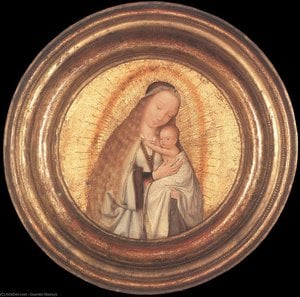
Virgin with the Child
Reproduction Size
In the quiet intimacy of Quentin Massys’ Virgin with the Child, we are invited into a moment of profound, silent devotion. This exquisite work serves as a window into the heart of the Antwerp Renaissance, capturing a scene that transcends time through its sheer emotional vulnerability. The painting depicts the Virgin Mary cradling the Christ child, her gaze cast downward in a look of tender contemplation. There is a palpable warmth radiating from the composition, a soft light that seems to emanate from the connection between mother and son. As she holds him close to her chest, the delicate interplay of shadow and light highlights the intricate textures of her white garments, creating a sense of tactile reality that draws the viewer into her sacred orbit.
The mastery of Massys lies in his ability to marry the meticulous detail characteristic of the Northern European tradition with a newfound, soulful humanism. Every fold of the Virgin’s dress and every soft contour of the infant's skin is rendered with a precision that speaks to the artist's profound technical skill. Set against a deep, dark background, the figures emerge with a sculptural presence, their luminosity heightened by the surrounding gloom. This technique, often employed by masters of the era, serves to strip away all worldly distractions, forcing the observer to confront the raw, unadorned beauty of this maternal bond.
Beyond its aesthetic splendor, the painting is rich with the symbolic language of the 16th century. The purity of the Virgin’s white attire is not merely a stylistic choice but a profound emblem of her sinless nature, a visual hymn to her sanctity. The way she cradles the child—protective, yet resigned to his divine destiny—encapsulates the theological weight of the Incarnation. For the contemporary viewer and the art collector alike, these elements offer a meditative experience, where the physical beauty of the oil medium serves as a vessel for spiritual reflection. The ornate framing suggested by the composition further elevates the subject, transforming a simple portrait into a precious icon of faith.
For interior designers and connoisseurs of fine art, this piece offers an unparalleled opportunity to introduce a sense of historical gravity and serene elegance into a space. A high-quality reproduction of this masterpiece does more than decorate a wall; it anchors a room with a sense of timelessness and peace. Whether placed in a sunlit gallery or a moody, sophisticated study, the Virgin with the Child brings with it an aura of classical sophistication and an enduring emotional resonance that continues to captivate the modern soul.

In the vibrant, burgeoning landscape of the sixteenth-century Low Countries, few names resonate with as much foundational importance as Quentin Massys. Often heralded as the pioneer of the Antwerp School, Massys was a painter who bridged the gap between the meticulous, spiritual devotion of the Early Netherlandish tradition and the burgeoning humanism of the Northern Renaissance. Born around 1466 in Leuven, Belgium, his early life remains a tapestry of legend and historical fragments. It is widely whispered in art history that before he ever grasped a fine brush, he was trained as an ironsmith—a detail that lends a profound, tactile weight to his later mastery of texture and material. This background in metalworking likely instilled in him a unique reverence for the physical world, allowing him to render the sheen of silk, the cold glint of coin, and the weathered skin of humanity with unparalleled precision.
As he transitioned from the academic atmosphere of Leuven to the bustling commercial hub of Antwerp around 1490, Massys began to weave his own distinct thread into the fabric of Flemish art. His early training, potentially under the guidance of Dirk Bouts, connected him to the lineage of masters like Hans Memling and Rogier van der Weyden. From these predecessors, he inherited a devotion to verisimilitude—the pursuit of truth in representation. Yet, Massys was far from a mere imitator. While he maintained the exquisite detail characteristic of his ancestors, he infused his work with a new, burgeoning vitality and a willingness to explore the complexities of the human condition through both religious solemnity and biting social commentary.
The brilliance of Massys lies in his remarkable ability to navigate two seemingly disparate worlds: the sacred and the profane. On one hand, his religious compositions serve as profound meditations on faith. In works such as Christ on the Cross with Donors, he captures the raw, emotional gravity of the crucifixion, utilizing a High Renaissance sensibility to present a scene that is both deeply moving and technically flawless. His ability to depict the divine through the lens of human suffering allowed his religious subjects to resonate with a visceral intimacy, making the spiritual palpable to the viewer.
Conversely, Massys was a master of the satirical genre, using his brush to hold a mirror up to the shifting social morals of his era. He possessed a keen eye for the foibles of humanity, often creating scenes that blended realism with a subtle, mocking wit. This duality is perhaps most evident in his approach to portraiture and genre painting, where he could pivot from the serene beauty of a Virgin and Child to the more complex, morally layered depictions of contemporary life. His work often explored themes of greed, vanity, and the tension between material wealth and spiritual purity, making him a precursor to the great genre painters who would follow in the centuries to come.
The historical significance of Quentin Massys cannot be overstated; he was the catalyst for an artistic revolution in Antwerp. By introducing new motifs and techniques while remaining anchored in the rich traditions of his homeland, he provided the blueprint for a school of painting that would dominate Flanders throughout the sixteenth century. His influence can be traced through the evolution of Northern European art, as he paved the way for a more expressive, observational style that embraced the complexities of the modernizing world.
Today, we remember Massys not just as a craftsman, but as a storyteller who captured the soul of an era. His legacy is preserved in the enduring power of his imagery:

1466 - 1530 , Belgium

Explore the exquisite precision of Flemish painting. From Jan van Eyck to Robert Campin, discover the revolutionary oil techniques and rich symbolism that defined the Northern Renaissance and continue to inspire fine art collectors today.

Embark on a journey through the exquisite precision of Flemish Art. Discover the pioneering oil techniques, profound symbolism, and luminous realism that define the Northern Renaissance masters in this expert guide for art enthusiasts.

Explore the profound beauty of Marian iconography through an art historian's lens. Discover iconic masterpieces by Raphael and Renaissance masters, celebrating the divine grace and timeless elegance of the Virgin Mary in classical fine art.

Explore the dramatic brilliance of the Flemish Baroque movement. Discover how masters like Peter Paul Rubens utilized chiaroscuro and dynamic composition to redefine art history through light, shadow, and unparalleled emotion.

Embark on a profound journey through art history with our exploration of the most iconic depictions of the Virgin Mary. Discover the divine grace, symbolism, and masterful techniques found in Renaissance masterpieces and sacred iconography.

 Preview
 Send
Send Share
Share
 Details
 Guide
Guide

 Download
 Similars
 X-Ray
X-Ray Diaporama
 Stats
Stats Read More







 Glass option is only available in size under 110 CM