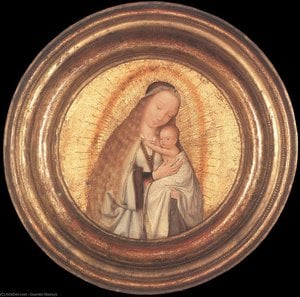
The Architect of the Antwerp School
In the vibrant, burgeoning landscape of the sixteenth-century Low Countries, few names resonate with as much foundational importance as Quentin Massys. Often heralded as the pioneer of the Antwerp School, Massys was a painter who bridged the gap between the meticulous, spiritual devotion of the Early Netherlandish tradition and the burgeoning humanism of the Northern Renaissance. Born around 1466 in Leuven, Belgium, his early life remains a tapestry of legend and historical fragments. It is widely whispered in art history that before he ever grasped a fine brush, he was trained as an ironsmith—a detail that lends a profound, tactile weight to his later mastery of texture and material. This background in metalworking likely instilled in him a unique reverence for the physical world, allowing him to render the sheen of silk, the cold glint of coin, and the weathered skin of humanity with unparalleled precision.
As he transitioned from the academic atmosphere of Leuven to the bustling commercial hub of Antwerp around 1490, Massys began to weave his own distinct thread into the fabric of Flemish art. His early training, potentially under the guidance of Dirk Bouts, connected him to the lineage of masters like Hans Memling and Rogier van der Weyden. From these predecessors, he inherited a devotion to verisimilitude—the pursuit of truth in representation. Yet, Massys was far from a mere imitator. While he maintained the exquisite detail characteristic of his ancestors, he infused his work with a new, burgeoning vitality and a willingness to explore the complexities of the human condition through both religious solemnity and biting social commentary.
A Mastery of Devotion and Satire
The brilliance of Massys lies in his remarkable ability to navigate two seemingly disparate worlds: the sacred and the profane. On one hand, his religious compositions serve as profound meditations on faith. In works such as Christ on the Cross with Donors, he captures the raw, emotional gravity of the crucifixion, utilizing a High Renaissance sensibility to present a scene that is both deeply moving and technically flawless. His ability to depict the divine through the lens of human suffering allowed his religious subjects to resonate with a visceral intimacy, making the spiritual palpable to the viewer.
Conversely, Massys was a master of the satirical genre, using his brush to hold a mirror up to the shifting social morals of his era. He possessed a keen eye for the foibles of humanity, often creating scenes that blended realism with a subtle, mocking wit. This duality is perhaps most evident in his approach to portraiture and genre painting, where he could pivot from the serene beauty of a Virgin and Child to the more complex, morally layered depictions of contemporary life. His work often explored themes of greed, vanity, and the tension between material wealth and spiritual purity, making him a precursor to the great genre painters who would follow in the centuries to come.
Legacy and Artistic Significance
The historical significance of Quentin Massys cannot be overstated; he was the catalyst for an artistic revolution in Antwerp. By introducing new motifs and techniques while remaining anchored in the rich traditions of his homeland, he provided the blueprint for a school of painting that would dominate Flanders throughout the sixteenth century. His influence can be traced through the evolution of Northern European art, as he paved the way for a more expressive, observational style that embraced the complexities of the modernizing world.
Today, we remember Massys not just as a craftsman, but as a storyteller who captured the soul of an era. His legacy is preserved in the enduring power of his imagery:
- Technical Innovation: The seamless integration of metalworking-inspired precision with the fluid grace of Renaissance oil painting.
- The Antwerp School: Establishing a lasting artistic movement that prioritized both realism and moral narrative.
- Humanist Perspective: A unique ability to blend the profound sanctity of religious icons with the sharp, observational wit of social satire.
Questions & Answers
Where are Quentin Massys's artworks mapped by subject?
The Subject Atlas page maps Quentin Massys's artworks by subject.
Where are Quentin Massys's artworks grouped by art movement?
The movements Quentin Massys worked in can be seen on the artist's All Movements page, which groups the artworks by movement.
What are the birthplace and birth year of Quentin Massys?
Quentin Massys was born in Leuven in 1466.
What are the birth city and country of Quentin Massys?
Quentin Massys was born in Leuven, in Belgium.
Can I explore Quentin Massys's works by keyword?
The By Keywords page of Quentin Massys groups the artist's artworks by their keywords.
In which historical period did Quentin Massys work?
Quentin Massys worked in the Renaissance period. The period situates the artist's activity in history.
Where is Quentin Massys from?
Quentin Massys was born in Belgium.