Museum-quality giclée or canvas print with fast production and flexible finish options. ( Buy Hand Made Painting Switch to Digital Image)





























Pick from our preset sizes that match the artwork's original proportions.

You may enter your own dimensions to fit a specific frame or space. If your selected size does not match the original image's proportions, we will either crop the artwork or extend the image with a mirrored or solid-fill edge. A digital mockup will be sent for your approval before production begins.
Please note that the on-screen preview does not reflect the actual cropping or extension. Only the mockup will accurately show the final composition.
While custom sizes are available, we recommend selecting a dimension from the predefined list to preserve the original proportions.
Worldwide Delivery () in 2 weeks instead of standard 4/5 weeks. (20 September)


Ecce Homo (detail)
Reproduction Size
The image before you is not merely a depiction of Christ; it’s an invitation into the heart of human reaction, a meticulously rendered tableau of judgment and sorrow. This detail from Quentin Massys' "Ecce Homo," painted in 1526, captures a pivotal moment – the presentation of Jesus to a hostile crowd, a scene brimming with psychological depth and unsettling realism. Massys, a key figure in establishing the Antwerp School’s distinctive style, masterfully utilizes oil paint on panel to achieve an astonishing level of detail, imbuing each face with a palpable sense of emotion.
Massys' approach diverges significantly from earlier depictions of this biblical episode. Instead of presenting a serene, sacrificial figure, he confronts the viewer with the raw, unfiltered responses of those present. The composition is dominated by a chaotic throng, their faces a study in varying degrees of scorn, mockery, and bewildered apathy. Notice how Massys doesn’t shy away from portraying the ugliness of human behavior – the leering expressions, the grasping hands, the blatant disregard for the man before them. This wasn't simply an attempt to illustrate a religious narrative; it was a profound exploration of humanity’s capacity for both cruelty and indifference.
The technical brilliance of “Ecce Homo (detail)” is immediately apparent. Massys demonstrates an extraordinary understanding of human anatomy, meticulously rendering the musculature, wrinkles, and expressions on each face. The figures are not idealized; they possess a tangible physicality, reflecting the artist’s interest in capturing the nuances of individual character. Crucially, Massys employs dramatic chiaroscuro – the skillful use of light and shadow – to heighten the emotional impact. Strong contrasts between illuminated faces and shadowed masses draw the eye to key elements within the composition, creating a sense of theatrical intensity.
The lighting itself seems to amplify the scene’s unsettling atmosphere. The figures closest to Christ are bathed in a harsh, almost unforgiving light, while those further back remain shrouded in darkness. This technique emphasizes Christ's vulnerability and isolation, highlighting his position as the object of public scorn. Massys’ use of color is equally deliberate; muted earth tones dominate the scene, punctuated by the vibrant red of the robe worn by Christ – a stark contrast that draws attention to his suffering.
Beyond its technical mastery, “Ecce Homo (detail)” is rich in symbolic meaning. The figures surrounding Jesus represent not just individual reactions but also broader themes of judgment, betrayal, and the consequences of indifference. The man pointing at Christ with a furious expression embodies the mob’s collective outrage, while the figure pulling Christ's beard symbolizes the act of defiance and mockery. Even seemingly minor details – such as the turban worn by one of the onlookers – carry symbolic weight, hinting at the exotic and unsettling nature of the scene.
The inclusion of figures like the “old fool” with glazed eyes speaks to a deeper commentary on humanity’s capacity for blindness and apathy. Massys isn't simply depicting a historical event; he is offering a timeless meditation on human nature, prompting viewers to confront their own roles in perpetuating cycles of judgment and cruelty. The painting serves as a potent reminder that even the most seemingly insignificant actions can contribute to a climate of disrespect and indifference.
“Ecce Homo (detail)” by Quentin Massys remains a profoundly moving work of art, captivating viewers with its raw emotional intensity and technical brilliance. It’s more than just a religious painting; it's a powerful exploration of human psychology, social dynamics, and the enduring consequences of judgment. Reproductions of this masterpiece offer an opportunity to bring this hauntingly beautiful image into your home or office, serving as a constant reminder of the complexities of human nature and the importance of empathy and compassion. Consider how its dramatic lighting and carefully rendered faces can transform any space, adding depth and intrigue to your surroundings.

In the vibrant, burgeoning landscape of the sixteenth-century Low Countries, few names resonate with as much foundational importance as Quentin Massys. Often heralded as the pioneer of the Antwerp School, Massys was a painter who bridged the gap between the meticulous, spiritual devotion of the Early Netherlandish tradition and the burgeoning humanism of the Northern Renaissance. Born around 1466 in Leuven, Belgium, his early life remains a tapestry of legend and historical fragments. It is widely whispered in art history that before he ever grasped a fine brush, he was trained as an ironsmith—a detail that lends a profound, tactile weight to his later mastery of texture and material. This background in metalworking likely instilled in him a unique reverence for the physical world, allowing him to render the sheen of silk, the cold glint of coin, and the weathered skin of humanity with unparalleled precision.
As he transitioned from the academic atmosphere of Leuven to the bustling commercial hub of Antwerp around 1490, Massys began to weave his own distinct thread into the fabric of Flemish art. His early training, potentially under the guidance of Dirk Bouts, connected him to the lineage of masters like Hans Memling and Rogier van der Weyden. From these predecessors, he inherited a devotion to verisimilitude—the pursuit of truth in representation. Yet, Massys was far from a mere imitator. While he maintained the exquisite detail characteristic of his ancestors, he infused his work with a new, burgeoning vitality and a willingness to explore the complexities of the human condition through both religious solemnity and biting social commentary.
The brilliance of Massys lies in his remarkable ability to navigate two seemingly disparate worlds: the sacred and the profane. On one hand, his religious compositions serve as profound meditations on faith. In works such as Christ on the Cross with Donors, he captures the raw, emotional gravity of the crucifixion, utilizing a High Renaissance sensibility to present a scene that is both deeply moving and technically flawless. His ability to depict the divine through the lens of human suffering allowed his religious subjects to resonate with a visceral intimacy, making the spiritual palpable to the viewer.
Conversely, Massys was a master of the satirical genre, using his brush to hold a mirror up to the shifting social morals of his era. He possessed a keen eye for the foibles of humanity, often creating scenes that blended realism with a subtle, mocking wit. This duality is perhaps most evident in his approach to portraiture and genre painting, where he could pivot from the serene beauty of a Virgin and Child to the more complex, morally layered depictions of contemporary life. His work often explored themes of greed, vanity, and the tension between material wealth and spiritual purity, making him a precursor to the great genre painters who would follow in the centuries to come.
The historical significance of Quentin Massys cannot be overstated; he was the catalyst for an artistic revolution in Antwerp. By introducing new motifs and techniques while remaining anchored in the rich traditions of his homeland, he provided the blueprint for a school of painting that would dominate Flanders throughout the sixteenth century. His influence can be traced through the evolution of Northern European art, as he paved the way for a more expressive, observational style that embraced the complexities of the modernizing world.
Today, we remember Massys not just as a craftsman, but as a storyteller who captured the soul of an era. His legacy is preserved in the enduring power of his imagery:

1466 - 1530 , Belgium
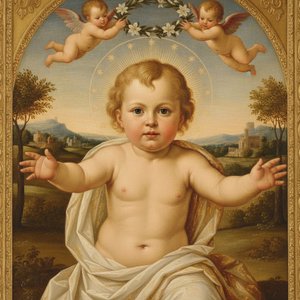
Explore the profound beauty of Baby Jesus in fine art history. From Raphael's Renaissance masterpieces to symbolic light, discover how classical painters captured divine innocence through masterful technique and sacred iconography.

 Preview
 Send
Send Share
Share
 Details

 Download
 Similars
 X-Ray
X-Ray Diaporama
 Stats
Stats


 Read More







 Glass option is only available in size under 110 CM