The artwork displayed on this page is protected by copyright law, which means we cannot legally create or sell an identical reproduction. This protection is enforced under international agreements such as the Berne Convention and by national laws, including those outlined by the U.S. Copyright Law - Title 17.
As a respectful and legal alternative, we offer custom, hand-painted artworks inspired by the original. Our skilled and professional artists carefully study the original's style, mood, and artistic essence to create a new, unique piece that evokes the same feeling - while remaining an original creation in its own right.
This method fully complies with copyright regulations because it does not involve copying or duplicating the protected artwork. Instead, it is a creative reinterpretation - a new painting that is influenced by the original but not identical to it.
Hand-painted oil on canvas in your size and frame, made to order by our artists. ( Switch to Print Switch to Digital Image)





























Pick from our preset sizes that match the artwork's original proportions.

Type the width and the height you need, to fit your frame or your wall. This is hand-painted, so for a size with a different shape the artist can paint a bit more around the picture, or cut a bit — you choose. We send you a digital mockup to approve before the painting starts. The picture shown on this page does not show the real result — only the mockup does.
Worldwide Delivery () in 3/4 weeks instead of standard 5 weeks. (19 October). No compromise on quality.
War
Reproduction Size
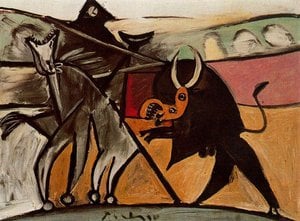
Pablo Picasso's *War*, painted in 1937, isn’t merely a depiction of a battlefield; it’s a visceral scream against the brutality and senselessness of conflict. Born from the immediate aftermath of the bombing of Guernica during the Spanish Civil War – an event that shocked Europe and ignited international outrage – the painting transcends its specific historical context to become a timeless indictment of violence itself. It's a work saturated with grief, disorientation, and a profound sense of loss, rendered in Picasso’s signature fractured style, reflecting the shattered reality of war.
The monochrome palette—a stark blend of greys, blacks, and whites—immediately establishes an atmosphere of devastation. There's no romanticism here, no heroic grandeur; instead, we are confronted with a scene stripped bare of color, mirroring the emotional desolation at its core. The figures – a screaming woman cradling her dead child, a wounded horse writhing in agony, a dismembered soldier clutching a broken sword – are not individualized portraits but archetypes of suffering, embodying universal themes of loss and despair. Picasso deliberately avoids specific details, opting for symbolic representation that allows the painting to resonate across cultures and generations.
Picasso's masterful use of Cubist techniques is central to *War*'s power. He dismantles forms, fracturing them into geometric shards and presenting multiple perspectives simultaneously. This fragmentation isn’t merely an aesthetic choice; it mirrors the psychological disorientation experienced by those caught in the chaos of war. The figures are not presented as solid, unified beings but rather as broken fragments, reflecting the shattered lives and fragmented realities left behind. The overlapping planes and distorted shapes create a sense of instability and unease, pulling the viewer into the heart of the scene’s turmoil.
Notice how Picasso employs sharp angles and jagged lines to convey violence and pain. The horse, perhaps the most iconic element of the painting, is rendered in agonizing detail – its body contorted, its mouth open in a silent scream. The bull, often interpreted as representing brutality or Spain itself, stands impassively amidst the carnage. Even the light source—a single, glaring eye-like shape—feels oppressive and accusatory, highlighting the horror of the scene.
Painted in response to the bombing of Guernica, a Basque town deliberately targeted by Nazi German and Fascist Italian warplanes during the Spanish Civil War, *War* quickly became an emblem of anti-war sentiment. Picasso stipulated that the painting should not be displayed in Spain until democracy was restored, a testament to his commitment to freedom and justice. It traveled extensively throughout Europe and America, raising awareness about the horrors of the conflict and serving as a powerful symbol of resistance against fascism.
Today, *War* resides at the Museo Reina Sofía in Madrid, where it continues to captivate viewers with its raw emotional intensity. It remains a potent reminder of the devastating consequences of war and a testament to Picasso’s enduring legacy as one of art history's most revolutionary figures. Reproductions of this iconic work offer a tangible connection to this pivotal moment in history, allowing us to contemplate the timeless themes of suffering, loss, and the urgent need for peace.
The X-Ray view of "War" by Pablo Picasso is on the artwork's X-Ray page: an interactive examination of the image through eleven optical layers.
"War" by Pablo Picasso is recommended as a gift for birthday. A reproduction of the artwork can be given as a present.
"War" was created by Pablo Picasso. The information on this page describes Pablo Picasso's original work.

A child's first words in Málaga were “piz, piz,” a small attempt at saying pencil. This early pull toward the lead and paper was nurtured by his father, José Ruiz y Blasco, who taught him the basics of figure drawing and oil painting. The boy learned to copy the masters and draw from plaster casts under a disciplined eye. As he grew, the family moved through A Coruña and Barcelona. These years were marked by the quiet weight of loss, particularly the death of his sister, Conchita, from diphtheria when she was only seven. Such shadows would later find their way into the heavy, blue-green tones of his early work.
By thirteen, he was already taking entrance exams for advanced classes in Barcelona, finishing in a week what took others a month. His hands moved with a precision that even his father noticed, once seeing him paint over an unfinished sketch of a pigeon with such accuracy that the instructor realized the student had surpassed him. He eventually moved to Paris, a city where he would spend much of his adult life, constantly shifting his focus from one way of seeing to another.
The early twentieth century saw his work move through distinct phases of color and mood. There was the Blue Period, where the canvases were filled with beggars, the blind, and the lonely, rendered in somber shades of blue. This gave way to the Rose Period, a time when pinks, oranges, and reds appeared, often featuring the figures of circus performers like harlequins and acrobats. These years showed a man reacting to his own life and the world around him through the temperature of his palette.
In 1907, the way he handled space changed fundamentally with Les Demoiselles d'Avignon. Influenced by African masks and Iberian sculpture, he began to break objects into geometric shapes. Alongside Georges Braque, he developed Cubism. This involved two main stages:
His work never settled into a single way of being. He explored Neoclassicism with large, monumental figures and later engaged with the imagery of Surrealism, using distorted perspectives to tap into the subconscious. The violence of the Spanish Civil War left its mark on his canvas in 1937 through Guernica. This large oil painting used a stark palette of black, white, and grey to show the suffering of a bombed town, featuring a gored horse, a bull, and screaming women. It remains a heavy, monochromatic response to the chaos of war.
In his later years, he continued to experiment with ceramics, sculpture, and printmaking. He even created large-scale public works, such as the 1967 steel sculpture in Chicago, which was inspired by the head of his Afghan Hound, Kabul. He died in Mougins, France, leaving behind a massive collection of work that spans over seventy-six years of experimentation.

1881 - 1973 , Spain
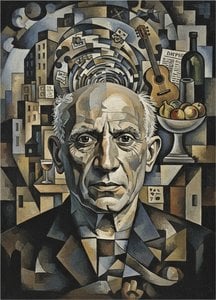
Explore the profound evolution of Cubism through an expert analysis of Pablo Picasso's revolutionary works. From Analytical to Synthetic Cubism, discover the techniques that redefined modern art and learn how to curate these iconic masterpieces for your private collection.

 Preview
 Send
Send Share
Share
 Details
 Guide
Guide

 Download
 Similars
 X-Ray
X-Ray Diaporama
 Stats
Stats
 Read More









 Glass option is only available in size under 110 CM