Hand-painted oil on canvas in your size and frame, made to order by our artists. ( Switch to Print Switch to Digital Image)





























Pick from our preset sizes that match the artwork's original proportions.

You may enter your own dimensions to fit a specific frame or space. If your selected size does not match the original image's proportions, we will either crop the artwork or extend the painting with additional hand-painted elements. A digital mockup will be sent for your approval before production begins.
Please note that the on-screen preview does not reflect the actual cropping or extension. Only the mockup will accurately show the final composition.
While custom sizes are available, we recommend selecting a dimension from the predefined list to preserve the original proportions.
Worldwide Delivery () in 3/4 weeks instead of standard 5 weeks. (13 October). No compromise on quality.
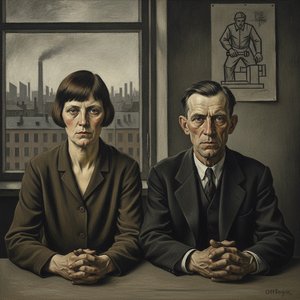
The actors
Reproduction Size
"The actors" is shadow overall, and its luminance is soft shadow.
"The actors" has a dramatic atmosphere.
"The actors" was created in 1942 as a work of the German Expressionism movement. Date and movement anchor the artwork in art history.
The color that stands out most in "The actors" is espresso (#633e32). The dominant color is useful when matching an artwork to an interior.
"The actors" is made in oil on canvas, in the German Expressionism style.
With its panoramic shape, a reproduction of "The actors" is suggested for a living room.
"The actors" by Max Beckmann is placed in the German Expressionism movement, within the Modern era of its creator.
A Guide page is available for "The actors" by Max Beckmann: a printable factsheet about the artwork, designed for students and classroom use.


1884 - 1950 , Germany

Delve into the visceral world of German Expressionism. Explore the history, key artists like Kirchner and Kandinsky, and the movement's profound emotional impact through an expert art-history lens. Discover how bold colors and distortion redefined modern aesthetics.

Explore the raw emotion of German Expressionism through a definitive guide to Ernst Ludwig Kirchner. Discover how his bold colors and distorted forms redefined modern art history, from Berlin street scenes to iconic masterpieces.

 Preview
 Send
Send Share
Share
 Details
 Guide
Guide

 Download
 Similars
 X-Ray
X-Ray Diaporama
 Stats
Stats

 Read More









 Glass option is only available in size under 110 CM