The artwork displayed on this page is protected by copyright law, which means we cannot legally create or sell an identical reproduction. This protection is enforced under international agreements such as the Berne Convention and by national laws, including those outlined by the U.S. Copyright Law - Title 17.
This method fully complies with copyright regulations because it does not involve copying or duplicating the protected artwork. Instead, it is a creative reinterpretation - a new painting that is influenced by the original but not identical to it.
Museum-quality giclée or canvas print with fast production and flexible finish options. ( Buy Hand Made Painting Switch to Digital Image)





























Pick from our preset sizes that match the artwork's original proportions.

Type the width and the height you need, to fit your frame or your wall. A print can only be cut, never made bigger than the picture, so a size with a different shape loses a part of the image. We send you a digital mockup to approve before we print anything. The picture shown on this page does not show the real cut — only the mockup does.
Worldwide Delivery () in 2 weeks instead of standard 4/5 weeks. (21 November)
Spatial Concept
Reproduction Size
In the mid-twentieth century, as the world grappled with the dawn of the nuclear age and the dizzying expansion of cosmic discovery, a radical new language of art began to emerge. At the heart of this revolution was Lucio Fontana, an artist who refused to be confined by the flat, two-dimensional boundaries of the traditional canvas. His 1956 masterpiece, Spatial Concept, serves as a profound testament to his role as the pioneer of Spatialism. This is not merely a painting to be observed; it is an invitation to step beyond the frame and encounter a new dimension of existence. Through a mesmerizing interplay of color and form, Fontana challenges our very perception of what art can be, transforming a simple rectangular surface into a gateway to the infinite.
The composition of Spatial Concept is both deceptively simple and deeply enigmatic. Upon first encounter, the eye is drawn to a singular, symbolic figure—a fish—suspended within a dreamlike landscape. With its vibrant blue tail and deep purple head, the creature appears to drift through a celestial sea, surrounded by a constellation of scattered circles. These circular motifs vary in size and hue, creating a rhythmic pulse that moves across the canvas. The technique employed here is nothing short of audacious; Fontana did not just apply pigment, but physically interacted with the medium. By combining delicate brushwork with precise incisions and perforations, he disrupted the perceived boundaries of the painting. These small, intentional wounds in the fabric allow light and shadow to play in ways that traditional painting cannot, mirroring the scientific fascination with the vast, empty expanses of the cosmos during the 1950s.
To understand Spatial Concept is to understand the tension between presence and absence. Fontana’s work was deeply rooted in the intellectual currents of Futurism and Surrealism, yet he sought to transcend them by embracing the concept of "emptiness." The fish, often a symbol of life and movement, becomes an inhabitant of a void that is not empty, but rather pregnant with possibility. The scattered circles act as celestial bodies, suggesting a universe in constant motion. This technique of sgraffito and perforation serves to blur the distinction between the artwork and the space surrounding it, effectively pulling the viewer into the work's internal atmosphere.
For the discerning collector or interior designer, this piece offers an unparalleled emotional resonance. It possesses a quiet, meditative power that can anchor a room, providing a focal point of intellectual depth and sophisticated modernism. The way the light interacts with the textured surface and the physical depth of the incisions creates a dynamic experience that changes depending on one's perspective. It is a work that demands contemplation, offering a sense of tranquility paired with an underlying energy of discovery.
Bringing a high-quality reproduction of Spatial Concept into a curated space is an act of celebrating art history's most daring moments. Whether placed in a minimalist gallery setting or as a bold statement piece in a contemporary living space, the artwork radiates an aura of avant-garde elegance. It speaks to a refined taste that values innovation, complexity, and the beauty of the unknown. As a tribute to Fontana’s legacy, this piece remains a vital, breathing part of the modern aesthetic, reminding us all that art has the power to tear through the veil of reality and reveal the infinite wonders waiting just beneath the surface.
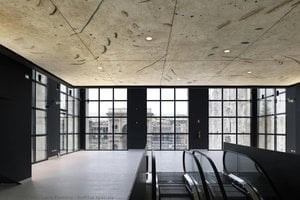
The copyright status of "Spatial Concept" by Lucio Fontana is clear: the work is still protected by copyright. Its presence at the Boschi Di Stefano House Museum does not change that status.
"Spatial Concept" is defined by a pastels palette led by putty (#e2d5ba).
The original "Spatial Concept" by Lucio Fontana is a mixed media work measuring 95 x 175 cm. Technique and size describe the original object.

To understand the radical shifts in mid-century abstraction, one must look back to the specific origins of Lucio Fontana. Born on 19 February 1899 in Rosario, Santa Fe, Argentina, his identity was forged at the intersection of two worlds. He was an Argentine-born Italian sculptor, painter, and theorist, a distinction that provided him with a dual perspective on form and space from his very beginning. This was no accidental lineage; he was the son of the sculptor Luigi Fontana, a man whose professional focus on monumental forms provided the material foundation for Lucio's later disruptions of the canvas.
His early years were defined by this proximity to craftsmanship and the physical weight of sculpture. Growing up in the shadow of his father's work, Lucio Fontana did not merely observe art; he was immersed in the technical realities of its creation. This early exposure to the tactile nature of material would eventually lead him to challenge the very surfaces he was taught to master. He moved between Argentina and Italy, a movement that prevented any singular, static adherence to a single tradition. By the time he reached adulthood, the tension between his Argentine roots and his Italian heritage had already begun to shape a perspective that refused to remain within the boundaries of traditional representation.
Fontana’s technical foundation was built on the practicalities of sculpture. He began his training under his father, Luigi Fontana, a sculptor who provided the initial discipline required to handle physical matter. This apprenticeship was not a mere academic exercise; it was a direct immersion into the mechanics of form. His early years were marked by significant movement between Argentina and Italy. After being sent to Italy in 1905, he remained there until 1922, a period that anchored his development within the European tradition before his later radical departures.
The transition from craftsmanship to formal academic study occurred at the Accademia di Brera in Milan. Between 1928 and 1930, he studied under Adolfo Wildt, a period that refined his understanding of volume and material. This academic rigor provided the necessary tension against which his later theories would react. By 1930, his presence in the Milanese art scene was established through his first exhibition, organized by the Milan art gallery Il Milione. This debut signaled the emergence of an artist who had mastered the traditional rules of sculpture and painting only to begin questioning their necessity.
Fontana did not merely participate in the avant-garde; he engineered a new way for art to exist in a post-war reality. In 1946, he authored the White Manifesto, a document that signaled a departure from the static limitations of traditional representation. This was not a mere theoretical exercise. It was a direct response to a world transformed by scientific and technological shifts. He understood that art had to evolve alongside the discovery of new physical forces and the mastery over matter and space. By 1946, his influence was already institutionalized through the founding of the Altamira academy in Buenos Aires.
The movement he established, Spatialism, sought to integrate real space and time into the work itself. Between 1947 and 1952, Fontana authored five Spatialism manifestos that codified this radical shift. He rejected the idea of the canvas as a flat, enclosed surface. Instead, he treated it as a site for action, a way to puncture the barrier between two-dimensional painting and the three-dimensional void. This was a calculated disruption of the picture plane. He moved beyond the illusion of depth to engage with the actual, physical dimensions of the cosmos.
Fontana’s approach was a direct assault on the traditional two-dimensional plane. He moved beyond mere representation to investigate the physical relationship between matter and space. This was achieved through deliberate, violent interventions in the medium. Using a specialized drill, he created buchi (holes) that functioned as portals, puncturing the barrier between the surface and the void. He also utilized slashed canvases, using a razor to create tagli that disrupted the visual field. These were not random acts of destruction but calculated methods to introduce actual, three-dimensional space into the work.
His material experimentation extended to the manipulation of texture and light. He frequently encrusted surfaces with heavy impasto and colored glass to create tactile, physical presence. To deepen the sense of mystery, he often lined the reverse of his canvases with black gauze, allowing a dark, shimmering depth to appear behind the cuts. He also integrated modern technology into his practice, employing neon to explore how light interacts with spatial dimensions. This combination of heavy, physical matter and the emptiness of the void defines his specific visual language.
Fontana’s early output reveals a sculptor deeply engaged with the physical weight of his medium. In 1931, he produced Busto femminile, a work that captures a transition from figurative elegance toward the radical spatial explorations that would later define his career. By 1934, his focus on materiality continued with Il fiocinatore. These early pieces demonstrate a command of form before he moved to dismantle the very concept of the object.
The shift toward Spatialism necessitated a move away from traditional representation. He began treating the canvas and the sculpture as sites of physical disruption. His Spatial Concept is a direct confrontation with this idea, utilizing wood and metal to create a tension between solid matter and the void. This was not a decorative gesture but a structural interrogation of space. He expanded this logic into the environment itself with the 1951 Luce spaziale, a neon ceiling that integrated light as a physical component of the work.
His later investigations into the void reached a peak in the mid-1960s. Between 1963 and 1964, he executed Concetto spaziale, La Fine di Dio, a work that pushed the boundaries of his spatial theories. These pieces prove that his interest was never in the surface, but in the dimensions existing beyond it.
Fontana’s impact is felt most clearly in the shift toward materiality and the reduction of form. His insistence on treating the canvas as a physical object rather than a window for illusion provided the groundwork for Minimalism. By stripping away representational clutter, he forced a confrontation with the raw properties of the medium. This focus on the essential nature of matter also anticipated the core tenets of Arte Povera, specifically in how he utilized unconventional materials and emphasized the physical presence of the work within a space.
His radical approach remains a touchstone for contemporary practitioners of installation and conceptual art. He moved beyond the two-dimensional plane to engage with the actual dimensions of the room, a move that anticipated much of the immersive art seen today. By treating the void as a tangible element, he changed how artists approach the relationship between an object and its environment. His work does not merely occupy space; it actively interrogates it.
The courage to challenge established conventions allowed him to redefine the essence of artistic expression. He moved art away from the act of depiction and toward the act of intervention. This shift from what a work represents to what a work does remains a fundamental concept in modern practice. His influence is visible in any work that prioritizes the physical gesture and the spatial reality of the medium over traditional narrative.
Fontana’s physical presence in the global museum circuit remains significant. To witness the actual impact of his spatial interventions, one must look to major institutional collections. In New York, his work is held by the Metropolitan Museum of Art and the Solomon R. Guggenheim Museum. These locations provide the necessary context to understand how his punctures and slashes functioned within the evolution of modern abstraction. His influence is equally visible in Europe, with permanent holdings in the Centre Pompidou in Paris and the Stedelijk Museum in Amsterdam. These institutions preserve the material reality of his experiments with depth and void.
The Venetian landscape also maintains a connection to his practice through the Peggy Guggenheim Collection. Seeing his work in these specific environments allows for a direct confrontation with the texture and the physical gaps he created. His presence in these cities ensures that his theories on space and matter remain part of the active dialogue in contemporary art history. The following works represent specific examples of his output found in various collections:

1899 - 1968 , Argentina

Elevate premium coworking and hotel interiors with museum-quality art reproductions. Discover how hand-painted oil masterpieces and bespoke architectural murals create sophisticated, inspiring workspaces for the modern professional.

Elevate your space with expert guidance on selecting fine art for luxury interiors. Discover how to curate timeless atmospheres through bespoke oil reproductions, classical masterpieces, and custom commissions tailored to your unique aesthetic and architectural grandeur.

Master the secrets of depth from Brunelleschi to Fontana. Explore how perspective creates infinite space in fine art.

Explore the profound impact of Modernism on art history. From Cubist fragmentation to Suprematist abstraction, discover how revolutionary movements redefined creativity and continue to inspire sophisticated collectors and connoisseurs worldwide.

Discover 10 iconic minimalist artworks that define modern elegance. From monochrome abstracts to geometric masters, explore the stories behind these timeless pieces and find museum-quality reproductions for your decor. Explore the full collection online at WahooArt.com.
 Preview
 Send
Send Share
Share
 Details
 Guide
Guide

 Download
 Similars
 X-Ray
X-Ray Diaporama
 Q&A
Q&A
 Stats
Stats


 Read More









 Glass option is only available in size under 110 CM