A Portal to the Infinite: The Visionary World of Lucio Fontana
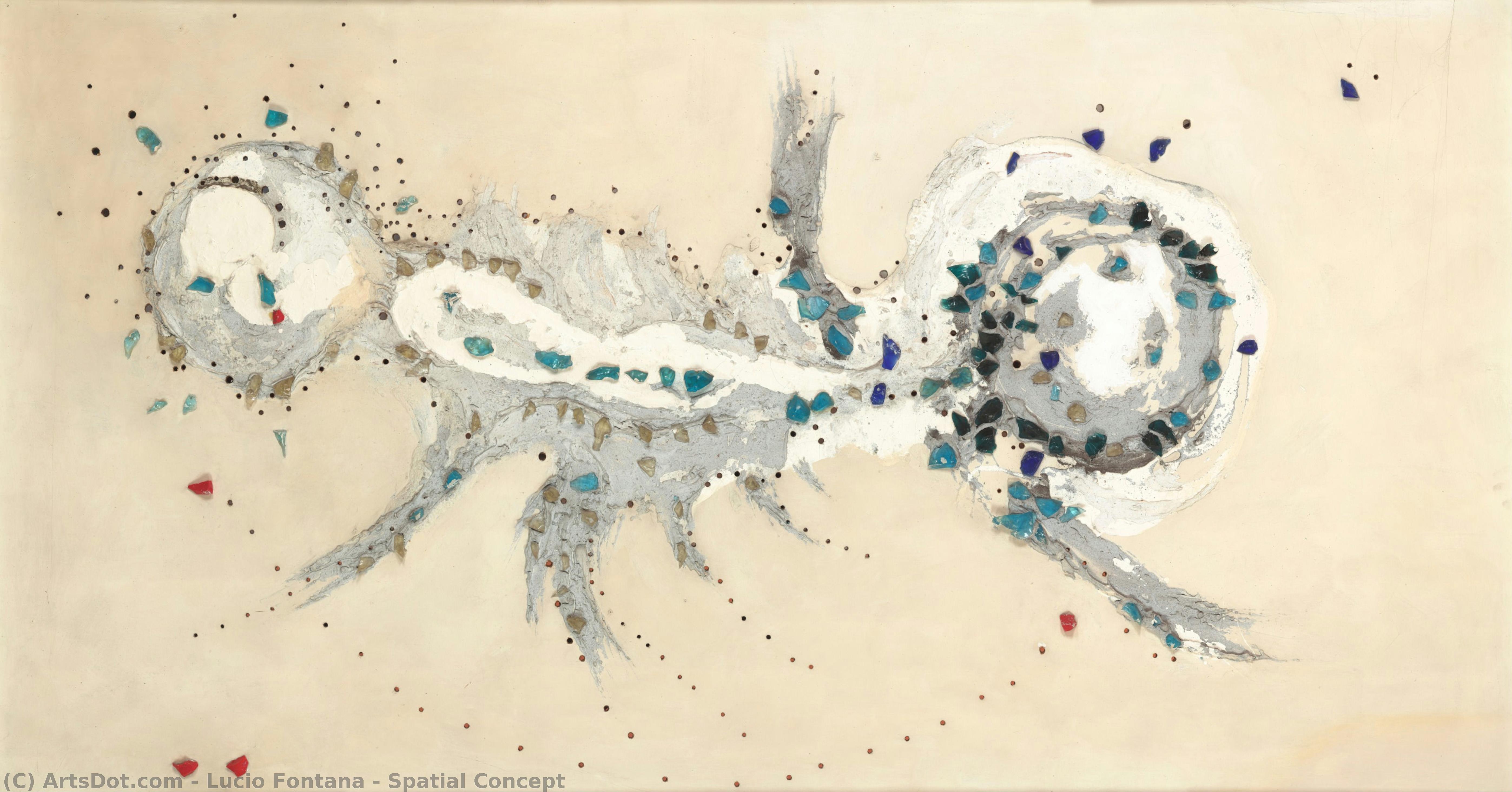
In the mid-twentieth century, as the world grappled with the dawn of the nuclear age and the dizzying expansion of cosmic discovery, a radical new language of art began to emerge. At the heart of this revolution was Lucio Fontana, an artist who refused to be confined by the flat, two-dimensional boundaries of the traditional canvas. His 1956 masterpiece, Spatial Concept, serves as a profound testament to his role as the pioneer of Spatialism. This is not merely a painting to be observed; it is an invitation to step beyond the frame and encounter a new dimension of existence. Through a mesmerizing interplay of color and form, Fontana challenges our very perception of what art can be, transforming a simple rectangular surface into a gateway to the infinite.
The composition of Spatial Concept is both deceptively simple and deeply enigmatic. Upon first encounter, the eye is drawn to a singular, symbolic figure—a fish—suspended within a dreamlike landscape. With its vibrant blue tail and deep purple head, the creature appears to drift through a celestial sea, surrounded by a constellation of scattered circles. These circular motifs vary in size and hue, creating a rhythmic pulse that moves across the canvas. The technique employed here is nothing short of audacious; Fontana did not just apply pigment, but physically interacted with the medium. By combining delicate brushwork with precise incisions and perforations, he disrupted the perceived boundaries of the painting. These small, intentional wounds in the fabric allow light and shadow to play in ways that traditional painting cannot, mirroring the scientific fascination with the vast, empty expanses of the cosmos during the 1950s.
The Alchemy of Space and Symbolism
To understand Spatial Concept is to understand the tension between presence and absence. Fontana’s work was deeply rooted in the intellectual currents of Futurism and Surrealism, yet he sought to transcend them by embracing the concept of "emptiness." The fish, often a symbol of life and movement, becomes an inhabitant of a void that is not empty, but rather pregnant with possibility. The scattered circles act as celestial bodies, suggesting a universe in constant motion. This technique of sgraffito and perforation serves to blur the distinction between the artwork and the space surrounding it, effectively pulling the viewer into the work's internal atmosphere.
For the discerning collector or interior designer, this piece offers an unparalleled emotional resonance. It possesses a quiet, meditative power that can anchor a room, providing a focal point of intellectual depth and sophisticated modernism. The way the light interacts with the textured surface and the physical depth of the incisions creates a dynamic experience that changes depending on one's perspective. It is a work that demands contemplation, offering a sense of tranquility paired with an underlying energy of discovery.
A Timeless Addition to the Modern Interior
Bringing a high-quality reproduction of Spatial Concept into a curated space is an act of celebrating art history's most daring moments. Whether placed in a minimalist gallery setting or as a bold statement piece in a contemporary living space, the artwork radiates an aura of avant-garde elegance. It speaks to a refined taste that values innovation, complexity, and the beauty of the unknown. As a tribute to Fontana’s legacy, this piece remains a vital, breathing part of the modern aesthetic, reminding us all that art has the power to tear through the veil of reality and reveal the infinite wonders waiting just beneath the surface.



 Preview
 Buy Print
 Send
Send Share
Share
 Details

 Download
 Similars
 X-Ray
X-Ray Diaporama


 Read More






































 Glass option is only available in size under 110 CM








