

 Oil On CanvasWallArtSynthetic Cubism
 1913Modern
 100.0 x 66.0 cm
Museum-quality giclée or canvas print with fast production and flexible finish options. ( Buy Hand Made Painting Switch to Digital Image)





























Pick from our preset sizes that match the artwork's original proportions.

You may enter your own dimensions to fit a specific frame or space. If your selected size does not match the original image's proportions, we will either crop the artwork or extend the image with a mirrored or solid-fill edge. A digital mockup will be sent for your approval before production begins.
Please note that the on-screen preview does not reflect the actual cropping or extension. Only the mockup will accurately show the final composition.
While custom sizes are available, we recommend selecting a dimension from the predefined list to preserve the original proportions.
Worldwide Delivery () in 2 weeks instead of standard 4/5 weeks. (26 September)


Violin and guitar - -
Reproduction Size
In the quiet intersection of melody and mathematics lies Juan Gris’s 1913 masterpiece, Violin and Guitar. This evocative work serves as a profound emblem of Synthetic Cubism, a movement that fundamentally redefined the visual language of the early twentieth century. Rather than offering a mere window into a room, Gris presents us with a meticulously constructed reality where the boundaries between object and space dissolve into a rhythmic dance of planes. The composition, measuring 100 x 66 cm, invites the viewer to look beyond the surface of the musical instruments and instead experience the structural harmony that binds them together. Through his expert use of geometric deconstruction, Gris transforms the familiar curves of a violin and the resonant body of a guitar into a complex tapestry of overlapping shapes, creating an illusion of depth that feels both intellectually stimulating and visually mesmerizing.
The technique employed in this piece is a testament to Gris’s unique ability to synthesize form and color. Unlike the more analytical approach of his contemporaries, which often stripped subjects down to monochromatic fragments, Gris embraced the richness of Synthetic Cubism. He utilized a palette that balances muted, earthy tones with sudden, vibrant accents, allowing each geometric shard to hold its own weight within the frame. The application of oil on canvas is deliberate and precise, reflecting his early training in engineering. This precision allows for a fascinating spatial ambiguity; one moment, a curve suggests the neck of a violin, and the next, it becomes part of a larger, abstract pattern. For the discerning collector or interior designer, this interplay of light and shadow offers a dynamic energy that can anchor a room, providing a sophisticated focal point that rewards prolonged contemplation.
Beyond its formal brilliance, Violin and Guitar carries a deep emotional and historical resonance. Created during a period of intense artistic upheaval in Paris, the painting captures the spirit of an era caught between tradition and the radical unknown. The choice of musical instruments is far from accidental; the violin and guitar are symbols of harmony, culture, and the human voice, yet here they are fractured and reassembled. This fragmentation can be seen as a metaphor for the modern experience—a world being broken down by rapid technological advancement and reconstructed through new, multifaceted perspectives. There is a certain poignant nostalgia in the way these classical objects are presented, even as they are subjected to the radical deconstruction of the Cubist lens.
For those seeking to bring a piece of art history into a contemporary living space, this reproduction offers more than just aesthetic beauty; it offers a conversation. The artwork’s ability to blend abstract complexity with recognizable motifs makes it an ideal choice for modern interiors that value intellectual depth and stylistic versatility. Whether placed in a minimalist gallery-style setting or a richly textured study, the painting radiates a sense of structured elegance. It is a work that does not merely decorate a wall but enriches the atmosphere, inviting anyone who gazes upon it to find their own rhythm within its beautiful, fragmented symphony.


1887 - 1927 , Spain

Explore the revolutionary world of Cubism with WahooArt. Discover Picasso & Braque's groundbreaking techniques, its philosophical roots, and lasting impact on modern art. Expert insights for collectors.

Explore 10 defining masterpieces of Geometric Abstraction! Discover Kandinsky, Mondrian & Malevich’s iconic works. Find museum-quality art reproductions and curated decor ideas to elevate your home at WahooArt.com.
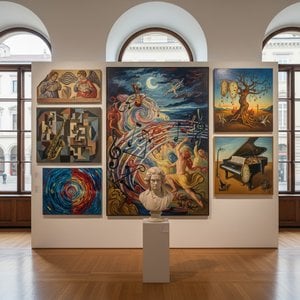
Explore the fascinating history of music's visual representation in art! From ancient symbolism to modern abstraction, discover how artists have captured sound and emotion on canvas. Expert insights & stunning examples.

Explore 25 iconic Georges Braque paintings that revolutionized Cubism & modern art. Discover the stories behind his masterpieces, from Fauvism to Analytical Cubism. Find museum-quality reproductions & elevate your home decor with WahooArt.com.
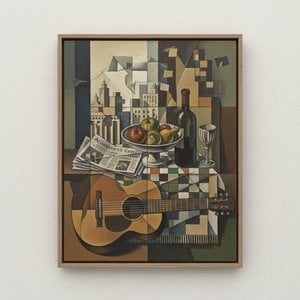
Explore the revolutionary art of Juan Gris – a master of Cubism. Discover his unique approach to deconstruction, vibrant Synthetic Cubist works, and lasting influence on modern art. Expert analysis for collectors.

 Preview
 Send
Send Share
Share
 Details
 Guide
Guide

 Download
 Similars
 X-Ray
X-Ray Diaporama
 Stats
Stats Read More







 Glass option is only available in size under 110 CM


