Preview AR preview Buy Hand Made Painting Switch to Digital Image Send
Details Guide Add to favorites Download Similars X-Ray Diaporama Stats

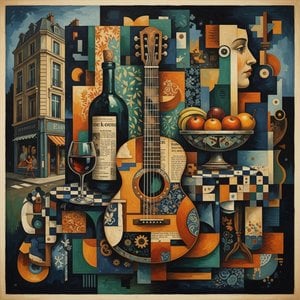
Pears and grapes on a table

Explore Juan Gris’s ‘Pears and Grapes,’ a revolutionary Synthetic Cubist masterpiece. Deconstructed forms, vibrant colors, and subtle collage create a dynamic visual language reflecting modern life.

Explore Juan Gris (1887-1927), the Spanish Cubist master! Discover his geometric style, Synthetic Cubism & lasting influence on modern art. View artworks now.

Giclée / Art Print

Museum-quality giclée or canvas print with fast production and flexible finish options. ( Buy Hand Made Painting Switch to Digital Image)

Corner sample of the P118B picture frame: moulded polystyrene, 5 cm wide and 3 cm thick
P118B $10
Corner sample of the P118H picture frame: moulded polystyrene, 5 cm wide and 3 cm thick
P118H $10
Corner sample of the P118W picture frame: moulded polystyrene, 5 cm wide and 3 cm thick
P118W $10
Corner sample of the P438Z picture frame: moulded polystyrene, 5.5 cm wide and 3.5 cm thick
P438Z $10
Corner sample of the P508JH picture frame: moulded polystyrene, 7 cm wide and 3.5 cm thick
P508JH $12
Corner sample of the P508YH picture frame: moulded polystyrene, 7 cm wide and 3.5 cm thick
P508YH $12
Corner sample of the P805H picture frame: moulded polystyrene, 5 cm wide and 3.5 cm thick
P805H $10
Corner sample of the P805Z picture frame: moulded polystyrene, 5 cm wide and 3.5 cm thick
P805Z $10
Corner sample of the P919BZ picture frame: moulded polystyrene, 7 cm wide and 3.5 cm thick
P919BZ $10
Corner sample of the P919G picture frame: moulded polystyrene, 7 cm wide and 3.5 cm thick
P919G $10
Corner sample of the P919XJ picture frame: moulded polystyrene, 7 cm wide and 3.5 cm thick
P919XJ $10
Corner sample of the P959ZH picture frame: moulded polystyrene, 5 cm wide and 3 cm thick
P959ZH $10
Corner sample of the P968JZ picture frame: moulded polystyrene, 6 cm wide and 4 cm thick
P968JZ $12
Corner sample of the W106C picture frame: solid wood, 5 cm wide and 3 cm thick
W106C $8
Corner sample of the W218G picture frame: solid wood, 5 cm wide and 3 cm thick
W218G $10
Corner sample of the W218JH picture frame: solid wood, 5 cm wide and 3 cm thick
W218JH $8
Corner sample of the W218Y picture frame: solid wood, 5 cm wide and 3 cm thick
W218Y $10
Corner sample of the W307PJ picture frame: solid wood, 6 cm wide and 3 cm thick
W307PJ $10
Corner sample of the W316G picture frame: solid wood, 6 cm wide and 3 cm thick
W316G $10
Corner sample of the W316PJ picture frame: solid wood, 6 cm wide and 3 cm thick
W316PJ $8
Corner sample of the W316Y picture frame: solid wood, 6 cm wide and 3 cm thick
W316Y $10
Corner sample of the W398PJ picture frame: solid wood, 5 cm wide and 3 cm thick
W398PJ $8
Corner sample of the W4111J picture frame: solid wood, 6.5 cm wide and 3.5 cm thick
W4111J $10
Corner sample of the W500HY picture frame: solid wood, 7 cm wide and 5 cm thick
W500HY $15
Corner sample of the W500JH picture frame: solid wood, 7 cm wide and 5 cm thick
W500JH $15
Corner sample of the W692G picture frame: solid wood, 8 cm wide and 4 cm thick
W692G $12
Corner sample of the W849H picture frame: solid wood, 5 cm wide and 3 cm thick
W849H $8
Corner sample of the W940BG picture frame: solid wood, 7.5 cm wide and 4.5 cm thick
W940BG $15
Corner sample of the W953PJ picture frame: solid wood, 6 cm wide and 3.5 cm thick
W953PJ $8

Standard
custom
CM
INCH

Pick from our preset sizes that match the artwork's original proportions.

width
height

Type the width and the height you need, to fit your frame or your wall. A print can only be cut, never made bigger than the picture, so a size with a different shape loses a part of the image. We send you a digital mockup to approve before we print anything. The picture shown on this page does not show the real cut — only the mockup does.

Worldwide Delivery () in 2 weeks instead of standard 4/5 weeks. (28 October)

Free Worldwide Express Shipping
High-Quality Linen Canvas
Full Shipping Insurance
Customs Tax Refund Guarantee
True Color Matching Guarantee
100-Day Return Policy (Defects Only)
100% Money-Back Guarantee
Bulk Discount Offer

Total Price

$ 69

Pears and grapes on a table

Giclée / Art Print

Reproduction Size

-

Total Price

$ 69

Quick Facts

  • Artist: Juan Gris
  • Title: Pears and grapes on a table
  • Influences:
    • Picasso
    • Braque
  • Movement: Synthetic Cubism
  • Subject or theme: Still life

Art Quiz

There is only one correct answer for each question.

Question 1:
What artistic movement is Juan Gris’ ‘Pears and Grapes on a Table’ most closely associated with?
Question 2:
The color palette of 'Pears and Grapes on a Table' is best described as:
Question 3:
What year was 'Pears and Grapes on a Table' created?
Question 4:
According to the description, what is a key characteristic of Gris' technique in this artwork?
Question 5:
The composition of 'Pears and Grapes on a Table' can be described as:

A Symphony of Form and Color: Deconstructing Reality with Juan Gris’ “Pears and Grapes on a Table”

Juan Gris' 1913 masterpiece, "Pears and grapes on a table," isn’t merely a depiction of fruit; it is a bold declaration of a new visual language. Emerging from the fertile ground of early 20th-century Paris, this painting embodies the core tenets of Synthetic Cubism, yet possesses a unique vibrancy that sets it apart. Gris doesn't attempt to replicate reality as we perceive it, but rather dissects and reassembles it, presenting multiple viewpoints simultaneously on a single canvas. The result is an exhilarating dance of geometric shapes – fragmented planes of color suggesting the forms of pears, grapes, a goblet, and other still-life elements – all interwoven in a dynamic composition that challenges our conventional understanding of space and form.

The Birth of Synthetic Cubism: A Revolutionary Approach

To fully appreciate “Pears and Grapes on a Table,” one must understand its place within the evolution of Cubism. Following Picasso and Braque’s pioneering Analytical Cubism, which broke down objects into increasingly fragmented forms, Gris championed a more constructive approach – Synthetic Cubism. This meant building up compositions from simpler shapes and bolder colors, incorporating elements of collage and emphasizing the flatness of the canvas. Gris wasn't interested in merely analyzing form; he sought to *create* a new reality through the deliberate arrangement of abstract components. The painting’s asymmetrical arrangement isn’t accidental; it contributes to the sense of movement and energy that permeates the work, drawing the eye across its surface and inviting prolonged contemplation. The inclusion of newspaper fragments – barely discernible yet present – hints at the modern world intruding upon this carefully constructed still life, a subtle commentary on the complexities of contemporary existence.

A Palette of Emotion: Color as Structure and Symbol

Gris’ masterful use of color is integral to the painting's impact. He eschews the muted tones often associated with early Cubism, instead embracing a vivid palette dominated by warm hues – reds, oranges, and yellows – punctuated by cooler greens and blues. These aren’t simply decorative choices; they are structural elements that define shapes and create visual relationships. The bright yellow package in the upper right corner acts as a focal point, drawing the eye upwards and providing a striking contrast to the darker tones surrounding it. This interplay of complementary colors generates a sense of vibrancy and intensity, imbuing the painting with an emotional charge. The careful balance between warm and cool tones prevents the composition from becoming overwhelming, creating a harmonious yet dynamic visual experience.

Beyond Representation: The Enduring Legacy of “Pears and Grapes”

“Pears and grapes on a table” is more than just a beautiful object; it’s a testament to Juan Gris' innovative spirit and his profound understanding of the principles of Cubism. The painting invites us to question our perceptions, to see beyond surface appearances, and to appreciate the beauty inherent in abstraction. Its enduring appeal lies not only in its historical significance but also in its aesthetic power – its ability to captivate and inspire viewers across generations. Whether adorning a modern living space or enriching an art collection, this artwork offers a unique blend of intellectual rigor and visual delight, a timeless masterpiece that continues to resonate with contemporary audiences.

Questions & Answers

At what size is "Pears and grapes on a table" suggested for a living room?

The recommended pairing for "Pears and grapes on a table" by Juan Gris: a medium print in a living room.

Can the image of "Pears and grapes on a table" by Juan Gris be freely reproduced?

The copyright answer for "Pears and grapes on a table" by Juan Gris: the work is in the public domain - its copyright has expired. This determines whether reproductions of the image may be freely made.

What mood and emotion does "Pears and grapes on a table" by Juan Gris express?

The recorded mood of "Pears and grapes on a table" by Juan Gris is calm, and its emotional tone is reflective.


Artist Biography

A Spanish Visionary of Cubism: The Life and Art of Juan Gris

Born José Victoriano González-Pérez in Madrid in 1887, the artist who would become known as Juan Gris embarked on a journey that would place him among the most significant figures of early 20th-century art. His initial path wasn’t one immediately leading to canvas and brush; he pursued engineering at the School of Arts and Sciences, demonstrating an analytical mind that would later profoundly influence his artistic approach. Even during these formative years, a creative spark flickered – contributing drawings to local periodicals hinted at a burgeoning visual talent. It was in 1905 that he adopted the pseudonym Juan Gris, a name resonating with a newfound sense of identity and purpose as he began formal painting studies under José Moreno Carbonero. This marked a pivotal shift, setting him on a course toward artistic innovation.

Parisian Awakening and the Embrace of Cubism

The year 1906 witnessed a transformative relocation to Paris, a city then pulsating with artistic energy. Gris immersed himself in this vibrant milieu, forging friendships with luminaries like Henri Matisse, Georges Braque, and Fernand Léger. He initially engaged in satirical illustration for publications such as *L'Assiette au Beurre*, honing his observational skills and developing a keen sense of visual wit. However, the magnetic pull of Pablo Picasso proved particularly influential. Around 1910, Gris began to seriously dedicate himself to painting, moving away from caricature towards the burgeoning language of Cubism. This wasn’t mere imitation; he embarked on a quest to distill the essence of form and space, seeking a new visual order. His early explorations were marked by a deliberate departure from traditional representation, embracing abstraction as a means of capturing reality's underlying structure.

The Geometry of Perception: Style and Key Works

Juan Gris’s artistic output is characterized by an exceptional clarity and intellectual rigor. He didn’t simply deconstruct objects; he reconstructed them with deliberate precision, emphasizing geometric forms and a carefully considered palette. This approach led to what became known as his “crystal period,” exemplified in masterpieces like *Still Life Before an Open Window* and *Place Ravignan* (1915). These works showcase a remarkable interplay of planes and angles, creating a sense of depth and solidity while simultaneously challenging conventional notions of perspective. After 1913, Gris wholeheartedly embraced Synthetic Cubism, pioneering the use of *papier collé* – collage – incorporating real-world materials like newspaper clippings and textured papers into his compositions. This technique added another layer of complexity and tactility to his work, blurring the boundaries between painting and sculpture. Notable examples include *Guitar in front of the sea* (1925), a testament to his simplified forms and adherence to cubist principles, and *Homage à Pablo Picasso* (1912), which signaled his growing recognition within the avant-garde art world.

Legacy and Lasting Influence

Juan Gris’s contribution to Cubism extends beyond mere stylistic innovation; he brought a unique intellectual depth and structural clarity to the movement. He moved past the analytical phase, towards a more organized and synthetic approach, emphasizing order and precision. His work profoundly influenced the Purist style championed by Amédée Ozenfant and Charles Edouard Jeanneret (Le Corbusier), advocating for a return to classical principles of form and composition. Gris’s emphasis on geometric forms, harmonious color palettes, and the integration of everyday objects into his art established him as a pivotal figure in 20th-century art. His legacy continues to inspire artists today, demonstrating the enduring power of Cubism and the visionary genius of Juan Gris – a Spanish master who reshaped our understanding of perception and representation.
Juan Gris

Juan Gris

1887 - 1927 , Spain

Quick Facts

  • Full Name: José Victoriano González-Pérez
  • Nationality: Spanish
  • Date Of Birth: 1887
  • Date Of Death: 1927
  • Place Of Birth: Madrid, Spain
  • Notable Artworks:
    • Guitar in front of the sea
    • Homage à Pablo Picasso
    • The Miller
    • Portrait of Madame Josette Gris
  • Artistic Movement Or Style: Cubism, Synthetic Cubism
  • Artists Who Influenced This Artist:
    • Pablo Picasso
    • Henri Matisse
    • Georges Braque
  • Artists Or Movements Influenced By This Artist:
    • Purism
    • Amédée Ozenfant
    • Le Corbusier
Explore artworks organized by themes, styles, and characteristics.