

 Oil On CanvasWallArtAnalytical Cubism
 1912Early Modern
 128.0 x 88.0 cm
 Philadelphia Museum of Art
Museum-quality giclée or canvas print with fast production and flexible finish options. ( Buy Hand Made Painting Switch to Digital Image)





























Pick from our preset sizes that match the artwork's original proportions.

You may enter your own dimensions to fit a specific frame or space. If your selected size does not match the original image's proportions, we will either crop the artwork or extend the image with a mirrored or solid-fill edge. A digital mockup will be sent for your approval before production begins.
Please note that the on-screen preview does not reflect the actual cropping or extension. Only the mockup will accurately show the final composition.
While custom sizes are available, we recommend selecting a dimension from the predefined list to preserve the original proportions.
Worldwide Delivery () in 2 weeks instead of standard 4/5 weeks. (22 September)


Man in the Cafe
Reproduction Size
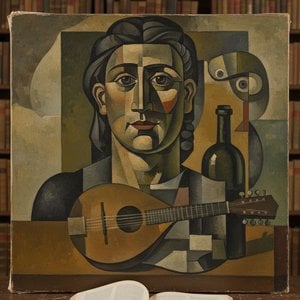
Juan Gris’s “Man in the Cafe,” completed in 1912, stands as a cornerstone of Analytical Cubism—a movement that irrevocably altered the landscape of European art. More than just a depiction of a Parisian café scene, it's an intellectual experiment meticulously crafted to dismantle traditional notions of perspective and representation.
Born José Victoriano González-Pérez in Madrid, Gris’s artistic journey began with an engineering education, demonstrating a methodical mind that would later translate into his groundbreaking visual explorations. Influenced by Pablo Picasso and Georges Braque—the architects of Cubism—Gris sought to push the boundaries of artistic expression during a period marked by significant intellectual ferment.
The movement emerged in Paris around 1907, responding to the burgeoning avant-garde spirit of the era. Artists like Picasso and Braque were actively dismantling established conventions, prioritizing geometric abstraction over realistic depiction—a daring stance that challenged the prevailing aesthetic sensibilities of their time.
Despite its apparent simplicity, “Man in the Cafe” is laden with symbolic significance. The obscured face of the man represents anonymity and universality—suggesting that he embodies the human condition itself. The pipe and bottle serve as grounding elements, anchoring the fragmented forms within a recognizable environment.
The muted color palette—dominated by earthy tones—contributes to the painting’s melancholic mood, mirroring the contemplative gaze of the subject. Gris's deliberate use of color reinforces the emotional resonance of the scene, inviting viewers to contemplate themes of isolation and introspection.
"Man in the Cafe" continues to captivate audiences today with its masterful blend of technique and conceptual innovation. It serves as a testament to Gris’s unwavering belief in the transformative power of art—a conviction that resonates across generations of artists and collectors alike.
Reproductions of this iconic artwork offer an opportunity to experience firsthand the profound aesthetic and intellectual legacy of Analytical Cubism, transporting viewers into the heart of a pivotal moment in artistic history. Its enduring appeal underscores the timeless beauty found within fragmented forms and contemplative observation.


1887 - 1927 , Spain

Unveil the radical revolution of Cubism. Explore how masters like Picasso and Braque redefined modern art through fragmented forms and geometric abstraction, offering profound insights for discerning collectors of fine art history and masterpieces.
Master the complexities of Analytical Cubism with our expert guide. Explore how Picasso and Braque revolutionized art through fragmented perspective, geometric abstraction, and muted palettes—essential knowledge for every discerning art collector.

Embark on a journey through the revolutionary world of Cubism. Discover how masters like Picasso redefined perspective through Analytical and Synthetic techniques in this expert-led guide for art enthusiasts and collectors.

Master the complexities of Cubism with our expert guide for collectors. Explore the revolutionary forms of Picasso, distinguish between Analytical and Synthetic styles, and learn to integrate these profound geometric aesthetics into your private art collection.

Explore the profound evolution of Cubism through an expert analysis of Pablo Picasso's revolutionary works. From Analytical to Synthetic Cubism, discover the techniques that redefined modern art and learn how to curate these iconic masterpieces for your private collection.

 Preview
 Send
Send Share
Share
 Details
 Guide
Guide

 Download
 Similars
 X-Ray
X-Ray Diaporama
 Stats
Stats Read More







 Glass option is only available in size under 110 CM


