

 Oil On CanvasWallArtCubism
 1913Modern
 60.0 x 73.0 cm
Museum-quality giclée or canvas print with fast production and flexible finish options. ( Buy Hand Made Painting Switch to Digital Image)





























Pick from our preset sizes that match the artwork's original proportions.

You may enter your own dimensions to fit a specific frame or space. If your selected size does not match the original image's proportions, we will either crop the artwork or extend the image with a mirrored or solid-fill edge. A digital mockup will be sent for your approval before production begins.
Please note that the on-screen preview does not reflect the actual cropping or extension. Only the mockup will accurately show the final composition.
While custom sizes are available, we recommend selecting a dimension from the predefined list to preserve the original proportions.
Worldwide Delivery () in 2 weeks instead of standard 4/5 weeks. (9 September)


Guitar on the Table
Reproduction Size
In the pantheon of early twentieth-century modernism, few names resonate with as much analytical precision and poetic grace as Juan Gris. His masterpiece, Guitar on the Table, created in 1913, serves as a breathtaking window into the heart of Synthetic Cubism. This oil on canvas work is not merely a depiction of an instrument; it is a profound exploration of how reality can be dismantled and reconstructed through the lens of geometric abstraction. As one contemplates this piece, the eye is immediately drawn to the central motif—a guitar that appears both solid and ephemeral, its form broken into a rhythmic dance of overlapping planes and intersecting lines. The painting captures a moment where the physical world dissolves into a sophisticated arrangement of shapes, inviting the viewer to participate in the intellectual reconstruction of the subject.
The technical mastery displayed in this work lies in Gris's ability to balance complexity with a restrained, almost meditative palette. Eschewing the chaotic fragmentation seen in earlier Analytic Cubism, Gris employs a harmonious blend of blues, browns, and whites, punctuated by subtle greens and intricate speckled patterns. These textures do more than provide visual interest; they create a tactile depth that mimics the grain of wood or the weave of fabric. The background, adorned with decorative motifs reminiscent of fine wallpaper or draped cloth, provides a soft counterpoint to the structural rigidity of the guitar. This interplay between the organic and the geometric, the flat and the dimensional, is what gives the composition its enduring vitality.
To possess or display a reproduction of Guitar on the Table is to bring a piece of art history into the contemporary living space. Created during the height of the Parisian avant-garde movement, this work stands as a testament to the era when artists like Picasso and Braque were redefining the very boundaries of sight. The painting carries with it the intellectual weight of the Museo Thyssen-Bornemisza, where such treasures are preserved, yet its aesthetic appeal is remarkably versatile for modern interior design. For the discerning collector or interior designer, this piece offers a sophisticated focal point that complements both minimalist contemporary settings and richly textured, classical environments.
Beyond its formal qualities, the painting evokes a sense of quiet introspection. The presence of secondary guitars and the subtle, abstracted figures in the periphery suggest a larger, bustling social scene—perhaps a Parisian café or a private studio—yet all is distilled into a singular, focused harmony. This creates an emotional impact of calm stability amidst complexity. Whether placed in a sunlit gallery or a moody, dimly lit study, Guitar on the Table acts as a conversation starter, prompting reflections on the nature of perception and the enduring beauty of structured abstraction. It is an investment in a legacy of innovation, offering a timeless elegance that transcends the decades.


1887 - 1927 , Spain
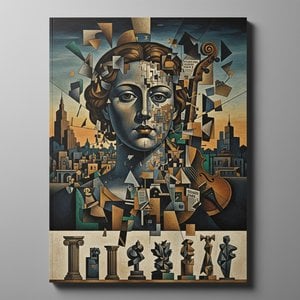
Master the complexities of Cubism with our expert guide. Explore the revolutionary fragmentation of Picasso and Braque, from Analytic to Synthetic styles, and learn how to evaluate these profound modernist masterpieces for your private collection.
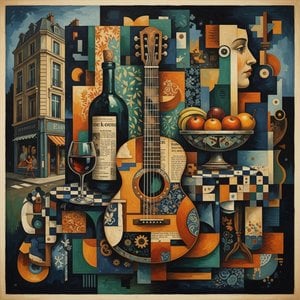
Master the vibrant world of Synthetic Cubism with our expert guide. Explore the revolutionary techniques of Picasso and Braque, from collage to color, and discover how this movement redefined modern art for collectors and connoisseurs alike.

Master the complexities of Cubism with our expert guide for collectors. Explore the revolutionary forms of Picasso, distinguish between Analytical and Synthetic styles, and learn to integrate these profound geometric aesthetics into your private art collection.

Unveil the radical revolution of Cubism. Explore how masters like Picasso and Braque redefined modern art through fragmented forms and geometric abstraction, offering profound insights for discerning collectors of fine art history and masterpieces.

Embark on a journey through the revolutionary world of Cubism. Discover how masters like Picasso redefined perspective through Analytical and Synthetic techniques in this expert-led guide for art enthusiasts and collectors.

 Preview
 Send
Send Share
Share
 Details

 Download
 Similars
 X-Ray
X-Ray Diaporama
 Stats
Stats Read More







 Glass option is only available in size under 110 CM


