


Museum-quality giclée or canvas print with fast production and flexible finish options. ( Buy Hand Made Painting Switch to Digital Image)





























Pick from our preset sizes that match the artwork's original proportions.

Type the width and the height you need, to fit your frame or your wall. A print can only be cut, never made bigger than the picture, so a size with a different shape loses a part of the image. We send you a digital mockup to approve before we print anything. The picture shown on this page does not show the real cut — only the mockup does.
Worldwide Delivery () in 2 weeks instead of standard 4/5 weeks. (21 November)
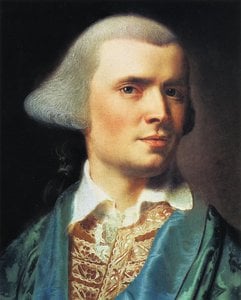
Theodore Atkinson Jr
Reproduction Size
You can order a hand-painted reproduction of "Theodore Atkinson Jr" by John Singleton Copley directly on its Hand-Painted Reproduction page: a hand-painted oil reproduction on linen canvas, made to order.
A print of "Theodore Atkinson Jr" by John Singleton Copley is recommended at a large size in portrait orientation.
In a living room, "Theodore Atkinson Jr" is suggested at a large print size.

John Singleton Copley emerged from the commercial grit of colonial Boston, born in 1738. His upbringing was rooted in the maritime trade of Long Wharf, where his mother, Mary Singleton Copley, managed a shop. His father, Richard Copley, worked as a tobacco merchant. This environment provided more than just a social backdrop; it offered a direct view of the material textures and social hierarchies that would later define his visual language. He was not born into an artistic dynasty, but his proximity to the merchant class ensured he understood the value of the objects he would eventually paint.
His formal introduction to the craft came through his stepfather, Peter Pelham, an engraver and limner. While Pelham provided the initial technical foundation, Copley’s true development was a product of solitary, relentless labor. He was largely self-taught, bypassing the traditional European academy system in favor of a rigorous, self-imposed curriculum. He spent years meticulously copying engravings to master the mechanics of light and form. This disciplined, self-cultivated approach allowed him to bypass the limitations of his local surroundings and develop a technical precision that his predecessors in the colonies lacked.
By the 1760s, Copley had already secured his position as Boston’s premier portraitist. He did not merely paint faces; he manufactured the social identities of the colonial elite. His ability to translate material wealth into visual authority made him the preferred choice for the city's most influential figures. He understood that a portrait was a tool for projecting status, using textures and specific objects to signal a sitter's place in the social hierarchy.
His technical precision allowed him to move beyond simple likenesses. In his 1771 portrait of Mrs. Ezekiel Gondthwait (Elizabeth Lewis), the rendering of luxurious fabrics and refined posture communicates a specific sense of social standing. This was not accidental. Copley used every detail—from the gleam of silver to the drape of a sleeve—to calibrate the viewer's perception of his subjects. He turned the act of sitting for a portrait into a calculated performance of wealth and power.
The breadth of his clientele reflects the shifting landscape of colonial leadership. He captured the likeness of Paul Revere about 1768 and painted Samuel Adams in 1772. These were not just commissions; they were visual records of the men shaping the political future of the colonies. His work provided the visual vocabulary for a society in transition, documenting the very people who would soon define a new political order.
Copley’s aesthetic represents a calculated confluence of Rococo elegance and Enlightenment intellectualism. He did not merely replicate the decorative flourishes of his predecessors; he tempered them with a rigorous, Neo-Classical vision. This approach prioritized order, clarity, and moral virtue, qualities that resonated deeply within the colonial context. His work avoids the superficiality often found in purely decorative styles by grounding every composition in anatomical accuracy and psychological depth. He did not settle for a surface-level likeness. Instead, he used the sitter's posture and expression to reveal an underlying character, turning a simple portrait into a precise study of human identity.
The technical execution of his paintings relies on a sophisticated layering of translucent glazes. This method, combined with rapid brushwork, allowed him to achieve a high degree of realism in texture and light. He possessed a specific ability to render the material world—the heavy weight of fabric, the cold gleam of metal, and the subtle gradations of skin—with a precision that felt immediate. This technical proficiency ensured that his subjects appeared as physical presences rather than flat representations. By mastering the interplay of light and shadow, he sculpted figures that possessed a tangible volume and a sense of permanence.
Copley’s move to Europe was a calculated attempt to secure a foothold in the established artistic centers of the Old World. Long before his departure, his talent had already registered in London; he was elected a Fellow of the Society of Artists of Great Britain on September 3, 1766. This recognition provided the necessary momentum for his eventual relocation. In 1774, he left the Thirteen Colonies behind, traveling with his wife, Susanna Farnsworth Clarke, and their children. He settled in London that same year and never returned to America.
His time in Europe was marked by a deliberate pursuit of classical training. During the summer of 1774, he studied in Rome, a move intended to refine his command of composition and historical narrative. This period of study was not a mere excursion but a fundamental shift in his professional trajectory. By positioning himself in London, he sought to transition from a colonial portraitist to a painter of significant historical weight, testing his technical ability against the standards of the British art scene.
Copley’s output reveals a calculated shift from the social portraiture that secured his colonial standing toward the high-stakes arena of history painting. His early engagement with classical themes is evident in The Return of Neptune, painted about 1754. This work shows an early attempt to move beyond the mere likenesses of Boston's elite by utilizing the compositions of Old Masters. Even in his more personal depictions, such as The Copley Family in 1776, there is a clear intent to use the canvas to establish a specific social identity through carefully choreographed settings and objects.
The move to Europe prompted a more aggressive pursuit of historical narratives. He sought to tackle the most prestigious genre of the era, often choosing scenes of intense drama or political weight. Watson and the Shark, painted about 1778, demonstrates this drive toward dramatic tension. His most ambitious undertaking in this vein was The Death of Major Peirson, a work that attempted to capture the chaos of the Battle of Jersey. While some critics questioned the composition, the painting remains a significant attempt to translate modern conflict into the grand scale of historical art.
His later career in London saw him tackling complex political scenes, such as The Colapse of the Earl of Chatham in the House of Lords in 1779. This work moved away from the battlefield to the structured, high-tension environment of British governance. Through these varied subjects, Copley attempted to prove that a painter trained in the colonies could master the heavy, dramatic requirements of European historical tradition.
The final chapter of Copley’s life in London was marked by a decline in the professional momentum he had once enjoyed. His later years were less successful than his earlier period of prominence. Financial instability shadowed his final years, and he died heavily in debt. This fiscal struggle stands in sharp contrast to the social status his colonial portraits once helped define for the New England elite.
He died in London in 1815. His remains were interred at Croydon Minster in Croydon, Surrey. While his career ended under financial strain, his technical precision remains a fixed point in the study of 18th-century portraiture and historical composition.
1738 - 1815 , United States

Discover the profound beauty of Modigliani-style art. Explore the elegance of elongated forms and soulful portraits through our expert curation of hand-painted oil reproductions and museum-quality prints designed for the sophisticated collector.

Discover the art of collecting with our expert guide to classical masterpiece reproductions. From bespoke hand-painted oils to museum-quality prints, learn how to curate timeless elegance and transform your space with authentic, high-end fine art craftsmanship.

Explore the refined world of Neoclassical portraiture. Discover the mastery of line, light, and order through an expert exploration of academic art history, from Jacques-Louis David to Jean-Antoine Houdon. Immerse yourself in the timeless elegance of classical realism.

Discover the unparalleled elegance of hand-painted masterpiece reproductions. Elevate your seasonal gifting with bespoke oil paintings, custom portraits, and museum-quality fine art designed to create a lasting legacy for the discerning collector.

Master the art of curation with our expert guide on building a cohesive abstract art collection. Discover professional techniques in color theory, composition, and scale to transform your space into a sophisticated gallery of timeless, museum-quality masterpieces.
 Preview
 Send
Send Share
Share
 Details
 Guide
Guide

 Download
 Similars
 X-Ray
X-Ray Diaporama
 Q&A
Q&A
 Stats
Stats


 Read More









 Glass option is only available in size under 110 CM


