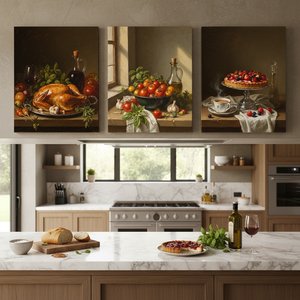
Joachim Beuckelaer’s Kitchen Interior: A Window into Renaissance Still Life
Joachim Beuckelaer stands as a singular figure in the burgeoning landscape of Flemish painting during the mid-16th century, marking a pivotal moment in artistic evolution. Born around 1533 in Antwerp—a city brimming with creativity and fueled by the patronage of wealthy merchants—Beuckelaer didn’t merely depict scenes from daily life; he fundamentally reimagined how artists approached representation, establishing himself as one of the foremost practitioners of market and kitchen interiors.
Unlike many of his contemporaries who focused on grand religious narratives or idealized portraits, Beuckelaer turned his gaze inward—towards the tangible world—capturing the meticulous detail of a domestic space populated with an astonishing array of foodstuffs and household objects. This stylistic choice wasn’t arbitrary; it signaled a deliberate departure from established conventions, aligning closely with emerging trends in Italy and Spain where artists were experimenting with new approaches to portraying inanimate subjects.
A Symphony of Detail: Technique and Composition
Beuckelaer's mastery lay not only in his subject matter but also in his unparalleled technical skill. Employing a meticulous glazing technique—a layering process that builds up translucent color over opaque undercoats—he achieved an astonishing level of realism, capturing the subtle nuances of light and texture with breathtaking accuracy. Observe how he renders the glistening surfaces of fruit bowls, the velvety sheen of fabrics draped across chairs, and the delicate folds of drapery; each element contributes to a cohesive visual experience.
- Glazing Technique: Beuckelaer’s signature method ensured luminous colors and remarkable depth.
- Perspective: Careful attention to linear perspective creates an illusion of space within the confined confines of the kitchen.
- Color Palette: Rich hues—primarily reds, yellows, and browns—evoke warmth and abundance, mirroring the visual richness of the depicted scene.
More Than Just Foodstuffs: Symbolism and Religious Undertones
However, Beuckelaer’s paintings transcend mere culinary representation. As evidenced by extensive research into his work – particularly references to scholarly articles like Kitchen Interior - BEUCKELAER, Joachim – scholars have noted that Beuckelaer deliberately incorporated religious symbolism into his compositions. The abundance of food—particularly fruits and grains—served as a potent metaphor for fertility and divine provision, reflecting the prevailing theological concerns of the era.
Furthermore, the presence of birds perched upon surfaces and shoulders carries symbolic significance, representing purity and spiritual aspiration. These subtle visual cues elevate Beuckelaer’s paintings beyond the everyday realm, inviting contemplation on themes of faith and transcendence. As noted in Joachim Beuckelaer, his work was influential on subsequent artists like Mor.
Emotional Resonance: Capturing the Essence of Domestic Life
Ultimately, “Interior of a Kitchen” succeeds in conveying an arresting emotional resonance. The painting captures not just the visual splendor of a well-appointed home but also the palpable atmosphere of activity and domestic comfort. It’s a scene brimming with life—a testament to Beuckelaer's ability to transform ordinary subjects into profound artistic statements.
A reproduction of this masterpiece offers an exceptional opportunity to bring a touch of Renaissance artistry into any interior space, celebrating the beauty of observation and the enduring power of visual storytelling. Explore its captivating detail at Interior of a Kitchen.
Questions & Answers
Which palette and lead color define "Kitchen Interior"?
The color identity of "Kitchen Interior" by Joachim Beuckelaer: an earthy palette, dominated by phthalo green (#2a221d).
What is the dominant hue of "Kitchen Interior" by Joachim Beuckelaer?
"Kitchen Interior" leans toward a golden yellow range tone.
At what age did Joachim Beuckelaer make "Kitchen Interior"?
When "Kitchen Interior" was created in 1566, Joachim Beuckelaer - born in 1533 - was 33 years old.



 Preview
 Buy Hand Made Painting
 Send
Send Share
Share
 Details
 Guide
Guide

 Download
 Similars
 X-Ray
X-Ray Diaporama
 Q&A
Q&A Stats
Stats


 Read More






































 Glass option is only available in size under 110 CM