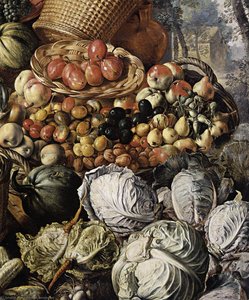
A Life Immersed in the Everyday: Joachim Beuckelaer and the Dawn of Still Life
Joachim Beuckelaer, a name perhaps less instantly recognizable than his contemporaries, occupies a pivotal position in the history of Flemish painting. Born around 1533 in Antwerp, a city then pulsing with artistic innovation, he emerged as a master of scenes depicting the bustling world of markets and kitchens. These weren’t merely depictions of daily life; they were carefully constructed narratives, often subtly interwoven with religious symbolism, that signaled a shift in artistic focus—a move towards observing and celebrating the tangible realities of existence alongside traditional spiritual themes. Beuckelaer wasn't simply *painting* what he saw; he was elevating the commonplace to a level worthy of artistic attention, laying crucial groundwork for the development of still life as an independent genre. His family background steeped in artistry—his father, Mattheus Beuckeleer, and uncle, Pieter Aertsen, were both established painters—provided him with early exposure and training. It was within his uncle’s workshop that he likely honed his skills, absorbing Aertsen's pioneering approach to market scenes before ultimately surpassing him in technical prowess and nuanced storytelling.
The Antwerp Workshop and Artistic Development
Antwerp during the 16th century was a vibrant hub of commerce and culture, and Beuckelaer’s art reflects this energy. He became an independent master within the Guild of Saint Luke in 1560, solidifying his place within the artistic community. However, he didn't simply replicate Aertsen’s style; he refined it, adding layers of complexity and detail. While Aertsen often presented a somewhat chaotic abundance, Beuckelaer brought a greater sense of order and clarity to his compositions. His scenes are meticulously arranged, with each object rendered with remarkable precision—the glistening scales of fish, the plumpness of fruit, the sheen of pewter vessels. This dedication to realism wasn’t merely about technical skill; it was about imbuing these everyday objects with a sense of presence and significance. The Four Elements series stands as a testament to this approach—a set of paintings depicting fish markets that simultaneously celebrate the bounty of nature and subtly allude to biblical narratives, with twelve varieties of fish representing the apostles and Christ’s miracle of the loaves and fishes unfolding in the background. This ability to seamlessly blend the secular and the sacred became a hallmark of his work.
Kitchens as Canvases: Symbolism and Narrative
Beyond market scenes, Beuckelaer also excelled at depicting kitchens—spaces brimming with activity and symbolic potential. His Kitchen Scene with Christ at Emmaus, for example, is a particularly striking example of his innovative approach. He doesn’t simply depict the biblical story as a separate scene; he integrates it directly into the bustling environment of a kitchen, where preparations for a meal are underway. This juxtaposition creates a powerful sense of immediacy and invites viewers to contemplate the spiritual significance of everyday acts. The abundance of food in these scenes wasn't merely decorative; it often carried symbolic weight—representing prosperity, fertility, or even temptation. Beuckelaer’s skill lay in his ability to imbue these seemingly mundane settings with layers of meaning, transforming them into compelling visual narratives. He also ventured into pure still life compositions, such as Still Life of a Carcass (1563), considered one of the earliest dated examples of this subject, further demonstrating his mastery of detail and realism and pushing the boundaries of artistic convention.
Legacy and Influence: A Bridge to New Artistic Horizons
Joachim Beuckelaer’s influence extended far beyond his own lifetime. His detailed depictions of everyday life paved the way for a new generation of artists who would further explore the possibilities of still life painting. Artists like Frans Snyders, known for his lavish and elaborate displays of food, directly built upon the foundations laid by Beuckelaer. His impact wasn’t limited to Northern Europe; his work also resonated with Italian painters such as Vincenzo Campi, demonstrating the widespread appeal of his innovative approach. By shifting the focus from primarily religious themes towards more secular subjects—while still retaining a subtle spiritual undercurrent—Beuckelaer played a crucial role in transforming Flemish art and anticipating the artistic trends that would define the centuries to come. He died around 1573, leaving behind a body of work that continues to captivate and inspire, reminding us of the beauty and significance hidden within the ordinary moments of life.