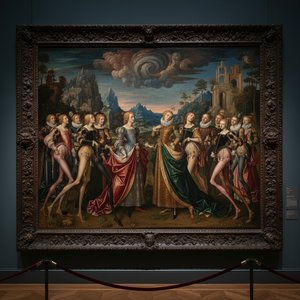
JUPITER ET DANAE by Joachim Anthonisz Wtewael, hand-painted oil painting reproduction by a master artist
Preview AR preview Switch to Print Switch to Digital Image Send
Details Guide Add to favorites Download Similars X-Ray Diaporama Q&A Presentation Stats

JUPITER ET DANAE Hand-painted oil painting reproduction

Experience Mannerist drama with Wtewael's Jupiter and Danaë, a masterpiece of divine encounter; discover this rich narrative art today.

Joachim Anthonisz Wtewael (1566-1638) was a Dutch Mannerist painter known for his highly polished figures, mythological & religious scenes, and unique style resisting naturalism. Explore his captivating art!

Hand Made Oil Reproduction

Hand-painted oil on canvas in your size and frame, made to order by our artists. ( Switch to Print Switch to Digital Image)

Corner sample of the P118B picture frame: moulded polystyrene, 5 cm wide and 3 cm thick
P118B $10
Corner sample of the P118H picture frame: moulded polystyrene, 5 cm wide and 3 cm thick
P118H $10
Corner sample of the P118W picture frame: moulded polystyrene, 5 cm wide and 3 cm thick
P118W $10
Corner sample of the P438Z picture frame: moulded polystyrene, 5.5 cm wide and 3.5 cm thick
P438Z $10
Corner sample of the P508JH picture frame: moulded polystyrene, 7 cm wide and 3.5 cm thick
P508JH $12
Corner sample of the P508YH picture frame: moulded polystyrene, 7 cm wide and 3.5 cm thick
P508YH $12
Corner sample of the P805H picture frame: moulded polystyrene, 5 cm wide and 3.5 cm thick
P805H $10
Corner sample of the P805Z picture frame: moulded polystyrene, 5 cm wide and 3.5 cm thick
P805Z $10
Corner sample of the P919BZ picture frame: moulded polystyrene, 7 cm wide and 3.5 cm thick
P919BZ $10
Corner sample of the P919G picture frame: moulded polystyrene, 7 cm wide and 3.5 cm thick
P919G $10
Corner sample of the P919XJ picture frame: moulded polystyrene, 7 cm wide and 3.5 cm thick
P919XJ $10
Corner sample of the P959ZH picture frame: moulded polystyrene, 5 cm wide and 3 cm thick
P959ZH $10
Corner sample of the P968JZ picture frame: moulded polystyrene, 6 cm wide and 4 cm thick
P968JZ $12
Corner sample of the W106C picture frame: solid wood, 5 cm wide and 3 cm thick
W106C $8
Corner sample of the W218G picture frame: solid wood, 5 cm wide and 3 cm thick
W218G $10
Corner sample of the W218JH picture frame: solid wood, 5 cm wide and 3 cm thick
W218JH $8
Corner sample of the W218Y picture frame: solid wood, 5 cm wide and 3 cm thick
W218Y $10
Corner sample of the W307PJ picture frame: solid wood, 6 cm wide and 3 cm thick
W307PJ $10
Corner sample of the W316G picture frame: solid wood, 6 cm wide and 3 cm thick
W316G $10
Corner sample of the W316PJ picture frame: solid wood, 6 cm wide and 3 cm thick
W316PJ $8
Corner sample of the W316Y picture frame: solid wood, 6 cm wide and 3 cm thick
W316Y $10
Corner sample of the W398PJ picture frame: solid wood, 5 cm wide and 3 cm thick
W398PJ $8
Corner sample of the W4111J picture frame: solid wood, 6.5 cm wide and 3.5 cm thick
W4111J $10
Corner sample of the W500HY picture frame: solid wood, 7 cm wide and 5 cm thick
W500HY $15
Corner sample of the W500JH picture frame: solid wood, 7 cm wide and 5 cm thick
W500JH $15
Corner sample of the W692G picture frame: solid wood, 8 cm wide and 4 cm thick
W692G $12
Corner sample of the W849H picture frame: solid wood, 5 cm wide and 3 cm thick
W849H $8
Corner sample of the W940BG picture frame: solid wood, 7.5 cm wide and 4.5 cm thick
W940BG $15
Corner sample of the W953PJ picture frame: solid wood, 6 cm wide and 3.5 cm thick
W953PJ $8

Standard
custom
CM
INCH

Pick from our preset sizes that match the artwork's original proportions.

width
height

Type the width and the height you need, to fit your frame or your wall. This is hand-painted, so for a size with a different shape the artist can paint a bit more around the picture, or cut a bit — you choose. We send you a digital mockup to approve before the painting starts. The picture shown on this page does not show the real result — only the mockup does.

Examples of what can be changed: Replace face with customer photo; Add pet (e.g., replace cat with dog); Include hidden message in background; Change background landscape or elements.
After order, WahooArt.com team will email client for instructions and provide a mockup preview

Worldwide Delivery () in 3/4 weeks instead of standard 5 weeks. (10 November). No compromise on quality.

Free Worldwide Express Shipping
High-Quality Linen Canvas
Full Shipping Insurance
Customs Tax Refund Guarantee
True Color Matching Guarantee
100-Day Return Policy (Defects Only)
100% Money-Back Guarantee
Bulk Discount Offer

Total Price

$ 322

JUPITER ET DANAE

Reproduction Medium

Reproduction Size

-

Total Price

$ 322

Quick Facts

  • Subject or theme: Mythology; Divine intervention
  • Title: Jupiter et Danaë
  • Influences: Italian Renaissance
  • Location: Louvre RF 1979-23
  • Artistic style: Elegant; Detailed

Art Quiz

There is only one correct answer for each question.

Question 1:
What artistic movement is Joachim Wtewael’s ‘Jupiter and Danaë’ primarily associated with?
Question 2:
The painting depicts a mythological narrative featuring Jupiter and Danaë. What is the central theme of this story?
Question 3:
What technique did Wtewael employ to achieve a rich, layered texture in ‘Jupiter and Danaë’?
Question 4:
The composition of the artwork emphasizes Jupiter's descent from the heavens. How does this visual element contribute to the overall dramatic effect?
Question 5:
‘Jupiter and Danaë’ draws inspiration from Renaissance art. Which artistic style is it most similar to?

The Mythological Subject of Jupiter and Danaë

In JUPITER ET DANAE, Joachim Anthonisz Wtewael explores a pivotal moment of divine intervention. The mythological narrative centers on the clandestine encounter between Zeus and Danaë, the daughter of King Acrisius of Argos. This specific scene captures the moment of Zeus’s transformation, as he descends to impregnate Danaë with golden rain. It is a quiet, yet profound, intersection of the mortal and the divine.

The weight of this encounter carries significant consequences for the lineage of heroes. Through this celestial union, the birth of Perseus is secured, a child destined to eventually slay Medusa and liberate Greece from tyranny. Joachim Anthonisz Wtewael focuses on the tension inherent in this prophecy, framing the event within the intimate confines of a bedchamber. The presence of gold and the vulnerability of the figures underscore the gravity of the unfolding fate.

Composition and Visual Elements

The vertical orientation of this work immediately directs the eye upward, following the descent of the divine into the earthly realm. Wtewael divides the composition into two distinct zones. The lower portion is set within the intimate confines of a bedchamber, where Danaë is positioned amidst the furniture. Above this, the scene opens into a turbulent, stormy sky, marking the arrival of Jupiter. This structural division creates a sense of tension between the domestic space and the celestial upheaval.

Movement is achieved through a series of dynamic diagonal lines, particularly those formed by the limbs and body of Zeus. These lines cut through the space, mirroring the energy of the swirling clouds. The artist balances the composition by juxtaposing organic forms, such as the human figures and the billowing clouds, against the more rigid, geometric lines of the architectural elements, like the window frames and bedposts. It is a careful arrangement of soft curves and sharp edges.

Lighting is used with great intention here. A strong, focused light source illuminates the figures of Jupiter and Danaë, pulling them out from the surrounding shadows. This selective illumination emphasizes their expressions and the physical interaction between them, while the rest of the chamber remains in a state of soft, atmospheric gloom. The interplay of light and shadow provides a sense of depth, even within the somewhat flattened perspective characteristic of the Mannerist style.

Materials and Artistic Technique

The work is executed in oil paint upon a copper plate. This choice of support allows for a specific kind of luminosity and a level of detail that canvas often struggles to sustain. One can see the artist's mastery in the way he handles the medium, employing sophisticated layering and blending to achieve a sense of depth. The surface is not merely a flat plane of color but a carefully constructed space where light and shadow interact to define form.

There is a tactile quality to the application of the paint. While the figures possess a polished finish, visible brushstrokes remain present, contributing to a textured surface. This technique captures the specific materiality of skin, the weight of fabric, and the ephemeral nature of clouds with remarkable accuracy. The interplay of these elements creates a sense of movement within the composition, particularly where the light catches the edges of the forms.

Current Location and Collection History

This work resides within the prestigious collection of the Louvre Museum in Paris. It is held specifically under the care of the Department of Paintings. To locate it during a visit, one must find the Richelieu Wing, where it is displayed in Room 808. It is cataloged under the inventory number RF 1979-23.

The painting's presence in such a significant institution ensures its preservation within a controlled environment. It remains a permanent part of the museum's holdings, situated among other significant works of the sixteenth century. Its placement in the Richelieu Wing allows for a quiet contemplation of its complex Mannerist composition.

Questions & Answers

What underlying hue runs through "JUPITER ET DANAE" by Joachim Anthonisz Wtewael?

"JUPITER ET DANAE" leans toward an ochre to sepia tone.

What type of artwork is "JUPITER ET DANAE" by Joachim Anthonisz Wtewael?

"JUPITER ET DANAE" is a wall art piece.

What level of contrast does "JUPITER ET DANAE" by Joachim Anthonisz Wtewael show?

"JUPITER ET DANAE" by Joachim Anthonisz Wtewael shows a statement contrast between its light and dark areas.


Artist Biography

The Enduring Polish of a Mannerist Master

Joachim Anthonisz Wtewael, a name whispered among connoisseurs of the Dutch Golden Age, remains a captivating figure whose art defies easy categorization. Born in 1566 and passing away in 1638, his life was as multifaceted as his canvases. While his artistic genius shone brightly, it is equally notable that he was also a successful flax merchant and an active town councillor of Utrecht. This dual existence—the meticulous artisan alongside the pillar of civic society—suggests a man whose life demanded both worldly acumen and profound creative focus. Wtewael’s signature style, however, possessed a remarkable consistency; it remained largely untouched by the sweeping naturalistic currents that were reshaping art across Europe during his lifetime.

A Journey Through Style and Influence

Wtewael's early training rooted him deeply in the sophisticated vocabulary of late 16th-century Haarlem Mannerism. His initial professional life saw him working as a glassmaker and engraver within his father’s workshop, an apprenticeship that undoubtedly honed his hand for intricate detail. A pivotal period arrived when he embarked on travels through Italy and France starting in 1586. These sojourns were crucial, exposing him to the rich artistic currents of the Second School of Fontainebleau. Yet, despite these influences, Wtewael possessed a unique internal compass. His work is characterized by figures that are masterfully drawn, possessing an almost porcelain-like polish, often arranged in poses that feel wonderfully capricious and dramatically charged.

Thematic Depth: Myth Meets Devotion

The body of his surviving work—comprising around one hundred paintings, alongside numerous drawings and stained glass designs—reveals a fascinating thematic duality. He was equally at home depicting profound religious narratives as he was celebrating the lush drama of classical mythology. Consider works such as Adoration of the Shepherds juxtaposed with Venus and Mars Surprised by Vulcan. These pieces showcase his remarkable ability to weave together conventional sacred subjects with pagan lore, often imbuing both realms with a palpable, sometimes strong erotic undercurrent that draws the viewer into its narrative embrace. His attention to detail is breathtaking; in works like Perseus and Andromeda, housed notably at the Mauritshuis museum in Utrecht, one can trace his unparalleled skill.

Historical Significance and Legacy

What makes Wtewael’s contribution so significant is precisely that resistance to change. While naturalism beckoned artists toward greater realism, Wtewael held fast to a polished, idealized aesthetic, creating a body of work that feels both historically situated and eternally vibrant. His cabinet paintings, executed on copper plates, are particularly distinctive and numerous, offering intimate glimpses into his artistic process. Though the final decade of his life saw him retreat from painting—a period possibly marked by personal sorrow following the passing of his wife—the impact of his vision endures. He gifted art history a style that remains both highly polished and wonderfully unpredictable.

Quick Facts

  • Artistic Movement Or Style: Mannerism
  • Artists Who Influenced This Artist: ['Second school of Fontainebleau']
  • Date Of Birth: 1566
  • Date Of Death: 1638
  • Full Name: Joachim Anthonisz Wtewael
  • Nationality: Dutch
  • Notable Artworks:
    • Adoration of the Shepherds
    • Venus and Mars surprised by Vulcan
Explore artworks organized by themes, styles, and characteristics.