Preview AR preview Switch to Print Switch to Digital Image Send
Details Guide Add to favorites Download Similars X-Ray Diaporama Stats

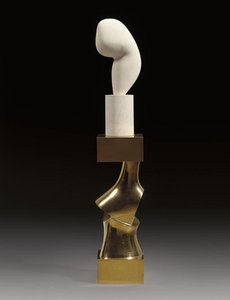
Relief, clock

Jean Arp (1886-1966), a Swiss-French sculptor and painter, revolutionized artistic expression during the Dada and Surrealist movements. His exploration of biomorphic forms and chance-based techniques challenged conventional aesthetics, establishing him as a pivotal figure in 20th-century art.

Jean Arp: A pioneering Dadaist and abstract sculptor known for biomorphic forms, chance-based collages, and a unique exploration of form and space, bridging artistic movements and challenging conventional art.

The artwork displayed on this page is protected by copyright law, which means we cannot legally create or sell an identical reproduction. This protection is enforced under international agreements such as the Berne Convention and by national laws, including those outlined by the U.S. Copyright Law - Title 17.

As a respectful and legal alternative, we offer custom, hand-painted artworks inspired by the original. Our skilled and professional artists carefully study the original's style, mood, and artistic essence to create a new, unique piece that evokes the same feeling - while remaining an original creation in its own right.

This method fully complies with copyright regulations because it does not involve copying or duplicating the protected artwork. Instead, it is a creative reinterpretation - a new painting that is influenced by the original but not identical to it.

Hand Made Oil Reproduction

Hand-painted oil on canvas in your size and frame, made to order by our artists. ( Switch to Print Switch to Digital Image)

Corner sample of the P118B picture frame: moulded polystyrene, 5 cm wide and 3 cm thick
P118B $10
Corner sample of the P118H picture frame: moulded polystyrene, 5 cm wide and 3 cm thick
P118H $10
Corner sample of the P118W picture frame: moulded polystyrene, 5 cm wide and 3 cm thick
P118W $10
Corner sample of the P438Z picture frame: moulded polystyrene, 5.5 cm wide and 3.5 cm thick
P438Z $10
Corner sample of the P508JH picture frame: moulded polystyrene, 7 cm wide and 3.5 cm thick
P508JH $12
Corner sample of the P508YH picture frame: moulded polystyrene, 7 cm wide and 3.5 cm thick
P508YH $12
Corner sample of the P805H picture frame: moulded polystyrene, 5 cm wide and 3.5 cm thick
P805H $10
Corner sample of the P805Z picture frame: moulded polystyrene, 5 cm wide and 3.5 cm thick
P805Z $10
Corner sample of the P919BZ picture frame: moulded polystyrene, 7 cm wide and 3.5 cm thick
P919BZ $10
Corner sample of the P919G picture frame: moulded polystyrene, 7 cm wide and 3.5 cm thick
P919G $10
Corner sample of the P919XJ picture frame: moulded polystyrene, 7 cm wide and 3.5 cm thick
P919XJ $10
Corner sample of the P959ZH picture frame: moulded polystyrene, 5 cm wide and 3 cm thick
P959ZH $10
Corner sample of the P968JZ picture frame: moulded polystyrene, 6 cm wide and 4 cm thick
P968JZ $12
Corner sample of the W106C picture frame: solid wood, 5 cm wide and 3 cm thick
W106C $8
Corner sample of the W218G picture frame: solid wood, 5 cm wide and 3 cm thick
W218G $10
Corner sample of the W218JH picture frame: solid wood, 5 cm wide and 3 cm thick
W218JH $8
Corner sample of the W218Y picture frame: solid wood, 5 cm wide and 3 cm thick
W218Y $10
Corner sample of the W307PJ picture frame: solid wood, 6 cm wide and 3 cm thick
W307PJ $10
Corner sample of the W316G picture frame: solid wood, 6 cm wide and 3 cm thick
W316G $10
Corner sample of the W316PJ picture frame: solid wood, 6 cm wide and 3 cm thick
W316PJ $8
Corner sample of the W316Y picture frame: solid wood, 6 cm wide and 3 cm thick
W316Y $10
Corner sample of the W398PJ picture frame: solid wood, 5 cm wide and 3 cm thick
W398PJ $8
Corner sample of the W4111J picture frame: solid wood, 6.5 cm wide and 3.5 cm thick
W4111J $10
Corner sample of the W500HY picture frame: solid wood, 7 cm wide and 5 cm thick
W500HY $15
Corner sample of the W500JH picture frame: solid wood, 7 cm wide and 5 cm thick
W500JH $15
Corner sample of the W692G picture frame: solid wood, 8 cm wide and 4 cm thick
W692G $12
Corner sample of the W849H picture frame: solid wood, 5 cm wide and 3 cm thick
W849H $8
Corner sample of the W940BG picture frame: solid wood, 7.5 cm wide and 4.5 cm thick
W940BG $15
Corner sample of the W953PJ picture frame: solid wood, 6 cm wide and 3.5 cm thick
W953PJ $8

Standard
custom
CM
INCH

Pick from our preset sizes that match the artwork's original proportions.

width
height

Type the width and the height you need, to fit your frame or your wall. This is hand-painted, so for a size with a different shape the artist can paint a bit more around the picture, or cut a bit — you choose. We send you a digital mockup to approve before the painting starts. The picture shown on this page does not show the real result — only the mockup does.

Examples of what can be changed: Replace face with customer photo; Add pet (e.g., replace cat with dog); Include hidden message in background; Change background landscape or elements.
After order, WahooArt.com team will email client for instructions and provide a mockup preview

Worldwide Delivery () in 3/4 weeks instead of standard 5 weeks. (22 October). No compromise on quality.

Free Worldwide Express Shipping
High-Quality Linen Canvas
Full Shipping Insurance
Customs Tax Refund Guarantee
True Color Matching Guarantee
100-Day Return Policy (Defects Only)
100% Money-Back Guarantee
Bulk Discount Offer

Total Price

$ 272

Relief, clock

Reproduction Medium

Reproduction Size

-

Total Price

$ 272

Quick Facts

  • Influences: Biomorphic Sculpture
  • Year: 1914
  • Movement: Surrealism
  • Subject or theme: Abstraction
  • Artistic style: Dadaist

Art Quiz

There is only one correct answer for each question.

Question 1:
What artistic movement is Jean Arp’s ‘Relief, Clock’ associated with?
Question 2:
The image description mentions a glossy finish. What technique is most likely employed to achieve this effect?
Question 3:
'Relief, Clock' utilizes geometric shapes and contrasting colors. Which stylistic element aligns closely with the principles of Dadaism?
Question 4:
The image description describes overlapping organic shapes within a circular boundary. What symbolic representation might this arrangement convey?
Question 5:
Based on the information provided, what material is most likely used to create Jean Arp’s ‘Relief, Clock’?

Relief, Clock (1914) by Jean Arp

Jean Arp’s “Relief, Clock,” created in 1914 during the tumultuous period of Dadaism and its nascent embrace of Surrealist principles, stands as a testament to artistic experimentation and a profound engagement with geometric abstraction. More than just a decorative object; it embodies a radical departure from traditional sculptural conventions—a deliberate rejection of representational accuracy in favor of exploring fundamental visual elements: form, color, and chance.

  • Overall Impression: The artwork presents a striking relief sculpture characterized by circular composition and bold chromatic contrasts. Its glossy finish suggests meticulous lacquering, highlighting the artist’s dedication to surface texture and visual impact.
  • Composition & Movement: Dominating the image is a large circle bisected by overlapping organic shapes—biomorphic forms reminiscent of abstracted natural elements—that generate an undeniable sense of dynamism. The arrangement isn't merely decorative; it speaks to Arp’s fascination with spontaneity and unpredictability, mirroring the Dadaist ethos.
  • Color Palette & Technique: Vibrant hues – sapphire blue, scarlet red, lemon yellow, olive green, charcoal black, and pristine white – are applied in flat planes with sharp boundaries, creating a visually arresting juxtaposition of colors. The technique involved layering cut shapes adhered to a rigid substrate like painted wood, demonstrating precision and careful consideration for material properties.

Historical Context & Artistic Influences

“Relief, Clock” emerged from the Dada movement’s rejection of logic and reason—a reaction against the horrors of World War I. Dada artists sought to dismantle established artistic hierarchies and embrace absurdity as a means of critique. Arp's work aligns closely with Surrealist explorations of subconscious imagery and dreamlike states, drawing inspiration from figures like Marcel Duchamp and Giorgio Morandi. Notably, it shares stylistic similarities with Jean Arp’s biomorphic sculptures—a deliberate move away from representational art toward an aesthetic rooted in organic forms.

Symbolism & Emotional Resonance

The circular motif symbolizes wholeness and unity – a concept central to Surrealist thought. The asymmetrical arrangement of shapes contributes to the artwork's emotional impact, conveying a feeling of playful disruption and inviting contemplation. Beyond its formal qualities, “Relief, Clock” evokes an atmosphere of quiet dynamism—a subtle suggestion of movement within stillness.

Material & Craftsmanship

Likely executed using painted wood or similar durable material, the sculpture’s surface is remarkably smooth and glossy due to a meticulous polishing process. The careful cutting and placement of geometric shapes underscore Arp's mastery of craftsmanship—a testament to his commitment to achieving visual harmony through precise execution.

Questions & Answers

What explains the copyright situation of "Relief, clock" by Jean Arp?

"Relief, clock" by Jean Arp is still protected by copyright. Copyright terms are measured from the artist's death, and Jean Arp died in 1966.

Where and for what purpose is "Relief, clock" recommended?

"Relief, clock" by Jean Arp is recommended for accent, ideally in a living room. Use and space together guide where a reproduction fits.

Is "Relief, clock" one of Jean Arp's most popular works?

The popularity level recorded for "Relief, clock" by Jean Arp is recognized.


Artist Biography

A Life Forged Between Worlds: The Early Years of Jean Arp

Born Hans Peter Wilhelm Arp in 1886 in the contested city of Strasbourg, a place oscillating between French and German identity, the artist who would become known as Jean Arp embodied a fascinating duality from his very beginnings. This geographical and cultural liminality profoundly shaped his artistic vision, instilling within him a sense of displacement and a questioning of fixed boundaries that would permeate his entire oeuvre. His parents – a French mother and a German father – unknowingly laid the foundation for an artist who consistently challenged categorization. Early studies at the École des Arts et Métiers in Strasbourg and later at the Weimarer Kunstschule in Germany provided Arp with a foundational artistic education, but it was the encouragement of his uncle, Carl Arp, a landscape painter, that truly ignited his passion. A move to Paris in 1908, attending the Académie Julian, further broadened his horizons, exposing him to the vibrant currents of the avant-garde. Yet, Strasbourg remained a potent memory – a city steeped in history and symbolic weight, forever influencing his artistic sensibility. This early period wasn’t merely about acquiring technique; it was about absorbing the complexities of identity and belonging, themes that would resonate throughout his life and work.

Embracing Chaos: Dada and the Birth of Biomorphic Forms

The outbreak of World War I proved a pivotal moment for Arp. Disillusioned by the senseless violence and the perceived failures of reason, he gravitated towards the burgeoning Dada movement around 1915. This wasn’t simply an aesthetic choice; it was a radical rejection of established norms, a defiant embrace of chaos as a response to a chaotic world. Arp found himself among a group of artists and intellectuals in neutral Switzerland – Hugo Ball, Tristan Tzara, Marcel Janco – who sought to dismantle traditional artistic conventions. He participated actively in exhibitions with the Moderne Bund, an early modern art alliance, and co-founded the Cologne Dada group in 1920 alongside Max Ernst and Alfred Grünwald. It was during this period that Arp began experimenting with chance operations, a technique reflecting Dada’s rejection of artistic control. His “chance collages,” created by dropping paper fragments onto a surface and adhering them where they fell, were revolutionary – an abdication of conscious design in favor of unpredictable outcomes. Simultaneously, he started to explore biomorphic forms—abstract shapes resembling organic life—which would become a defining characteristic of his work. These weren’t merely abstract designs; they hinted at hidden energies, the fundamental building blocks of existence, and a subconscious connection to nature. This exploration was significantly influenced by his profound artistic partnership with Sophie Taeuber-Arp, whom he married in 1922. Their collaborative projects were innovative and mutually inspiring, pushing the boundaries of both their practices.

Surrealist Visions and Sculptural Explorations

As Dada began to dissipate, Arp’s artistic trajectory led him towards Surrealism. His work was featured in the first surrealist exhibition at the Galerie Pierre in Paris in 1925, solidifying his connection to this movement that delved into the realm of dreams and the subconscious. However, Arp didn't simply adopt Surrealism wholesale; he infused it with his own unique sensibility. He began a significant transition from relief sculptures to three-dimensional works, exploring organic abstraction in freestanding forms. The “Human Concretion” series emerged during this period – smooth, rounded sculptures that evoked ambiguous references to both the human form and natural objects. Arp’s material exploration was equally important. He experimented with marble, bronze, glass, and wood, each medium offering different textures and effects, allowing him to further refine his vision of organic abstraction. His biomorphic forms profoundly influenced the development of Surrealism, particularly its fascination with automatism and subconscious imagery. Arp wasn't interested in depicting recognizable objects; he sought to capture the essence of life itself – its growth, its fluidity, its inherent mystery.

Legacy and Enduring Influence

Jean Arp’s impact on 20th-century art is undeniable. His pioneering role in organic abstraction, his embrace of chance, and his exploration of biomorphic forms cemented his place as a pivotal figure in the avant-garde. Notable works like *Trousse d'un dada*, the *Dada Heads* series, *Human Concretion without Oval Bowl*, *Le Soleil recerclé*, and *The Three Graces* continue to captivate audiences with their elegant simplicity and profound symbolism. He received increasing recognition in the post-World War II era, culminating in the Grand Prize for Sculpture at the Venice Biennale in 1954, and major retrospective exhibitions at the Museum of Modern Art in New York (1958) and the Musée National d’Art Moderne in Paris (1962). His creation of a relief sculpture for the Harvard Graduate Center stands as a testament to his enduring legacy. Arp's emphasis on organic forms resonated with subsequent generations of artists, influencing movements like Abstract Expressionism and beyond. His embrace of chance operations continues to inspire those exploring randomness and unconventional creative methods. The collaborative work he shared with Sophie Taeuber-Arp is now recognized as some of the most significant contributions to the Dada movement, highlighting the power of artistic partnership. Jean Arp’s innovative approach, his willingness to challenge convention, and his unwavering commitment to exploring the fundamental forces of life ensure that his art will continue to inspire and provoke for generations to come.
Jean Arp

Jean Arp

1886 - 1966 , Germany

Quick Facts

  • Full Name: Jean Arp
  • Nationality: German-French
  • Date Of Birth: 1886
  • Date Of Death: 1966
  • Place Of Birth: Strasbourg, Germany
  • Notable Artworks:
    • Trousse d'un dada
    • Human Concretion
    • Le Soleil recerclé
  • Artistic Movement Or Style: Dada, Surrealism
  • Artists Who Influenced This Artist: ['Wassily Kandinsky']
  • Artists Or Movements Influenced By This Artist:
    • Surrealism
    • Abstract art
Explore artworks organized by themes, styles, and characteristics.