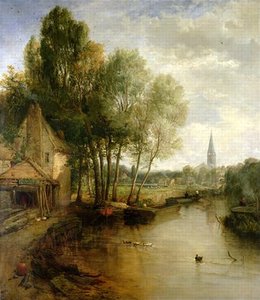
The Master of Coastal Visions: The Life and Legacy of James Webb
In the heart of Victorian London, amidst the bustling streets of Chelsea, a profound sensitivity to the natural world was being nurtured within the home of an artistic dynasty. James Webb, born into a family where the brush and palette were as common as the hearth, emerged as one of the most evocative chroniclers of the sea and sky during the nineteenth century. While historical records occasionally debate his exact birth year, placing it between 1825 and 1835, there is no ambiguity regarding his profound impact on British marine painting. Raised under the watchful eye of his father, the esteemed marine painter Archibald Webb, James was immersed in the nuances of light, tide, and atmosphere from his earliest years. This familial lineage provided more than just technical guidance; it instilled a deep-seated reverence for the maritime landscapes that would become his life's work.
Webb’s artistic journey was shaped by a rigorous pursuit of excellence, moving beyond mere familial apprenticeship to engage with the formal traditions of his era. His development was marked by an ability to blend the disciplined precision of academic training with a romantic, almost poetic, interpretation of the elements. Whether he was capturing the turbulent energy of a storm-tossed Atlantic or the serene, sun-drenched canals of Venice, Webb possessed a rare gift for atmospheric perspective. He utilized a luminous palette and delicate, textured brushstrokes to create depth, allowing distant horizons to dissolve into hazy blues and soft greys, effectively pulling the viewer into the very heart of the scene. His mastery lay in his ability to make the canvas breathe, capturing the fleeting moment when light strikes a cresting wave or settles upon a rugged cliffside.
A Journey Through Light and Water
The breadth of Webb’s oeuvre is a testament to his insatiable curiosity about the world's diverse coastlines. His subjects were not limited to the familiar shores of England; rather, he sought out the dramatic topography of France, the sun-soaked coasts of Italy and southern Spain, and even the winding, industrious rivers of the Netherlands and the Rhine. This geographical range allowed him to explore a vast spectrum of moods, from the sublime terror of crashing waves against jagged rocks to the tranquil, pastoral beauty of inland river landscapes. In works such as his "Coast Scene," one can feel the raw power of the ocean, rendered with a meticulous attention to geological detail that speaks to his profound respect for the natural world.
Beyond the sheer scale of his maritime adventures, Webb’s work is celebrated for its intimate portrayals of light and atmosphere. He was a painter who understood that water is never just one color, but a shifting mosaic of reflections, shadows, and brilliance. His technique allowed him to capture:
- The translucent quality of shallow coastal waters over sand and stone.
- The heavy, moisture-laden air of an approaching maritime storm.
- The soft, golden glow of twilight reflecting off calm, rhythmic tides.
- The intricate interplay between man-made structures, such as piers or distant spires, and the encroaching sea.
Historical Significance and Enduring Impression
As a regular exhibitor at the prestigious Royal Academy and the British Institution, James Webb secured his place within the upper echelons of the Victorian art establishment. His works were not merely decorations for the wealthy; they were windows into the grandeur of the natural world, often finding permanent homes in some of the most significant collections in the United Kingdom. Today, the presence of his canvases in the Tate Gallery and the Victoria and Albert Museum serves as a lasting testament to his technical prowess and his ability to capture the ephemeral beauty of the coast.
Though he passed away in 1895, leaving behind a legacy etched in oil and canvas, Webb’s influence persists. He remains a pivotal figure for those studying the transition from the structured landscapes of the early nineteenth century to the more emotive, atmospheric styles that would follow. His ability to marry scientific accuracy in topography with a deeply felt romanticism ensures that whenever we gaze upon his seascapes, we are not just looking at water and land, but experiencing the very soul of the maritime spirit.



 Preview
 Buy Hand Made Painting
 Send
Send Share
Share
 Details

 Download
 Similars
 X-Ray
X-Ray Diaporama
 Read More






































 Glass option is only available in size under 110 CM