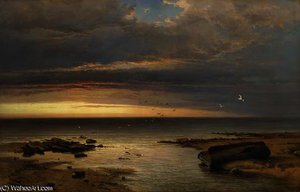
A Life Captured in Landscape
Born in London, George Edwards Hering emerged as a distinguished figure in the nineteenth-century English art scene, leaving behind a legacy defined by his profound connection to the natural world. Though he began his professional journey as a clerk in a bank, the call of the brush proved irresistible, leading him to abandon the structured life of finance for the boundless horizons of landscape painting. This transition from commerce to creativity was underpinned by formal training at the art school in Munich, an experience that provided him with the technical foundation necessary to translate the grandeur of the earth onto canvas.
His early travels were deeply transformative, shaped significantly by the patronage and guidance of figures such as Lord Erskine. With letters of introduction to Venice, Hering embarked on a journey that would become the cornerstone of his artistic identity. His wanderings took him through the sun-drenched landscapes of Italy, around the Adriatic to Constantinople and Smyrna, and even into the rugged terrains of Hungary and Transylvania among the Carpathian mountains. These expeditions were not merely travels but essential quests for light and topography, allowing him to absorb the diverse atmospheres of Europe and the Near East.
Mastery of Light and Terrain
Hering’s artistic development was characterized by a specialized focus on Italian scenery, particularly the serene beauty of its lakes. His ability to capture the delicate interplay of light and water became a hallmark of his work, evoking a sense of peace and solitude in the viewer. This mastery was recognized by the highest echelons of society; notably, his depictions of Amalfi and Capri were so evocative that they were purchased for the royal collection by Albert, Prince Consort. Such accolades cemented his reputation as a painter capable of rendering the sublime qualities of the Mediterranean landscape.
Beyond his oil paintings, Hering demonstrated remarkable versatility through his work in printmaking and lithography. His published collections, such as The Mountains and Lakes in Switzerland, the Tyrol, and Italy, allowed his vision to reach a much wider audience, bringing the majesty of distant peaks and tranquil valleys into the homes of many. His contributions were not limited to solo endeavors; he also provided illustrations for the travel accounts of others, most notably John Paget, further intertwining his visual narrative with the era's great explorations.
Legacy and Artistic Significance
Throughout his career, Hering was a regular and respected contributor to prestigious institutions, including the Royal Academy and the British Institution. His work often bridged the gap between topographical accuracy and romantic emotion, a balance that made him a significant voice in nineteenth-century landscape art. Whether capturing the dramatic ruins of Rome or the quietude of a Scottish scene, his paintings possess an enduring quality that speaks to the timelessness of nature.
The breadth of his impact can be seen in the various forms his art took:
- Landscape Painting: Renowned for his detailed and atmospheric depictions of Italian lakes, coastal scenes, and European mountains.
- Lithography: A skilled creator of colored lithographs that documented the landscapes of Switzerland and Italy.
- Illustrative Work: Providing visual accompaniment to significant travelogues and geographical accounts of the era.
Hering settled in London for the remainder of his life, continuing to practice his craft and occasionally returning to the Italian landscapes that had so profoundly shaped his soul. He remains a vital figure for those studying the evolution of English landscape painting, representing a period when art served as both a window to the world and a deeply personal meditation on the beauty of the earth.
Questions & Answers
Can I browse George Edwards Hering's works by color palette?
The By Palettes page groups George Edwards Hering's artworks by their color palettes.
What are the birthplace and birth year of George Edwards Hering?
George Edwards Hering was born in London in 1805.
Is there an overview of all the subjects George Edwards Hering painted?
George Edwards Hering's works can be explored by subject on the artist's Subject Atlas page.