

 Baroque
 1683Early Modern
 74.0 x 151.0 cm
 Wien Museum
Hand-painted oil on canvas in your size and frame, made to order by our artists. ( Switch to Print Switch to Digital Image)





























Pick from our preset sizes that match the artwork's original proportions.

Type the width and the height you need, to fit your frame or your wall. This is hand-painted, so for a size with a different shape the artist can paint a bit more around the picture, or cut a bit — you choose. We send you a digital mockup to approve before the painting starts. The picture shown on this page does not show the real result — only the mockup does.
Worldwide Delivery () in 3/4 weeks instead of standard 5 weeks. (26 October). No compromise on quality.
Bird
Reproduction Size
In the delicate interplay of light and meticulous detail, Jacob Hoefnagel’s Bird serves as a profound testament to the era of scientific awakening and artistic refinement. While the title suggests a singular focus on avian life, the work invites the viewer into a much larger, more complex narrative of observation and artistry. As a master miniaturist and naturalist, Hoeflamel possessed the rare ability to bridge the gap between the biological reality of the natural world and the poetic elegance of the late Renaissance style. This piece does not merely depict a subject; it captures the very essence of life, rendered with a precision that demands a slow, contemplative gaze from every admirer.
The technique employed in this work reflects the extraordinary discipline of the Hoefnagel lineage. Every feather, every subtle shift in hue, and every minute texture is executed with a level of craftsmanship that speaks to the artist's background in courtly illumination. The brushwork is nearly invisible, creating a surface where the subject seems to emerge naturally from the medium itself. For the discerning collector or interior designer, this painting offers more than just visual beauty; it provides a sense of depth and texture that can anchor a room, acting as a focal point of quiet sophistication and intellectual curiosity.
Beyond its immediate aesthetic appeal, the artwork carries a weight of historical significance. Created during a period when the boundaries between art and science were beautifully blurred, the painting embodies the spirit of the Age of Discovery. Hoefnagel’s work often functioned as a visual encyclopedia, documenting the wonders of the natural world with an accuracy that served both the aesthetic tastes of European royalty and the burgeoning scientific inquiries of the time. To possess such a piece is to hold a fragment of history—a moment when the act of painting was an essential tool for understanding the mysteries of the earth.
The emotional resonance of the work lies in its ability to evoke a sense of wonder. There is a profound stillness within the composition, a quietude that allows the viewer to escape the frantic pace of modern life and reconnect with the intricate details of the living world. Whether placed in a sunlit study, a grand library, or a contemporary living space, this reproduction brings an atmosphere of timelessness and grace. It serves as a reminder that true beauty is found in the smallest details, and that the legacy of the masters continues to inspire awe across the centuries.
Artworks similar to "Bird" by Jacob Hoefnagel are gathered on the artwork's Similars page.
"Bird" by Jacob Hoefnagel was created in 1683.
"Bird" by Jacob Hoefnagel dates from the Early-Modern period. The period gives the historical context of the work.

Born in Antwerp around 1573, Jacob Hoefnagel’s life was a vibrant tapestry woven from artistic pursuits, diplomatic endeavors, and the shifting currents of European politics. More than simply a painter, he was a multifaceted figure – a miniaturist, draftsman, art dealer, diplomat, merchant, and even a political player during a tumultuous era. His legacy rests primarily on his remarkably detailed illustrations of natural history subjects, a field where his meticulous observation and artistic skill converged to create works that continue to fascinate and inform us today. Hoefnagel’s career unfolded against the backdrop of the late Renaissance and early Baroque periods, a time of burgeoning scientific inquiry and artistic experimentation.
His early life was deeply intertwined with the artistic lineage of his father, Joris Hoefnagel, a renowned miniaturist and court painter to the Dukes of Bavaria and Emperor Rudolf II. Unlike his father, who began as a merchant dealing in luxury goods, Jacob received formal training under Abraham Liesaert in Antwerp’s Guild of Saint Luke, marking a deliberate shift towards a dedicated artistic career. This structured education provided him with the foundational skills necessary for his later success, though it was arguably his experiences outside the confines of the guild – his travels and interactions within various European courts – that truly shaped his distinctive style.
Hoefnagel’s rise to prominence began with his publication in 1592 of *Archetypa studiaque patris Georgii Hoefnagelii*, a groundbreaking collection of engravings depicting plants, insects, and small animals. This work, meticulously copied from his father's drawings, established him as a skilled illustrator and demonstrated an early fascination with the natural world. His subsequent years were spent at the court of Rudolf II in Prague, a position he held until 1613. During this time, he produced a remarkable body of work that blended Mannerist elegance with a burgeoning scientific approach to observation – a hallmark of his artistic identity.
The works created during his time at the Prague court are particularly noteworthy. *Orpheus charming the animals* (circa 1613) exemplifies this fusion, showcasing a dramatic scene rendered in a late Mannerist style, yet imbued with an astonishing level of detail and realism. Similarly, *Winter* (1618) captures a frozen landscape with a precise attention to texture and light, reflecting the growing interest in scientific understanding of natural phenomena. These paintings weren’t merely decorative; they were carefully constructed studies, demonstrating Hoefnagel's commitment to accurate representation.
Hoefnagel’s life was not without its challenges. Financial difficulties plagued him throughout his career, often attributed to the court’s failure to consistently pay his salary. He became deeply involved in the political turmoil of the Thirty Years' War, siding with Frederick V, the Protestant Winter King of the Palatinate, against the Catholic Habsburg dynasty. This allegiance ultimately led to his downfall; he was convicted *in absentia* of embezzlement and all his possessions were confiscated. This period marked a significant turning point in his life, forcing him into exile.
Driven by political conviction, Hoefnagel sought refuge in the Dutch Republic, where he served as an agent for the Bohemian estates. He spent several years in Amsterdam, engaging in trade and diplomatic activities. His experiences during this time undoubtedly influenced his artistic output, adding a layer of complexity to his depictions of human interaction and social dynamics. His final years were marked by continued travel and shifting allegiances, culminating in his death around 1632 in Hamburg.
Jacob Hoefnagel’s artistic output is remarkably diverse, encompassing portraits, topographical views, emblems, and of course, his celebrated natural history illustrations. His *A Young Man Caressing an Old Woman* (circa 1605) offers a poignant example of his ability to convey complex emotions through subtle gestures and nuanced expressions – a testament to his skill as a portraitist. His meticulous depictions of insects, flowers, and animals were not simply aesthetically pleasing; they represented a significant contribution to the burgeoning field of natural history illustration.
While he may not be as widely recognized as some of his contemporaries, Jacob Hoefnagel’s work holds a unique place in art history. He stands as a bridge between the artistic conventions of the Renaissance and the scientific observation that would characterize the early Baroque period. His legacy lies not only in the beauty of his paintings but also in his pioneering approach to naturalistic illustration – an approach that continues to inspire artists and researchers alike. His detailed studies remain valuable resources for understanding the flora and fauna of his era, offering a glimpse into a world where art and science were inextricably linked.

1575 - 1632 , Belgium
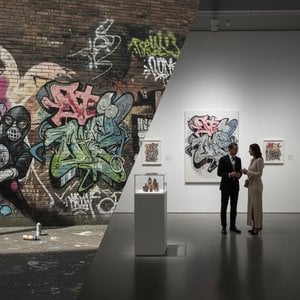
Explore the captivating journey of street art from urban walls to prestigious galleries. Discover how contemporary graffiti has evolved into a high-end collectible movement, redefining modern interior design and global art culture.

 Preview
 Send
Send Share
Share
 Details
 Guide
Guide

 Download
 Similars
 X-Ray
X-Ray Diaporama
 Stats
Stats Read More









 Glass option is only available in size under 110 CM


![Urban Light [in Situ] — Christopher Lee Burden, Contemporary Art](/media/artworks/images-thumb/bb/41/bb41e0e98ca1ce05061042408c88a300.jpg)


