
x


 Oil On CanvasWallArtRomantic Landscape
 1787Early Modern
 242.0 x 242.0 cm
 The Louvre
Hand-painted oil on canvas in your size and frame, made to order by our artists. ( Buy Print Buy Image)





























Pick from our preset sizes that match the artwork's original proportions.

You may enter your own dimensions to fit a specific frame or space. If your selected size does not match the original image's proportions, we will either crop the artwork or extend the painting with additional hand-painted elements. A digital mockup will be sent for your approval before production begins.
Please note that the on-screen preview does not reflect the actual cropping or extension. Only the mockup will accurately show the final composition.
While custom sizes are available, we recommend selecting a dimension from the predefined list to preserve the original proportions.
Worldwide Delivery () in 3/4 weeks instead of standard 5 weeks. (29 August). No compromise on quality.


The Pont du Gard
Reproduction Size
In the soft, diffused light of a fading afternoon, Hubert Robert’s 1787 masterpiece, The Pont du Gard, invites the viewer into a world where history and imagination coalesce. This breathtaking work transcends a mere topographical record of the famous Roman aqueduct; instead, it serves as a profound meditation on the passage of time and the enduring spirit of human achievement. As the eye travels across the canvas, one is immediately struck by the monumental scale of the stone arches, which soar against a hazy, ethereal sky. Robert, a master of the capriccio style, does not simply present a ruin; he crafts a stage where the grandeur of antiquity meets the quiet pulse of contemporary life. The structure itself, a UNESCO World Heritage Site, stands as a silent sentinel of Roman engineering, its weathered stones telling stories of an empire that once commanded the landscape.
The painting is alive with a delicate, rhythmic energy. Below the imposing arches, the river flows with a gentle grace, populated by small figures and boats that provide a vital sense of scale. These tiny, scattered souls—some standing near the water's edge, others navigating the currents in small vessels—act as a poignant reminder of the fleeting nature of human existence when juxtaposed against the permanence of stone. This deliberate contrast creates a captivating tension, drawing the observer into a contemplative state where one might reflect on their own place within the vast tapestry of history.
Technically, Robert’s brilliance lies in his ability to manipulate light and atmosphere to evoke deep emotion. Moving away from the rigid precision of earlier eras, he employs a technique reminiscent of sfumato, subtly blending tonal variations to soften edges and create a sense of mysterious depth. The color palette is a masterful study in harmony; warm, earthy ochres and sun-drenched stones contrast beautifully with the cool, receding blues and purples of the distant sky. This use of atmospheric perspective does more than create distance; it imbues the scene with a dreamlike, almost spiritual quality, as if the viewer is witnessing a memory rather than a physical location.
For the discerning collector or interior designer, this painting offers an unparalleled opportunity to introduce a sense of timelessness and intellectual depth into a space. The composition is balanced yet dynamic, making it a perfect centerpiece for a room that seeks to inspire quiet reflection or sophisticated conversation. Whether placed in a sunlit gallery or a moody, library-style study, the luminous quality of Robert’s brushwork brings an air of classical elegance and romantic nostalgia to any environment.
Historically, The Pont du Gard emerged during a pivotal moment in French art, capturing the transition from the playful ornamentation of the Rococo to the more austere, thoughtful ideals of Neoclassicism. Robert was uniquely positioned to capture this shift, blending the decorative charm of his era with an emerging fascination for the sublime and the melancholic beauty of ruins. His work anticipates the Romantic movement, prioritizing feeling and imagination over literal documentation. Through this lens, the aqueduct becomes a symbol of both stability and inevitable decay—a testament to the triumph of human ambition and the inescapable cycle of nature.
To possess a high-quality reproduction of this work is to hold a piece of the Enlightenment’s soul. It is an invitation to look beyond the surface of the modern world and reconnect with the monumental echoes of the past. For those who appreciate art that speaks to the heart as much as the eye, Robert’s vision remains an eternal masterpiece of light, shadow, and historical wonder.


1733 - 1808 , France
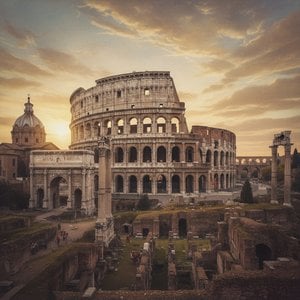
Explore the profound beauty of Roman architecture through art history. From Piranesi's evocative engravings to classical masterpieces, discover how the grandeur of ancient Rome continues to inspire collectors and art enthusiasts worldwide.

Explore the profound beauty of ancient ruins through fine art history. Discover how masters like Pannini captured Roman grandeur, and learn how to bring this timeless architectural majesty into your home with museum-quality, hand-painted oil reproductions.

Explore the profound beauty of Roman ruins through the lens of Baroque masters. Discover how fine art captures the grandeur and decay of antiquity, offering timeless elegance for sophisticated collectors and lovers of classical history.

Explore the profound tension between Neoclassicism's rational order and Romanticism's emotional depth. An expert journey through the masters of art history, from David to Delacroix, perfect for collectors and enthusiasts seeking a deeper understanding of artistic evolution.

Explore the breathtaking world of the Pre-Raphaelite Brotherhood. Discover how this movement redefined Victorian art through vivid detail, mythological depth, and romanticism. An expert guide for classic art enthusiasts seeking to rediscover these timeless masterpieces.


Stay updated with the latest art news, exclusive offers, and decoration ideas.
Tell us about your project and our art experts will provide you with 3 personalized art suggestions.
Let Us Curate 3 Options Just for You - Free!

 Preview
 Send
Send Share
Share
 Details

 Download
 Similars
 X-Ray
X-Ray Diaporama
 Read More







 Glass option is only available in size under 110 CM


