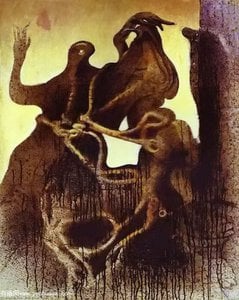
Get a print-ready file that goes far beyond the web preview. Every digital image we sell comes from a high-resolution master in our stock database — usually 5,000 to 15,000 pixels wide — so you can print large, crop tightly, or reproduce fine detail with confidence.
No file leaves our studio untouched. A digital expert checks the colors against the original painting and corrects them if needed, then improves clarity and detail with professional retouching tools — always staying faithful to the artist's brushwork and style. The result is an image that looks like the painting, not like a filtered scan.
You approve before you're done: our expert sends the image by e-mail within 72 hours for your review. Not satisfied? Ask for improvements or corrections, or request a refund if the quality falls short.
This is the quality relied on by publishers, design studios, galleries and print shops.
Download a high-resolution file for personal display, printing, and creative projects. ( Switch to Print Buy Hand Made Painting)
When you choose WahooArt.com, you're not just getting an image - you're receiving a professionally enhanced digital artwork, crafted with precision and backed by a satisfaction guarantee. Here's everything that comes with your order, automatically:
Your high-resolution digital image file will be emailed to you within 72 hours of ordering - ready for immediate use.
Your artwork is professionally optimized using advanced AI tools and manual editing, ensuring maximum detail, clarity, and color accuracy.
Accidentally deleted or lost your file? No worries - we'll resend it to you anytime, free of charge.
Enjoy your artwork instantly with zero customs, duties, or delivery fees - digital downloads are always tax-free.
We ensure your digital image reflects the original colors as closely as possible using professional tools and color management.
If you're not satisfied with your digital image, we'll revise it or refund 100% within 100 days - no questions asked.
Not satisfied? Get a full refund within 100 days of receiving your digital file - no questions asked.
Buy 3 images, save 10% - Buy 5, save 15% - Buy 10+, save 20%. Great for creative projects, galleries, and agencies.

Erik Olson was born on 9 May 1901 in Halmstad, Sweden. Growing up in Halmstad, he was part of an artistic environment that included his brother, the artist Axel Olson. His early path was not set on a creative life; his father had expected him to become an engineer. Instead, Olson spent his evenings cultivating his interest in drawing and painting by studying at the Halmstad Technical School. This period of self-directed study provided the foundation for a career that would eventually move far beyond the technical constraints his father had envisioned.
The trajectory of his training shifted significantly through contact with the avant-garde. In 1919, Olson participated in an amateur show in Halmstad secondary school alongside his brother and cousin Waldemar Lorentzon. This exhibition brought him into contact with Gosta Adrian-Nilsson, a meeting that fundamentally altered his artistic direction. By 1924, Olson had moved to Paris with Lorentzon. They enrolled at the Academie Moderne, studying under Fernand Léger. This formal training in the school spirit of cubism provided the technical rigor that would define his later explorations of surrealism and complex spatial perspectives.
Olson’s reputation rests on his command of Swedish surrealism. He moved away from the rigid structures of cubism to embrace a style defined by dream-like, over-realistic depictions. His canvases do not merely represent objects; they construct entire psychological landscapes. These works often feature ecstatic and erotic space travels, pushing the viewer into environments that defy standard logic. He utilized light paintings to define these spaces, creating a sense of depth that feels both physical and hallucinatory.
The technical execution of his work relies on the use of labyrinthine spaces and impossible perspectives. He rejected the comfort of a stable horizon, opting instead to build complex, winding environments that trap the eye. Within these distorted geometries, he placed mythological figures that feel grounded by their hyper-realistic rendering. This tension between the recognizable detail of the subject and the irrationality of the setting is what gives his visionaries such weight. He did not rely on abstraction to create unease; he used clarity to make the impossible feel tangible.
Olson’s career was defined by a restless movement between the avant-garde circles of Europe and the regional art scene of Sweden. In 1915, he helped form the group Gnistan, an early step that preceded his significant shift toward international modernism. His time in Paris was particularly decisive. While studying at the Académie Moderne, he became part of the concrete art group Cercle et Carré, a connection that solidified his standing within the European avant-garde. This period was not merely about learning; it was about positioning himself within the most radical shifts of the era.
His commitment to collective identity was a recurring theme. In 1929, he became a co-founder of Halmstadgruppen, a group that would become a central force in Swedish art. This membership was not a static affiliation; it remained a constant throughout his professional life. His influence also extended across borders, as he became a member of a Danish surrealist group in Copenhagen after moving to Denmark in 1935. Even when political tensions forced him to flee occupied Denmark in 1944, his ties to the Halmstadgruppen remained intact, anchoring his return to Sweden.
Olson’s artistic trajectory shifted significantly in 1950 when he converted to Catholicism. This spiritual turn redirected his focus toward religious art, moving away from the earlier surrealist explorations that defined his mid-career. His later years were marked by a renewed engagement with sacred themes, translating his visual language into the medium of glass.
His contribution to ecclesiastical architecture is most visible in his stained glass commissions. He moved beyond the canvas to manipulate light through glass, creating works that occupy specific liturgical spaces. These installations demonstrate how his formal training in composition was applied to the structural requirements of church interiors.
Olson’s presence in major institutional collections confirms his standing within the Swedish and international canon. His works are represented at the National Museum, ensuring his contribution to the country's visual history remains accessible. On a global scale, his pieces are held by the Museum of Modern Art, placing his surrealist explorations within a broader context of twentieth-century modernism.
The reach of his legacy extends through significant exhibition histories in Sweden. His paintings have been featured at Liljevalchs konsthall in Stockholm, a venue that has hosted his work alongside other major movements. Additionally, his art has been exhibited at the Malmö museum, marking his continued relevance in regional art discourse. These locations provide the necessary physical evidence of his influence on the development of surrealism and cubism in the Nordic region.

1901 - 1986 , Sweden
 Preview

 Send
 Share
 Details
 Guide


 Download
 Similars
 X-Ray
 Diaporama
 Q&A

 Stats


 Read More