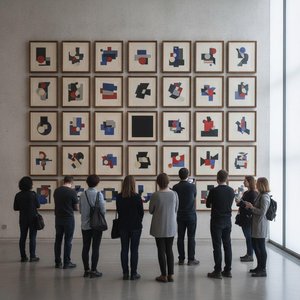
The Dawn of Disruption: Breaking from Academic Tradition
For centuries, the sanctity of art was guarded by the rigid doctrines of the Academies, where beauty was measured by anatomical perfection, historical grandeur, and a meticulous adherence to realism. The canvas was a window into a predictable world, governed by the laws of perspective and the soft, blended light of classical mastery. However, as the nineteenth century waned, a profound restlessness began to stir within the creative soul. This was not merely a change in technique, but a fundamental rebellion against the constraints of representation.
The emergence of Modernism marked the moment when artists ceased to be mere chroniclers of reality and instead became architects of perception. The initial tremors were felt through movements like Post-Impressionism, where masters such as Paul Cézanne began to dismantle the illusion of depth. In works like Woman in a Green Hat (Madame Cézanne), we witness the seeds of revolution; the brushstrokes become bold and deliberate, and geometric forms begin to assert their dominance over mere likeness. This shift signaled that the true subject of art was no longer the object itself, but the artist's subjective experience of it.
This era of disruption demanded a new way of seeing—one that embraced the raw, the fragmented, and the unrefined. It was an invitation to move beyond the surface of things and explore the structural essence of our visual world, setting the stage for a century of unprecedented aesthetic upheaval.
Fragmentation and Form: The Cubist Revolution and the Legacy of Cézanne
If Cézanne provided the blueprint for modern thought, then Cubism constructed the edifice. This movement represented perhaps the most radical departure from the Renaissance tradition of a single, fixed viewpoint. By deconstructing objects into a series of overlapping planes and geometric facets, Cubist pioneers like Pablo Picasso challenged the very notion of space and time within a two-dimensional medium.
To view a Cubist masterpiece is to witness a simultaneous experience of multiple perspectives. The subject is no longer static; it is broken, analyzed, and reassembled in a way that reflects the frenetic energy of a modernizing world. This fragmentation was not an act of destruction, but one of profound reconstruction. It allowed for a deeper exploration of form, where the boundaries between object and atmosphere began to dissolve.
The legacy of this revolution extends far beyond the early twentieth century. The Cubist impulse to find structure within chaos remains a cornerstone of modern aesthetic appreciation. For the discerning collector, these works offer more than visual complexity; they provide a window into the intellectual rigor required to redefine reality through the lens of geometry and rhythm.
Beyond Representation: Suprematism, Abstraction, and the Search for Pure Essence
As the twentieth century progressed, the drive toward abstraction reached its zenith, stripping away all vestiges of the recognizable world to reach a state of pure, spiritual essence. This was the era of Suprematism, a movement led by the visionary Kazimir Malevich. In works such as Movement Suprematist Square, the artist sought to liberate painting from the "burden" of the object, finding profound meaning in the interaction of simple shapes and stark contrasts.
This was art reduced to its most fundamental elements: color, line, and form. There was no landscape to guide the eye, no portrait to evoke empathy; there was only the sublime tension of the composition itself. This pursuit of the "zero point" of painting pushed the boundaries of what could be considered art, suggesting that meaning could reside in the void as much as in the figure.
For the connoisseur, this period represents the ultimate test of aesthetic intuition. To engage with Suprematism is to enter a meditative space where the intellect and emotion must align to interpret the weight of a black square or the velocity of a floating line. It remains one of the most daring chapters in art history, proving that even in total abstraction, there is an undeniable, resonant truth.
The Subversion of Reality: Dadaism, Readymades, and the Redefinition of Art
While Suprematism sought spiritual purity, another faction of the avant-garde sought to dismantle the very concept of "high art" through irony, absurdity, and provocation. Dadaism emerged from the trauma of global conflict, a movement that used nonsense as a weapon against the logic that had led to such devastation. It was an era of profound subversion, where the boundaries between fine art and everyday objects were intentionally blurred.
The most radical tool in the Dadaist arsenal was the "readymade," popularized by Marcel Duchamp. By selecting mass-produced objects—most infamously a urinal titled Fountain—and presenting them as art, Duchamp shifted the locus of creativity from the hand of the artist to the mind of the artist. The question was no longer "How well is this painted?" but "Why is this art?"
This philosophical pivot fundamentally altered the trajectory of modernism. It introduced the concept of conceptualism, where the idea takes precedence over the execution. For collectors today, understanding Dada is essential to grasping the contemporary landscape, where the provocations of the past continue to inform the boundary-pushing installations and performances of the present.
Avant-Garde Intersections: Rayonism, Futurism, and the Pulse of Modernity
The modern movement was never a monolithic entity; it was a vibrant web of intersecting ideologies. In Russia, artists like Natalia Goncharova pioneered Rayonism, an approach that focused on the intersection of light rays reflected from various objects, creating a sense of dynamic, luminous energy. Her work bridged the gap between folk tradition and the cutting edge of Cubist-inspired abstraction.
Simultaneously, across Europe, movements like Futurism sought to capture the speed, noise, and mechanical power of the industrial age. These artists were obsessed with motion, attempting to paint the very sensation of velocity through fragmented lines and repetitive forms. Even in more localized contexts, such as the impactful works of Corneliu Michăilescu, we see the infusion of Cubist and Surrealist themes reflecting the interwar tensions of the era.
This intersectionality is what gave Modernism its inexhaustible vitality. It was a global conversation, where different cultures and techniques collided to create a multifaceted vision of a new century. To study these movements is to trace the pulse of human progress itself.
Modernism’s Enduring Legacy in Contemporary Collecting and Curation
Today, the echoes of the Modernist revolution are heard in every corner of the art world. The freedom to experiment, the courage to abstract, and the audacity to challenge tradition are the very pillars upon which contemporary art stands. For the modern collector, these historical movements offer more than just aesthetic pleasure; they provide a foundational language for understanding the complexities of our current visual culture.
Whether it is through the appreciation of a meticulously textured oil reproduction that captures the impasto of a master, or the curation of a collection that spans from the geometric precision of Cubism to the conceptual depth of Dada, the spirit of Modernism remains alive. It continues to challenge us to look beyond the surface and find the profound truths hidden within form, color, and idea.
At WahooArt.com, we celebrate this enduring legacy by bringing the masterpieces of these revolutionary eras into the modern home. From hand-painted oil reproductions that honor the tactile soul of the original to bespoke commissions that reimagine history through a contemporary lens, we provide collectors with the means to possess a piece of this transformative journey. Our commitment to academic excellence and museum-quality craftsmanship ensures that the revolutionary spirit of Modernism is not just remembered, but lived.